
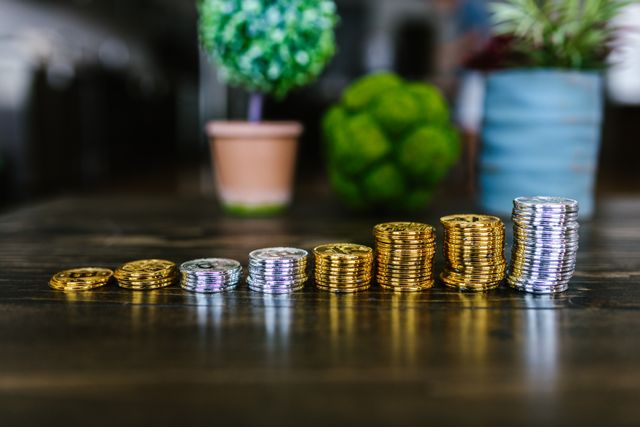
General Investing
The Power of Compound Interest: How Your Money Doubles (and the Rule of 72)
Compound interest means your returns start earning returns of their own — so your money grows faster and faster the longer you leave it alone. A simple trick called the Rule of 72 tells you exactly when it doubles: just divide 72 by your annual return.
📊 This article includes an interactive compound interest calculator. Enter your numbers and see exactly how your money grows. Jump to the calculator ↓
What is compound interest?
Earning returns on your returns. Your interest starts earning interest too, so growth accelerates over time.
The Rule of 72
Divide 72 by your annual rate to find years to double. At 8%, that’s 9 years; at 6%, 12 years.
The formula: A = P(1 + r/n)^(nt)
P = principal, r = annual rate, n = compounds/year, t = years. More compounding = slightly faster growth.
Most important factor?
Time — not rate, not amount. Starting 10 years earlier can beat investing 3× more, every time.
The money your money earns starts earning money too. Give it enough time, and a modest return turns into a snowball.
| Annual return | Years to double | Doublings in 40 years |
|---|---|---|
| 4% | 18 years | ~2× |
| 6% | 12 years | ~3× |
| 8% | 9 years | ~4× |
| 10% | 7.2 years | ~5× |
| 12% | 6 years | ~6× |
Read the last column again. At 8%, your money doesn’t just grow over 40 years — it doubles roughly four times over. But here’s the part that surprises people: the size of your return matters far less than how early you start. A 25-year-old who invests a little can end up ahead of a 35-year-old who invests a lot, purely because their money had more time to compound.
What Compound Interest Actually Is (The Snowball)
Picture a snowball at the top of a long hill. It starts small. But as it rolls, it picks up snow, and that new snow picks up more snow, and by the bottom it’s enormous — not because the hill got steeper, but because it kept building on what it had already gathered. That’s compounding.
In money terms: put $1 to work and it earns, say, a dime. The next year you’re no longer earning on just your dollar — you’re earning on $1.10. That extra dime earns its own penny, that penny earns a fraction of a penny, and on it goes. The SEC’s investor-education site defines compound interest plainly as interest paid on your principal and on the interest you’ve already earned (Investor.gov). Simple interest only ever pays you on the original dollar. Compound interest pays you on the whole growing pile — which is why the curve bends upward instead of running in a straight line.
You may have heard compounding called “the eighth wonder of the world,” a line often pinned on Albert Einstein. He almost certainly never said it — quote historians trace the phrase to old advertising copy, not the physicist (Quote Investigator). The attribution is fake; the math is very real. Can it make you rich? Yes — but slowly and reliably, which is exactly what the rest of this guide will show you.
Simple vs. Compound Interest — Why the Difference Is Huge
Same rate. Same amount. Same number of years. The only thing that changes is whether your interest earns interest — and the gap is enormous.
Take $10,000 at a fixed 5% for 40 years. With simple interest, you earn 5% of the original $10,000 every year and nothing more — about $20,000 of interest, for roughly $30,000 in the end. With compound interest, each year’s 5% is figured on a balance that keeps climbing, and that same rate throws off about $60,400 of interest — for roughly $70,400. More than three times the interest, from nothing but letting it ride.
| How the interest is calculated | Interest earned | Ending balance |
|---|---|---|
| Simple (principal only) | ~$20,000 | ~$30,000 |
| Compound (returns on returns) | ~$60,400 | ~$70,400 |
That’s the whole case for compounding in one table. Now let’s make it something you can calculate.
The Compound Interest Formula Explained
The math behind compounding isn’t complicated — one formula covers almost every situation you’ll encounter.
- A — Future Value
- The total balance after compounding: your original money plus all growth.
- P — Principal
- Your starting amount, e.g. $10,000.
- r — Annual interest rate (decimal)
- 8% becomes 0.08. Always enter it as a decimal.
- n — Compounding frequency per year
- Daily = 365, monthly = 12, quarterly = 4, annually = 1. This is the variable most people overlook.
- t — Time in years
- The single most powerful lever you have.
Worked example: $10,000 at 8% compounded monthly for 20 years
A = 10,000 × (1 + 0.08/12)12×20 = 10,000 × (1.00667)240 ≈ $49,268
The same $10,000 compounded annually at 8% for 20 years gives about $46,610 — a $2,658 difference just from switching from annual to monthly compounding. It matters, but not as much as the rate and time.
Continuous compounding and the Rule of 69.3
Push compounding to the extreme — infinitely often — and the formula becomes A = Pert, where e ≈ 2.718. This is called continuous compounding. Banks rarely use it (daily is the practical limit), but it appears in advanced finance. For daily or continuous compounding, the more precise shortcut for doubling time is 69.3 ÷ rate rather than 72. The reason: 72 is slightly inflated from its mathematically exact value, but it divides more cleanly into common interest rates (6, 8, 9, 12) — which is exactly why people use it. If precision matters more than mental math convenience, reach for 69.3.
How often does a HYSA compound interest?
Most high-yield savings accounts (HYSAs) compound daily and credit interest monthly. Compounding daily on a 4.5% APY account versus monthly makes a difference of roughly $1–$5 per $10,000 per year — real, but not the main event. The rate is always the bigger driver, so focus on finding the best APY rather than obsessing over compounding frequency.
The Rule of 72: When Will Your Money Double?
You don’t need a spreadsheet to estimate how fast money grows. You need one division problem.
The Rule of 72 turns an abstract percentage into a real timeline. A 2% return doubles your money in 36 years (72 ÷ 2). A 0.5% savings account? 144 years — which tells you a lot about why cash alone rarely builds wealth. Flip it around and it also tells you the return you’d need: to double in 10 years, you need about 7.2%.
Rule of 72 vs. Rule of 69.3 — which should you use?
72 is better for everyday mental math because it divides evenly by 2, 3, 4, 6, 8, 9, and 12 — basically every common interest rate. The mathematically exact number for continuously compounding growth is ln(2) ≈ 69.3, making 69.3 (or simply 70) more accurate for daily compounding accounts. As a practical guide: use 72 for quick estimates and investment planning, use 69.3 when precision matters (continuous compounding or daily compounding scenarios).
Limitations of the Rule of 72
It’s an approximation — a brilliant one, but still an estimate. It’s most reliable for rates roughly in the 6%–10% range, and it drifts at the extremes. As U.S. News notes, the shortcut also ignores taxes, fees, and the fact that real returns bounce around year to year. Two quick tips: keep your rate as a whole number (use 8, not 0.08), and for very high rates above 20%, the estimate 78 tracks a bit better.
The doubling chain
Because money doubles on a schedule, a long horizon stacks several doublings on top of each other. The St. Louis Fed illustrates this clearly: set aside $5,000 at 8% and leave it for 36 years. Since 72 ÷ 8 = 9, it doubles every nine years — four times in 36 years. So $5,000 becomes $10,000, then $20,000, then $40,000, then $80,000 (an exact calculation lands at about $79,841, so the shortcut is nearly spot-on) (St. Louis Fed).
Does a 401(k) really double every 7 years?
You’ve probably heard this one. Run the math backward: 72 ÷ 7 works out to about 10.3%. So a 401(k) doubles every seven years only if it earns roughly 10.3% a year, every year. Over long stretches the U.S. stock market has averaged less than that, and real returns swing hard from one year to the next. Treat “doubles every seven years” as an optimistic best case, not a guarantee you can bank on.
The Snowball Over Decades ($10,000 in Action)
Numbers in a formula are easy to shrug off. Watching one number grow is not. Here’s a single $10,000 invested once at 8% and never touched again — no extra contributions, ever.
| Years invested | Total value | Interest earned | Your own money |
|---|---|---|---|
| 0 years | $10,000 | $0 | $10,000 |
| 10 years | $21,589 | $11,589 | $10,000 |
| 20 years | $46,610 | $36,610 | $10,000 |
| 30 years | $100,627 | $90,627 | $10,000 |
| 40 years | $217,245 | $207,245 | $10,000 |
Follow the “interest earned” column. Somewhere around year 20, the interest ($36,610) has already blown past the $10,000 you put in — from here on, your money is doing far more work than you ever did. By year 40, one $10,000 deposit is worth about $217,000, and $207,000 of that is pure growth.
Notice the shape: slow at first, then steep. Compounding barely seems to move early on, which is exactly when most people give up on it — and then the last decade adds more than the first three combined. The lesson is the same at any scale — swap in your own amount and rate and the curve looks identical, just larger or smaller.
🧮 Compound Interest Calculator
See exactly how your snowball grows — adjust any number and hit Calculate.
To explore additional scenarios, the SEC also offers a free compound interest calculator at Investor.gov.
Why Starting Early Beats Investing More
This is the section that changes behavior, so slow down here. The most valuable thing you can put into an investment isn't money — it's time, and it's the one ingredient you can never buy back.
Start with a single $1,000, left completely alone at about 7.2% (so it doubles roughly every decade):
Now the comparison that tends to stick with people for life. Meet two investors who each put in $6,000 a year at a fixed 7% return. Early Erin invests from age 25 to 35 — just ten years — and then stops contributing entirely, letting it ride to 65. Late Luke waits until 35, then diligently invests for 30 straight years to 65.
| Early Erin | Late Luke | |
|---|---|---|
| Starts investing at | Age 25 | Age 35 |
| Years contributing | 10, then stops | 30 straight |
| Total put in | $60,000 | $180,000 |
| Balance at age 65 | ~$675,000 | ~$606,000 |
Look at what just happened. Erin contributed one-third as much money as Luke — $60,000 versus $180,000 — quit after a decade, and still ended up with more. Her secret wasn't a better return or bigger paychecks. It was that her early dollars got to compound for 40 years, and Luke could never buy those extra years back no matter how much he shoveled in later.
How to take advantage of compound interest in your 20s
The math above makes the case — here's what to actually do. Open a Roth IRA the moment you have earned income (contributions in 2026 are capped at $7,000/year). Start with even $50 a month inside a low-cost index fund. Turn on automatic reinvestment so every dividend goes straight back to work. Then raise your contribution every time you get a raise, before lifestyle inflation absorbs it. The specific amount matters far less than starting: a 22-year-old investing $100/month will, at 8%, accumulate more by 65 than a 32-year-old investing $300/month for the same period — because those missing ten years are irreplaceable.
There's an old saying that fits perfectly: the best time to plant a tree was 20 years ago; the second best time is today. If you're not sure how to begin, see Dollar-Cost Averaging vs. Lump Sum for how to actually start, and Average Retirement Savings by Age to see where you stand.
The Dark Side: Compounding Works Against You Too
Compounding isn't a force for good. It's just a force. It grows whatever balance it's attached to — and when that balance is debt, the same snowball that builds your wealth can bury you.
Run the Rule of 72 on a credit card. At a 24% APR, that's 72 ÷ 24 = 3 years for the balance to double if you're not paying it down. That is the exact mirror image of investing: while an 8% investment patiently doubles over nine years, a 24% debt doubles in three.
| Scenario | Doubling time (72 ÷ rate) | What happens |
|---|---|---|
| Investment at 8% | 9 years | Your money doubles — for you |
| Credit card at 24% APR | 3 years | Your debt doubles — against you |
Two quieter versions of the same force: inflation compounds too — at 3% a year, prices double in about 24 years, so a dollar sitting idle loses half its buying power over that span. And fees compound against you exactly like interest, skimming a little off the top of a growing balance year after year. For the full picture on debt, see How Credit Card Interest Works and How to Pay Off Credit Card Debt Fast.
APR vs. APY — Reading the Fine Print
Banks and credit card companies use two different rate figures, and confusing them is expensive. Here's the difference in plain terms.
| Metric | APY (Annual Percentage Yield) | APR (Annual Percentage Rate) |
|---|---|---|
| Includes compounding? | Yes | No |
| What it reflects | Your actual annual return | The stated rate, before compounding |
| Best used for | Savings accounts, CDs, HYSAs | Loans, credit cards, mortgages |
| Which is higher? | APY is always ≥ APR | APR is always ≤ APY |
Why it matters for savers: When your bank advertises "4.75% APY," that's the real, compounding-included return. That's the number to compare across accounts.
Why it matters for borrowers: Credit cards advertise an APR, but they compound daily — meaning the effective rate you actually pay is the APY, which is higher. A card with a 24% APR compounded daily has an APY closer to 27.1%. Always think in APY when comparing both what you'll earn and what you'll owe.
The Tax Drag: How Taxes Slow Your Snowball
Compounding math assumes your returns stay invested and keep growing. Taxes interrupt that. Understanding where your money lives is almost as important as understanding how it grows.
Taxable brokerage accounts (the drag)
In a standard brokerage account, the IRS taxes dividends and interest income in the year you receive them, whether or not you reinvest. Qualified dividends are taxed at 0%, 15%, or 20% depending on your income bracket. If you sell shares at a profit, you owe capital gains taxes (short-term gains, held under a year, are taxed as ordinary income; long-term gains, held over a year, get lower rates). Every time you pay that tax bill, you're removing money from the snowball — your effective return is lower, and compounding has less to work with. Over 30 years at 8%, the gap between a fully taxable account and a tax-sheltered one can equal hundreds of thousands of dollars.
Tax-advantaged accounts (the accelerant)
Accounts like a 401(k) and Traditional IRA defer taxes: you invest pre-tax dollars, the entire balance compounds undisturbed, and you pay taxes only when you withdraw in retirement. A Roth IRA works in reverse — you invest after-tax money, but qualified withdrawals in retirement are completely tax-free, including every dollar of compound growth. That makes a Roth the ultimate compounding vehicle for anyone who expects to be in the same or higher tax bracket in retirement.
The practical upshot: max out your Roth IRA or 401(k) before putting money in a taxable brokerage account. Let the snowball roll without the government's hand in it as long as possible.
Where Do You Actually Earn Compound Growth?
Compounding isn't a product you buy — it's what happens when you reinvest what your money earns instead of spending it. A few places it shows up:
- Dividend-reinvesting index funds and ETFs. Stocks don't pay literal "interest," but when you automatically reinvest dividends and let gains ride, you get the identical snowball effect. See How to Invest in the S&P 500 and Dividend Stocks: Best Monthly, Growth & Long-Term.
- Retirement accounts (401(k) and IRA). Contributions plus reinvested growth, often with tax advantages that let the snowball roll faster — see the tax drag section above.
- Reinvested bond interest. Coupons put back to work compound just like anything else — see How to Invest in Bonds.
- High-yield savings accounts (HYSAs), CDs, and money market accounts. Most compound daily and credit monthly. Safer and steadier, but slower. The difference between daily and monthly compounding at the same rate is tiny — prioritize finding the highest APY — see Is High-Yield Savings Interest Taxable?
What about compounding frequency — daily vs. monthly vs. annually? More frequent compounding does grow a bit faster, but don't lose sleep over it: the difference is small, and your rate and your time horizon do the overwhelming majority of the heavy lifting. Chasing "compounds daily!" marketing while ignoring the rate is optimizing the wrong knob.
Frequently Asked Questions
- What is compound interest, in simple terms?
- It's earning returns on your returns. Your original money earns a return, that return gets added to the pile, and next time everything earns — so the balance grows faster and faster the longer you leave it.
- What is the compound interest formula?
- A = P(1 + r/n)nt, where A is the ending balance, P is the principal, r is the annual rate as a decimal, n is how many times it compounds per year, and t is years. For continuous compounding the formula is A = Pert.
- How do I calculate compound interest?
- Plug your numbers into A = P(1 + r/n)nt. Example: $5,000 at 7% compounded monthly for 10 years → 5,000 × (1 + 0.07/12)120 ≈ $10,034. Or use the calculator above to skip the algebra.
- What is the difference between APR and APY?
- APR is the stated annual rate without compounding; APY is the effective annual yield after compounding is applied. APY is always equal to or higher than APR. For savings, always compare APYs. For debt, know that the APY is what you actually pay — often meaningfully higher than the advertised APR.
- How does the Rule of 72 work?
- Divide 72 by your annual return (as a whole number) to estimate the years it takes to double. At 6% that's 12 years; at 9%, about 8. It's an approximation, most reliable for returns in the 6%–10% range.
- Why do we use 69.3 instead of 72 sometimes?
- 69.3 is mathematically more accurate for continuously compounding growth (it equals ln(2) × 100). But 72 divides evenly into the most common interest rates — 6, 8, 9, 12 — making it easier to compute in your head. Use 72 for daily conversation; use 69.3 when working with daily or continuously compounding accounts where precision matters.
- How long will it take to double my money?
- 72 ÷ your rate. About 9 years at 8%, 12 years at 6%, 6 years at 12% — and a painful 144 years at 0.5%. Higher, steadier returns double faster.
- How much will $10,000 grow to in 20 years?
- At a fixed 8%, roughly $46,600 — with about $36,600 of that being pure growth. At 6% it's closer to $32,000; at 10%, about $67,000. Real returns vary, so treat these as illustrations, not promises.
- Is compound interest taxable every year?
- In a standard taxable brokerage account, yes — dividends and interest are taxed in the year you receive them, even if reinvested. In a 401(k) or Traditional IRA, taxes are deferred until withdrawal. In a Roth IRA, qualified withdrawals are completely tax-free. Choosing the right account type can be worth more to your snowball than chasing a slightly higher return.
- How is compound interest taxed in a standard brokerage account?
- Dividends are taxed as either ordinary income or at the lower qualified dividend rate (0%, 15%, or 20%) in the year paid. Reinvested dividends raise your cost basis, which matters when you sell. Interest income is taxed as ordinary income. Capital gains taxes apply when you sell shares at a profit — short-term (held under a year) at ordinary income rates, long-term at lower preferential rates.
- Does starting early really beat investing more later?
- Very often, yes. In the example above, someone who invests for ten years starting at 25 and then stops can finish ahead of someone who invests for 30 years starting at 35 — because early dollars compound the longest. Time tends to beat amount.
- Can compound interest work against me?
- Absolutely — on debt. A credit card at 24% APR doubles the balance in about three years if unpaid (72 ÷ 24). High-interest debt compounds faster than most investments grow, which is why paying it off is so powerful.
- Can you lose money with compound interest?
- Yes, if your investment is tied to volatile assets like stocks. In a market downturn, losses compound just as gains do — a 30% drop followed by a flat year is worse than it sounds because you need a 43% gain just to get back to even. This is why time horizon matters: stocks have historically recovered given enough time, but compound interest alone isn't a guarantee of positive returns.
- Do stocks earn compound interest?
- Not literal "interest" — stocks pay dividends and rise (or fall) in price. But reinvesting dividends and letting gains ride produces the very same compounding effect, which is how most long-term stock wealth is built.
- Does a savings account compound interest?
- Yes. High-yield savings accounts, CDs, and money market accounts all compound — typically daily, credited monthly. The catch is the low rate: at 0.5% it would take about 144 years to double, so savings are great for stability and emergencies, less so for long-term growth.
- Does compound interest beat inflation?
- It can, but only if your return outpaces inflation. Idle cash usually loses ground (prices double about every 24 years at 3% inflation), while stocks have historically outrun inflation over long periods — not guaranteed, but that's the goal of investing.
- What are the best compounding investments for beginners?
- For long-term growth: low-cost broad market index funds inside a Roth IRA or 401(k) — you get stock-market compounding plus the tax shelter. For short-term savings: a high-yield savings account or short-term CD. The "best" option depends on your timeline and risk tolerance, but starting anywhere beats waiting for perfection.
- Can I really get rich from compound interest?
- Yes — but slowly. Compounding is a get-rich-slow engine that rewards patience and time, not speed. Anyone promising to double your money in a month or "10% a month" is selling a fantasy; the real magic takes decades, and it works.
This article is for educational and informational purposes only and is not financial advice. All growth figures assume fixed rates of return and are illustrative estimates; real investment returns fluctuate, and past performance does not guarantee future results. Tax treatment depends on individual circumstances and may change. Consider your own goals and consult a licensed financial professional before investing.

Daniel Hayes is the founder and sole researcher at AdvoraHQ. He covers U.S. personal finance, insurance, and consumer law — working directly from IRS publications, federal and state statutes, court opinions, and SEC filings rather than secondary summaries. His focus is the gap between what readers think they know and what the source documents actually say. Daniel is not a licensed attorney, CPA, or financial advisor; his articles are educational and not personalized advice. Reach him at Daniel.Hayes@advorahq.com.