Your homeowners policy was written for a household. Once part of that household becomes a business, some of the coverage you’re counting on can shrink, or disappear.
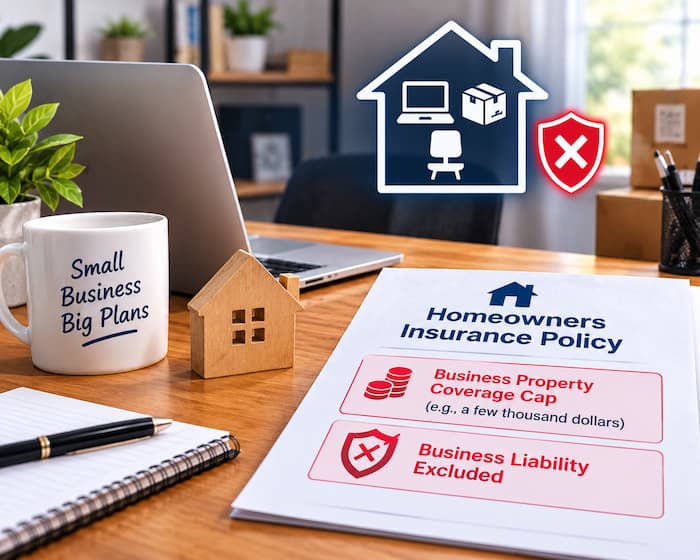
Usually only partly. A standard homeowners or renters policy typically caps property used mainly for business at a few thousand dollars ($3,000 at home and $1,500 away on the current ISO form, and less on many older and carrier forms), and it may exclude liability if a client or customer is hurt because of your business. A property-limit endorsement, a home business endorsement or in-home business policy, or a business owner’s policy (BOP) can close those gaps, depending on what your business does.
The gap in 30 seconds (2022 ISO HO-3 example)
PROPERTY GAP A $4,000 laptop used mainly for your business is destroyed in a house fire
Pays up to $3,000
PROPERTY GAP The same laptop is stolen from your car on the way to a repair shop
Pays up to $1,500
LIABILITY GAP A client slips on your front steps during a business visit
May not be covered under the business exclusion
Based on IRMI’s analysis of the 2022 ISO form. Deductibles apply, and your insurer’s form may use different limits.
Check my coverage in 5 minutes12 quick questions. No sign-up, nothing saved.
Find these 3 lines in your policy
- Special Limits of Liability (under Coverage C, Personal Property): your cap on business property, usually one number for at home and a lower one for away from home.
- Definition of “business” (in the Definitions section): what your insurer counts as business activity, and whether small side income is carved out.
- Liability exclusions (Section II): look for exclusions tied to “business” and “professional services.”
Whether you just started one of the side hustles that actually pay $1K+ a month or you’ve run a home studio for years, this is the insurance check most people skip. Keep one question in mind as you read, because it decides a lot of claims: is that laptop “used primarily for business”?
Checked against ISO form language and guidance from IRMI, the NAIC, and the Insurance Information Institute. Updated .
5-Minute Home Business Coverage Audit
Answer what you can. Nothing you enter is saved or sent anywhere; the result is built on this page.
Does Homeowners Insurance Cover a Home-Based Business?
Partly, and less than most owners assume. A homeowners policy is built for household risks: fire, theft, storms, and the everyday accident where a guest trips on your stairs. When the thing that goes wrong is connected to a business, the policy changes the rules in two places. It shrinks the property coverage for business stuff, and it may remove liability coverage for business-related injuries altogether.
The National Association of Insurance Commissioners (NAIC) puts it bluntly: homeowners and renters policies are rarely adequate for a home-based business, business property coverage is limited, and professional liability isn’t included in standard policies. The NAIC also warns that failing to tell your insurer you run a substantial business from home can lead to a denied business-related claim or a nonrenewal.
This matters to a lot of households. The Census Bureau counted more than 22 million U.S. workers who usually worked from home in 2023, up from about 9 million in 2019. That figure includes remote employees, so it isn’t a count of home businesses, but it shows how many homes now double as workplaces.
Everything below turns on how your policy defines “business.” The current ISO homeowners form (the standardized form many insurers build from) treats a trade, profession, or occupation as business whether it’s full-time, part-time, or occasional, along with other activities you do for money, with a few narrow exceptions covered in the IRS vs. insurance section. Here’s the whole picture in three lines:
PROPERTY GAP Business property is capped by a small special limit, usually a few thousand dollars, with an even lower cap away from home. Business data and some structures used for business may not be covered at all.
LIABILITY GAP Injuries or damage arising from your business may be excluded, and professional mistakes are excluded under standard forms.
FIX Depending on your business: an endorsement that raises the property cap, a home business endorsement or in-home business policy, a BOP, and separate policies for professional liability, business driving, or employees.
How Much Business Property Is Covered?
Your personal property coverage (Coverage C) might be $150,000, but that number doesn’t apply to business property. Inside Coverage C is a list called Special Limits of Liability, and one line caps property “used primarily for business purposes.” A second line caps that same property when it’s away from your home. The special limit is the most the policy pays for that whole category in one loss, and it doesn’t add to your Coverage C total.
The figure you’ll see quoted online depends on which edition of the form the writer was looking at. That’s why so many articles disagree.
| Policy version | At home | Away from home |
|---|---|---|
| Older ISO editions and many carrier forms | $2,500 | Often $250 to $500 |
| 2011 ISO HO-3 | $2,500 | $1,500 |
| 2022 ISO HO-3 (current ISO edition) | $3,000 | $1,500 |
| Texas HOB form (an example of a state form) | Check the form | Excluded entirely |
| Your policy | Read the Special Limits of Liability list under Coverage C. That’s the number that counts. | |
Here’s how that plays out, using an example IRMI gives for the 2022 form. A $4,000 computer used primarily for a graphic art business is destroyed in a house fire: the policy pays up to $3,000. The same computer is stolen from the car on the way to a repair shop: the cap drops to $1,500. Your deductible applies too.
Three other items catch owners off guard:
- Inventory counts. Products you’ve made or bought to sell are business property, and they share the same small cap as your equipment. Some versions of the endorsement that raises the cap don’t extend the increase to stock held for sale or awaiting delivery.
- Business data generally isn’t covered. ISO homeowners forms exclude business data, whether it lives in paper records or on computers, and pay only for blank storage media and off-the-shelf software. Client files, designs, and records are a backup problem, not a homeowners claim.
- Carrier forms can be stricter. Many insurers write their own forms rather than using ISO’s. Some carry lower limits, and some exclude business property away from home entirely.
Don’t memorize a number. Check your policy.
Online articles quote $2,500 because that figure was standard for decades. The current ISO form says $3,000, and your insurer’s own form may say something else. The only number that matters is the one printed in your policy’s Special Limits of Liability.
The “Used Primarily for Business” Test
The special limit doesn’t apply to everything you’ve ever answered an email on. On current ISO forms it applies to property “used primarily for business purposes.” That word, primarily, decides which bucket an item lands in: the full personal property limit, or the small business cap.
The form doesn’t define “primarily,” so the question after a loss becomes factual. How is the item mainly used? Who uses it? Was it bought for the business? Where is it kept? Occasional work use doesn’t automatically reclassify a personal item, but an item that’s mainly a work tool will likely be treated as business property even if the family uses it on weekends.
Four common examples:
The laptop
A family laptop you also use to invoice clients a few hours a week is mainly personal, so it’s more likely to fall under your regular personal property coverage. A second laptop bought for client work and used almost entirely for it is mainly business, so the special limit likely applies. A laptop your employer owns is generally your employer’s property and your employer’s insurance question; ask both your employer and your insurer before assuming either covers it.
The camera
A camera you use on vacations that shoots two paid events a year is a closer call; the balance of use matters. A camera body and lens kit bought for a photography business, used mainly on paid shoots, is business property. Because photographers carry gear to shoots, the lower away-from-home cap often matters more than the at-home one.
The 3D printer
A printer that makes hobby projects is personal property. The same printer running every night to fill online orders is business property, and so are the spools of filament and finished pieces waiting to ship.
The tools
A table saw in the garage for household projects is personal. The same saw, plus clamps, sanders, and lumber, used to build furniture for sale is business property, and if the work happens in a detached garage there’s a second problem covered in the garages and studios section. The same logic reaches further than people expect: one agency notes that a piano used to teach lessons at home falls under the business limit.
Two cautions. First, the wording hasn’t always said “primarily.” The 1991 ISO form applied the limit to property used “at any time or in any manner” for business, and some older or carrier forms still use broad wording, so read yours. Second, disputes happen over items that used to be business property; a policyholder law firm describes a case where an insurer argued that property once used in a business stayed business property. The honest way to protect yourself is to describe your equipment accurately to your insurer and buy the right coverage, not to recharacterize items after a loss.
The Bigger Gap: Business Liability
Losing a $3,000 laptop hurts. A lawsuit over a client’s broken wrist can cost far more, and that’s where the homeowners policy is weakest.
The liability section of the ISO homeowners form excludes bodily injury or property damage arising out of or in connection with a “business” conducted from your home or engaged in by an insured. In plain terms: if the injury happened because of your business, the personal liability coverage you rely on for guests may not respond, and the same exclusion generally reaches the small medical payments coverage too.
The exceptions are narrow. ISO’s form preserves coverage for certain rentals of your home, including renting part of it out as an office, studio, school, or private garage, and for a part-time, self-employed business run by an insured under 21 with no employees. Most adult home businesses fit neither.
A separate exclusion removes coverage for injury or damage arising out of providing, or failing to provide, professional services. If your work is advice, design, bookkeeping, or anything where a client relies on your expertise, a mistake is not a homeowners claim; it needs errors and omissions (professional liability) insurance.
What “business pursuits” means
You’ll see the phrase “business pursuits exclusion” in search results; it’s a common name for the business exclusion above. ISO also has an endorsement called Business Pursuits (HO 24 71), and its name misleads a lot of owners. It adds liability coverage for certain occupations, such as sales, clerical, and teaching, but it doesn’t apply to a business you own or financially control. It’s designed for employees, not owners.
The endorsements that do address owners
Two ISO options are built for business on the premises. A Permitted Incidental Occupancies endorsement (HO 04 42) covers a described office, studio, or school operated from the home. The Home Business Insurance Coverage endorsement (HO 07 01) is broader and covers property, business income, and liability for qualifying home businesses. Both are explained in the fix ladder. Your insurer may offer its own versions under different names.
Liability is usually the bigger gap.
Raising your business property limit is cheap and easy, which is why many owners stop there. But an endorsement that only raises the property cap does nothing for the business liability exclusion. If clients, customers, or students come to your home, or you sell products people use, solve liability first.
What If a Client Gets Hurt at Your Home?
Picture a tutor who teaches in the dining room. A student’s parent slips on the icy front steps during pickup and breaks a wrist. The same fall at a birthday party would look like a routine homeowners claim. Because the visit was tied to the business, it may not be.
What typically happens next:
- You report it. Report every injury promptly, even if you think it’s excluded. Late notice can create a second problem on top of the first.
- The insurer investigates the connection to business. Was the visitor there because of the business? Is the activity “business” under your policy’s definition? Does an endorsement change the answer?
- You get an answer. The claim may be accepted, accepted while the insurer reserves its right to deny later (a “reservation of rights” letter), or denied under the business exclusion.
- If it’s denied, the costs of defending a claim and any settlement may fall to you unless another policy, such as a home business endorsement, in-home business policy, or general liability policy, responds.
The gray areas are real. A delivery driver bringing your inventory, a customer picking up an order at the door, or a friend who happens to also be a client can all raise the “in connection with a business” question. The Insurance Information Institute’s own guidance notes that home business owners need liability coverage in case clients or delivery people are injured on the property.
If clients visit regularly, the audit above will flag this as a LIABILITY GAP. A personal umbrella policy is worth asking about too, but check its business wording; IRMI notes that stand-alone umbrella forms can carry their own business restrictions.
Garages, Sheds, and Home Studios
Moving the business out of the house and into the backyard can create a bigger gap, not a smaller one.
Your policy’s Other Structures coverage (Coverage B) protects things like a detached garage, shed, or studio. According to IRMI’s analysis, the 2022 ISO HO-3 doesn’t cover an other structure from which any business is conducted. That isn’t a reduced limit; the structure itself may not be covered. Similar language appears in earlier editions and many carrier forms.
There’s a useful exception. A structure used only to store business property that you or a tenant of the dwelling solely own stays covered, as long as that property doesn’t include liquid fuel (fuel in the permanent tank of a stored vehicle or craft is excepted). So:
- A garage where you store Etsy inventory likely keeps its structure coverage, but the inventory is still subject to the business property cap.
- A garage woodshop where you build furniture for sale is a structure from which business is conducted, so the building itself may be excluded.
- A backyard studio where you teach lessons or meet clients has both problems: the structure may be excluded and so may liability for visitor injuries.
A detached studio may be a separate problem.
If you’ve converted a garage, shed, or studio for work, ask your insurer specifically whether that structure is covered given how you use it. Options can include an endorsement that restores coverage for the structure, a home business endorsement, or commercial property coverage through a BOP.
Etsy, Daycare, Salon, Freelancer: What Each Should Check
The same homeowners policy leaves very different gaps depending on what you do. Find your row, then read the notes below the table.
| Business | Main exposure | What to check |
|---|---|---|
| Etsy or online seller who makes products | Inventory and supplies; injuries from products you make | Business property cap; product liability; eligibility for a home business endorsement |
| Reseller or dropshipper | Inventory at home; products you sell | Business property cap; whether stock for sale is covered by any limit increase |
| Freelancer or consultant (writing, design, development) | Professional mistakes; equipment; client data | Errors and omissions; equipment value vs. cap; business data exclusion |
| Tutor or music teacher | Students and parents on the premises | Business liability exclusion; incidental occupancy or home business endorsement; instruments at the business cap |
| Photographer or videographer | Gear off-site; clients at a home studio | Away-from-home cap; equipment coverage that travels; studio structure |
| In-home salon, esthetician, nail tech | Client injuries; treatment-related claims | Business liability exclusion; professional liability for beauty services; products used on clients |
| Home daycare | Children in your care | Home day care endorsement availability; separate daycare policy; state licensing rules |
| Pet sitter or groomer | Animals in your care; visitors | Business liability exclusion; coverage for animals in your custody |
| Home baker or body-care maker | Products people eat or apply | Specialty coverage; standard home business endorsements often exclude these |
Etsy and online sellers
Your inventory, packaging, and equipment share one small business cap, so a stocked-up season can blow past it. Selling online also brings product liability: if something you made injures someone, a homeowners policy isn’t built for that claim. Check eligibility carefully. ISO’s home business endorsement excludes businesses that manufacture or sell food or that make personal care products such as soap or lotion, and the AAIS home business program excludes sellers who manufacture their own products or sell under their own label. Craft fairs and markets often ask vendors for proof of insurance; if that’s you, see what to do when someone asks for a COI.
Home daycare
Paid child care is one of the clearest cases where a standard policy may not respond. ISO’s business definition does carve out unpaid swaps (you watch a neighbor’s kids, they watch yours) and care for a relative, but regular paid care is business. ISO offers a Home Day Care Coverage endorsement (HO 04 97) that adds property and liability for a described day care operation, though not all insurers write it; others require a separate day care policy. The AAIS home business program lists child care as ineligible. Your state licensing agency sets its own rules for providers, so check with it directly.
In-home salons and estheticians
Clients sit in your chair, in your home, while you use tools and products on them. That’s two exposures: premises injuries (a slip on the way in) and treatment claims (a chemical burn, an allergic reaction). The first needs business liability; the second is typically professional liability for beauty services. The AAIS home business program lists hair styling as eligible, with cosmetologist’s liability as an option. Ask about local permits separately; they’re outside the insurance question.
Freelancers and consultants
Few visitors, so the premises exposure is small, but the professional exposure is large. A missed deadline, a design error, or bad advice is excluded under the homeowners professional services exclusion and isn’t covered by a BOP either. Start with errors and omissions insurance, then check whether your equipment exceeds the business cap.
Tutors, music teachers, and coaches
Students on the premises, often minors, make the business liability exclusion the central issue. A Permitted Incidental Occupancies endorsement is designed for exactly this kind of described office, studio, or school use at home. Instruments and teaching equipment used for the business fall under the business property cap.
Photographers
Gear travels, so the away-from-home cap (as low as a few hundred dollars on some forms) matters most. Ask about equipment coverage that follows the gear, often written as an inland marine or equipment floater. If clients come to a home studio, add the liability question.
Anyone who drives for the business
Personal auto policies handle most incidental business driving, but carrying passengers or delivering goods for pay is a different story; IRMI notes that courts have applied the public or livery conveyance exclusion to deliveries of goods, not only people. See the rideshare insurance gap for how that works.
If You Rent
Renters insurance generally has the same shape of gap. The ISO renters form (HO-4) uses the same Coverage C special limits structure for business property, and its liability section carries the same business and professional services exclusions. The NAIC’s warning covers both: homeowners and renters policies are rarely adequate for a home-based business.
Renters have two extra things to check:
- The building isn’t yours to insure. Renters policies don’t include Other Structures coverage, so a detached garage or studio you rent is the landlord’s building. Your business property inside it is still subject to the business cap.
- Your lease. Some leases restrict business use or client visits. Your landlord’s insurance covers the building, not your equipment or your business liability.
- Where the fix lives. Many insurers offer business property and home business endorsements on renters policies too, and in-home business policies and BOPs don’t require you to own your home.
For what a renters policy covers outside of business use, see what renters insurance covers.
Endorsement vs. In-Home Business Policy vs. BOP
Think of the options as a ladder. Climb only as high as your business needs; each rung covers more, costs more, and suits a bigger or riskier operation. Form names below are ISO’s; your insurer may use its own names and rules.
FIX Rung 1: Increased Limits on Business Property (ISO HO 04 12). Raises the at-home business property cap; on the 2022 form, IRMI describes increases up to $10,000. Some versions also raise the away-from-home limit, and some don’t extend to stock held for sale. It does nothing for liability. Right for: equipment-only exposure, no visitors, no products.
FIX Rung 2: Permitted Incidental Occupancies (ISO HO 04 42). Covers a described office, studio, or school on the premises, extending property and liability coverage for that use. Right for: tutors, music teachers, home offices with light client traffic.
FIX Rung 3: Home Business Insurance Coverage (ISO HO 07 01) or an in-home business policy. The ISO endorsement covers business property, business income, extra expense, and liability, including personal and advertising injury, with products and completed operations available. Per IRMI, the business must be owned by the named insured (or with resident family), run from the home, have no more than three employees and no more than $250,000 in gross annual receipts, and can’t involve food or self-made personal care products. Stand-alone in-home business policies from homeowners and specialty insurers work similarly, often with higher liability limits. Neither covers professional liability.
FIX Rung 4: Business owner’s policy (BOP) or micro-BOP. A package of commercial property and general liability, usually with business income. Suits businesses too big or too risky for home endorsements, or with more than one location. IRMI describes micro-BOP programs for very small businesses (for example, up to $500,000 in sales and four employees including the owner). A BOP excludes professional liability, workers’ comp, and commercial auto. For the broader picture, see small business insurance: what you need and what it costs.
| Situation | Coverage path to investigate |
|---|---|
| Equipment worth more than the cap; no visitors, no products | Property-limit endorsement |
| Office, studio, or lessons at home with light client traffic | Incidental occupancy endorsement, or a home business endorsement |
| Regular clients, products for sale, or inventory; small and eligible | Home business endorsement or in-home business policy |
| Over $250,000 in receipts, more than three employees, or multiple locations | BOP or micro-BOP |
| You give advice or professional services | Add errors and omissions (not included in any option above) |
| Food or homemade body-care products | Specialty coverage; ask about product liability |
| Paid home daycare | Home day care endorsement where offered, or a day care policy |
| Business run from a detached garage or studio | Ask how the structure is covered; home business endorsement or BOP |
| Deliveries or passengers for pay | Commercial auto or a delivery or rideshare endorsement |
| Any employees | Ask about workers’ compensation rules in your state |
What It Costs (Attributed Examples)
Nobody can quote your price without your details, and this article doesn’t try. These published figures give a sense of scale.
- Raising the property cap: the Insurance Information Institute says that for as little as $25 you can raise the limit from $2,500 to $5,000, and some insurers allow increases up to $10,000 in $2,500 steps. That guidance is based on the older $2,500 limit, so treat it as a ballpark.
- Home-based business policies: Insureon reports medians for home-based businesses that apply for quotes through it of $42 a month for general liability, $49 for professional liability, $58 for a BOP, and $64 for cyber insurance.
- For comparison: Insureon’s medians across all its small business customers are $45 a month for general liability and $83 for a BOP, so home-based figures run lower.
These are medians and examples, not quotes. Your price depends on your business type, revenue, limits, deductible, state, claims history, and how much contact you have with the public. A writer and a home salon won’t pay the same.
IRS “Business” vs. Insurance “Business”
Owners often assume that if the IRS treats their side hustle as a business, their insurer does too, or the reverse. They’re separate systems with separate definitions, and neither decides the other.
The IRS home office deduction generally requires that part of your home be used regularly and exclusively for business and be your principal place of business, with exceptions for things like day care facilities and storing inventory or product samples. That test is about the space.
Your homeowners policy asks whether an activity is a “business” under its own definition, and that test is about the activity. Under the current ISO form, a trade, profession, or occupation counts whether it’s full-time, part-time, or occasional.
ISO’s form also has a small-income carve-out, and it’s often misquoted. Here’s the history:
- 2000 and 2011 ISO editions: activities (other than a few specifically listed ones) that earned an insured $2,000 or less in total compensation during the 12 months before the policy period began are not “business.”
- 2022 ISO edition: the threshold rises to $5,000, according to PIA Northeast’s analysis of the 2022 program and IRMI.
- Many carrier forms: IRMI notes that many insurers’ own forms have no exceptions to the business definition at all.
Two catches. The carve-out looks back at the 12 months before your policy began, so a hustle that grows during the year can cross the line at renewal. And the carve-out can’t make a professional mistake covered; the professional services exclusion is separate. Whatever your tax situation, describe your business activity honestly to your insurer.
What This Isn’t
This guide is about owners and side hustlers running a business from home. A few related questions live elsewhere:
- Remote employees working for someone else face a narrower version: company-owned equipment is usually the employer’s to insure, and personal equipment used mainly for work may still hit the business cap.
- Choosing a side hustle is covered in side hustles that actually pay $1K+ a month.
- The rest of your homeowners policy, including coverages people forget they have, is in homeowners insurance: hidden coverages.
- Health, disability, and tax planning for the self-employed are separate topics.
FAQ
Does homeowners insurance cover a home business?
Partly. It usually covers a small amount of business property through a special limit, and it may exclude liability for injuries connected to the business. Most home businesses need at least an endorsement to fill the gaps.
Does homeowners insurance cover business equipment?
Up to the special limit for property used primarily for business: $3,000 at home and $1,500 away on the 2022 ISO form, and often $2,500 at home and $250 to $500 away on older and carrier forms. Check your policy’s Special Limits of Liability.
What is the business property limit on a homeowners policy?
It’s the special limit in Coverage C for property used primarily for business. It’s the most the policy pays for that category in one loss, and it doesn’t increase your total personal property limit.
Does homeowners insurance cover business liability?
Often not. Standard forms exclude injury or damage arising out of a business, with narrow exceptions, and exclude professional services. Coverage depends on your form, your endorsements, and the facts of the claim.
What is the business pursuits exclusion?
It’s a common name for the homeowners exclusion of liability arising from a business. ISO’s Business Pursuits endorsement (HO 24 71) adds some coverage for certain employees’ work activities, but it doesn’t apply to a business you own.
What does “used primarily for business” mean?
It means the item’s main use is business. Occasional work use doesn’t automatically move a personal item into the business limit, but an item that’s mainly a work tool likely falls under it. The policy doesn’t define “primarily,” so the facts of how you use the item matter.
Is my work laptop covered by homeowners insurance?
It depends who owns it and how it’s used. An employer-owned laptop is generally the employer’s to insure. A personal laptop used mainly for your business likely falls under the business special limit. A family laptop you occasionally work on is more likely treated as personal property.
What happens if a client gets hurt at my home business?
Report it to your insurer promptly. The insurer will look at whether the injury arose from your business. If it did and you have no endorsement or business policy, the claim may be denied, leaving you responsible for defense costs and any settlement.
Does homeowners insurance cover an Etsy business?
It may cover a limited amount of your inventory and equipment under the business special limit, but it generally isn’t built for product liability. Sellers who make their own products should check eligibility carefully, since some home business programs exclude them.
Does homeowners insurance cover a home daycare?
Regular paid child care is generally treated as business and may not be covered. Some insurers offer a home day care endorsement (ISO HO 04 97); others require a separate day care policy. Check your state licensing agency for its rules.
Does homeowners insurance cover an in-home salon?
Client injuries may fall under the business exclusion, and treatment-related claims are a professional liability issue. In-home salons usually need business liability plus professional liability for beauty services.
Does renters insurance cover a home business?
Generally in the same limited way as homeowners insurance: a small business property special limit and business-related liability exclusions. Many insurers offer business endorsements on renters policies.
How much does a home business endorsement cost?
The Insurance Information Institute says raising the property limit from $2,500 to $5,000 can cost as little as $25. Endorsements that add liability cost more. Only your insurer can quote your price.
Is an endorsement enough for a home business?
For a business with modest equipment, no visitors, no products, and no professional advice, possibly. An endorsement that only raises the property limit leaves the liability exclusion in place, and no homeowners endorsement adds professional liability.
When do I need a BOP instead?
Consider a BOP when your business outgrows home business endorsements, for example more than $250,000 in receipts or more than three employees under ISO’s program, when you operate from more than one location, or when you need broader commercial coverage.
Is business inventory covered by homeowners insurance?
Inventory is business property, so it’s generally subject to the same special limit as your equipment. Some limit-increase endorsements don’t apply to stock held for sale, so ask specifically.
Is business property covered away from home?
Usually at a lower limit: $1,500 on the 2011 and 2022 ISO forms and as little as $250 to $500 on older and carrier forms. Some forms exclude it entirely.
Does homeowners insurance cover a detached garage used for business?
Possibly not. The 2022 ISO form doesn’t cover an other structure from which any business is conducted, though a structure used only to store business property you own stays covered if that property doesn’t include liquid fuel.
Do I need professional liability insurance for a home business?
If clients rely on your advice or expertise, it’s worth considering. Professional liability isn’t included in standard homeowners or renters policies, home business endorsements, or BOPs.
Sources
- IRMI, Insuring the Home-Based Business, Part 1 and Part 3 (September 2024)
- PIA Northeast, ISO 2022 HO Program, Part I (2021)
- NAIC, Small Business Insurance and Working from Home and Your Insurance Coverage
- Insurance Information Institute, Insuring Your Home-based Business
- U.S. Census Bureau, New Data Show Detailed Characteristics of Home-Based Workers (January 2025)
- Insureon, Business Insurance Costs for Home-Based Businesses
- PropertyCasualty360, Standard Homeowners Endorsements Discussed, Part 4
Educational only, not insurance or legal advice. Whether you’re covered depends on your policy form, your insurer, your endorsements, your state, and the facts of a claim. Form references are to ISO standard forms; many insurers use their own. AdvoraHQ doesn’t recommend insurers or provide quotes. Last updated .

Daniel Hayes is the founder and sole researcher at AdvoraHQ. He covers U.S. personal finance, insurance, and consumer law — working directly from IRS publications, federal and state statutes, court opinions, and SEC filings rather than secondary summaries. His focus is the gap between what readers think they know and what the source documents actually say. Daniel is not a licensed attorney, CPA, or financial advisor; his articles are educational and not personalized advice. Reach him at Daniel.Hayes@advorahq.com.