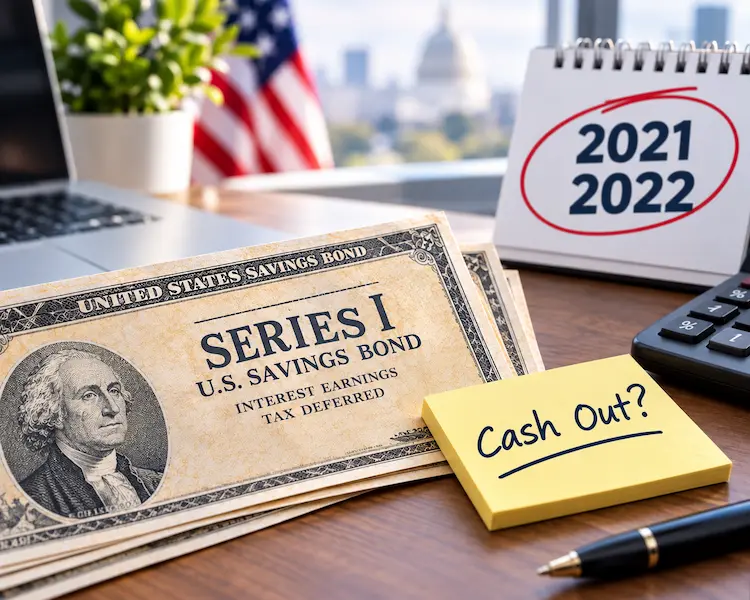
Bought I Bonds in the 2021–2022 Rush? When to Cash Out — and the 0% Fixed-Rate Catch
If you bought I bonds between May 2021 and October 2022, your bond’s fixed rate is 0% — it earns only the inflation component, 3.34% annualized in the current rate period (bonds with an April or October issue month move to that rate on October 1, 2026), versus 4.26% for a new bond. You can cash out anytime after 12 months, but you’ll lose the last 3 months of interest until the bond turns five. For May–September 2021 issues that has already happened; for the rest it falls between October 2026 and December 2027, depending on your issue month.
Find Your Issue Month
| Issue months | Initial 6-month rate | Fixed rate | Penalty-free (5 years) |
|---|---|---|---|
| May–Oct 2021 | 3.54% | 0.00% | May–Oct 2026 |
| Nov 2021–Apr 2022 | 7.12% | 0.00% | Nov 2026–Apr 2027 |
| May–Oct 2022 | 9.62% | 0.00% | May–Oct 2027 |
| Nov–Dec 2022 | 6.89% | 0.40% | Nov–Dec 2027 |
Want an answer for your own bond? Run the exit checker — and watch for the ripple almost nobody plans for: cash out a big bond in 2026, and your Medicare premiums could feel it in 2028.
This guide is a decision framework, not a recommendation to keep or sell. It is educational only and is not tax or investment advice.
Rush-Era I Bond Exit Checker
Pick the issue month printed in your TreasuryDirect account, a planned redemption month, and the interest your bond has earned. The checker does arithmetic and points you to the sections that matter. It stores nothing and sends nothing.
What “0% Fixed Rate” Actually Means
Every I bond earns a composite rate built from two pieces: a fixed rate that is set the month you buy and never changes, and an inflation adjustment that resets every six months. Treasury combines them like this: fixed rate + (2 × semiannual inflation) + (fixed rate × semiannual inflation). The result is floored at 0%, so an I bond’s composite rate never goes negative.
When the fixed rate is 0%, the formula leaves only the inflation piece. Using the semiannual inflation figure of 1.67% that Treasury set on May 1, 2026, the three fixed rates in this guide work out to:
- 0.00% fixed (May 2021–Oct 2022 issues): 3.34% annualized.
- 0.40% fixed (Nov–Dec 2022 issues): about 3.75% annualized.
- 0.90% fixed (new bonds, May–Oct 2026): 4.26% annualized.
0% fixed doesn’t mean 0% return. A 0%-fixed bond still earns the inflation adjustment every six months, and its value can’t fall. What it lacks is any return above inflation. The fixed rate is that extra layer, and it is the one thing that separates your rush-era bond from a new one.
Two details are easy to miss. First, not every 2022 bond is a 0% bond: November and December 2022 issues carry a 0.40% fixed rate. Second, the fixed rate lasts for the bond’s 30-year life, so the gap between an old bond and a new one doesn’t close on its own — it just persists at roughly the difference between the two fixed rates.
What Your Rush-Era Bond Earns Right Now
The 9.62% you may remember lasted six months. Initial rates applied only to each bond’s first six months; no 2022 bond earns 9.62% today. After that, every bond earns its fixed rate plus whatever the inflation adjustment is for its current six-month period.
Each bond resets on its own schedule: in its issue month and six months later. Treasury announces new inflation figures every May 1 and November 1, and your bond picks up the new figure at its next reset. That means the current 3.34% inflation component reached different bonds in different months of 2026:
| Issue month (any year) | Reset months | Moved to the May 2026 inflation figure | Next reset (November 2026 figure) |
|---|---|---|---|
| May or November | May, Nov | May 1, 2026 | Nov 1, 2026 |
| June or December | Jun, Dec | Jun 1, 2026 | Dec 1, 2026 |
| July or January | Jul, Jan | Jul 1, 2026 | Jan 1, 2027 |
| August or February | Aug, Feb | Aug 1, 2026 | Feb 1, 2027 |
| September or March | Sep, Mar | Sep 1, 2026 | Mar 1, 2027 |
| October or April | Oct, Apr | Oct 1, 2026 | Apr 1, 2027 |
Interest accrues monthly, and Treasury adds it to the bond’s value on a schedule that compounds every six months. A rate here is an annualized figure, not a payout you receive.
Old 0%-fixed bond vs. new bond
| Feature | Old bond (0% fixed) | New bond (May–Oct 2026) |
|---|---|---|
| Fixed rate | 0.00% | 0.90% |
| Rate in effect now | Inflation component only: 3.34% annualized (April and October issue months switch to it on Oct 1, 2026) | 4.26% for the first six months |
| After the first six months | Inflation component only, reset every six months | 0.90% fixed plus the inflation component, reset every six months |
| Interest already built up | Yes, several years of it, untaxed until you redeem | None yet |
| Lock and penalty | See the calendar below; no penalty once the bond is five years old | Locked 12 months; then 3 months of interest forfeited until year five |
| Purchase limit | Existing bonds don’t count against this year’s limit | Counts toward the $10,000 per person, per calendar year cap |
| Federal tax | Accrued interest is taxable in the year you redeem (or at maturity) | No taxable interest until you redeem |
Your Penalty-Free Calendar, Month by Month
A bond’s issue date is the first day of its issue month, and the penalty ends when the bond is five years old. So each issue month maps to the first day of the same month five years later. Only bonds bought in October 2021 or earlier are already penalty-free or about to be; 2022 buyers reach five years during 2027, not in 2026.
PENALTY APPLIES means cashing out now forfeits the last 3 months of interest. PENALTY-FREE means the bond is five years old.
| Issue month | Fixed rate | Penalty-free from | Status on Sept. 29, 2026 |
|---|---|---|---|
| May 2021 | 0.00% | May 1, 2026 | PENALTY-FREE |
| June 2021 | 0.00% | June 1, 2026 | PENALTY-FREE |
| July 2021 | 0.00% | July 1, 2026 | PENALTY-FREE |
| August 2021 | 0.00% | Aug. 1, 2026 | PENALTY-FREE |
| September 2021 | 0.00% | Sept. 1, 2026 | PENALTY-FREE |
| October 2021 | 0.00% | Oct. 1, 2026 | PENALTY APPLIES until Oct. 1 |
| November 2021 | 0.00% | Nov. 1, 2026 | PENALTY APPLIES |
| December 2021 | 0.00% | Dec. 1, 2026 | PENALTY APPLIES |
| January 2022 | 0.00% | Jan. 1, 2027 | PENALTY APPLIES |
| February 2022 | 0.00% | Feb. 1, 2027 | PENALTY APPLIES |
| March 2022 | 0.00% | Mar. 1, 2027 | PENALTY APPLIES |
| April 2022 | 0.00% | Apr. 1, 2027 | PENALTY APPLIES |
| May 2022 | 0.00% | May 1, 2027 | PENALTY APPLIES |
| June 2022 | 0.00% | June 1, 2027 | PENALTY APPLIES |
| July 2022 | 0.00% | July 1, 2027 | PENALTY APPLIES |
| August 2022 | 0.00% | Aug. 1, 2027 | PENALTY APPLIES |
| September 2022 | 0.00% | Sept. 1, 2027 | PENALTY APPLIES |
| October 2022 | 0.00% | Oct. 1, 2027 | PENALTY APPLIES |
| November 2022 | 0.40% | Nov. 1, 2027 | PENALTY APPLIES |
| December 2022 | 0.40% | Dec. 1, 2027 | PENALTY APPLIES |
The first row where the fixed rate changes is November 2022. That is why the checker above treats those two months differently from the rest of the rush.
How the 3-Month Penalty Really Works
Three rules govern early redemption:
- You can’t cash an I bond during its first 12 months. Every bond in this guide is past that point.
- Cashing before five years forfeits the last three months of interest. Your principal isn’t touched, and no fee is charged.
- The penalty disappears when the bond turns five. After that, you can redeem any time, and the bond keeps earning until it reaches 30 years.
TreasuryDirect’s displayed value for a bond under five years already excludes the last three months, so the number you see is what you’d receive. It’s a good sanity check against any estimate.
Hypothetical illustration. Suppose a bond is worth $12,000 and currently earns 3.34% annualized. Three months of interest is roughly $12,000 × 3.34% ÷ 4 ≈ $100. That’s the approximate cost of cashing out early in this made-up case. Your actual amount depends on your bond’s value and rate; TreasuryDirect shows the exact figure.
The penalty equals three months of interest on your bond’s current value, not a percentage of everything you hold. The calendar tells you exactly when it ends.
Timing Within the Month
Interest on an I bond accrues monthly, and TreasuryDirect updates each bond’s displayed value on that monthly rhythm. Common guidance is to redeem early in a month, after the prior month’s interest has posted, rather than in the last days of a month. Rather than treat that as a rule, apply it like this:
- The month matters more than the day for the penalty. A bond issued in November 2021 turns five on November 1, 2026. A redemption in October is inside the penalty window; a redemption anywhere in November is not.
- Redeeming at the very end of a month can leave a month of interest behind. Check your account’s displayed value near a month change to see how it moves.
- Your displayed value is what counts. Confirm it in your TreasuryDirect account on the day you redeem; that figure, not a rule of thumb, is what gets paid.
Old Bond vs. New Bond: Should You Swap?
This section is a framework, not a recommendation. Whether swapping fits depends on your tax situation, your horizon, and what else you could do with the cash.
Selling doesn’t give you more buying room. Electronic I bond purchases are capped at $10,000 per person per calendar year. Redeeming an old bond doesn’t restore any of that room. If you already bought $10,000 of I bonds in 2026, you can’t buy more this year no matter how much you redeem.
Buying a new bond also doesn’t require selling an old one. The purchase comes from your bank account. Cashing out is a separate decision from buying.
Four questions to work through
- Does the penalty still apply? Check the calendar. PENALTY APPLIES adds a cost; PENALTY-FREE removes it.
- What does redeeming trigger? All of the bond’s built-up interest becomes taxable in the year you redeem. See taxes, Medicare and ACA. CHECK TAX IMPACT
- How much can you rebuy? At most $10,000 per person this calendar year, minus anything you’ve already bought. Proceeds beyond that have to go elsewhere.
- How long would you hold the new bond? The extra return accrues per year of holding, while the penalty and taxes are paid up front. A new bond also has its own 12-month lock and 3-month penalty until year five.
The arithmetic, made explicit
After its first six months, a new bond earns about 0.9 percentage points more per year than a 0%-fixed bond, because the fixed rate is the only part that differs. The inflation piece applies to both.
Hypothetical illustration. Say you rebuy $10,000 in a new bond with a 0.90% fixed rate. The extra return over an old 0%-fixed bond is about $10,000 × 0.90% ≈ $90 a year. If cashing out the old bond costs roughly $100 in forfeited interest (from the penalty example above), that cost alone equals about a year of the extra return, before any tax effect. If the old bond is already penalty-free, the penalty part of that math drops out. These numbers are made up to show the method; use your own.
The November 1 timing point
A new bond’s fixed rate is set for every bond issued in a six-month window. Bonds issued through October 31, 2026 get the 0.90% fixed rate announced on May 1. New rates, including a new fixed rate for bonds issued from November, are scheduled to take effect on November 1, 2026. We don’t forecast what they’ll be. Treasury published the last two resets (November 2025 and May 2026) on the last business day before the effective date. Because November 1, 2026 is a Sunday, check TreasuryDirect at the end of October and again on Monday, November 2.
The Tax Bill When You Cash Out
Here is how I bond interest is generally taxed. Confirm details in IRS Publication 550 and with a tax professional.
- Federal income tax applies; state and local income tax does not. I bond interest is exempt from state and local income taxes.
- Most owners defer the reporting. You can wait until you redeem the bond or until it matures, then report all the built-up interest at once. TreasuryDirect issues a Form 1099-INT for the year you redeem.
- It’s ordinary interest income, not a capital gain. The whole gain above what you paid is interest.
- Bunching is the catch. A bond bought in 2021 or 2022 has gathered years of interest. Recognizing it all in one year can lift your income more than a regular year of savings interest would.
- Partial redemptions are proportional. Redeeming part of a bond generally recognizes a proportional slice of its interest, which lets you spread the income across years if the penalty calendar allows.
- Higher earners may face one more layer. Interest can count as net investment income for the 3.8% surtax above certain income levels. Ask your tax professional.
For a comparison with interest that’s taxed every year, see Is High-Yield Savings Interest Taxable?
The ripple effects at a glance
| Effect | When it shows up | Who should check |
|---|---|---|
| Federal income tax | Tax year you redeem; reported the following spring | Anyone with built-up interest |
| State and local income tax | Not applicable to I bond interest | Residents of states with an income tax (no action needed) |
| Medicare IRMAA | Two years later: a 2026 redemption generally affects 2028 premiums | People on Medicare or within about two years of enrolling |
| ACA premium tax credit | Same tax year as the redemption; reconciled on next spring’s return | Marketplace enrollees, especially near the 400% poverty-level limit |
| Education exclusion (Form 8815) | Same year as redemption, if you pay qualified education expenses | Owners paying for college, within the income limits |
| Net investment income tax | Same tax year as the redemption | Higher earners over the surtax thresholds |
Could It Raise Your Medicare Premiums?
CHECK TAX IMPACT 2026 income can show up in 2028 Medicare premiums. Social Security generally sets your Medicare Part B and Part D surcharge (IRMAA) from your tax return two years earlier. Interest you recognize in 2026 would generally count toward 2028 determinations.
Here’s how the lookback works. Premiums for 2026 use your 2024 return. Premiums for 2027 use 2025. Premiums for 2028 use 2026. The income measure is modified adjusted gross income (MAGI): adjusted gross income plus tax-exempt interest. The I bond interest you report when you redeem is part of it.
- 2026 thresholds start above $109,000 (single) and $218,000 (married filing jointly). The thresholds for 2028 will be different, so use them as a rough guide only.
- Each tier is a step, not a slope. Crossing a threshold by a dollar puts you in the next bracket for the whole year.
- The cost is real. In 2026, the first surcharge tier adds about $974 a year per person to Part B, plus a separate Part D surcharge. A couple both on Medicare pays it twice.
- Timing to watch: if you’ll enroll in Medicare by 2028, your 2026 return may already be a lookback year.
- An appeal isn’t a plan. Social Security’s SSA-44 process covers specific life-changing events. A voluntary redemption generally isn’t one of them. Confirm with SSA.
For the current tiers and dollar amounts, see IRMAA 2026 Brackets.
Could It Shrink Your ACA Subsidy?
Marketplace premium tax credits are based on your household MAGI for the year, and taxable interest is part of it. So the interest you recognize by redeeming a bond lands in the same year’s credit calculation.
- The 400% limit is back for 2026. The temporary enhanced credits expired after 2025, so under current law premium tax credits end above 400% of the federal poverty level. Based on 2025 guidelines, that’s about $62,600 for one person and about $128,600 for a family of four.
- It’s a cliff, not a slope. Above the limit, the credit drops to zero.
- Advance credits get reconciled. If your final income differs from your projection, Form 8962 settles the difference, and you may owe some or all of the advance credit back. Check the current repayment rules in the form’s instructions.
- Your projection matters. If you redeem a bond mid-year, update your marketplace income estimate.
Legislative rules on these credits have changed before, so confirm the current status. For a fuller walkthrough of the cliff, see ACA Subsidy Cliff 2026.
Using I Bonds for College (Form 8815)
Interest on qualifying I bonds can be excluded from federal income if you use the proceeds for qualified higher-education expenses in the same year you redeem. You claim it on Form 8815, and the exclusion has conditions:
- The bond owner must have been at least 24 before the issue date. A bond in a child’s name doesn’t qualify.
- The expenses are for you, your spouse, or your dependent, and they’re generally reduced by tax-free aid and any education credits claimed.
- Married owners must file jointly. Married filing separately can’t claim it.
- Your MAGI, including the bond interest, sets the limit.
For 2026, the exclusion starts to phase out at a MAGI of $101,800 (single and head of household) and $152,650 (married filing jointly). It’s fully phased out at $116,800 and $182,650. Qualifying surviving spouses should check the Form 8815 instructions for their limit. If your MAGI is inside the range, you get a partial exclusion. Proceeds larger than qualified expenses reduce the exclusion proportionally.
Contributions to a 529 plan can count as qualified expenses on Form 8815, subject to the form’s rules. For how 529s work, see 529 Plans in 2026. Because this exclusion has many moving parts, review the Form 8815 instructions or ask a tax professional before relying on it.
How to Cash Out in TreasuryDirect
This guide assumes electronic bonds held in a TreasuryDirect account. Menu wording changes, so follow TreasuryDirect’s own cashing instructions if a label differs from what’s below.
- Log in and find the bond. Open your account’s holdings and note the issue date and current value of each I bond.
- Check the penalty date. Use the calendar above. If the bond is under five years old, the displayed value already excludes the last three months.
- Choose the bond and the amount. You can cash a bond in full or in part. At least $25 must remain in a partially redeemed bond, and there are no fees.
- Confirm your linked bank account. Proceeds go to the account linked to your TreasuryDirect account.
- Submit and keep a record. Save the confirmation and the interest amount; you’ll want them at tax time.
- Watch for the Form 1099-INT. It arrives for the year you redeemed.
Full vs. partial. A full redemption ends the bond and recognizes all its interest that year. A partial redemption recognizes a proportional share and leaves the rest earning, which can help with the income-based effects above.
Three Hypothetical Examples
These are made-up households with assumed bond values, not calculations of any actual issue month. The point is to show how the pieces interact. None is a recommendation.
Example 1: $10,000 face value, one November 2021 bond
Hypothetical assumptions: the bond is worth $12,400 ($2,400 of interest). The owner files single, isn’t near Medicare, and has no marketplace plan.
- PENALTY-FREE from Nov. 1, 2026. Cashing out in October instead would be PENALTY APPLIES: roughly $12,400 × 3.34% ÷ 4 ≈ $100 of forfeited interest.
- CHECK TAX IMPACT About $2,400 becomes federally taxable in the year of redemption. At a hypothetical 12% rate that’s about $288; at 22%, about $528.
- Up to $10,000 could be rebought this calendar year if the owner hasn’t already used that year’s limit.
Example 2: $25,000 face value, a couple both headed for Medicare
Hypothetical assumptions: the holdings are worth $31,000 ($6,000 of interest). Half sits in November–December 2021 bonds (penalty-free late 2026); half in January–April 2022 bonds (penalty-free early 2027). They file jointly with $214,000 of other MAGI each year, and both will be on Medicare in 2028.
- CHECK TAX IMPACT Redeeming everything in 2026 puts MAGI at $220,000, above the 2026 joint starting threshold of $218,000. The same year’s income could then affect 2028 premiums. At 2026 amounts, the first Part B tier is roughly $974 per person, about $1,948 for two, before Part D.
- Splitting at the calendar change puts about $3,000 of interest in each of two years, or $217,000 each year. That’s under $218,000. Each year then affects a different premium year (2028 and 2029).
- The split happens to line up with the penalty-free dates here. The 2028 and 2029 thresholds will differ, so this only shows the method.
Example 3: $50,000 face value, a family of four on an ACA plan
Hypothetical assumptions: the holdings are worth $62,000 ($12,000 of interest), across several owners and bonds. The household’s other 2026 MAGI is $122,000. Only $4,000 of the interest sits in bonds that are penalty-free in 2026 (November–December 2021 issues); the rest is in bonds that reach five years in 2027.
- CHECK TAX IMPACT Redeeming everything in 2026 puts MAGI at $134,000, above the roughly $128,600 limit for a family of four (2026 coverage). The credit would drop to zero, and any advance credits could need repayment.
- Redeeming only the penalty-free portion in 2026 puts MAGI at $126,000, under the limit. The rest could wait until 2027 penalty-free dates, subject to that year’s limits and income.
- Check the 2027 rules and your projected income before assuming the split works.
If You Cash Out, Where Could the Money Go?
Cash from a redemption lands in your bank account, and the alternatives differ in taxes, access and risk. Common options include high-yield savings accounts, certificates of deposit and Treasury bills. Interest on savings accounts and CDs is generally taxed at both federal and state levels every year, while Treasury bill interest is federally taxable and exempt from state and local tax. Compare options in Where to Park Cash in 2026. If you’re new to bonds more broadly, start with How to Invest in Bonds.
Frequently Asked Questions
When can I cash out I bonds bought in 2022 without penalty?
Five years after the first day of your issue month. January 2022 bonds reach that point on January 1, 2027, and October 2022 bonds on October 1, 2027. November and December 2022 bonds follow in November and December 2027. The full list is in the calendar.
Which 2022 I bonds have a 0% fixed rate?
Bonds issued January through October 2022 have a 0.00% fixed rate. Bonds issued November and December 2022 have a 0.40% fixed rate.
Do 2022 I bonds still earn 9.62%?
No. The 9.62% rate applied only to the first six months of bonds issued May through October 2022. After that, each bond earned its fixed rate plus the inflation adjustment for the period.
What rate are 2022 I bonds earning now?
A 0%-fixed bond earns the inflation component only: 3.34% annualized in the current period (April and October issue months reach it on October 1, 2026). A 0.40%-fixed bond from November or December 2022 earns about 3.75%.
What is the current I bond rate?
The rate for new bonds issued May 1 through October 31, 2026 is 4.26%: a 0.90% fixed rate plus a 3.34% annualized inflation component.
What will the I bond rate be in November 2026?
New rates are scheduled to take effect on November 1, 2026. We don’t predict them. Check TreasuryDirect at the end of October and again on November 2.
Should I sell my 0% fixed I bonds?
This guide doesn’t recommend keeping or selling. It shows what to weigh: penalty status, taxes on built-up interest, income-based effects, and what else you’d do with the money. See the swap section.
Should I sell old I bonds and buy new ones?
That depends on your penalty date, tax situation, holding period and the $10,000 purchase cap. A new bond earns about 0.9 percentage points more per year than a 0%-fixed bond, while the costs of switching are paid up front.
Does selling I bonds reset the purchase limit?
No. The limit is $10,000 per person per calendar year for electronic I bonds, and redeeming doesn’t restore any of it.
When is I bond interest taxable?
For most owners, in the year they redeem the bond or when it matures, rather than each year as it accrues. TreasuryDirect reports it on Form 1099-INT.
Are I bonds taxed by states?
No. Interest is subject to federal income tax but exempt from state and local income taxes.
Does cashing I bonds affect IRMAA?
It can. The interest you recognize is part of your MAGI, and IRMAA is generally based on the return from two years earlier. Interest recognized in 2026 would generally affect 2028 premiums. See the Medicare section.
Do I bonds affect my ACA subsidy?
The interest you recognize counts toward household MAGI in the year you redeem, which can affect your premium tax credit. For 2026, the 400% federal-poverty-level limit applies. See the ACA section.
Is I bond interest part of MAGI?
Yes, taxable interest is part of adjusted gross income, which is the starting point for the MAGI used for IRMAA, ACA credits and the Form 8815 phase-out. Each measure has its own add-backs.
Can I partially redeem I bonds?
Yes. At least $25 must remain in the bond, and there are no fees. A partial redemption generally recognizes a proportional share of the interest.
How do I cash out I bonds on TreasuryDirect?
Log in, select the bond, choose a full or partial redemption, confirm your linked bank account and submit. Follow the steps above and TreasuryDirect’s own instructions.
What is my I bond worth right now?
Log in to TreasuryDirect. For bonds under five years old, the displayed value excludes the last three months of interest, so it shows what you’d actually receive.
What are the Form 8815 income limits for 2026?
The exclusion phases out between MAGI of $101,800 and $116,800 for single and head-of-household filers, and between $152,650 and $182,650 for married filing jointly. Married filing separately can’t claim it.
Is there a best day of the month to cash out?
No universal day. Common guidance is to redeem early in a month, after the prior month’s interest has posted. For a bond turning five, the month decides the penalty. See timing within the month.
What are I bonds?
Series I savings bonds are U.S. savings bonds whose rate combines a fixed rate with an inflation adjustment that resets every six months. Their value doesn’t fall.
Sources
- TreasuryDirect: I bond interest rates and rate chart
- TreasuryDirect: May 1, 2026 savings bond rate announcement
- TreasuryDirect: Series I savings bonds: rules, purchase limits and redemption
- IRS: Publication 550, Investment Income and Expenses
- IRS: Form 8815 and Internal Revenue Bulletin 2025-45 (2026 phase-out limits)
- IRS: Questions and Answers on the Premium Tax Credit
- Social Security Administration: POMS HI 01101.010 (IRMAA and MAGI)
- U.S. Treasury Fiscal Data: Treasury Savings Bonds Explained. Americans bought nearly $153 billion of I bonds between April 2021 and February 2023, which is why so many households sit in the cohorts above.
Last updated: . This page will be updated after the November 2026 rate announcement.
This article is for educational purposes only and is not tax, legal or investment advice. Rates and tax thresholds change. Confirm current figures on TreasuryDirect and with a qualified tax professional before you redeem.

Daniel Hayes is the founder and sole researcher at AdvoraHQ. He covers U.S. personal finance, insurance, and consumer law — working directly from IRS publications, federal and state statutes, court opinions, and SEC filings rather than secondary summaries. His focus is the gap between what readers think they know and what the source documents actually say. Daniel is not a licensed attorney, CPA, or financial advisor; his articles are educational and not personalized advice. Reach him at Daniel.Hayes@advorahq.com.