
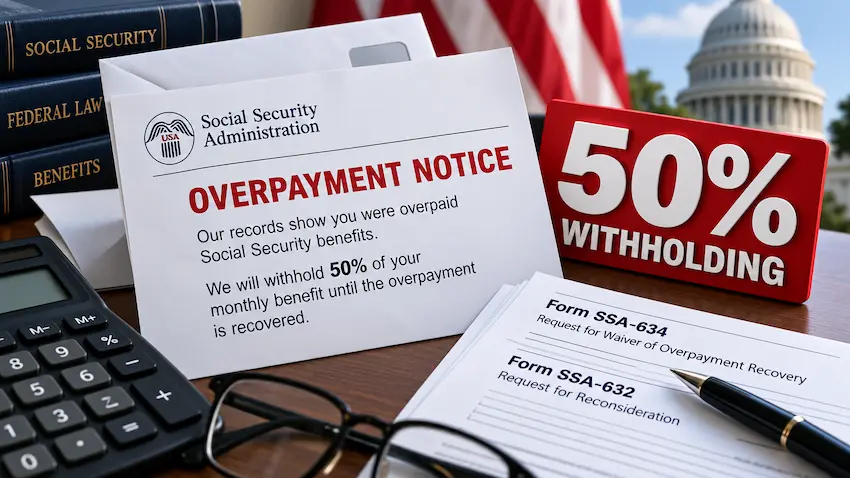
Don’t pay yet, and don’t ignore it. First check the amount, the reason, and the dates on your letter. For most retirement, survivor, and SSDI notices dated on or after April 25, 2025, Social Security can withhold up to 50% of your check by default. Asking for reconsideration, a waiver, or a lower rate (ideally within 30 days) may pause or reduce that.
Check These 3 Things First
- The amount and the months listed. Does the total match your records, and do the months match when you were paid?
- The reason given. The notice should say what change caused the overpayment and when. If it doesn’t, that is worth knowing before you decide anything.
- The dates printed on your notice. Find the notice date and any deadlines. Circle them. Your letter’s dates are the ones that count.
Which Form?
- DISPUTE (SSA-561)
You think you weren’t overpaid, or the amount is wrong. - WAIVE (SSA-632)
You agree, but it wasn’t your fault and repaying would cause hardship or be unfair. - REDUCE (SSA-634)
You agree you owe, but 50% is too much.
Want the fast answer? Jump to the form-and-dates tool, and to the audit finding most people never hear about: federal auditors found problems in nearly half of the overpayment notices they reviewed.
Which Form — and Which Dates?
Answer what you can. The tool suggests a starting point and counts 30 and 60 days from the notice date. It runs in your browser and stores nothing.
Why Social Security Can Take 50% Now
Social Security treats an overpayment as a debt. If you don’t repay it or ask for a review, it collects by holding back part of your monthly benefit. The size of that default holdback has changed in recent years:
- Before March 25, 2024: a default of 100% of the monthly benefit.
- From March 25, 2024: 10%.
- From April 25, 2025: up to 50% (SSA emergency message EM-25029 REV).
The 50% default applies to Title II overpayment notices (retirement, survivors, and SSDI) dated on or after April 25, 2025, when there is no fraud or similar fault. SSI stays at 10%. Cases involving fraud or similar fault follow different rules that this guide doesn’t cover.
To see what that could mean, a $1,800 monthly benefit could have up to $900 withheld each month. That is an illustration, not a prediction. Your notice states the rate that applies to you.
| Program | Default rate | Notes |
|---|---|---|
| Title II: retirement, survivors, SSDI | Up to 50% of the monthly benefit | Notices dated on or after April 25, 2025, with no fraud or similar fault. Earlier notices may show a different rate. |
| SSI | 10% of the monthly payment | SSI overpayment rules differ from Title II. Follow the dates and rate on your SSI notice. |
| Fraud or similar fault | Different rules | Not covered here. Ask SSA or a legal aid office. |
30 Days, 60 Days, or Anytime? The Real Deadlines
You will see “30 days” and “60 days” used loosely online, sometimes both for “appeals.” They are different clocks that do different jobs, and one request has no deadline at all.
| Timeframe | What it means |
|---|---|
| The notice date | The date printed on your letter. SSA’s overpayment page measures the 30-day window from it. |
| 30 days | SSA generally waits at least 30 days after sending the notice before it starts collecting. Requesting reconsideration or a waiver within 30 days generally prevents collection while SSA reviews the request. If you neither repay nor ask, SSA generally begins withholding. |
| 60 days | Generally the time to request reconsideration (SSA-561) if you dispute whether you were overpaid or the amount. Later requests may require “good cause.” |
| Anytime | A waiver (SSA-632) can be requested at any time, even after recovery has begun (POMS NL 00720.390, updated 09/22/2026; GN 02250.001). You still have to meet the standards. |
| If your benefits stop | SSA says the law allows it to collect in other ways, such as withholding a tax refund, certain state payments, or garnishing wages. If you no longer receive benefits, call SSA about a payment plan. |
Your letter’s dates are the ones that count. This table describes the general rules. If your notice prints a different deadline, or says something this page doesn’t, follow your notice and ask SSA if anything is unclear.
One more point that trips people up: the 30-day date is mainly about when collection starts, not a deadline to “appeal.” Missing it doesn’t end your options. Reconsideration has its own window, and a waiver has none. But acting within 30 days is the way to avoid withholding beginning while your request is pending.
Your Notice Might Be Wrong
Nearly half of reviewed notices had problems. In an audit published in September 2026, SSA’s Office of the Inspector General (OIG) found that 46% of sampled Old-Age, Survivors, and Disability Insurance overpayment notices did not meet SSA policy. OIG estimated that more than 469,000 notices were processed incorrectly in fiscal year 2023.
Read that carefully. It is a finding about the quality of letters, drawn from a sample of fiscal 2023 notices. Auditors described notices that were missing explanations, that left out or misstated amounts, or that lacked required information about appeal and waiver rights. It does not mean 46% of debts are invalid, and a flawed letter can still describe a real overpayment. It does mean your letter deserves a check before you accept it.
The same audit looked at requests for an explanation and, as reported, found processing errors in a majority of the sampled requests (79 of 125). That is another reason to keep copies of everything you send.
What to check on your letter
- Amount: the total, and how it compares with what you actually received.
- Months: the period covered. Do the start and end months match when the change happened?
- Reason and date: what changed (work, marriage, a death, something else) and the date SSA used.
- Whose record: your name and claim number, and whether the notice is about your benefit or someone else’s.
- Rate: the withholding rate stated, and when it is scheduled to start.
- Your rights: whether the letter explains how to dispute, ask for a waiver, or ask for a lower rate.
- Your records: pay stubs, benefit statements, and bank deposits for those months.
Ask for an explanation
If something doesn’t add up, you can ask SSA to explain the calculation in writing. Here is a neutral letter you can copy and adapt.
[Your name]
[Your address and phone number]
[Claim number or Social Security number, as shown on your notice]
[Date]

Social Security Administration
[Address of your local office or the address on your notice]

Re: Overpayment notice dated [notice date] - request for explanation

I received a notice dated [notice date] stating that I was overpaid $[amount] for [months listed].

Please send me a written explanation of how this amount was calculated, including:

1. The months covered by the overpayment.
2. The benefit amount I was paid and the amount you believe I should have been paid for each month.
3. The specific reason for the overpayment and the date of the change that caused it.
4. How the withholding rate was determined and when withholding is scheduled to begin.

Please provide this explanation before any collection begins. If needed, I will also file a request for reconsideration, waiver, or a change in the recovery rate within the deadlines on my notice.

Sincerely,
[Your signature]
Don’t assume this letter stops any clock. An explanation request is not the same as a reconsideration or waiver request. If a date on your notice is close, file the form that fits, too.
SSA-561: Disputing the Overpayment
DISPUTE. Form SSA-561 is the Request for Reconsideration. Use it if you think SSA made a mistake in deciding you were overpaid, or you disagree with the amount. SSA’s own overpayment page says an appeal should only be filed if you disagree with the amount.
- Window: generally 60 days from the notice. Later requests may require good cause for the delay.
- Collection: a request within 30 days generally prevents collection while SSA reviews it.
- What helps: your evidence for the months in question, such as pay stubs, benefit statements, or records showing when a change happened.
- What comes after: if you disagree with the reconsideration decision, SSA’s waiver form points to form HA-501 for requesting a hearing before an administrative law judge.
A reconsideration can confirm, change, or remove an overpayment. No one can tell you in advance which. If you’re unsure how to file, call SSA at 1-800-772-1213 (TTY 1-800-325-0778) or ask at your local office, and keep proof of submission.
SSA-632: Asking for a Waiver
WAIVE. A waiver asks SSA to excuse repayment, in whole or in part. The current form is SSA-632-BK, “Request for Waiver of Overpayment Recovery” (edition 06-2025).
A waiver can be requested at any time. There is no filing deadline, even after recovery has begun. A request within 30 days also generally prevents collection while SSA decides.
What SSA looks for
You have to show the overpayment was not your fault, and one of these:
- Repaying would defeat the purpose of the Act, meaning you couldn’t pay for necessary expenses such as food, clothing, housing, and medical care.
- Repaying would be against equity and good conscience, which SSA’s rules generally look at through things like whether you gave up something or changed your position because of the extra money.
SSA decides fault based on your circumstances. The form asks what you know about why the overpayment happened and, if there was a change you didn’t understand or couldn’t report, why.
Documents and shortcuts
- Financial documents: the form lists rent or mortgage information, recent bank statements, two or three recent utility, medical, charge card, and insurance bills, current pay stubs, your most recent tax return, and canceled checks. They should be dated within three months of your request.
- Bank records authorization: the form asks you to authorize SSA to obtain financial account records. It warns that declining may lead SSA not to approve the request.
- Smaller overpayments: the current form says that if you think you’re not at fault and the overpayment on your letter is $2,000 or less, you can call SSA at 1-800-772-1213 instead of completing the whole form. Older SSA publications say $1,000, so check the form edition you have.
- Need-based benefits: if you or a dependent household member receives SSI, TANF, a VA need-based pension, SNAP, or Medicare Part D Extra Help, the form lets you skip the financial sections. Attach proof of TANF, VA pension, or SNAP.
- Not eligible: the form says not to use it if you were convicted of fraud relating to this overpayment.
You can upload the form, mail or fax it, or make an appointment through SSA. Approval isn’t guaranteed. The form also asks whether you want the entire overpayment waived, including money you already repaid, or only what remains.
SSA-634: Lowering the Withholding
REDUCE. Form SSA-634 is the Request for Change in Overpayment Recovery Rate. It is for when you agree you owe the money but the withholding would leave you unable to meet necessary living expenses.
- What you provide: the total you owe, the amount you can afford each month, and a financial statement covering assets, income, and expenses. Supporting documents should be no older than three months.
- How SSA decides: it considers your income and expenses (POMS GN 02210.030) and mails a decision. There is no guaranteed rate.
- Deadline: the form itself doesn’t state one. It is separate from the 60-day reconsideration window.
- Filing: sign in and upload the form, or bring or send it to your local office.
If you no longer receive benefits and want a payment plan, SSA says to call. If you’d rather repay, SSA’s page lists online payment through pay.gov (with the Remittance ID on your letter) and a phone line at 1-855-807-8807.
| Your situation | Form | What it asks SSA to do |
|---|---|---|
| I think I wasn’t overpaid, or the amount, months, or reason is wrong | DISPUTE: SSA-561 | Take another look at whether you were overpaid and how much. |
| I agree, but it wasn’t my fault and repaying would cause hardship or be unfair | WAIVE: SSA-632-BK | Excuse repayment, all or part. |
| I agree I owe it, but the withholding is too high | REDUCE: SSA-634 | Lower the monthly recovery rate. |
| I’m not sure what happened | Ask first | Explain the calculation in writing, then choose. Watch your dates. |
Working Before Full Retirement Age: A Common Cause
Working while collecting retirement or survivors benefits before full retirement age (FRA) is a common cause of overpayments. The earnings test can withhold benefits when your earnings pass a yearly limit. If SSA paid you in full and your earnings turn out to be higher than you estimated or reported, the result can be an overpayment notice.
- Under FRA all of 2026: the limit is $24,480. SSA withholds $1 for every $2 you earn above it.
- The year you reach FRA: the limit is $65,160, counting only earnings before the month you reach FRA. SSA withholds $1 for every $3 above it.
- First year of retirement: a special monthly rule can pay a full benefit for any whole month you are considered retired, regardless of yearly earnings. SSA’s 2026 monthly figures are $2,040 (under FRA) and $5,430 (in the FRA year).
- What counts: wages and net self-employment earnings.
SSA’s own example: someone under FRA all year who earns $33,400 is $8,920 over the $24,480 limit, so $4,460 of benefits would be withheld. If that person kept receiving full payments, the difference is the kind of overpayment that shows up in a letter. If you receive survivors benefits, SSA uses your full retirement age for retirement benefits when applying the test.
If you get a notice like this, compare SSA’s earnings figures with your W-2s or self-employment records, and ask SSA whether months withheld or repaid will be credited when your benefit is recalculated at FRA. To avoid a repeat, tell SSA when your expected earnings change. For the bigger claiming picture, see When to Take Social Security: 62 vs 67 vs 70.
SSI Is Different
SSI and Title II (retirement, survivors, SSDI) are separate programs with separate overpayment rules. The default withholding for SSI is 10%, not 50%. The forms have similar names and SSA-632-BK and SSA-634 both ask whether you receive SSI, but don’t assume Title II details, including the timelines in this guide, carry over. Your SSI notice will list its own dates. Follow them.
If you get both SSI and a Title II benefit, read each notice separately. Which program the notice is about determines the rate and the rules that apply.
After a Spouse or Parent Dies
There are two different situations, and it helps to know which one you’re in.
- The overpayment is on your own survivor benefit. Then it works like any other Title II notice: check the amount, reason, and dates, and use the DISPUTE, WAIVE, or REDUCE path.
- The overpayment is on the deceased person’s record. Then the question is who SSA is seeking repayment from.
In an August 2026 audit, OIG identified 17,979 adult beneficiaries who died between December 2022 and December 2024 with about $240 million in outstanding overpayments, and estimated that about $106 million was potentially recoverable. It found SSA had not followed its own policy in 47% of a sample, including not attempting recovery from some estates. SSA’s recovery steps can include withholding underpayments and lump-sum death payments, and seeking payment from an estate or from people who are contingently liable.
If the letter arrives after a death, ask SSA in writing whose record the debt is on, who is being asked to pay and why, and how the amount was calculated. The same question comes up with other debts after death: whether it belongs to the estate or to you personally. Our guide Who Pays Credit Card Debt After Death? walks through that parallel. Don’t assume the answer; confirm it.
Withholding Already Started? You Still Have Options
- Waiver: can be requested at any time, even after recovery has begun.
- Reduce: if the withholding leaves you unable to meet necessary expenses, SSA-634 asks for a lower rate.
- Dispute: SSA-561 is generally due within 60 days of the notice, and later requests may require good cause.
- Collection while a request is pending: SSA’s overpayment publication says it generally stops collection until it decides an appeal or waiver request. If withholding continues after you file, contact SSA and give them your filing date and proof of submission.
- Check the math: compare what was withheld with the rate and start date on your notice.
Keep copies of every form and a record of how and when you sent each one.
What This Isn’t
- Not legal advice, and not a sales pitch. You don’t need to pay anyone to file these forms. Free help includes SSA itself (1-800-772-1213), your local legal aid office, the Eldercare Locator (1-800-677-1116), and, if you work while getting SSDI or SSI, a benefits counselor through the Work Incentives Planning and Assistance program.
- Not a fraud guide. Overpayments involving fraud or similar fault follow different rules.
- Not the trust fund question. A projected benefit cut is a separate issue from your notice. See Social Security’s 2032 Cut, Calculated.
- Not a budget. For living on a smaller check, see Retirement Income Planning.
- Not a way to verify a letter. Scammers imitate government letters. If you’re unsure a notice is real, check your my Social Security account or call SSA at the number above instead of using contact details printed only on the letter.
FAQ
What should I do first when I get a Social Security overpayment letter?
Find the notice date, then check the amount, the months, and the reason. Decide whether you want to dispute it, ask for a waiver, or ask for a lower rate, and note the deadlines on the letter.
How long do I have to respond?
Generally 30 days to avoid collection starting, 60 days for reconsideration, and no deadline for a waiver. Your letter’s dates control.
Will Social Security really take 50% of my check?
For Title II notices dated on or after April 25, 2025, with no fraud or similar fault, the default is up to 50% of your monthly benefit if you don’t repay or ask for a review.
Does the 50% apply to SSI?
No. SSI’s default is 10%.
My notice is older than April 25, 2025. Does 50% apply?
Possibly not. The default was 10% from March 25, 2024. Your notice states the rate that applies to you.
How do I stop Social Security from taking 50%?
Requesting reconsideration or a waiver within 30 days generally prevents collection while SSA decides. You can also ask for a lower rate with SSA-634. None of these is guaranteed to succeed.
What’s the difference between SSA-561 and SSA-632?
SSA-561 disputes whether you were overpaid or the amount. SSA-632 accepts that you were overpaid but asks SSA to excuse repayment.
Which form should I use: SSA-561, SSA-632, or SSA-634?
DISPUTE if you think it’s wrong, WAIVE if you agree but it wasn’t your fault and repaying would cause hardship or be unfair, REDUCE if you agree you owe and the rate is too high. See the table above or use the tool.
Can I file more than one?
They can be combined. Ask SSA how to file more than one request so each is considered.
Can I appeal after 60 days?
Later reconsideration requests may require good cause for the delay. Explain why you were late when you file.
Can I request a waiver after 60 days?
Yes. A waiver can be requested at any time.
Can I request a waiver after withholding has started?
Yes, even after recovery has begun.
What does “not at fault” mean?
SSA decides based on your circumstances. It asks what you know about why the overpayment happened and whether there was a change you didn’t understand or couldn’t report.
What does “defeat the purpose of the Act” mean?
Repaying would leave you unable to pay for necessary expenses such as food, clothing, housing, and medical care.
What does “against equity and good conscience” mean?
It’s the other route to a waiver. SSA generally looks at things like whether you gave up something or changed your position because of the extra money.
Is there a simplified waiver process for smaller overpayments?
The current SSA-632-BK says that if you think you’re not at fault and your letter’s overpayment is $2,000 or less, you can call SSA instead of completing the whole form. Older SSA publications say $1,000, so check the current form.
Does SSA-632 require my bank information?
The form asks for authorization for SSA to obtain financial records, and warns that declining may lead SSA not to approve the request. Filers who receive need-based benefits such as SSI or SNAP can skip the financial sections.
Can Social Security forgive an overpayment?
SSA can waive repayment, in whole or in part, if you meet the standards. Nobody can promise the result.
The amount on my notice looks wrong. How do I dispute it?
Ask SSA for a written explanation of the calculation and, within the window on your notice, file SSA-561.
Could my overpayment be from working?
It’s a common cause if you collect before full retirement age. For 2026 the limits are $24,480 (under FRA all year) and $65,160 (the year you reach FRA).
What if I no longer receive benefits?
SSA says the law allows it to collect in other ways, including withholding a tax refund, certain state payments, or garnishing wages. Call SSA about a payment plan.
Do I owe my spouse’s overpayment after they died?
Don’t assume. Ask SSA in writing whose record the debt is on and who is being asked to pay. See the section above.
Can I pay it back in one payment?
Yes. SSA’s page lists online payment through pay.gov using the Remittance ID on your letter, and phone payment at 1-855-807-8807. Check the amount and reason before you pay.
Do I need a lawyer?
Not to file these forms. Free help is available from SSA, local legal aid, and benefits counselors.
Does asking for an explanation stop the clock on my deadlines?
Don’t assume it does. If a date is close, file the form that fits as well.
Sources We Checked
- SSA emergency message EM-25029 REV (default withholding rate)
- SSA: Resolve an overpayment; Repay overpaid benefits; Ask us to waive an overpayment
- Form SSA-632-BK (06-2025); Form SSA-634 (12-2023); Form SSA-561
- POMS GN 02201.025, GN 02250.001, NL 00720.390, GN 02210.030, SI 02220.016
- SSA: Receiving benefits while working (2026 earnings limits)
- SSA OIG: OASDI Overpayment Notices audit (report 152407, September 2026)
- SSA OIG: Overpayments to deceased beneficiaries (August 12, 2026)
Last updated:
This article is for educational purposes only and is not legal advice. Follow the dates and instructions on your own notice. Social Security policies, forms, and dollar thresholds can change, so confirm current details with SSA.

Daniel Hayes is the founder and sole researcher at AdvoraHQ. He covers U.S. personal finance, insurance, and consumer law — working directly from IRS publications, federal and state statutes, court opinions, and SEC filings rather than secondary summaries. His focus is the gap between what readers think they know and what the source documents actually say. Daniel is not a licensed attorney, CPA, or financial advisor; his articles are educational and not personalized advice. Reach him at Daniel.Hayes@advorahq.com.