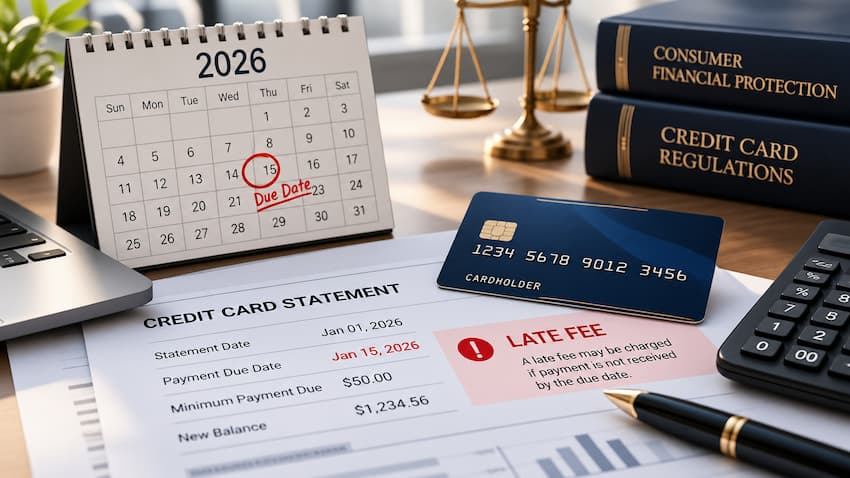
Paying one day late usually means a late fee — typically around $30 to $32 the first time under the federal safe harbor — but it generally won't show up on your credit report unless you fall 30 days behind. The fee also can't be more than your minimum payment, and many issuers will waive a first late fee if you ask.
Three facts to know first
- $8 isn't the rule. A court struck it down in April 2025, even though you may still see it online.
- Your fee can't exceed your minimum payment.
- One day late does not equal a reported late payment.
- Due date (5 p.m.)Pay by the cutoff and none of this applies.
- 1 day lateFEE RISK A late fee can post.
- 30+ daysCREDIT RISK Credit reporting usually starts here.
- 60+ daysRATE RISK Penalty APR can apply to existing balances.
- 6 on-time paymentsThe prior rate may be restored.
Want numbers for your own situation? Jump to the Late Fee Checker.
And here's the limit almost nobody checks: if your minimum payment was $15, your late fee can't be $32.
Late Fee Checker
Enter what you know. Leave anything blank if you're unsure. Nothing you type is stored or sent anywhere.
What Happens When You're One Day Late
A one day late credit card payment sounds small, and in credit terms it often is. Here is what usually happens, starting with the most likely consequence.
FEE RISK A late fee can post to your account. This is the most likely result of a credit card late payment that's a day behind.
Your minimum payment is still owed, so pay at least that now. Interest continues to accrue on your balance. If you usually pay your full statement balance, paying late or short can mean interest charges you wouldn't normally see. Our guide on how credit card interest works covers the details.
Issuers generally can't charge more than one penalty fee for a single late payment. If you see two separate fees tied to the same missed payment, ask the issuer to explain each one.
What usually does not happen after one day: a mark on your credit report, or a higher interest rate. Those come later. The table shows the full ladder.
| Stage | What can happen | What to do |
|---|---|---|
| Payment received by the 5 p.m. cutoff on the due date | Generally counts as on time. | Pay at least the minimum. Keep the confirmation. |
| 1 to 29 days late | FEE RISK: a late fee can post. Interest continues. Generally not reported as delinquent. | Pay now. Check the fee against your minimum payment. Ask for a waiver. |
| 30+ days late | CREDIT RISK: issuers commonly report accounts at 30 days past due. | Pay immediately. Review your credit reports. |
| More than 60 days late | RATE RISK: a penalty APR may be applied to existing balances, with notice. | Contact your issuer. Ask what it takes to restore your rate. |
| Six consecutive on-time payments afterward | The prior rate may be restored on that balance. Certain increases must be reviewed every six months. | Keep paying on time. Ask your issuer to confirm the status. |
How Much Can the Late Fee Be in 2026?
There is no single 2026 maximum. Federal rules set safe-harbor amounts: fee levels an issuer can charge without having to prove its own costs. Sources describe the current figures in two slightly different ways, depending on whether they use the older amounts or the inflation-adjusted ones published in 2024.
- About $30 to $32 for a first late payment.
- About $41 to $43 for another late payment within the next six billing cycles.
The lower figures ($30 and $41) are the pre-2024 amounts. The higher ones ($32 and $43) are the inflation-adjusted amounts published in the 2024 rule. With that rule vacated, many sources point back to the lower pair, but practice varies.
FEE RISK The fee disclosed in your card agreement is the one that applies. Look for the "late payment fee" line in your agreement or on your statement.
The safe harbor isn't an absolute ceiling either. Under Regulation Z (12 CFR § 1026.52(b)(1)(i)), an issuer can also justify a fee based on its costs. And whatever the issuer's number, the minimum-payment limit in the next section can bring your fee down.
The Limit Most People Miss: Your Minimum Payment
A late fee can't exceed the minimum payment that was due. This comes from Regulation Z (12 CFR § 1026.52(b)(2)(i)(A)) and its official interpretation. The CFPB's own example: if your minimum payment was $15, the late fee can't be more than $15.
Your fee can't top your minimum payment.
FEE RISK If your statement showed a $15 minimum and the late fee is $32, that fee looks too high.
The relevant minimum is the required minimum payment due immediately before the fee was charged. The table shows how it plays out. The fee columns are illustrative, using the safe-harbor ranges above; your agreement's disclosed fee still applies if it is lower.
| Minimum due | Highest first late fee | Highest repeat late fee |
|---|---|---|
| $15 | $15 | $15 |
| $25 | $25 | $25 |
| $35 | $30 to $32 | $35 |
| $60 | $30 to $32 | $41 to $43 |
How to check yours in two minutes
- Find the statement that listed your minimum payment due for the missed date.
- Find the late fee on the next statement.
- If the fee is larger than that minimum, contact the issuer, say the fee appears to exceed the minimum payment limit in Regulation Z § 1026.52(b)(2)(i)(A), and ask them to review it.
Don't confuse this with the 25% idea. A cap tied to 25% of the minimum payment was proposed in 2023, but it was not adopted. It is not current law. The limit above is the existing rule: the fee can't exceed the minimum payment itself.
What Happened to the $8 Late Fee?
Seeing $8 online? That rule was struck down.
In March 2024 the CFPB finalized its Credit Card Penalty Fees rule, which set an $8 late-fee safe harbor for larger issuers (those with one million or more open card accounts). On April 15, 2025, a federal court vacated that rule, and the CFPB confirms the vacatur on its penalty-fees page. The $8 safe harbor is not in force.
Why do you still see $8? Two reasons. First, plenty of articles were written when the rule was new and were never corrected. Second, the Electronic Code of Federal Regulations (eCFR) still prints the $8 text. A court order can set a rule aside before the printed text catches up, so a regulation that's printed isn't proof it's in effect.
In July 2026, the CFPB submitted a Request for Information titled "Credit Card Late Fees and Late Payments" (RIN 3170-ZA54) for federal review. As of this update, its contents are not public, and a request for information is not a rule. We draw no conclusions about where it leads. Nothing about your fee changes because of it.
Federal caps on credit card costs are a fast-moving topic. For a related debate, see Is the 10% Credit Card Interest Cap Real?
| Date | What changed | In force? |
|---|---|---|
| 2023 | CFPB proposed late-fee changes, including an $8 safe harbor and a 25% minimum-payment cap. | No. Proposal only; the 25% cap was never adopted. |
| March 2024 | CFPB finalized a rule setting an $8 safe harbor for larger issuers (1M+ open accounts). | No. Vacated. |
| April 15, 2025 | A federal court vacated the 2024 rule. CFPB confirms. | The vacatur stands. The $8 rule is not in effect. |
| July 2026 | CFPB submitted a Request for Information on late fees and late payments for review. Contents not public. | Not a rule. No change to fee limits. |
The 5 P.M. Rule
Being "a day late" and being "a few hours late" are very different. Under CFPB guidance, an issuer generally can't treat a payment as late if it receives it by 5 p.m. on the due date, in the time zone stated on your statement. Rules for in-person payments differ, so check how your statement describes branch payments.
Practical points:
- 5 p.m. is the earliest cutoff an issuer may set. Some issuers accept payments later in the day.
- The time zone on your statement is the one that counts, not your own.
- Keep your confirmation number and timestamp. A scheduled payment and a received payment are not the same thing.
If you paid after 5 p.m. on the due date, don't assume the fee is automatic. Check your statement for the issuer's stated cutoff and ask whether your payment counts as on time.
When the Due Date Lands on a Weekend or Holiday
If your due date falls on a day the issuer doesn't receive or accept mail payments, a payment received on the next business day is generally timely.
The precision matters here. This protection is about mailed payments. Online and phone payments are usually accepted every day, including weekends, so a Sunday due date generally still means Sunday is the deadline for those. If you're not sure how the issuer treats your due date, check your statement or ask, and keep proof of when you paid.
Will It Hurt Your Credit Score?
CREDIT RISK 30 days is when credit reporting usually starts — not a free pass.
Will a one day late credit card payment hurt your credit score? Generally not. A payment that's a few days late isn't usually reported as delinquent. Issuers generally report at 30 days past due. That is industry practice, not a federal grace period, and a late fee can still apply well before then.
If you're approaching 30 days, pay immediately and read what happens if you don't pay your credit card for the longer timeline. If a 30-day late payment has already been reported, see how to fix your credit score fast.
When a Penalty APR Can Kick In
RATE RISK A penalty APR is not a one-day-late consequence. It generally requires a minimum payment that is more than 60 days late.
Per the CFPB, an issuer may raise the interest rate on existing balances once your minimum payment is more than 60 days late, with notice. If you then make six consecutive on-time payments, the prior rate can be restored for that balance, and certain increases must be reviewed every six months.
Your agreement states the actual penalty rate. For how interest and grace periods work in general, see how credit card interest works.
How to Get the Late Fee Waived
Issuers often consider waiving a first late fee when you ask. It's discretionary: the law doesn't require it and nothing guarantees it. Pay at least the minimum first, then ask. A calm, specific request works better than a long explanation. On your phone, tap a quoted script to select it, then copy.
Phone script
"Hi, I'm calling about a late fee of [amount] on my account ending in [last four digits]. My payment was due on [date] and I paid on [date]. I've been a customer for [time] and this is my first late payment. Could you waive the fee as a one-time courtesy?"
If they say no: "Is there someone else who can review this?" Then thank them and ask them to note the request on your account.
Chat or secure message script
"I'd like to request a one-time waiver of the [amount] late fee posted on [date]. I paid on [date] and my payment history is otherwise on time. Please confirm whether the fee can be credited back."
If your fee looks higher than your minimum payment
"My minimum payment due on [date] was [amount], but the late fee is [fee]. Under Regulation Z § 1026.52(b)(2)(i)(A), the fee can't exceed the minimum payment. Can you review and correct it?"
Afterward, look for the credit on your next statement. If the issuer says no, you can ask again later, or through a different channel. Don't tell an issuer what its policy is; just ask what it can do.
What to Do Right Now
FEE RISK A few days late: pay at least the minimum today, save the confirmation, compare the fee to your minimum payment, and ask for a first-time waiver.
CREDIT RISK Approaching 30 days: pay as soon as you can and contact the issuer before the 30-day mark if you're able.
RATE RISK Past 60 days: contact the issuer, ask what notice you've received, and ask what it takes to restore your rate. Then work toward six on-time payments.
FAQ
What happens if I pay my credit card one day late?
You'll usually be charged a late fee. A payment that's only a day late generally isn't reported to credit bureaus, and a penalty APR generally requires a payment more than 60 days late.
How much is a credit card late fee in 2026?
There's no single maximum. The safe-harbor amounts are about $30 to $32 for a first late payment and $41 to $43 for another within the next six billing cycles. Your card agreement's disclosed fee is what applies.
Can a late fee be more than my minimum payment?
No. A late fee can't exceed the minimum payment due. The CFPB's example: a $15 minimum means the fee can't exceed $15.
Is the $8 credit card late fee still in effect?
No. A federal court vacated the CFPB's 2024 rule on April 15, 2025, and the CFPB confirms this.
Why does the eCFR still say $8?
The eCFR still prints the $8 text, but the rule isn't in force. A vacatur is a court order, and printed regulation text can lag behind it.
What if I paid a few hours late?
An issuer generally can't treat a payment as late if it receives it by 5 p.m. on the due date, in the time zone on your statement. Some issuers accept payments later, so check yours.
What if my due date is a Sunday or a holiday?
If the issuer doesn't receive or accept mailed payments that day, a payment received the next business day is generally timely. Online and phone payments are usually accepted on weekends.
Will one day late hurt my credit score?
Generally not. Issuers usually report a late payment at 30 days past due. That's industry practice, not a federal grace period.
When is a late payment reported?
Usually when it's 30 days past due. A fee can still apply before then.
Can they charge more than one fee for a single late payment?
Generally not. Issuers can't normally charge multiple penalty fees for a single late payment. If you see more than one, ask for an explanation.
Will the issuer waive my first late fee?
Many issuers consider it, but it's discretionary and not guaranteed. Ask politely, and mention your payment history.
Can I get a late fee refunded after it posts?
You can ask. If the issuer agrees, the fee is typically credited back. Check your next statement to confirm.
When can a penalty APR apply, and how do I end it?
An issuer may raise the rate on existing balances if your minimum payment is more than 60 days late, with notice. Six consecutive on-time payments can restore the prior rate for that balance.
Sources
- CFPB: Credit card penalty fees (vacatur status)
- 12 CFR § 1026.52 and official interpretation (CFPB)
- Federal Register: Credit Card Penalty Fees (Regulation Z) final rule, March 15, 2024 (89 FR 19128)
- Ask CFPB: late payments and interest-rate increases
- Consumer Finance Monitor, July 8, 2026: CFPB signals it may revisit credit card late fee regulation
- Reginfo.gov: pending EO 12866 review, RIN 3170-ZA54
Disclaimer: This article is educational only and is not financial or legal advice. Fees depend on your card agreement and current federal rules, which can change.

Daniel Hayes is the founder and sole researcher at AdvoraHQ. He covers U.S. personal finance, insurance, and consumer law — working directly from IRS publications, federal and state statutes, court opinions, and SEC filings rather than secondary summaries. His focus is the gap between what readers think they know and what the source documents actually say. Daniel is not a licensed attorney, CPA, or financial advisor; his articles are educational and not personalized advice. Reach him at Daniel.Hayes@advorahq.com.