
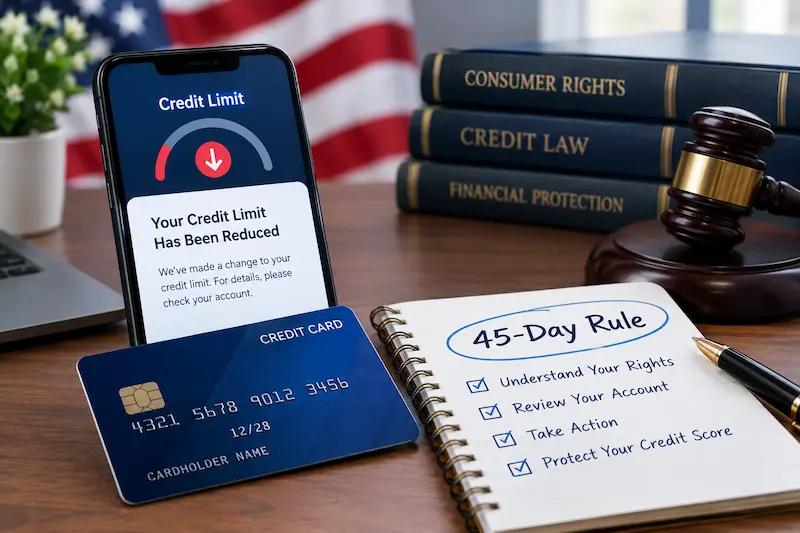
You open your card app and a $15,000 limit is now $7,500. Your balance didn’t change — your available credit did.
The 30-second answer: Card issuers can generally lower your limit without asking first — and without warning. If the new limit is below your balance, they can’t charge an over-limit fee or a penalty rate for that for 45 days after notifying you. You may get a letter explaining why within 30 days — but not always: cuts tied to inactivity or a current late payment, or applied across a whole group of accounts, may not require one. The immediate risk is higher credit utilization — so check your numbers, move key autopays, and then ask for reasons and a review.
| Question | Short answer |
|---|---|
| Can they cut my limit without warning? | Generally yes |
| Do I get 45 days’ notice before the cut? | No — 45 days covers fees and penalty rates after notice |
| Will I get a letter explaining why? | Often within 30 days — but not in every case |
| Can my card be declined now? | Yes, if available credit is too low |
| Will my score be affected? | It can, through utilization |
| Can I get the old limit back? | Sometimes — ask, and ask how they’ll check your credit |
→ Calculate your new utilization
→ Find out why and what to do next
Also inside: what the 45-day rule really covers, and why you might never get a letter explaining the cut.
Utilization Impact Calculator
Enter your old limit, new limit and balance to see how the cut changes your utilization and how much you would need to pay down to reach common benchmarks.
Utilization is the share of your credit limits that you’re using. Add up to four cards (include every card you want counted) and leave unused cards blank. Enter 0 as the balance if a card has none.
Card 1
Card 2
Card 3
Card 4
Balances usually report around your statement date. See Charged Interest After Paying Statement Balance for how paying before the closing date can change what’s reported. For the theory behind the numbers, see Credit Utilization Ratio.
Your First Hour After a Limit Cut
In the first hour, check your new limit against your balance, move anything that charges this card automatically, and stop adding new charges.
Balance over the limit, declines and autopays are the urgent items.
1. Check the new limit and your balance
Open the app or statement and compare your current balance with the new limit. If the balance is higher, you are over the limit.
2. Move your autopays and subscriptions
List everything that charges this card (bills, streaming, memberships) and move it to another payment method before a decline causes a missed payment or a lapsed service.
3. Avoid new charges on this card
If you have no available credit, the CFPB says you can't make new charges until you pay down part of the balance. Keep using other payment methods in the meantime.
4. Screenshot and save everything
Capture the new limit, the balance, the date you noticed, and any email, letter or in-app message. Dates matter for the 45-day rule and the 30-day notice.
Run the calculator above, then work out how much to pay down. Balances usually report around your statement date, so timing matters (see Charged Interest After Paying Statement Balance).
Ask for the specific reasons, check your credit reports, dispute errors, and only then ask for a review of the limit. Scripts and letters are below.
Why Did My Credit Limit Decrease?
Issuers cut limits for several reasons, including low use, risk signals on your credit report, late payments, or a broader portfolio decision, and only your issuer can tell you which one applied to you.
Treat the list below as possibilities, not a diagnosis. Never assume one reason is certain until the issuer tells you.
Low or no use
A card that sits unused can be trimmed or closed during account reviews.
Higher balances or utilization elsewhere
If your balances rose on other accounts, a risk review may treat you as more exposed.
Late payments
A recent or current late payment can prompt an issuer to reduce risk on the account.
Changes on your credit report
New loans, new cards, a score drop or other report changes can trigger a review.
Issuer portfolio or risk decisions
An issuer may adjust limits across a group of accounts at once, not just yours.
An error on your credit report
Inaccurate information can contribute to a decision. You can dispute it (see the dispute steps).
Paying on time doesn't make a cut impossible. A cut can be driven by something other than your payment history, such as inactivity, changes elsewhere on your credit report, or an issuer-wide decision.
Why & What Now Router
Answer seven quick questions to see your starting tier, the possible reasons, whether a notice was likely required, your 45-day status, and your next steps.
Related guides: Best Balance Transfer Credit Cards and Charged Interest After Paying Statement Balance.
Is It Legal to Cut Your Limit Without Warning?
Generally yes: the CFPB says card companies can generally decrease credit limits, even to the point where you have no available credit, and the 45-day rule is about fees after notice, not warning before the cut.
Two different rules get mixed up online. One is about notice of the action (Regulation B). The other is about fees and penalty rates after a decrease (Regulation Z). They have different timelines and different triggers.
30-day notice (Reg B)
For many unfavorable changes to an existing account, the issuer must notify you within 30 days after the action. The notice gives the specific reasons or tells you how to request them. It does not apply to every cut. See the exceptions.
45-day fee rule (Reg Z)
After a decrease, the issuer can't charge an over-limit fee or a penalty rate for exceeding the new, lower limit until 45 days after notice of the decrease. It protects you from those charges, not from the cut. See the rule in detail.
Your cardholder agreement may also describe how limits can change, so it's worth reading yours. If the issuer has no available credit to offer you after the cut, the CFPB notes you can't make new charges until you pay down part of the balance.
The adverse-action notice rule exists in part to discourage discrimination, so asking for the reasons is a legitimate step, not a favor. Notices on new applications work differently; see Credit Card Application Denied?
The 45-Day Rule — What It Actually Covers
After cutting your limit, the issuer can't charge an over-limit fee or a penalty rate for exceeding the new, lower limit until 45 days after notice of the decrease, which is not the same as 45 days' warning before the cut.
| Point | Reg B notice | Reg Z 45-day rule |
|---|---|---|
| What it covers | Notice of certain unfavorable changes (adverse action) | Over-limit fees and penalty rates tied to exceeding the new limit |
| Timing | Generally within 30 days after the action | No such charge until 45 days after notice of the decrease |
| What you get | Specific reasons, or how to request them | A window to pay down before fees or penalty rates can apply |
| Always applies? | No. Exceptions include inactivity, current delinquency and class-wide changes | Applies to charges triggered by exceeding the decreased limit |
| Where to read it | 12 CFR § 1002.2(c) and § 1002.9 | 12 CFR § 1026.9(c)(2)(vi) |
Over-limit fees need your opt-in
Over-limit fees also require your prior opt-in (see 12 CFR § 1026.56). The CFPB says an issuer can't charge over-limit fees if it didn't give notice of the decrease and you haven't opted into over-the-limit transactions. If you never opted in, an over-limit fee is a red flag worth questioning.
Penalty rates
A penalty rate is a higher APR. During the 45-day window, the issuer can't impose one for exceeding the new limit. After the window, whether a penalty rate can apply depends on your card agreement and other Regulation Z rules. Aim to get below the new limit well before the window ends.
Example (hypothetical)
Suppose your limit is cut from $15,000 to $7,500 and the notice is dated March 1. Counting 45 days from March 1 lands on April 15. Until then, an over-limit fee or penalty rate for exceeding the new limit shouldn't appear. If one does, see Script 3 below.
Will You Get a Letter? When a Notice Is — and Isn't — Required
You often get a letter within 30 days, but not always, because Regulation B excludes some actions, such as those tied to inactivity or a current delinquency, from its definition of adverse action.
Under Regulation B (§ 1002.2(c)), adverse action includes an unfavorable change in account terms that doesn't affect all or substantially all of a class of the creditor's accounts. The definition leaves out actions taken in connection with inactivity, default, or delinquency on that account, and point-of-sale declines because a transaction exceeds the limit.
| Situation | Notice required? | Why |
|---|---|---|
| Cut tied to inactivity on that account | Often no | Reg B excludes actions taken in connection with inactivity |
| Cut tied to a current late payment or default | Often no | Reg B excludes actions in connection with delinquency or default on that account; official commentary says termination for current delinquency isn't adverse action |
| Cut based on past delinquency (you've caught up) | Generally yes | Official commentary says action based on past delinquency generally requires notice |
| Change applied to all or substantially all of a class of accounts | Often no | The definition covers changes that don't affect all or substantially all of a class |
| Purchase declined at the register because it exceeds the limit | No | Point-of-sale declines for exceeding the limit are excluded |
| Cut based on your own profile or a credit report review | Generally yes | Likely an adverse action on an existing account |
When a notice is required
For an existing account, the creditor must generally notify you within 30 days after taking adverse action. The notice must either give the specific reasons or tell you that you can request them. If it tells you that you can request them, you generally have 60 days from the notice to ask, and the creditor must then provide the statement of reasons within 30 days. Follow the instructions on the notice for how to make the request. Script 2 is built for a written request.
Balance Above Your New Limit? What Happens Now
If your balance is above the new limit, new purchases may be declined until you pay down, you still owe the balance, and fees and penalty rates tied to exceeding the limit are restricted for 45 days after notice.
Credit card declined after a limit decrease
If your available credit is zero or too low, a purchase can be declined. The CFPB says that with no available credit you can't make new charges until you pay down part of the balance. Even if you opted in to over-limit transactions, the issuer isn't required to approve a purchase that takes you over the limit.
Recurring payment declined after a limit decrease
Recurring charges can fail if there isn't enough available credit. Move them to another payment method. Check any bills those charges were paying for, so a decline doesn't turn into a late payment elsewhere.
Minimum payment with a balance above the new limit
The cut doesn't erase your debt. Your minimum payment is set by your card agreement, so check your next statement and pay at least that amount on time. A late payment would add a separate problem on top of the cut.
Balance transfer after a credit limit decrease
A balance transfer onto the cut card needs available credit, so a lower limit can cap what you can move. A transfer to a new card usually involves an application, which can mean a hard inquiry, and a fee. Weigh those costs before moving a balance. See Best Balance Transfer Credit Cards.
How a Lower Limit Affects Your Credit Score
A lower limit can hurt your score through utilization, the share of your total limits you're using, but the size of the effect depends on your balances, your other accounts, and many other factors.
Experian gives an example: a card's limit drops from $15,000 to $12,000, and with a $10,000 total balance across $27,000 in total limits, overall utilization is 37%. Your balance didn't change, but your utilization did.
| Card | Old limit | New limit | Balance | Utilization (before → after) |
|---|---|---|---|---|
| Card A (cut) | $15,000 | $12,000 | $4,000 | 26.7% → 33.3% |
| Card B | $15,000 | $15,000 | $6,000 | 40.0% → 40.0% |
| Total | $30,000 | $27,000 | $10,000 | 33.3% → 37.0% |
Lower utilization is typically better for FICO scores, and myFICO says some low usage can even help more than none. myFICO has also said the data doesn't show a score dip at exactly 30%. Treat 30% and 10% as benchmarks, not cliffs. FICO also looks at the amount owed on individual accounts, which is why the calculator shows per-card figures too. For the full explanation, see Credit Utilization Ratio.
Balances usually report around your statement date, so paying before the closing date can lower the balance that gets reported. See Charged Interest After Paying Statement Balance. To check your reports and scores, see How to Check Your Credit Score Free and the Credit Score Guide.
No one can promise how much your score will move or when it will rebound. The calculator above is an illustration, not a prediction.
How to Ask for Your Old Limit Back
You can ask the issuer to review your limit, but there is no guarantee, so learn the reasons first and ask how they will check your credit before you agree to a review.
Timing matters. If the cut came from a fixable cause (high balances, a report error, an income change), fix it first, then ask. Ask for the reasons before asking for a review. A review may involve a soft pull or a hard pull. For how increase requests work and which inquiry they trigger, see Credit Limit Increase: Soft or Hard Pull?
| Do | Don't |
|---|---|
| Learn the reasons for the cut first | Ask for a review before you know why it happened |
| Ask whether the review is a soft or hard pull | Agree to a hard inquiry without knowing |
| Pay down the balance and update your income if it changed | Run up new balances on the card while you ask |
| Name the amount you want and say why | Demand, threaten, or repeat the request daily |
| Note the date, rep's name and a reference number | Treat a phone promise as final without written confirmation |
| Fix report errors with the bureau first | Open several new cards at once to replace the lost credit |
Scripts and Letters
Copy a script, replace the [placeholders], and send or read it as written. Open one to read it. Use the Copy button to copy it.
1. Phone script: reasons and review
2. Written request for specific reasons
3. Fee or penalty-rate reversal request
4. Restoration request
5. Credit-report error note
For the CFPB's dispute steps, see How do I dispute an error on my credit report? To check your reports first, see How to Check Your Credit Score Free.
If a Credit-Report Error Caused It
If inaccurate information on your credit report contributed to the cut, the CFPB says fixing it generally means contacting both the credit bureau and the company that reported the information, starting with the bureau.
- Get your credit reports and read each account and personal detail. See How to Check Your Credit Score Free.
- Mark anything inaccurate: an account that isn't yours, a late payment that was on time, a balance that's wrong.
- Dispute it with the credit bureau first, then also contact the company that reported it (the furnisher). Use Script 5 for each and attach proof. See the CFPB's dispute steps.
- Keep copies and note dates.
- Once it's corrected, ask the issuer to review your limit (Script 4). A correction doesn't oblige the issuer to restore it.
When to File a CFPB Complaint
Consider a CFPB complaint after you've asked your issuer and the answer isn't adequate, for example, an over-limit fee or penalty rate within 45 days of notice, a required notice that never came, or an error that wasn't fixed.
The CFPB accepts credit card complaints and forwards them to the company for a response. Before you file, gather your screenshots, the dates of the cut and of any notice, copies of your letters, the names and reference numbers from calls, and what outcome you want. You can submit a complaint at the CFPB's site. A complaint doesn't guarantee a particular result.
If the Card Gets Closed Instead
If the issuer closes the card instead of lowering the limit, different steps apply: check for a closure notice, ask for the reason, and watch your utilization on your other cards.
See Credit Card Closed Without Warning. If the cut or closure came while you were struggling to pay, see Credit Card Hardship Programs for options to ask about.
FAQ
These are the most common questions about a lowered credit limit, answered briefly.
Can a credit card company lower my limit without warning?
Generally yes. The CFPB says card companies can generally decrease credit limits, even to the point where you have no available credit. The 45-day rule is about fees and penalty rates after notice, not warning before the cut.
Why did my limit drop if I always pay on time?
On-time payments don't prevent a cut. Possible reasons include low use of the card, higher balances or changes elsewhere on your credit report, or a broader issuer decision. Ask the issuer for the specific reasons.
Can not using my card cause a lower limit?
It can. Low or no use is a commonly cited reason. Regulation B also leaves actions taken in connection with inactivity out of its adverse-action definition, so you may not get a letter.
Can high balances on other cards cause a cut?
They can be one possibility. If your balances or utilization rose elsewhere, a risk review may take that into account. No one reason is certain until the issuer tells you.
What is the 45-day rule?
After a limit decrease, the issuer can't charge an over-limit fee or a penalty rate for exceeding the new, lower limit until 45 days after notice of the decrease (12 CFR § 1026.9(c)(2)(vi)).
Does it mean I get 45 days' notice before the cut?
No. It covers fees and penalty rates after notice. It doesn't require 45 days' warning before the cut.
What is an adverse-action notice?
It's a notice about certain unfavorable changes to your account, such as lowering your limit. It should give the specific reasons or tell you how to request them.
Why didn't I get a letter?
Regulation B excludes some actions, including those tied to inactivity or current delinquency on the account, and changes that affect all or substantially all of a class of accounts. Point-of-sale declines for exceeding the limit are also excluded. You can still ask for reasons.
How long does the issuer have to send a notice?
When a notice is required for an existing account, generally within 30 days after the action. If it tells you that you can request reasons, you generally have 60 days to ask, and the creditor must answer within 30 days.
What if my balance is now over the limit?
You still owe the balance, and new purchases may be declined. Pay down below the new limit, and pay at least the minimum on time. Fees and penalty rates for exceeding the new limit are restricted for 45 days after notice.
Can they charge an over-limit fee after cutting my limit?
Not until 45 days after notice, and only if you opted in to over-limit transactions. The CFPB says an issuer can't charge over-limit fees if you haven't opted in.
Can a lower limit trigger a penalty APR?
The issuer can't impose a penalty rate solely for exceeding the new limit until 45 days after notice. After that, it depends on your card agreement and other Regulation Z rules.
Will a limit cut lower my credit score?
It can, through higher utilization. The effect depends on your balances and other factors. No one can promise a specific change.
How much should I pay to fix my utilization?
Use the calculator for pay-down targets to reach 30% and 10%. These are common benchmarks, not cliffs.
Can I get my old limit back?
Sometimes. Ask for the reasons first, fix what you can, then ask for a review. There is no guarantee.
Will asking to restore it cause a hard inquiry?
It might. Ask before you agree whether the review is a soft or hard pull. See Credit Limit Increase: Soft or Hard Pull?
Should I open another card to make up the lost credit?
Think it through first. A new application can mean a hard inquiry and a new account. Weigh that against paying down your balance, which also lowers utilization.
What if wrong credit-report information caused it?
Dispute it with the credit bureau first and also contact the company that reported it. See the steps above.
When should I file a CFPB complaint?
After you've asked the issuer and the response isn't adequate. See When to File a CFPB Complaint.
What if the issuer closes my card instead?
See Credit Card Closed Without Warning.
Sources and Further Reading
This guide draws on federal consumer-finance sources, the text of the regulations, and credit-industry education pages.
- CFPB: Can my credit card issuer reduce my credit limit?
- Regulation B: 12 CFR § 1002.9 (Notifications) and § 1002.2(c) (adverse action)
- Regulation Z: 12 CFR § 1026.9(c)(2)(vi) and § 1026.56 (over-the-limit opt-in)
- FTC: Using consumer reports for credit decisions (adverse action notices)
- CFPB: How do I dispute an error on my credit report? and submit a complaint
- Experian: What to do if your credit limit decreases
- myFICO: Amounts owed (utilization) and myFICO: What should my credit utilization ratio be?
Last updated:
This article is for educational purposes only and is not financial or legal advice. Card agreements and issuer policies vary.

Daniel Hayes is the founder and sole researcher at AdvoraHQ. He covers U.S. personal finance, insurance, and consumer law — working directly from IRS publications, federal and state statutes, court opinions, and SEC filings rather than secondary summaries. His focus is the gap between what readers think they know and what the source documents actually say. Daniel is not a licensed attorney, CPA, or financial advisor; his articles are educational and not personalized advice. Reach him at Daniel.Hayes@advorahq.com.