
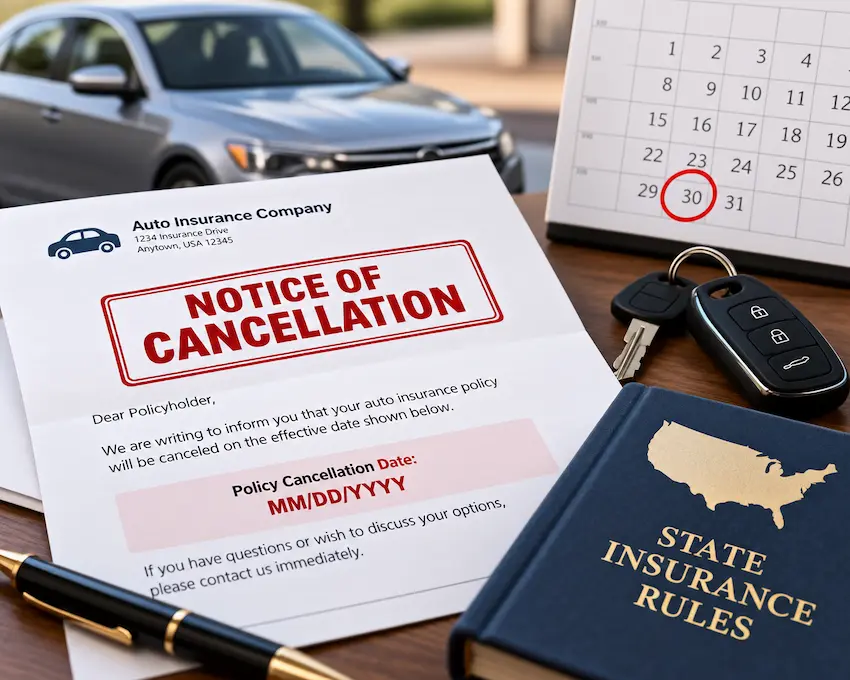
Quick answer: Cancellation ends your policy mid-term; nonrenewal just means it won’t be renewed when it expires — and the deadlines are different. A nonpayment cancellation can give you as few as 10 days, and in some states paying within that window stops the cancellation. Don’t let your coverage lapse: buy replacement insurance to start before the old policy ends.
Three immediate steps:
- Find the effective date and the reason on your notice.
- If it’s nonpayment, call today and ask what will stop the cancellation.
- Line up replacement coverage to begin no later than the effective date on your notice, so there’s no gap.
Check your deadline in 30 seconds → Jump to the deadline checker
- Canceled vs nonrenewed
- My state’s deadline
- Nonpayment
- Lapse costs
- Nobody will insure me
- Refunds
- CLUE
- Financed car
- Appeal
And there’s a rule in some states that keeps your old policy alive when the insurer sends its notice late — it’s covered below.
Cancellation & Nonrenewal Deadline Checker
Answer what’s on your notice. This tool won’t ask for your name, policy number, or any identifying details — it only works with the dates and facts you type in, and nothing is saved or sent anywhere.
Canceled vs. Nonrenewed vs. Rescinded
A cancellation ends your policy before its term is up; a nonrenewal simply means the insurer won’t offer you a new term when the current one expires; a rescission undoes the policy entirely, back to its start date, usually over a misrepresentation or fraud finding.
These three sound similar but carry very different timelines. A cancellation for nonpayment can happen with as little as 10 days’ notice in many states. A nonrenewal almost always gives you more runway — often 30 to 60 days — because the insurer isn’t cutting you off mid-term, it’s simply declining to start a new one.
| What it is | When it happens | Typical notice | Your main move |
|---|---|---|---|
| Cancellation | During the policy term | As little as 10 days for nonpayment; longer for other reasons | Find out if you can cure it or must replace coverage fast |
| Nonrenewal | At the end of the policy term | Usually 30–60 days, varies by state | Shop early; it isn’t always about your driving |
| Rescission | Retroactive, back to the policy’s start | No fixed notice window; follows a misrepresentation or fraud finding | Check whether a correction window applies in your state |
Nonrenewal is often not a verdict on you personally. Insurers sometimes pull back from an entire state or product line — see our guide on insurance companies leaving states for what that looks like and what to do.
The First 60 Days: Why a New Policy Is Different
Many states give insurers wide latitude to cancel a brand-new policy for almost any reason during an early underwriting window — often the first 60 days, though the exact window varies by state.
During this period, the insurer is still verifying what it was told on the application: your driving record, who lives in your household, how the car is used, and whether the rating is accurate. Texas, for example, allows cancellation in the first 60 days of a new policy for nearly any reason, as long as it isn’t illegal or discriminatory. After that window, the reasons narrow to a specific list.
If your notice says your policy is new, check the deadline checker above — it flags when the first-60-days window likely applies to your situation.
How Much Notice Your Insurer Must Give
The required notice period depends on the reason, not just the state — nonpayment is almost always the shortest.
Treating “30 days” as a universal rule is the single most common mistake people make when they get a cancellation notice. In reality, a cancellation for nonpayment of premium is frequently the shortest notice period a state allows — often 10 days, sometimes less. A nonrenewal at the end of your term is usually given much more lead time.
California is a useful illustration. Under Insurance Code § 662, a mid-term cancellation generally needs at least 20 days’ notice, but a cancellation for nonpayment only needs 10 days — and critically, that cancellation only takes effect if you haven’t paid what you owe by the end of those 10 days. Under § 663, nonrenewal needs at least 30 days’ notice (or a renewal offer at least 20 days out), and if the insurer gives neither, your current policy stays in force, unchanged, for another 30 days from whenever the late notice finally goes out.
Texas works differently but tells the same basic story: nonrenewal needs at least 60 days’ notice, a mid-term cancellation needs 10 days, and any unearned premium must be refunded within 15 days of cancellation, per the Texas Department of Insurance.
Your state’s exact numbers are in the state-by-state table below.
State-by-State Notice Rules
Here’s what each reason requires in your state, sourced from the state’s own insurance code or department of insurance, with the date we last checked it.
We verified the figures below directly against official state codes or department-of-insurance pages — 10 states and the District of Columbia so far. For the other 41 states, we say so plainly rather than guess — use the NAIC directory of state insurance departments to reach your regulator directly. We’re continuing to add states; check the “last updated” date at the bottom of this page.
Arizona
Cancellation (nonpayment): No separate notice window beyond a 7-day grace period; cancellation is effective the date the notice is mailed, and you have 10 days after that to file a complaint with the Department of Insurance.
Cancellation (other reasons): At least 10 days.
Nonrenewal: At least 45 days. (A commonly repeated figure of “30 days” for Arizona is out of date — the statute was amended years ago.)
Refund rule: Two different timelines apply. As the general rule, the unearned-premium refund must go out together with, or no later than, the notice itself — at least 10 days before the effective date. The exception: if an affiliate of the insurer collects and remits your premium on the insurer’s behalf, the refund instead goes out within 10 days after the cancellation or nonrenewal takes effect.
Source: Arizona Revised Statutes §§ 20-1632, 20-1632.01. Verified: Oct. 10, 2026.
California
Cancellation (nonpayment): At least 10 days, and the cancellation only takes effect if you haven’t paid by the end of that window.
Cancellation (other reasons): At least 20 days.
Nonrenewal: At least 30 days (or a renewal offer at least 20 days out). If the insurer gives neither, your policy continues unchanged for 30 more days from whenever the late notice goes out.
First-60-days rule: Not a blanket rule under §§ 662–663; cancellation reasons and notice periods apply from day one, though other underwriting provisions may apply.
Source: California Insurance Code §§ 662, 663. Verified: Oct. 10, 2026.
District of Columbia
Cancellation (nonpayment): At least 15 days from when you receive the notice. Note: this shorter nonpayment provision was written to take effect only once DC’s DMV certified its systems were ready to support it (no later than October 1, 2002) — confirm with DC’s Department of Insurance, Securities and Banking (DISB) that it’s currently in force before relying on the 15-day figure specifically.
Cancellation (other reasons): At least 30 days.
Nonrenewal: At least 30 days before the end of the policy period.
Source: D.C. Code § 31-2409. Verified: Oct. 10, 2026.
Illinois
Cancellation (nonpayment): At least 10 days.
Cancellation (other reasons) / Nonrenewal, currently in force: At least 30 days, under the currently codified text of 215 ILCS 5/143.17.
Change already enacted, not yet in force: Illinois Public Act 104-534 has been signed into law and extends nonrenewal notice to 60 days and adds a formal first-60-days cancellation rule — but those specific changes to 215 ILCS 5/143.16 and 143.17 don’t take effect until January 1, 2027. Until then, the 30-day/10-day rule above is what’s actually enforceable. If your notice is dated on or after January 1, 2027, confirm the new 60-day figure with the Illinois Department of Insurance.
Source: 215 ILCS 5/143.15, 143.17 (current); Public Act 104-534 (eff. Jan. 1, 2027). Verified: Oct. 10, 2026.
Kentucky
Cancellation (nonpayment): At least 14 days.
Cancellation (other reasons): At least 20 days.
Nonrenewal: At least 75 days. (A commonly repeated figure of “70 days” is incorrect — the Kentucky Department of Insurance’s own consumer guidance and KRS 304.20-040 both say 75.)
Source: KRS 304.20-040; Kentucky Department of Insurance consumer guidance. Verified: Oct. 10, 2026.
Maryland
Cancellation (nonpayment): At least 10 days.
Cancellation (other reasons), after the first 45 days: At least 45 days.
Nonrenewal: At least 45 days.
First-45-days rule: Policies in effect 45 days or less fall under a separate underwriting provision rather than the standard notice rule.
Source: Md. Code, Insurance §§ 27-602, 27-609. Verified: Oct. 10, 2026.
Massachusetts
Cancellation: At least 20 days before the proposed effective date, under the state’s motor vehicle cancellation regulation.
First-90-days rule: An insurer may cancel a new policy up to 90 days after it takes effect for a limited set of reasons specific to Massachusetts law.
Nonrenewal: Governed by the same regulation; confirm the exact day count for your situation with the Massachusetts Division of Insurance, since it can depend on the specific reason.
Source: 211 CMR 97.00, citing M.G.L. c. 175, § 193R. Verified: Oct. 10, 2026.
Mississippi
Cancellation (nonpayment): At least 10 days.
Cancellation (other reasons): At least 30 days.
Nonrenewal: At least 30 days.
Source: Miss. Code Ann. §§ 83-11-5, 83-11-7. Verified: Oct. 10, 2026.
Texas
Cancellation (nonpayment or other reasons): At least 10 days.
Nonrenewal: At least 60 days.
First-60-days rule: An insurer may cancel for almost any reason within the first 60 days of a new policy; after that, only specific listed reasons apply.
Refund rule: Unearned premium refunded within 15 days of cancellation.
Last-resort plan: The Texas Automobile Insurance Plan Association (TAIPA) can provide minimum coverage once two insurers have turned you down.
Source: Texas Department of Insurance, “Was your auto insurance not renewed or canceled?” Verified: Oct. 10, 2026.
Wisconsin
Cancellation (any reason, including new policies under 60 days): At least 10 days.
Nonrenewal: At least 60 days.
Important nuance: That 10-day window applies to the specific grounds Wisconsin law allows for a mid-term cancellation — nonpayment is one of them, but not every reason an insurer writes on a notice is automatically valid grounds, especially after a policy’s first 60 days. If your notice doesn’t fit a permitted ground, ask your insurer which one applies, or raise it with the Office of the Commissioner of Insurance.
Source: Wis. Stat. § 631.36; Wisconsin Office of the Commissioner of Insurance consumer fact sheet. Verified: Oct. 10, 2026.
All other states
We haven’t yet confirmed this state’s exact figures directly against its own code or department of insurance for this guide. Rather than guess, we’re telling you plainly: check your state’s department of insurance using the NAIC directory, or call and ask directly whether your notice meets the legal minimum.
As a general pattern across the states we have confirmed, nonpayment cancellation notices run from about 10 to 15 days, other-reason cancellations from about 10 to 45 days, and nonrenewal notices from about 30 to 75 days — but don’t rely on that range for your specific state. Use your state’s own number.
| State | Cancellation — nonpayment | Cancellation — other reasons | Nonrenewal | First-X-days rule | Refund rule | Official source | Verified |
|---|---|---|---|---|---|---|---|
| Arizona | Effective on mailing date, after 7-day grace period | 10 days | 45 days | None found | General: 10 days before effective date. Affiliate-collected exception: 10 days after. | A.R.S. §§ 20-1632, 20-1632.01 | Oct. 10, 2026 |
| California | 10 days (cancellation voided if you pay in time) | 20 days | 30 days | None under §§ 662–663 | Not specified in §§ 662–663 | Cal. Ins. Code §§ 662, 663 | Oct. 10, 2026 |
| District of Columbia | 15 days from receipt (contingent provision — confirm in force with DISB) | 30 days | 30 days | None found | Not specified here | D.C. Code § 31-2409 | Oct. 10, 2026 |
| Illinois | 10 days (currently in force) | 30 days (currently in force) | 30 days now; 60 days starting Jan. 1, 2027 under enacted P.A. 104-534 | None currently; formal rule starts Jan. 1, 2027 | Not specified here | 215 ILCS 5/143.15, 143.17; P.A. 104-534 | Oct. 10, 2026 |
| Kentucky | 14 days | 20 days | 75 days | None found | Not specified here | KRS 304.20-040 | Oct. 10, 2026 |
| Maryland | 10 days | 45 days | 45 days | First 45 days separately governed | Not specified here | Md. Code, Ins. §§ 27-602, 27-609 | Oct. 10, 2026 |
| Massachusetts | 20 days (same regulation) | 20 days | Confirm with MA DOI | Up to 90 days for specified reasons | Not specified here | 211 CMR 97.00 | Oct. 10, 2026 |
| Mississippi | 10 days | 30 days | 30 days | None found | Not specified here | Miss. Code §§ 83-11-5, 83-11-7 | Oct. 10, 2026 |
| Texas | 10 days | 10 days | 60 days | First 60 days, nearly any reason | 15 days | Texas Dept. of Insurance | Oct. 10, 2026 |
| Wisconsin | 10 days | 10 days, for a permitted ground only | 60 days | Same 10-day rule applies under 60 days; permitted grounds still apply | Not specified here | Wis. Stat. § 631.36 | Oct. 10, 2026 |
| All other states | Check your state’s department of insurance — NAIC directory | ||||||
Why Insurers Cancel or Nonrenew
The reason on your notice determines both your options and the clock you’re working against.
- Nonpayment — the most common and often the fastest-moving. See the nonpayment section below.
- Claims history — frequency matters more than any single claim; see Claim or Pay Out of Pocket? for how claims factor into renewal decisions.
- Tickets or a license issue — yours or a household member’s, including a suspended or revoked license.
- A household driver — someone who lives with you or regularly drives your car can trigger nonrenewal even if you’ve never been in an accident; see Friend Crashed My Car.
- Misrepresentation on the original application — covered in detail below.
- Vehicle changes that affect rating, like adding a high-performance car or changing how it’s used.
- Market withdrawal — the insurer is leaving your state or product line entirely; see Insurance Companies Leaving States.
Two related factors worth understanding: how your rates get set in the first place (How Car Insurance Rates Are Calculated) and how your credit history factors in (Credit Score and Car Insurance).
If the Reason Is Misrepresentation
Misrepresentation cancellations hinge on whether the mistake was negligent or intentional — and some states let you fix a negligent one.
In California, for example, an insured who negligently misrepresented certain information on the application may be able to avoid cancellation by providing the corrected information within 20 days of the cancellation notice and paying any resulting difference in premium. This is a narrow, state-specific rule — it generally doesn’t apply to intentional fraud, and the exact scope varies, so confirm the details with your state’s department of insurance or an attorney if a lot is riding on it.
Rescission is the more serious outcome: the insurer treats the policy as if it never existed, which matters enormously if a claim happened in between. Rules and standards for rescission vary significantly by state, and this is an area where talking to a licensed professional is worth the time.
Can You Get Reinstated?
Reinstatement means your same policy picks back up, usually after a nonpayment cancellation — but it’s something to ask for, not something you’re automatically entitled to.
Some insurers will reinstate a policy within a set window after a nonpayment cancellation, sometimes with a gap in coverage for the days in between even if the policy itself is restored. Ask your insurer directly: what’s the reinstatement window, is there a fee, and will there be any gap days on your record. Treat reinstatement as something to request, not a guaranteed right — it depends on your insurer’s own rules and your state’s law.
If reinstatement isn’t available or the gap is too long, a fresh policy with a new carrier, timed to start before the old one ends, is usually the safer path.
If the Reason Is Nonpayment
Nonpayment cancellations move the fastest, but in some states, paying what you owe before the deadline stops the cancellation entirely.
California is the clearest example: a cancellation for nonpayment only takes effect if you haven’t cured the unpaid premium by the end of the 10-day notice period. Not every state works this way, so the first call you make should ask your insurer directly: “If I pay the balance today, does this cancellation go away?”
Nonpayment can mean 10 days, not 30. Don’t assume you have more time than your notice actually says.
If curing isn’t available, or you’ve already missed the window, ask about reinstatement (above) or move straight to shopping for a new policy, timed to start the day your old one ends.
What to Do in the First 24 Hours
Your first moves depend on the reason, but a few apply no matter what’s on the notice.
Today, whatever the reason:
- Photograph or save the notice.
- Write down the effective date and the stated reason.
- Call the insurer and ask exactly what would stop the cancellation.
- Ask for the unearned-premium refund rule that applies to you.
- Don’t cancel anything yourself before replacement coverage is bound.
FIXABLE TODAY covers a nonpayment cure, a reinstatement offer, or correcting bad information within your state’s window.
SHOP NOW covers a nonrenewal, a claims-history decision, or your insurer leaving the market — none of these are typically something you can undo, so the clock is about replacing coverage, not fixing the old policy.
ESCALATE covers a notice with no stated reason, a notice period that looks shorter than your state allows, or anything that looks like it might not follow the rules.
Avoiding a Lapse (and What a Lapse Costs)
The single most protective move is simple: set your new policy to start no later than the effective date (cancellation) or expiration date (nonrenewal) printed on your notice, so there’s no day where you’re uncovered.
A lapse in coverage — even a short one — can affect how insurers price you going forward, and in many states can trigger separate registration, license, or reinstatement-fee consequences through the DMV, independent of anything your insurer does. Exactly how much a lapse affects your quotes isn’t something we can state as a single national number; it varies by insurer, by state, and by how long the gap was, and a lapse during active shopping (comparing quotes before your policy ends) isn’t the same thing as actually driving uninsured.
See How Car Insurance Rates Are Calculated for the mechanics, and How to Switch Car Insurance for how to time a switch so there’s no gap at all.
Buy the new policy to start no later than the effective or expiration date on your notice — not after.
If No One Will Insure You
If the standard market turns you down, a nonstandard carrier or your state’s last-resort plan is the next step — not driving uninsured.
An independent agent (see Car Insurance Agents) can shop multiple nonstandard carriers at once, which is often faster than approaching them one at a time yourself. If the standard and nonstandard markets both decline you, most states run a last-resort plan under names like an assigned-risk plan or automobile insurance plan; Texas calls its version TAIPA, and it’s available once two insurers have turned you down. Use the NAIC directory to find your state’s plan if it isn’t listed in the table above.
An SR-22 is not automatic just because a policy was canceled or nonrenewed — whether you need one depends on your state and the specific reason (commonly a DUI or a serious violation). See Car Insurance After a DUI for that context, and Cheap Car Insurance Quotes and How to Lower Car Insurance once you’re shopping.
Named Driver Exclusions
Excluding a household driver by signed endorsement can sometimes save an otherwise-doomed policy — but it comes at a real cost.
Many states let you exclude a specific household member from your policy if that person is the reason an insurer wants to cancel or nonrenew you — a suspended license or a poor driving record, for example. The tradeoff is steep: the excluded driver typically has no coverage at all if they drive the car, even in an emergency. Availability of this option varies by state, so confirm it’s offered before counting on it. See Friend Crashed My Car for more on how permissive-driver situations play out.
If Your Insurer Is Leaving Your State
A nonrenewal tied to market withdrawal isn’t about your driving record — it’s a business decision, and it’s worth knowing the difference.
When an insurer pulls back from a state or a line of business, every policyholder in that book gets nonrenewed, regardless of claims history. The notice should say so; if it doesn’t, ask. Our full guide, Insurance Companies Leaving States, covers the regulatory side of a market withdrawal and what it means for your timeline.
Financed or Leased Cars
If your car is financed and your coverage lapses, your lender can buy a policy that protects the lender — not you — and bill you for it.
This is usually called force-placed or lender-placed insurance. It’s built to protect the lender’s financial interest in the vehicle, it’s typically more expensive than a normal policy, and it usually does not include liability coverage for you. If your car is financed or leased, notify your lender as soon as you get a cancellation or nonrenewal notice, and treat finding replacement coverage as more urgent, not less. See Minimum Car Insurance by State and Full Coverage vs. Liability for what your lender likely requires you to carry.
Your Refund, and What’s on Your Record
You’re usually owed a refund of the premium you already paid for coverage you won’t use, and a cancellation itself does not appear as a mark against you the way a claim does.
Unearned premium is the part of your payment that covers time after your policy ends. Some states set a hard deadline for the refund — Texas requires it within 15 days of cancellation — while others don’t specify one in the sections we reviewed. Ask your insurer directly what their refund timeline is.
A CLUE report (Comprehensive Loss Underwriting Exchange), compiled by LexisNexis, is a different thing entirely from your cancellation history. It’s a record of your personal auto and property claims — generally covering up to seven years — including claims that were paid, denied, or had a file opened. Insurers are advised not to report a simple coverage question that never became a claim. A cancellation or nonrenewal is not, by itself, a CLUE entry — what shows up is the claims behind it, if any.
Under the Fair Credit Reporting Act, you’re entitled to one free copy of your CLUE report a year. You can dispute anything inaccurate, and if a claim is being misread, you can add an explanatory statement that will appear on future reports pulled by insurers.
| Item | On a CLUE report? |
|---|---|
| Paid claims | Yes |
| Denied claims | Yes |
| Opened claim files | Yes |
| A coverage question with no claim filed | Generally no |
| Policy cancellations | No |
| Traffic tickets | No — that’s your motor vehicle record, a separate system |
Appealing and Filing a Complaint
If a notice looks wrong — too short, no stated reason, or simply confusing — you can ask for the reason in writing and, if needed, take it to your state regulator.
Several states require insurers to provide a reason if you ask in writing, and some set a deadline for that request relative to the effective date (California’s window is at least 15 days before the effective date, for example). If you believe your insurer broke the rules — a notice period shorter than your state’s minimum, or no stated reason when one is required — keep the envelope and postmark, note the date you actually received it, and file a complaint with your state’s department of insurance through the NAIC directory.
A complaint can prompt a review of whether the insurer followed the law; it generally can’t force an insurer to keep insuring you if they’re within their rights to decline. That’s why lining up replacement coverage stays the priority even while you’re appealing.
Checklists
Before coverage ends:
- Get quotes — an independent agent can place difficult risks.
- Set the new policy’s start date to no later than the effective or expiration date on your current notice.
- Don’t cancel the old policy early.
- Tell your lender if the car is financed or leased.
- Keep proof of continuous coverage.
If everyone declines you:
- Ask about your state’s last-resort plan.
- Ask whether excluding a household driver by endorsement would make you insurable — remembering that person then has no coverage at all.
- Ask whether a higher deductible or lower limits helps.
Records and money:
- Request your free annual CLUE report.
- Dispute errors and add an explanatory statement if needed.
- Confirm your unearned-premium refund.
- Check whether your state requires you to surrender plates or file proof of financial responsibility after a lapse.
If the notice looks wrong:
- Keep the envelope and postmark.
- Note the date you actually received it.
- File a complaint with your state’s department of insurance.
FAQ
My car insurance was canceled — what do I do first?
Read the notice for the effective date and the stated reason, then call your insurer and ask what, specifically, would stop the cancellation.
What’s the difference between cancellation and nonrenewal?
Cancellation ends your policy mid-term; nonrenewal means the insurer won’t offer a new term when the current one expires. Notice periods differ, and nonrenewal usually gives you more time.
How many days’ notice must my insurer give?
It depends on your state and the reason — nonpayment is usually the shortest. Check the state table above.
Can my policy be canceled without notice?
No — every state we reviewed requires some form of written notice before a cancellation takes effect, though the required lead time varies.
If I pay what I owe, does the cancellation stop?
In some states, yes — California is one. Ask your insurer directly whether paying within the notice window stops your specific cancellation.
Can they cancel me in the first 60 days for any reason?
In some states, yes, within an early underwriting window — Texas is explicit about this. The exact window and rules vary by state.
Does a nonrenewal mean I’m uninsured right now?
No — your current policy stays in force until its stated expiration date. The urgency is having new coverage ready before that date.
Does nonrenewal mean I’m a bad driver?
Not necessarily. Insurers also nonrenew entire books of business when they exit a state or change their underwriting appetite.
What happens if I’m uninsured for one day?
Driving uninsured, even briefly, risks fines, registration or license penalties in many states, and leaves you financially exposed if something happens. Don’t let the gap occur — time your new policy to start before the old one ends.
Will a lapse raise my rates?
It can affect future quotes, but by how much varies by insurer, state, and the length of the gap — there’s no single reliable national figure to quote.
Can I get my policy reinstated?
Sometimes, within a window your insurer sets — ask directly, and ask whether any gap days would remain on your record even if reinstated.
Can I appeal or complain?
Yes — many states let you request the specific reason in writing, and you can file a complaint with your state’s department of insurance if you believe the rules weren’t followed.
What if no company will insure me?
Ask an independent agent about nonstandard carriers, and ask about your state’s last-resort or assigned-risk plan.
Do cancellations show up on my CLUE report?
No. CLUE tracks claims — paid, denied, or opened — not cancellations or nonrenewals themselves.
How do I get and fix my CLUE report?
Request your free annual copy from LexisNexis under the Fair Credit Reporting Act, dispute anything inaccurate, and add an explanatory statement if a claim is being misread.
Can they cancel me because of someone in my household?
Yes — a household member’s suspended or revoked license, for example, is a recognized reason for cancellation or nonrenewal in several states, including Texas.
Can I exclude a household driver?
In many states, yes, by signed endorsement — but that person then has no coverage at all if they drive the car.
What happens to my financed car?
Notify your lender immediately. If coverage lapses, the lender can force-place insurance that protects their interest, not yours, and bill you for it.
Do I get a refund?
Usually, yes — for unearned premium on the time you won’t be covered. Some states set a refund deadline; Texas requires 15 days.
Do I need an SR-22 after a lapse?
Not automatically. It depends on your state and the specific reason, commonly a DUI or serious violation — not every cancellation or nonrenewal triggers one.
This is general information, not legal or insurance advice. State rules above were verified on Oct. 10, 2026 from the official sources cited in each row; your notice and your state’s law control. AdvoraHQ doesn’t sell insurance or receive quote referrals.
— re-verify state rows every 6 months.

Daniel Hayes is the founder and sole researcher at AdvoraHQ. He covers U.S. personal finance, insurance, and consumer law — working directly from IRS publications, federal and state statutes, court opinions, and SEC filings rather than secondary summaries. His focus is the gap between what readers think they know and what the source documents actually say. Daniel is not a licensed attorney, CPA, or financial advisor; his articles are educational and not personalized advice. Reach him at Daniel.Hayes@advorahq.com.
