
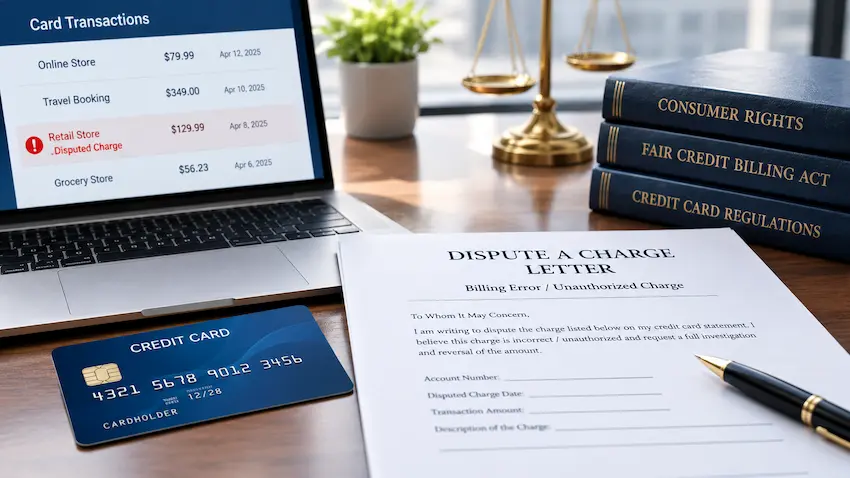
Quick answer: Tapping “dispute” in your card’s app starts a process. Sending a written notice is what triggers your full federal protections — and it has to reach your issuer’s billing inquiries address within 60 days of the day they sent the first statement showing the charge. Do both.
- You don’t have to pay the disputed amount.
- They can’t report you late over it.
- They can’t close or restrict your account for disputing in good faith.
Which route fits your charge? Jump to the route guide →
Keep reading for the rule that stops autopay from pulling the disputed amount out of your bank account while your dispute is open.
Which Dispute Route Fits Your Charge?
Answer a few questions and get a plain-language read on your route, your deadline, and which letter to send.
What Legally Counts as a Billing Error
A billing error is one of seven specific problems defined by federal regulation — not just “any charge I don’t like.”
Regulation Z, at 12 CFR § 1026.13(a), defines “billing error” for purposes of your dispute rights. If your situation fits one of the seven, you have the right to send a billing error notice and get the protections covered throughout this guide.
- 1. A charge made without authorization — no actual, implied, or apparent authority from you. (This covers unauthorized use; see the dedicated section below.)
- 2. A charge that isn’t properly identified on your statement.
- 3. Property or services you didn’t accept, or that weren’t delivered as agreed.
- 4. A payment or credit the creditor failed to apply correctly.
- 5. A computational or accounting mistake by the creditor.
- 6. A charge for which you’ve asked for additional clarification, including documentary evidence.
- 7. Failure to mail or deliver your statement to your last known address, if you gave that address in writing at least 20 days before the billing cycle ended.
| What happened | Is it a billing error? | What to send |
|---|---|---|
| I didn’t make or authorize this charge | Yes — §1026.13(a)(1) | Letter 2 (Unauthorized Use) |
| The amount on my statement is wrong | Yes — §1026.13(a)(5) | Letter 1 (Billing Error Notice) |
| I was charged twice for the same thing | Yes — §1026.13(a)(2)/(a)(5) | Letter 1 |
| A payment or credit I made isn’t showing up | Yes — §1026.13(a)(4) | Letter 1 |
| An item never arrived, or wasn’t as agreed | Yes — §1026.13(a)(3) | Letter 1, and possibly Letter 3 |
| I just don’t like something I received as agreed | No — not a billing error | Contact the merchant directly; see the three-tier note below |
| I want an itemized receipt or documentation | Yes — §1026.13(a)(6) | Letter 1 |
| My statement never arrived (address given in writing 20+ days ahead) | Yes — §1026.13(a)(7) | Letter 1 |
The 60-Day Clock — and Where It Starts
Your 60 days start on the day your issuer sent the statement that first shows the charge, not the day you bought something or spotted the problem.
Under 12 CFR § 1026.13(b), your written notice must be received at the address disclosed for billing inquiries no later than 60 days after the creditor transmitted the first periodic statement reflecting the error.
The notice must be written, must identify your name and account number, and should state your belief, your reasons, and the type, date, and amount of the error.
Filing in the app is fast and worth doing for speed. But to lock in your full federal protections, also confirm a written notice reaches the billing inquiries address printed on your statement — many issuers’ online dispute forms satisfy “written,” but check.
What You Don’t Have to Pay While It’s Pending
From the moment your written notice arrives until the dispute is resolved, you don’t have to pay the disputed amount — and your issuer has to follow a specific set of rules.
- FEDERAL RIGHT
You don’t have to pay the disputed amount or related finance or other charges, and the creditor may not try to collect it. (§1026.13(d)(1)) - FEDERAL RIGHT
Autopay: if you’re enrolled in your issuer’s automatic payment plan from a deposit account, they must not deduct the disputed amount, or related charges, if your notice arrives any time up to 3 business days before the scheduled payment date. (§1026.13(d)(1)) - FEDERAL RIGHT
No adverse credit report — and no threat of one — because the disputed amount went unpaid. (§1026.13(d)(2)) - FEDERAL RIGHT
No accelerating your balance, and no closing or restricting your account, solely because you exercised this right in good faith. A creditor that doesn’t comply can face a forfeiture penalty under 15 U.S.C. § 1666(e). (§1026.13(d)(3))
What the creditor may still do while your dispute is open:
- Collect the undisputed portion of your bill.
- Deduct the disputed amount from your available credit limit.
- Show the disputed amount on your statement — as long as it also states that paying it isn’t required yet. (§1026.13(d)(4))
The Investigation Timeline
Your issuer has 30 days to acknowledge your notice and up to two billing cycles — never more than 90 days — to finish investigating.
Under 12 CFR § 1026.13(c), the creditor must mail or deliver written acknowledgment within 30 days of receiving your notice (unless it has already resolved the dispute within that window), and must complete its investigation within two complete billing cycles, but never later than 90 days after receiving your notice.
| Step | Deadline | Source |
|---|---|---|
| Your written notice | Must arrive within 60 days of the date the statement was sent | §1026.13(b) |
| Acknowledgment | Within 30 days of receipt | §1026.13(c)(1) |
| Resolution | Two complete billing cycles, never more than 90 days | §1026.13(c)(2) |
| Payment window after a denial | Your disclosed grace period, or 10 days — whichever is longer | §1026.13(g)(2)–(3) |
| Refund credit | 7 business days (merchant to issuer), then 3 business days (issuer to your account) | §1026.12(e) |
When the Merchant Won’t Fix It: Claims and Defenses
If a merchant won’t make a purchase right, you may be able to withhold payment and raise the same claims against your card issuer — this is the real “$50 and 100 miles” rule, and six exceptions can erase its conditions entirely.
Under 12 CFR § 1026.12(c)(1), when a merchant fails to satisfactorily resolve a dispute about property or services you bought with the card, you may assert against the card issuer all claims and defenses (other than tort claims) arising from that transaction, and withhold payment up to the amount of credit outstanding for the purchase, plus related charges.
While that amount is withheld, the issuer cannot report it as delinquent until the dispute is settled or a judgment is rendered. (§1026.12(c)(2))
Two conditions normally apply (§1026.12(c)(3)(i)):
- You made a good-faith attempt to resolve the dispute with the merchant first.
- The amount of credit extended exceeds $50, and the purchase happened in your state or within 100 miles of your current designated address.
But those two conditions disappear entirely in six situations — because in each one, the merchant and the issuer are close enough that the $50/100-mile limits don’t serve their purpose. (§1026.12(c)(3)(ii))
| Situation | Why the conditions drop away |
|---|---|
| The merchant is the card issuer itself | No independent third party to protect |
| The merchant is controlled by the card issuer | Same reason — common ownership |
| The merchant is under common control with the issuer (a third party controls both) | Same reason — common ownership |
| The merchant controls the card issuer | Same reason — common ownership |
| The merchant is a franchised dealer in the issuer’s products or services | Close business relationship with the issuer |
| The order was obtained through a mail solicitation the issuer made or took part in | The issuer helped generate the transaction |
Chargebacks Are Policy, Not Law
A “chargeback” is how your issuer reverses a charge through the card network’s own rulebook — useful, but it’s private policy, not a federal right, so its timelines and odds of success vary.
ISSUER OR NETWORK POLICY
The rights covered above — billing errors and claims and defenses — come from federal regulation and apply the same way at every issuer. A network chargeback is different: it runs on rules the card network publishes and the issuer administers, reason codes differ by situation, and windows and outcomes can vary by network and by issuer.
A chargeback can still be your best or only option — for example, outside the legal 60-day window, or for a situation (like a subscription dispute or simple dissatisfaction) that a billing error notice doesn’t cleanly cover. Ask your issuer what reason codes and timelines apply to your situation.
| Where it comes from | When it applies | Deadline | What you can withhold | Credit-reporting protection |
|---|---|---|---|---|
| Billing error — federal law, §1026.13 | Any of the seven billing-error types | Notice must arrive within 60 days of the statement date | The disputed amount and related charges | No delinquency reporting or threat over the disputed amount while pending |
| Claims and defenses — federal law, §1026.12(c) | Merchant dispute the merchant won’t resolve (plus the good-faith and $50/100-mile conditions, unless an exception applies) | No fixed federal deadline; raise it while you still hold the claim against the merchant | Up to the credit outstanding for that purchase plus related charges | No delinquency reporting on that amount until settled or judgment is rendered |
| Network chargeback — network/issuer policy | Varies by card network and reason code | Set by the network, not by federal law | Set by the network’s process | Not a federal protection — ask your issuer what applies |
Subscriptions, Free Trials, and Charges After Cancellation
A charge that lands after you canceled is usually a billing error, but good documentation is what makes the dispute easy to win.
FEDERAL RIGHT — if a charge posted after you canceled and the merchant had no authority to bill you further, that’s typically an unauthorized charge — a billing error under §1026.13(a)(1).
Before you file, gather your cancellation confirmation (email, screenshot, or confirmation number) and the date you canceled. If the merchant disputes that you canceled in time and won’t fix it, the claims-and-defenses route (above) may also apply once you’ve made a good-faith attempt to resolve it with them.
NOT A DISPUTE — if you simply forgot to cancel before a renewal and were charged as agreed under the terms you accepted, that’s not a billing error. Cancel going forward and ask the merchant, as a courtesy, whether they’ll refund the renewal.
See also How Credit Card Interest Works for how related finance charges are treated while a dispute is pending.
Where’s My Refund?
A merchant return has its own federal clock, separate from the dispute process.
Under 12 CFR § 1026.12(e), once a merchant accepts your return or forgives a debt for services, it must transmit a credit statement to your card issuer within 7 business days. The issuer then has 3 business days from receiving that credit statement to credit your account.
This applies once the merchant has already agreed to the refund — you don’t need to file a billing-error notice to get the benefit of this clock, though a billing-error notice is still the right tool if the merchant won’t agree in the first place.
If Your Dispute Is Denied
A denial isn’t the end — you’re owed an explanation, and you can keep the amount out of a delinquency report by writing again before the payment window closes.
If the creditor determines no error occurred (or a different one did), it must send you a written explanation of its reasons, and furnish copies of the documentary evidence it relied on if you ask. (§1026.13(f))
After resolution, you get your disclosed grace period, or 10 days — whichever is longer — to pay before delinquency can be reported. (§1026.13(g)(2)–(3))
The second-notice right: if, within that payment window, you send the creditor a further written notice that part of the amount is still disputed, the creditor can’t report it delinquent unless it also (i) reports the amount as in dispute, (ii) sends you the name and address of everyone it reported to, and (iii) reports the resolution to all of them afterward. (§1026.13(g)(4))
Reasserting substantially the same error after the creditor has fully complied creates no new duties for them — bring new facts, not a repeat of the same notice. (§1026.13(h))
You can also file a complaint with the CFPB if you believe your issuer didn’t follow these procedures.
Credit Card vs. Debit Card Disputes
Debit and prepaid cards run on a different federal rulebook — Regulation E, not Regulation Z — and both the deadlines and the protections change.
For transfers involving a deposit account, Regulation E’s error-resolution procedures (12 CFR § 1005.11, and § 1005.18(e) for prepaid accounts) apply instead of most of §1026.13. (§1026.13(i), §1026.12(g))
Under Regulation E, your notice can be oral or written and must reach the institution within 60 days of the statement first showing the error. The institution then has 10 business days to investigate (20 business days for transfers on a new account), and must report results within 3 business days of finishing.
If it needs more time, it can take up to 45 days (90 days for foreign-initiated, point-of-sale debit, or new-account transfers) — but only if it provisionally credits your account within 10 business days of your notice (it may withhold up to $50 of that credit if it reasonably believes the transfer was unauthorized and has met its own notice requirements under §1005.6(a)).
There’s no claims-and-defenses right under Regulation E comparable to §1026.12(c) for credit cards. For bank-transfer scams specifically, see Zelle Scams.
One More Protection: No Offsets
The issuer can’t raid your deposits to cover card debt, with narrow exceptions.
Under 12 CFR § 1026.12(d), a card issuer may not offset your card debt against funds you hold on deposit with it. This doesn’t affect the issuer’s ability to get or enforce a consensual security interest, attach or levy funds, or get or enforce a court order — if those routes are generally available to creditors under state or federal law.
It also doesn’t prohibit a plan you authorized in writing letting the issuer periodically deduct your card debt from a deposit account — subject to the pending-dispute limits in §1026.13(d)(1) covered above.
Letters and Checklists
Copy whichever letter matches your situation, fill in the brackets, and send it to the billing inquiries address on your statement.
Letter 1 — Billing Error Notice
[Your Name]
[Your Address]
[Date]

[Card Issuer Name]
[Billing Inquiries Address — from your statement, not the payment address]

Re: Billing Error Notice — Account Number [Your Account Number]

I am writing to notify you of a billing error on the above account under 12 CFR § 1026.13.

Type of error: [describe the error]
Date of the error: [transaction or statement date]
Amount in dispute: $[amount]

[One or two sentences explaining why you believe this is an error.]

Please investigate and send me documentary evidence supporting this charge.

Under 12 CFR § 1026.13(d), I understand I am not required to pay the disputed amount, or any related finance or other charges, while this investigation is pending, and that you may not report this account as delinquent because of this unpaid amount.

Please acknowledge receipt of this notice and keep me informed of your findings.

Sincerely,
[Your Name]
[Account Number]
Letter 2 — Unauthorized Use
[Your Name]
[Your Address]
[Date]

[Card Issuer Name]
[Billing Inquiries Address]

Re: Notice of Unauthorized Use — Account Number [Your Account Number]

I am writing to report an unauthorized transaction on my account.

Transaction details: [merchant name, date, amount]
Date I discovered it: [date]
Date I am reporting it to you: [today's date]

I did not make this transaction and did not give anyone actual, implied, or apparent authority to make it. I received no benefit from it.

Under 12 CFR § 1026.12(b), I understand my liability for unauthorized use is limited to the lesser of $50 or the amount obtained before this notification.

Please confirm in writing that you have received this report, including the date and time of my notification, and let me know what additional information you need.

Sincerely,
[Your Name]
[Account Number]
Letter 3 — Claims and Defenses
[Your Name]
[Your Address]
[Date]

[Card Issuer Name]
[Billing Inquiries Address]

Re: Assertion of Claims and Defenses — Account Number [Your Account Number]

I am writing under 12 CFR § 1026.12(c) to assert a claim regarding a purchase made with this account that the merchant has failed to resolve satisfactorily.

Merchant: [merchant name]
Transaction date and amount: [date], $[amount]
Description of the problem: [what went wrong]

Good-faith attempt to resolve with the merchant: [dates and method of contact, and their response]

[This purchase exceeded $50 and occurred in my state / within 100 miles of my designated address.] OR [The following exception applies: explain — e.g., the merchant is a franchised dealer in the issuer's products.]

I am withholding payment of $[amount] — the credit outstanding for this purchase and related charges — pending resolution.

Please confirm receipt and let me know what additional documentation you need.

Sincerely,
[Your Name]
[Account Number]
Before You Send
- Keep a copy of the letter for your records.
- Use trackable mail so you can prove delivery.
- Note the delivery date — it matters for every deadline above.
- Also file in the app or by phone for speed, in addition to the written notice.
- Keep paying the undisputed portion of your balance.
If Denied
- Request the written explanation and the documentary evidence.
- Send a second written notice within the payment window if you still dispute it.
- Ask for the names and addresses of anyone they report to.
- Consider a CFPB complaint.
NOT A DISPUTE — never use these letters to dispute a charge you authorized and received as agreed. That’s not what this process is for, and issuers can and do deny disputes filed this way.
FAQ
How long do I have to dispute a charge?
Your written notice must be received at the billing inquiries address within 60 days of the date your issuer sent the statement that first showed the error.
When exactly does the 60 days start?
From the date the creditor transmitted the first statement reflecting the error — not your purchase date and not the date you noticed it.
Is calling enough, or do I need to write?
Call for speed, but send a written notice too — it’s what triggers the full set of protections under §1026.13.
Where do I send the letter?
To the billing inquiries address printed on your statement, which may differ from the payment address.
Do I have to pay the charge while they investigate?
No. You don’t have to pay the disputed amount or related finance or other charges while your billing-error notice is pending.
Can they charge me interest on it?
Related finance or other charges tied to the disputed amount are also covered by the same pending-dispute protection.
Will disputing hurt my credit score?
The creditor can’t make or threaten an adverse credit report, or report the amount delinquent, because you didn’t pay a disputed amount while it’s pending.
Can they close my account for disputing?
No — not solely because you exercised this right in good faith.
Will autopay still take the money?
If you’re enrolled in your issuer’s autopay from a bank account, they must not deduct the disputed amount if your written notice arrives any time up to 3 business days before the scheduled payment date.
What is unauthorized use?
Use of your card by someone without actual, implied, or apparent authority from you, where you receive no benefit from it.
How much can I be liable for?
The lesser of $50 or the amount obtained before you notified your issuer — and less than that if your state law or card agreement says so.
Can I dispute a charge for bad service?
If the merchant won’t resolve it and you made a good-faith attempt first, the claims-and-defenses right may let you withhold payment — this is different from a billing error.
What is the $50 and 100-mile rule?
It’s a pair of conditions on the claims-and-defenses right: the purchase must exceed $50, and it must have happened in your state or within 100 miles of your address.
When does that rule not apply?
When the merchant and the card issuer are closely connected — for example, the merchant is the issuer, is controlled by or controls the issuer, shares common control with the issuer, is a franchised dealer in the issuer’s products, or got your order through a mail solicitation the issuer made or took part in.
Do I have to contact the merchant first?
For the claims-and-defenses right, yes — a good-faith attempt to resolve it with the merchant is a condition. For a straightforward billing error, it isn’t required, though it’s often still a fast first step.
What if I’m charged after canceling?
That’s usually a billing error — document your cancellation date and confirmation, then send a billing error notice.
How long should a refund take?
Once a merchant accepts a return, it has 7 business days to send the credit to your issuer, who then has 3 business days to post it to your account.
What if they say no?
You’re owed a written explanation and, if you ask, the documentary evidence behind it. You can send a further written notice within the payment window to protect against a delinquency report while you keep disputing.
Can I dispute the same charge twice?
Reasserting substantially the same error after the creditor has fully complied creates no new duties for them — bring new information if you’re raising it again.
Is a debit card dispute the same?
No — debit and prepaid cards are governed by Regulation E, with different notice and investigation timelines and no claims-and-defenses right.
This is general information, not legal advice, based on 12 CFR §§ 1026.12 and 1026.13 (Regulation Z), verified October 12, 2026. Card-network chargeback rules are private policy and change over time. Your issuer’s own disclosures control the exact billing inquiries address and procedures that apply to your account.

Daniel Hayes is the founder and sole researcher at AdvoraHQ. He covers U.S. personal finance, insurance, and consumer law — working directly from IRS publications, federal and state statutes, court opinions, and SEC filings rather than secondary summaries. His focus is the gap between what readers think they know and what the source documents actually say. Daniel is not a licensed attorney, CPA, or financial advisor; his articles are educational and not personalized advice. Reach him at Daniel.Hayes@advorahq.com.
