
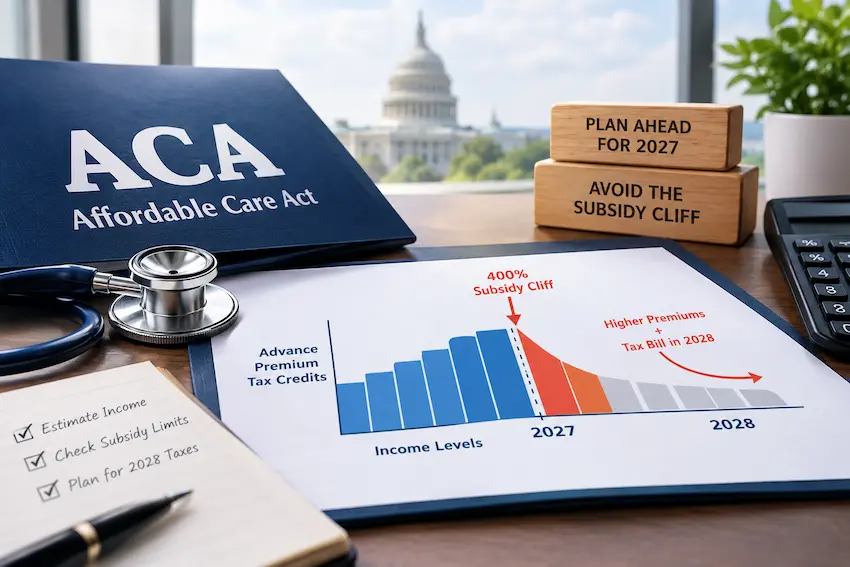
Your Marketplace subsidy is an estimate, paid to your insurer in advance. Starting with the 2026 tax year, if those advance payments turn out larger than the credit you actually earned, you repay the entire difference — the old repayment caps are gone. And because income above 400% of the federal poverty level now ends eligibility completely, a household that guesses too low can end up owing back a full year of subsidies.
- Repayment caps: eliminated
For tax year 2026 and after, any excess advance credit is repaid in full, at every income level — not just above 400%. - The 400% cliff: back
For 2026 coverage and later, household income above 400% of the federal poverty level ends subsidy eligibility entirely.
See your income buffer and what’s at risk →
Open Enrollment for 2027: November 1, 2026 – January 15, 2027. Enroll by December 15, 2026 for coverage starting January 1, 2027.
This is a planning guide, not tax advice. Free Marketplace assisters can help, and a tax professional should review anything complicated.
2027 Subsidy Risk Estimator
This tool sorts households into three tiers: LOW RISK for stable income well under the line, WATCH CLOSELY for variable or commission income anywhere near the line, and HIGH RISK for a household likely to cross 400% FPL, or facing a possible bonus, sale, or retirement withdrawal.
Enter your numbers to see your 400% threshold, your income buffer, and how much advance credit you’d be exposed to repaying.
Two Changes That Now Stack
Two separate rules changed at the same time, and together they raise the cost of a wrong income estimate more than either one alone would.
The first is about repayment. Under the tax law enacted in 2025, the IRS says "the taxpayer must repay the full amount of any excess advance payments" of the premium tax credit, and the repayment limits that used to cap how much a household owed back no longer apply, starting with tax year 2026. Before this change, repayment was capped at roughly $750 to $3,150 depending on filing status and income, for households under 400% of the poverty line. That cushion is gone for 2026 and later.
The second is about eligibility. The enhanced premium tax credits that ran from 2021 through 2025 temporarily removed the income ceiling on subsidies. Those enhancements expired December 31, 2025, which restores the earlier rule: household income above 400% of the federal poverty level ends eligibility for the credit entirely, starting with 2026 coverage.
Put the two together, and a household that estimates low on income can both lose eligibility for part of the year and owe back every dollar of advance credit it wasn't entitled to — with nothing capping the damage.
| Change | Effective | First felt on which return |
|---|---|---|
| Repayment caps on excess advance credit eliminated | Tax year 2026 and later | 2026 return, filed in 2027 |
| Enhanced premium tax credits (2021–2025 expansion) expired | December 31, 2025 | Already affecting 2026 coverage |
| 400% FPL "subsidy cliff" restored | Coverage year 2026 and later | Already affecting 2026 coverage |
| 2027 coverage reconciliation | Filed with your 2027 return | Due in 2028 |
The Risk Isn't Only the Cliff
A household that never goes near 400% of the poverty level can still owe money back.
Here's why: your advance premium tax credit is based on the income you estimate when you enroll. If your actual 2027 income comes in higher than that estimate — a strong year for your business, a bonus, a one-time sale — your allowed credit shrinks, even if you're nowhere near 400% FPL. The difference between what the Marketplace paid your insurer and what you actually qualified for is excess advance payment, and as of tax year 2026, you repay all of it.
In plain terms: a household that estimated $50,000 and received advance credit based on that figure all year, but whose actual income comes in at $62,000 — still comfortably under most 400% thresholds — will have a smaller allowed credit than what was paid out, and will owe the difference in full when filing. The cliff is a separate, additional risk that applies to a different group: households that cross 400%.
The 400% Line for 2027
For 2027 coverage, eligibility ends when household income is above 400% of the federal poverty level — not at exactly 400%.
2027 Marketplace coverage uses the 2026 HHS poverty guidelines, published January 15, 2026, because federal rules apply the most recently published guidelines as of the start of open enrollment. Alaska and Hawaii use separate, higher guidelines than the other 48 states and DC.
Household of 9 or more: add $22,720 (48 states/DC), $28,400 (Alaska), or $26,120 (Hawaii) per additional person to the 8-person figure.
| Household size | 48 states + DC | Alaska | Hawaii |
|---|---|---|---|
| 1 | $63,840 | $79,800 | $73,440 |
| 2 | $86,560 | $108,200 | $99,560 |
| 3 | $109,280 | $136,600 | $125,680 |
| 4 | $132,000 | $165,000 | $151,800 |
| 5 | $154,720 | $193,400 | $177,920 |
| 6 | $177,440 | $221,800 | $204,040 |
| 7 | $200,160 | $250,200 | $230,160 |
| 8 | $222,880 | $278,600 | $256,280 |
What the Marketplace Counts as Income
The Marketplace wants your projected household income for the coverage year — 2027 — not last year's tax return.
Your tax household generally includes you, your spouse if filing jointly, and anyone you'll claim as a tax dependent, even if they don't need coverage themselves. Household income for Marketplace purposes is based on Modified Adjusted Gross Income (MAGI): wages, net self-employment profit, most retirement and investment income, and other taxable income for everyone in the tax household who's required to file a return.
Capital gains count toward MAGI. If you're expecting to sell investments, including mutual fund distributions, factor that in before you finalize your estimate — see our guide to mutual fund capital gains distributions for how those get taxed.
Use last year's return as a starting point, not the final answer — adjust it for anything you already know will be different in 2027.
Estimating Variable and Self-Employment Income
If your income moves around, build your estimate on the high side rather than on your most optimistic number.
For self-employment, use your net profit after business expenses, not gross revenue. Look at your last one to three years, account for any known changes to your client base or seasonal patterns, and build in a cushion for a stronger-than-expected year — that's the direction that triggers a repayment, not the direction that costs you nothing.
Commission and bonus income is often lumpy. If a strong quarter or a year-end bonus is plausible, include a conservative estimate of it rather than assuming your lowest month repeats all year.
If a bonus, asset sale, or windfall could push your income up mid-year, our guide on how to invest a windfall can help once you know it's coming — but build the income itself into your Marketplace estimate first.
Net self-employment profit
Use revenue minus deductible business expenses, not gross receipts. If profit is trending up, estimate closer to this year's pace than last year's.
Commissions and bonuses
Include a realistic estimate of expected commissions or bonuses rather than assuming your slowest month all year.
Seasonal or project-based work
Average your full annual pattern, not just the months you're estimating from, and note any known changes to your workload.
Lowering Your Repayment Risk
You have real, legitimate control over how much advance credit you're exposed to — starting with how much you choose to take.
- Report changes promptly. Any time your estimate changes, tell the Marketplace so your advance payments can be adjusted going forward.
- Take a smaller advance credit than you're offered. A smaller monthly subsidy means a smaller gap to close if your income comes in higher than planned.
- Take none in advance, and claim the credit at tax time. You carry the full premium each month, then claim whatever credit you actually qualify for on your return — nothing to reconcile from advance payments.
Some variable-income households also use deductible retirement account contributions to manage their MAGI. A deductible contribution can lower the income the Marketplace counts, but it doesn't guarantee a particular outcome and won't by itself keep a household eligible — talk to a tax professional before building a plan around it.
If Your Income Changes Mid-Year
Report income and household changes to the Marketplace as soon as you know about them — not at tax time.
You can report changes online, by phone, or in person (not by mail). When you report a change, the Marketplace can adjust your advance credit going forward, which shrinks the gap you'd otherwise have to close when you file.
Waiting is expensive: every month that passes on an estimate you already know is wrong is another month of advance credit calculated on the wrong number.
Reconciling: Form 1095-A and Form 8962
Anyone who received advance premium tax credit in 2027 must file a federal tax return and attach Form 8962 — even if they wouldn't otherwise be required to file.
Your insurer and the Marketplace issue Form 1095-A, typically by early February of the following year; for 2027 coverage, that's early 2028. It reports your monthly premiums, your benchmark plan cost, and the advance payments made on your behalf. You use those figures to complete Form 8962, which compares your advance payments to the credit you actually qualify for based on your final income.
Don't conflate the two tax years here: the repayment-cap elimination and the restored 400% cliff already apply starting with the 2026 return, filed in 2027. Your 2027 coverage reconciles separately, on the return you file in 2028.
If you're also working through your 2026 filing, see our 2026 tax refund schedule and free tax filing options.
2027 Enrollment Dates and Deadlines
Open Enrollment for 2027 coverage runs November 1, 2026 through January 15, 2027 on HealthCare.gov.
| Date | What it means |
|---|---|
| November 1, 2026 | Open Enrollment opens on HealthCare.gov and most state exchanges |
| December 15, 2026 | Last day to enroll for coverage starting January 1, 2027 |
| January 1, 2027 | Coverage starts for everyone who enrolled by December 15 |
| January 15, 2027 | Open Enrollment ends on HealthCare.gov (roughly 29 states); last day to enroll for 2027 at all in those states |
| February 1, 2027 | Coverage starts for people who enrolled December 16 – January 15 |
| Varies | State-based exchanges set their own dates; several run later into January — check your own state's site |
A 2025 federal rule would have shortened this window to end on December 15 starting with 2027 coverage. A federal court in Maryland vacated that provision on June 12, 2026, and CMS confirmed in writing over the following months that HealthCare.gov's window would stay at November 1 – January 15. An appeal remains possible, so it's worth re-checking this close to enrollment and again once enrollment opens.
State-based exchanges set their own calendars — some run later than January 15, and a few differ in other ways. Check your own state's Marketplace site rather than assuming the federal dates apply.
Medicare's Annual Enrollment Period, October 15 – December 7, is a separate program for Medicare beneficiaries. It doesn't apply to Marketplace (ACA) coverage, and the two are easy to mix up because they overlap on the calendar.
Will Congress Bring the Enhanced Credits Back?
As of this writing, Congress has not restored the enhanced premium tax credits that expired at the end of 2025.
The House of Representatives passed a three-year extension in January 2026. The Senate has not passed matching legislation; a bipartisan group has discussed a shorter extension with new conditions, such as an income cap and a minimum monthly premium, but no deal had been finalized as of the most recent reporting available when this guide was written (verified October 12, 2026).
This status can change at any point during enrollment. Enroll based on the rules in effect when you apply — if Congress changes the law later, reconciliation on your return is how any difference gets sorted out. Don't delay enrolling while waiting to see what Congress does.
Checklists
Building your 2027 estimate
- □ Last year's return as a starting point, not the answer
- □ Expected wages
- □ Net self-employment profit
- □ Bonuses and commissions
- □ Taxable retirement withdrawals
- □ Capital gains
- □ Unemployment compensation, if applicable
- □ Any other taxable income
Questions to answer before you pick your advance amount
- □ How wrong could my estimate be on the high side?
- □ Could I cover the full premium for a month or two if I took less advance credit?
- □ Is a one-time income event plausible this year?
During 2027
- □ Report income and household changes to the Marketplace as soon as they happen
- □ Recheck your estimate mid-year
- □ Keep records of every update you make
At tax time (early 2028)
- □ Wait for Form 1095-A before filing
- □ File a return and attach Form 8962, even if you otherwise wouldn't have to
- □ Match the 1095-A figures exactly
- □ Keep copies of the forms
Where to get free help
Marketplace Navigators and assisters can help you enroll and estimate income at no cost. A licensed tax professional should review anything complicated, including self-employment income or a major life change.
FAQ
What happens if I underestimate my income for 2027?
If your actual income comes in higher than your estimate, your final credit will be smaller than the advance payments you received, and you'll repay the full difference when you file in 2028 — there's no cap anymore.
Do I have to pay back my subsidy if my income goes up?
Only the excess — the amount of advance credit above what you actually qualified for based on your final income. If your final income matches your estimate, there's nothing extra to repay.
Are the repayment caps really gone?
Yes. Starting with tax year 2026, the IRS requires full repayment of excess advance credit at every income level; the previous caps (roughly $750–$3,150 depending on filing status) no longer apply.
What's the 2027 income limit?
There's no single dollar figure — the limit is 400% of the federal poverty level for your household size and region. See the threshold table above, based on the 2026 HHS guidelines.
What if I'm one dollar over 400%?
Eligibility ends entirely above 400% FPL — there's no partial credit for being just over the line. That's why this is called a cliff rather than a slope.
Can I owe money even if I stay under 400%?
Yes. Any time your actual income is higher than what you estimated, you can owe back excess advance credit, whether or not you cross 400%.
Can I choose not to take the subsidy in advance?
Yes. You can decline advance payments entirely and claim the allowable credit when you file your return instead, which means nothing to reconcile from advance payments.
Can I take only part of it?
Yes. You can ask the Marketplace for less than the full amount you're eligible for, which lowers how much you'd owe back if your income comes in higher than expected.
How do I estimate self-employment income?
Use your net profit after business expenses, not gross revenue, and build in a cushion on the high side if your income has been growing or is seasonal.
Do capital gains count?
Yes. Capital gains are part of Modified Adjusted Gross Income (MAGI), which is what the Marketplace uses to measure your income.
Does an IRA withdrawal count?
Taxable retirement account withdrawals generally count toward MAGI. Check with a tax professional about your specific situation, especially if you're mixing taxable and non-taxable withdrawals.
Can I update my estimate during the year?
Yes, and you should — report any income or household change to the Marketplace as soon as you know about it, not just at renewal time.
When do I repay a 2027 subsidy?
On the federal tax return you file in 2028, using Form 1095-A and Form 8962 to reconcile your 2027 coverage.
Do I need Form 8962 if I don't normally file a return?
Yes. Anyone who received advance premium tax credit must file a return and attach Form 8962, even if they wouldn't otherwise be required to file.
What is Form 1095-A?
It's the statement from the Marketplace showing your monthly premiums, your benchmark plan cost, and the advance credit paid on your behalf. It typically arrives by early February of the following year, and you need it to complete Form 8962.
When does open enrollment end for 2027 coverage?
January 15, 2027, on HealthCare.gov and in most states. Some state-based exchanges run later — check your own state's site.
Is December 15 or January 15 the deadline?
Both matter, for different things: enroll by December 15, 2026 for coverage starting January 1, 2027; enroll by January 15, 2027 (the final deadline) for coverage starting February 1, 2027.
Where can I get free help?
Marketplace Navigators and assisters can help at no cost. Find local help through HealthCare.gov, and talk to a tax professional for anything complicated at filing time.
This article is general information, not tax or insurance advice. It's based on IRS, CMS, HHS, and HealthCare.gov sources verified on October 12, 2026. Rules and dollar thresholds can change, and legislation pending in Congress could alter 2027 subsidies before or during enrollment. For your own situation, talk to a free Marketplace Navigator or assister, or a licensed tax professional.
Last updated: . Re-verify every figure here on November 1, 2026, again in December, and again before tax season.

Daniel Hayes is the founder and sole researcher at AdvoraHQ. He covers U.S. personal finance, insurance, and consumer law — working directly from IRS publications, federal and state statutes, court opinions, and SEC filings rather than secondary summaries. His focus is the gap between what readers think they know and what the source documents actually say. Daniel is not a licensed attorney, CPA, or financial advisor; his articles are educational and not personalized advice. Reach him at Daniel.Hayes@advorahq.com.
