
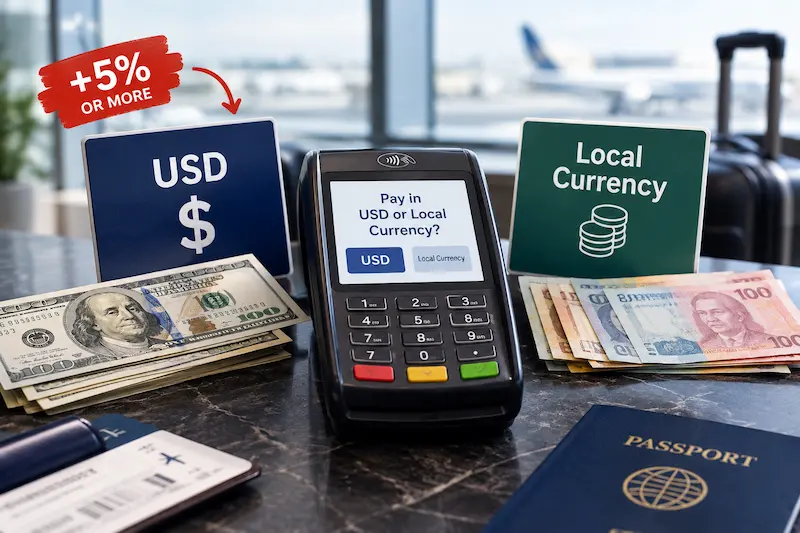
The card machine asks whether you want to pay in dollars or in euros. One of those answers adds a markup set by the merchant — and it does not remove the fee your own bank charges. You pay both.
Pay in the local currency. Almost always, and for a reason you can check on your own statement.
See what the other choice would have cost →
Currency Choice Calculator
Enter your own numbers to see what each choice would cost on this purchase.
The price shown on the terminal or receipt, before any conversion.
This is in your cardmember agreement. Enter 0 if your card doesn’t charge one.
If the screen doesn’t show one, the rules require it to — enter what it displays, or leave this blank.
This is your own figure, used only for this illustration.
Network rules require that you be offered a real choice. If a terminal converted your purchase to dollars without asking, that is a rule violation — and there is a specific way to raise it with your bank. Jump to what to do if you weren’t asked →
Network rules and fee structures verified October 15, 2026.
This article recommends no credit cards and contains no affiliate links.
What You Actually Pay on a Foreign Purchase
You pay two things on a foreign-currency purchase, not four: the network’s conversion rate, and your issuer’s foreign transaction fee.
The first layer is the exchange rate that Visa or Mastercard sets, usually reset once a day from a wholesale rate that isn’t the same as the rate you’d see on a currency-converter site, though it’s typically close to it.
The second layer is your card issuer’s foreign transaction fee, which generally runs somewhere between 0% and 3% depending on the card. It shows up as its own line on your statement, or it’s folded quietly into the converted amount — your cardmember agreement will say which. Because it varies by card and by product, there’s no single figure worth quoting here; your own agreement is the only reliable source for your card’s number.
If you add a DCC markup on top (next section), that’s a third layer — but only if you accept it.
That’s the whole consumer-side math for a purchase made in the local currency: the converted amount, plus your issuer’s fee, if it has one.
| Fee | Who is billed | Appears on your statement? | Typical basis |
|---|---|---|---|
| Network conversion rate | You | Built into the converted amount | Set daily, Visa or Mastercard |
| Issuer foreign transaction fee | You | Yes, or folded into the amount | Roughly 0%–3%, varies by card |
| DCC markup (only if you accept it) | You | Shown on the terminal screen/receipt | Disclosed at the point of sale |
| International Service Assessment / cross-border fee | The merchant and its acquirer | No — it’s on the merchant’s processing statement | Network assessment |
| International Acquirer Fee (0.45%) / acquirer program support fee | The merchant and its acquirer | No | Network assessment |
What the Merchant Pays — and Why It’s Not Your Problem
The merchant’s side has its own fees, and they’re billed to the merchant, not to you.
Visa charges merchants (through their acquiring bank) an International Service Assessment plus a 0.45% International Acquirer Fee on cross-border card-not-present and in-person transactions. Mastercard’s equivalents are its cross-border fee and acquirer program support fee. These appear on the merchant’s processing statement, not yours, and they’re why some smaller foreign merchants post a minimum card amount or a small surcharge — it’s covering a cost on their end, not yours.
You’ll see these terms mentioned in guides that explain “foreign transaction fees,” sometimes stacked into a reader’s math by mistake. They shouldn’t be. Keep this distinction in mind, and the next sections only get simpler.
The Terminal Question
When a terminal offers to charge you in dollars instead of the local currency, that’s Dynamic Currency Conversion, and it’s run by the merchant’s payment provider, not by Visa or Mastercard.
If you accept it, the merchant’s DCC provider converts the purchase at its own rate, plus a markup it sets and discloses on the screen or receipt. Mastercard’s own guide for merchants is direct about this: DCC is not a Mastercard product or service — it’s a commercial arrangement between the merchant, its acquirer, and a DCC provider. The markup varies; sample disclosure screens in that guide show figures as high as 8.0% on an illustrative transaction.
Here’s the sentence worth remembering: choosing dollars does not cancel your issuer’s foreign transaction fee. The purchase is still a cross-border transaction from your bank’s point of view. You’re not trading one fee for the other — you’re adding the DCC markup on top of whatever your issuer already charges.
That’s the whole case for the local-currency answer. It isn’t about loyalty to the local currency; it’s that the dollar option adds a cost without removing one.
| Step | Paying in local currency | Paying in dollars |
|---|---|---|
| Who converts | The card network | The merchant’s DCC provider |
| Whose rate | Network’s daily rate | Provider’s own rate |
| Whose markup | None at this step | Disclosed markup, set by the provider |
| Does your issuer’s fee still apply? | Yes, if your card has one | Yes, if your card has one |
| What the receipt shows | Local amount charged | Converted amount, rate, and markup |
What the Rules Require the Screen to Show
Visa and Mastercard both require that you be offered a genuine choice, with specific information disclosed before you accept.
The terminal or ATM has to display the amount in the local currency, the converted amount, the exchange rate used, and the markup applied — and it has to let you decline and pay in the local currency instead. Automatic or defaulted DCC, with no option shown, isn’t allowed under the rules.
A default is not a choice. If a screen only shows a dollar total with no visible way to pick the local currency, that’s not a compliant screen — see what to do if you weren’t asked.
| Item | Required? | Why it matters |
|---|---|---|
| Local-currency amount | Yes | What the purchase actually cost before conversion |
| Converted (dollar) amount | Yes, if DCC was used | Lets you check the math |
| Exchange rate applied | Yes, if DCC was used | Shows what rate you accepted |
| Disclosed markup | Yes, if DCC was used | The cost of choosing dollars |
| A visible opt-out to local currency | Yes | Required for DCC to be valid at all |
The Same Trap at an ATM
An ATM abroad stacks more layers than a store terminal, and on a credit card, one of those layers is expensive in a different way.
The DCC question at the ATM
Many foreign ATMs ask the same local-currency-or-dollars question a terminal does, with the same answer: local currency, for the same reason DCC costs more at a register.
The ATM operator’s surcharge
On top of any conversion choice, the ATM’s owner may charge its own flat withdrawal fee, separate from anything your bank charges.
Your bank’s out-of-network fee
Your own bank may add a fee for using an ATM outside its network, and a separate fee for the withdrawal being foreign, depending on your account’s terms.
A credit card cash withdrawal abroad is usually treated as a cash advance: a separate fee, interest that typically starts accruing immediately with no grace period, and no rewards. That’s a cost structure worth knowing before you’re standing at the machine — see Credit Card Cash Advance for how that works.
And on Foreign Websites
A foreign website priced in its own currency can trigger the same two layers as an in-person purchase, and some checkout pages offer DCC the same way a terminal does — a toggle or dropdown to bill you in dollars instead.
And a price already shown in dollars doesn’t guarantee you’re in the clear: if the merchant itself is based abroad, your issuer may still treat it as a foreign transaction and apply its fee, even though no currency conversion happened on your end. Your cardmember agreement describes how your issuer decides this — it generally comes down to where the merchant is located, not what currency the price was shown in.
| Setting | Extra layers | What to do |
|---|---|---|
| Card terminal | DCC markup, if offered and accepted | Choose the local currency |
| ATM | DCC markup, operator surcharge, possible cash-advance terms | Choose local currency; know your card’s cash-advance terms first |
| Foreign website | DCC toggle at checkout, possible issuer fee regardless | Choose local currency where offered; check your statement either way |
| Hotel checkout | DCC markup, often pre-selected | Ask for the folio in the local currency before signing |
If You Were Never Given the Choice
If a terminal, ATM, or website converted your purchase to dollars without giving you a real option to decline, that’s a specific, named kind of processing error — and there’s a defined way to raise it.
Visa groups this under its Processing Errors category, dispute condition 12.3, “Incorrect Currency,” which covers a DCC conversion applied without the cardholder’s agreement or after it was declined. Your issuer has 120 calendar days from the transaction’s processing date to raise it. (This replaced an older code, legacy reason code 76, under Visa’s rules.) Mastercard has a comparable category for point-of-interaction currency errors; your issuer will know which one applies to a Mastercard-branded card.
You don’t file a reason code yourself. You describe what happened to your issuer, and your issuer — not you — selects the code and files the dispute against the merchant’s acquirer. Don’t go into a bank call asking to “file a 12.3”; just describe what happened in plain terms.
And there’s no guaranteed outcome here. A clear receipt is useful evidence, not a guaranteed win — the result depends on your issuer’s review and the evidence on both sides.
If You Weren’t Given the Choice
- At the terminal, before you sign: say you want to be charged in the local currency, and ask for the transaction to be voided and re-run. This is routine, and staff can usually do it on the spot.
- Keep the receipt. It normally prints the converted amount and the exchange rate used — that’s your evidence.
- Photograph the screen if it defaulted to dollars with no visible option, and note the date, time, and merchant.
- Check your statement for the posted amount, the posting date, and any separate foreign transaction fee line.
- Contact your card issuer and describe it plainly: the transaction was converted to U.S. dollars without being offered a choice of currency. Ask that it be treated as a currency processing error. You don’t file the code yourself — your issuer selects it.
- Put it in writing too, and keep a copy; written notice is what protects your billing-error rights. See How to Dispute a Credit Card Charge for the general mechanics and deadlines.
- Act quickly. The dispute window for this category is measured from the transaction’s processing date, not from when you noticed it.
- Don’t refuse to pay the merchant, cancel the card, or dispute the whole purchase when the goods or service were received — the issue is the currency, not the sale.
Before Your Next Trip
The only preparation that matters is knowing your own card’s number and deciding your answer before you’re standing at a counter.
- Find your card’s foreign transaction fee in your cardmember agreement — it’s the one number in this whole article that’s specific to you.
- Decide now that your answer at any terminal or ATM is the local currency, so it isn’t a decision you’re making under time pressure.
- Know, going in, that a credit card cash withdrawal abroad is usually a cash advance with its own cost.
We’re not going to tell you which card to carry for this. This article recommends no credit cards and contains no affiliate links — if you’re comparing cards for travel, Best Travel and Rewards Credit Cards covers that separately, and Hidden Credit Card Benefits covers travel protections some cards include.
FAQ
Should I pay in local currency or dollars?
Local currency, in almost every case — it avoids the DCC markup and still leaves your issuer’s fee exactly where it would be either way.
Do I still pay a foreign transaction fee if I choose dollars?
Usually yes. Choosing dollars adds a DCC markup; it doesn’t cancel your issuer’s fee.
What is dynamic currency conversion?
A service offered by a merchant’s payment provider that converts your purchase to your home currency at the point of sale, at a rate that includes a disclosed markup.
Who sets the DCC exchange rate?
The merchant’s DCC provider, not Visa or Mastercard.
Is DCC a Visa or Mastercard service?
No. Mastercard’s own merchant guide states plainly that DCC is not a Mastercard product or service; it’s a commercial arrangement the merchant enters into.
Does the machine have to show me the markup?
Yes. Network rules require the local amount, the converted amount, the exchange rate, and the markup to be disclosed, with an option to decline.
What if the terminal didn’t give me a choice?
That’s a rule violation. See If You Were Never Given the Choice for what to do.
Can I dispute a currency conversion charge?
Yes, with your issuer, under a currency-specific processing-error category — not by filing a code yourself.
How long do I have to raise it?
For Visa’s incorrect-currency category, your issuer has 120 calendar days from the transaction’s processing date to raise the dispute, so don’t wait to report it.
Do I file the reason code myself?
No. You describe what happened to your issuer; your issuer selects and files the code.
Why was I charged a foreign transaction fee on a purchase in dollars?
Because the fee is usually based on where the merchant is located, not what currency the price was shown in.
What exchange rate does my card use?
The daily rate set by Visa or Mastercard for a local-currency purchase, or the DCC provider’s own rate if you accept a dollar conversion.
Is it cheaper to use cash abroad?
It depends on how you obtained the cash and what your card or bank charges for the withdrawal — there’s no single answer, and the ATM section above covers the extra layers involved.
Is an ATM withdrawal abroad a cash advance?
On a credit card, usually yes, which typically means a separate fee and interest starting immediately, with no grace period.
Do foreign websites do this too?
Some do, with a DCC toggle at checkout, and a foreign merchant can trigger your issuer’s fee even when the price is already shown in dollars.
Does a no-foreign-transaction-fee card protect me from DCC?
No. It removes one layer, not the other — the DCC markup is separate from your issuer’s fee, and it still applies if you accept a dollar conversion.
This is general information, not financial or legal advice. Fees, exchange rates, and network rules differ by card, issuer, and country, and can change. Figures in the examples above are illustrative. Verified October 15, 2026; check your own cardmember agreement for your card’s actual terms.
Last Updated:

Daniel Hayes is the founder and sole researcher at AdvoraHQ. He covers U.S. personal finance, insurance, and consumer law — working directly from IRS publications, federal and state statutes, court opinions, and SEC filings rather than secondary summaries. His focus is the gap between what readers think they know and what the source documents actually say. Daniel is not a licensed attorney, CPA, or financial advisor; his articles are educational and not personalized advice. Reach him at Daniel.Hayes@advorahq.com.
