
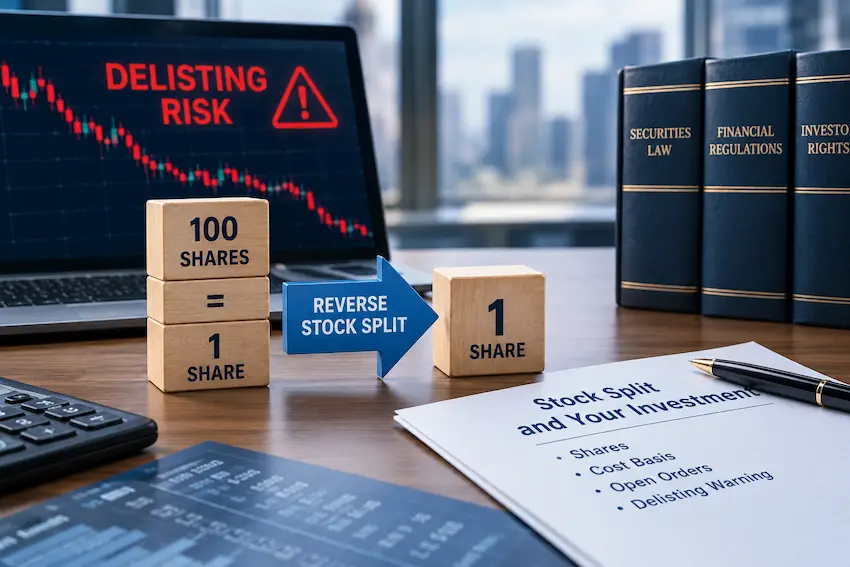
Quick answer: A reverse split cuts your share count and raises the price by the same ratio, so your total value doesn’t change on the split itself. But your open orders are usually canceled, you may get a small taxable cash payment for a fractional share, and the reason behind the split matters.
Calculate your new shares and cost basis →
| Item | Before | After (1-for-4 example) |
|---|---|---|
| Share count CHANGED | 100 shares | 25 shares |
| Price per share CHANGED | $2.00 | $8.00 |
| Total value UNCHANGED | $200 | $200 (before any cash paid for a fraction) |
| Basis per share CHANGED | $1.50 (total basis $150) | $6.00 (total basis still $150) |
| Open orders CHANGED | Working | Usually canceled; re-enter at the new price |
| Options CHANGED | Standard contract | Adjusted contract, often with a modified symbol |
Rules verified . Not investment or tax advice.
Reverse Split Calculator
Enter your numbers to see your new share count, basis per share, and what a cash-in-lieu payment could mean.
Your result
Fractional Shares and Cash in Lieu
Whether a leftover fraction becomes cash, stays in your account, or is rounded up depends on the issuer’s terms and on how your broker processes them.
CHECK How your split treats fractions.
Fractions appear when your shares don’t divide evenly by the ratio. In a 1-for-10 split, 25 shares become 2.5 new shares. The issuer’s announcement says what happens to the 0.5, and your broker then processes it.
- Cash in lieu: you receive money for the fraction, and it is treated like a sale (see the tax section).
- Fraction kept: your account holds a fractional share, and nothing is cashed out.
- Rounded up: the fraction becomes a whole share under the issuer’s terms.
Why brokers handle it differently
Robinhood’s corporate actions page says most reverse splits retain fractional shares, with cash in lieu typically settling about three to four weeks after the split. Its fractional shares page describes cash for fractions, and its corporate actions tracker lists each split as retained, cash in lieu, or rounded up. Look up your specific split.
Firstrade’s stock splits page says reverse-split fractions are typically paid as cash in lieu or rounded up, depending on the company. Tiger Brokers’ help page says they are cashed out. All pages were retrieved Oct. 20, 2026.
An industry group also notes that timing, payment method, and fraction treatment differ across broker-dealers (SIFMA letter).
What to do
- Read the issuer’s announcement and your broker’s corporate actions page for your split.
- Watch for a cash-in-lieu deposit, which can arrive weeks after the split.
- If a stock trades over the counter (OTC), confirm with your broker how fractions are handled; we could not confirm a single rule across brokers.
- ETFs can differ: one ETF issuer’s split Q&A says fractional shares can’t trade on its exchange, so it redeems them for cash at split-adjusted net asset value.
- Moving brokers? Robinhood’s page says a full transfer out sells fractions for cash, while a partial transfer leaves them in place. See our ACATS transfer guide before you start.
Your Cost Basis and Taxes
A reverse split is generally not a taxable event, and your total cost basis stays the same, but it is spread across fewer shares, so your basis per share rises by the ratio.
CHANGED Basis per share. CHECK Any cash in lieu.
Step 1: Find the issuer’s Form 8937
Companies file Form 8937 with the IRS to report actions that affect basis, and many post it on their investor-relations sites.
Issuers often describe a reverse split as a recapitalization (§ 368(a)(1)(E)), so no gain or loss is recognized except on cash received for a fraction. Wording varies, so read your issuer’s own form. For the format, see an issuer’s attachment for a July 2026 1-for-5 reverse split.
Step 2: Spread your total basis over the new shares
Basis per new share = total basis ÷ new shares. In a 1-for-10 split, that is the old basis per share times 10.
Worked example (illustrative math): You own 1,783 shares with a $1.00 basis each, so your total basis is $1,783. A 1-for-10 split gives you 178.3 new shares, so your basis is $10.00 per new share.
Step 3: Handle any cash in lieu
If cash is paid for the 0.3 fraction, you are treated as having sold it. Your gain or loss is the cash received minus the part of your basis that belongs to the fraction, as issuers’ Form 8937 attachments describe it.
In the example, the 0.3 fraction carries $3.00 of basis (0.3 × $10.00). If you receive $3.60, your gain is $0.60. If you receive $2.40, your loss is $0.60. The other 178 shares keep $1,780.00 of basis.
Issuer forms generally say the gain or loss is long-term if you held the old shares more than a year.
Cash in lieu is typically reported to you on Form 1099-B, often marked “cash in lieu” (H&R Block). IRS Publication 550 treats cash from fractional shares sold under a stock-dividend plan as an amount received on a sale, reported on Form 8949. That passage is about stock dividends, so rely on your issuer’s Form 8937 for a reverse split.
Step 4: Compare with your broker’s records
Issuer forms note that shares bought at different times can keep separate basis and holding-period segments, so check your broker’s lot-level records against the 8937. For how gains are taxed, see our capital gains tax guide. This is general information, not tax advice.
Your Open Orders Get Canceled
Under FINRA Rule 5330(b), a pending buy or sell order in a stock that reverse-splits “shall be cancelled,” so your broker will usually cancel yours.
CHANGED Your open orders.
The reason is simple: a price you set before the split no longer means the same thing after it. A limit order at $2.00 would sit far from an $8.00 market after a 1-for-4 split. FINRA’s Regulatory Notice 10-10 says the 2010 version of the rule broadened this so that all such orders, buy and sell, are canceled.
Some orders are handled under exchange rules, and the rule’s carve-outs in paragraph (e) apply to its adjustment provisions. In practice, assume your order will be canceled and check your order list. One ETF issuer’s Q&A says splits cancel limit and good-til-canceled (GTC) orders and that investors should re-enter at the post-split price (source).
Forward splits work differently
For a forward split, the rule generally calls for adjusting qualifying open orders, and under paragraph (c) a firm must promptly notify you if an order isn’t otherwise adjusted. Brokers can go further: Firstrade’s page says pending GT90 orders are canceled for both forward and reverse splits (retrieved Oct. 20, 2026).
What to do
- Open your order list on the effective date and the day before it.
- Note any limit, GTC, or stop-loss orders you had in that stock.
- Convert old prices: new price = old price × the split ratio (for a 1-for-4 split, multiply by 4).
- Re-enter an order only if you still want it. Until you do, a stop-loss order is not protecting the position.
For how stops work, see our stop-loss order guide.
Your Options
In a reverse split, the Options Clearing Corporation (OCC) typically keeps your number of contracts and strike but changes what each contract delivers, and the contract often gets a new symbol.
CHANGED Deliverable and symbol. UNCHANGED The economics of the position.
In a 1-for-10 reverse split, the deliverable generally goes from 100 shares to 10 shares per contract. A modified symbol, such as a “1” added to the ticker, marks the contract as adjusted and non-standard.
Each adjustment is decided case by case, so read the OCC memo for your split. See an OCC information memo on a past 1-for-15 split for the format; it shows the deliverable can include cash for a fraction, which settles later.
Memos from at least one options exchange for past reverse splits say resting orders in that exchange’s book are canceled, so check your option orders too.
New standard contracts are usually listed at the post-split price, while adjusted contracts are non-standard. Non-standard options often trade with less liquidity and wider spreads, so look at the bid-ask gap before you act (tastytrade options page, retrieved Oct. 20, 2026).
Your broker’s contract details show the deliverable. For how option value is described, see options in the money. This is educational, not a recommendation.
When a Reverse Split Is a Warning Sign
A reverse split is not automatically a bad sign, but since January 2025, a company that falls below $1 within a year of one gets no grace period on Nasdaq or the NYSE.
CHECK The reason and the listing status.
Both exchanges require a $1 minimum price. On Nasdaq, a bid below $1 for 30 consecutive business days brings a deficiency notice, then a 180-calendar-day period to get back to $1 for 10 consecutive business days (Winston & Strawn summary). On the NYSE, the test is an average closing price under $1 over 30 trading days.
The SEC approved NYSE’s change to Section 802.01C on Jan. 15, 2025, and Nasdaq’s change to Rule 5810(c)(3)(A)(iv) on Jan. 17, 2025 (K&L Gates summary). These are exchange listing rules approved by the SEC, not federal law.
Under them, a company that falls below the minimum and did a reverse split in the prior year skips the compliance period, and the exchange moves to delisting procedures.
Two further limits apply. Nasdaq has denied a compliance period since 2020 after reverse splits totaling 250-to-1 or more over two years, and the NYSE’s cumulative threshold is 200-to-1.
Since October 2024, if a reverse split causes a different Nasdaq deficiency, such as too few publicly held shares, Nasdaq gives no new compliance period for it (Nasdaq filing, Winston & Strawn summary). The NYSE also bars a reverse split that would push a company below its distribution criteria.
Nasdaq’s stated concern was companies, especially financially distressed ones, using repeated reverse splits to stay listed (ArentFox Schiff summary). Plenty of reverse splits don’t raise this concern, so use the checklist below rather than a single rule of thumb.
Listing rules after a reverse split (Table 3)
| Exchange | Rule | One-year rule | Cumulative-ratio rule | Normal compliance period |
|---|---|---|---|---|
| Nasdaq | Listing Rule 5810(c)(3)(A)(iv) | Below the $1 minimum bid and a reverse split in the prior year: no compliance period; delisting determination | 250-to-1 or more over two years: no compliance period | 180 calendar days; compliance means $1 or more for 10 consecutive business days |
| NYSE | Listed Company Manual 802.01C | Below the price criteria and a reverse split in the prior year: no compliance period; suspension and delisting procedures begin right away | 200-to-1 or more over two years: same result | Six months to cure |
Is This Reverse Split a Warning Sign? Checklist
- Does the announcement mention the $1 minimum bid price or a Nasdaq or NYSE deficiency notice?
- Has the company done a reverse split in the last year, or several in two years?
- Is the ratio unusually large (for example, 1-for-50 or more)?
- Is the proxy statement also asking to increase authorized shares, or is an offering announced? Read what it says about why.
- Has the company received a delisting determination or other listing-deficiency notice? Check its 8-K filings.
- If several answers are yes, read the latest 10-Q or 10-K risk factors and consider your own risk tolerance. This checklist is not a recommendation.
If a stock is delisted, your shares don’t disappear, but where and how they trade can change. See what happens when a stock is delisted.
Stock Split vs. Reverse Split
A forward split gives you more shares at a lower price, a reverse split gives you fewer shares at a higher price, and total value is unchanged in both.
| Item | Forward split | Reverse split |
|---|---|---|
| Shares | Increase | Decrease |
| Price | Falls by the ratio | Rises by the ratio |
| Open orders | Adjusted where the rule requires, or you are notified | Canceled |
| Options | Adjusted by the OCC | Adjusted, often through the deliverable and a modified symbol |
| Fractions | Depends on the broker; may be added to your position or paid as cash | Cash in lieu, kept, or rounded up, depending on issuer and broker |
UNCHANGED In both: total value and ownership percentage.
CHECK In both: how your broker handles fractions and open orders.
FAQ
Do you lose money in a reverse stock split?
Not from the split itself, because the price rises by the same ratio as your shares fall. Small differences can come from a cashed-out fraction, and the price can move afterward like any other day.
Why did my number of shares go down?
The company combined shares at a set ratio. In a 1-for-10 split, ten shares became one.
What happens to fractional shares?
It depends on the issuer and your broker: cash in lieu, a kept fraction, or rounding up. Check the issuer’s announcement and your broker’s corporate actions page.
How long does cash in lieu take?
Robinhood’s help page says typically about three to four weeks after the corporate action (retrieved Oct. 20, 2026). Other brokers vary, so watch your account activity.
Is cash in lieu taxable?
Generally yes, as a sale of the fractional share. Your gain or loss is the cash minus the basis allocated to the fraction, usually a small amount. It is typically reported on Form 1099-B.
How do I adjust my cost basis?
Divide your total basis by your new share count, then follow the issuer’s Form 8937 for any basis tied to a fraction. Use the calculator above for the arithmetic.
Where do I find Form 8937?
Many issuers post it on their investor-relations websites. Your broker may also summarize the basis change.
Why was my stop-loss order canceled?
FINRA Rule 5330(b) calls for pending orders to be canceled when a stock reverse-splits. Re-enter the order at the new price if you still want it. See our stop-loss order guide.
What happens to my options?
The OCC adjusts them, typically through the deliverable, and the contract often gets a modified symbol. Check the OCC memo and your broker’s contract details.
What does “ABC1” mean in my options chain?
A symbol with a “1” added usually marks an adjusted, non-standard contract from a corporate action such as a reverse split.
Is a reverse split a sign of bankruptcy?
Not by itself. Companies and funds reverse-split for several reasons. Exchanges have targeted repeated reverse splits used to stay listed, so use the warning-sign checklist and read the filings.
What is Nasdaq’s $1 minimum bid rule?
Nasdaq requires a $1 minimum bid. After 30 consecutive business days below it, a company gets a deficiency notice and normally 180 calendar days to cure. If it did a reverse split in the prior year, it gets no compliance period.
Can a company do a reverse split twice?
Yes, but listed companies below the minimum price face the one-year rule and the cumulative limits (250-to-1 on Nasdaq, 200-to-1 on the NYSE over two years).
Does a reverse split change my ownership percentage?
Generally no, since all holders’ shares combine at the same ratio. A cashed-out or rounded fraction can change it slightly.
What’s the difference between a stock split and a reverse split?
A forward split adds shares and lowers the price, and a reverse split removes shares and raises it. See Table 2 above.
What happens to my shares if the stock is delisted?
You still own them, but where and how they trade can change, and your broker’s support may differ. See our delisting guide.
Sources
- FINRA Rule 5330, Adjustment of Orders (checked Oct. 20, 2026)
- Nasdaq Rule 5800 Series, including 5810 and NYSE Listed Company Manual 802.01C amendment (SEC filing)
- K&L Gates summary of the January 2025 SEC approvals
- OCC information memo on a past reverse split
- Issuer Form 8937 attachment (example), IRS Publication 550, and H&R Block on cash in lieu
- Broker help pages: Robinhood, Firstrade, Tiger Brokers, tastytrade (all retrieved Oct. 20, 2026)
Last updated:
This article is general information, not investment or tax advice. Broker handling varies, and rules were verified on Oct. 20, 2026. Check your broker’s pages and the issuer’s filings for your situation.

Daniel Hayes is the founder and sole researcher at AdvoraHQ. He covers U.S. personal finance, insurance, and consumer law — working directly from IRS publications, federal and state statutes, court opinions, and SEC filings rather than secondary summaries. His focus is the gap between what readers think they know and what the source documents actually say. Daniel is not a licensed attorney, CPA, or financial advisor; his articles are educational and not personalized advice. Reach him at Daniel.Hayes@advorahq.com.