
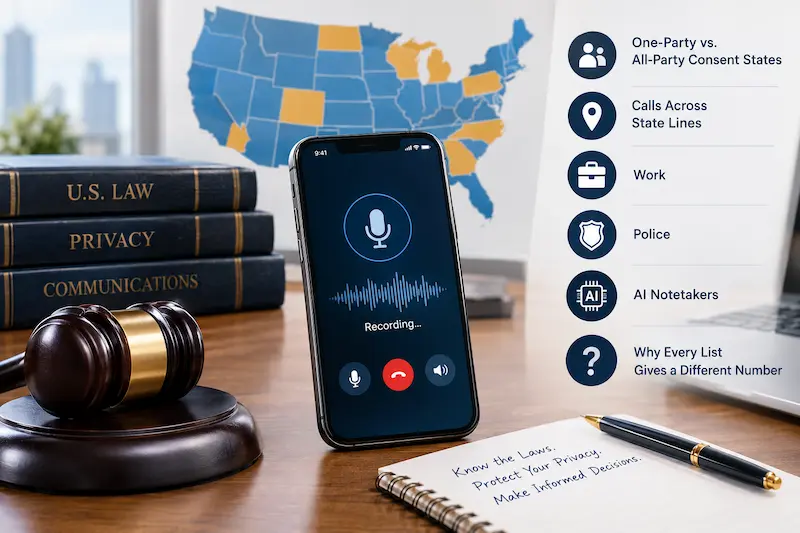
Federal law and most states: you can record a call you’re part of without telling the other person (one-party consent).
About a dozen states require everyone’s consent, at least for private conversations.
If the other person is in one of those states, follow the stricter rule.
Lists disagree because some states treat phone calls and in-person talks differently. The tool below accounts for that.
Pick both states and the type of conversation →
Recording laws are state law; check yours before relying on a recording.
Can I Record This?
You’ll get one of three answers: LIKELY LEGAL, GET CONSENT FIRST, or DON’T RECORD. It always applies the stricter rule.
The Federal Rule: One-Party Consent
Federal law lets you record a conversation you are part of, or one a participant has agreed to record.
The federal Wiretap Act, 18 U.S.C. § 2511(2)(d), says:
“It shall not be unlawful under this chapter for a person not acting under color of law to intercept a wire, oral, or electronic communication where such person is a party to the communication or where one of the parties to the communication has given prior consent to such interception unless such communication is intercepted for the purpose of committing any criminal or tortious act in violation of the Constitution or laws of the United States or of any State.”
Two points matter. A participant can record; someone listening in cannot. And the “criminal or tortious” exception means a recording made to commit a crime or a civil wrong is not protected.
This is a floor, not a ceiling. States can be stricter, and many are.
Why Every List Gives a Different Number
Sources count 9, 11, 12, 13, or “up to 15” all-party states because they draw the line in different places.
Here is the breakdown we use, with no single “number” to hide behind:
- 9 strict all-party states: California, Florida, Illinois, Maryland, Massachusetts, Montana, New Hampshire, Pennsylvania, Washington.
- 6 split or unsettled: Connecticut, Nevada, Oregon, Missouri, Michigan, Delaware.
- 36 one-party: the other 35 states and D.C. (Vermont has no state recording statute, so the federal rule applies).
The Reporters Committee’s list of about 11 includes Delaware and Michigan. Counts of 12 to 15 add the split states with qualifiers.
All-Party States
Nine states require everyone’s consent for the conversations their laws cover, and each limits that rule in a different way.
All-party states (9)
California
Phone: All-party (confidential calls; calls involving a cell or cordless phone regardless)
In person: All-party (confidential conversations)
Scope: Public gatherings and settings where people could reasonably expect to be overheard or recorded are outside the "confidential" rule (§ 632(c)). Calls involving a cell or cordless phone are covered regardless of confidentiality (§ 632.7). Calls placed from one-party states can still be covered (Kearney, Cal. 2006).
Statute: Cal. Penal Code §§ 632, 632.7, 637.2
Verified: 2026-10-25 (statute text of § 632; RCFP state guide)
Florida
Phone: All-party
In person: All-party
Scope: The in-person rule covers "oral communications" where the speaker has a reasonable expectation of privacy; public meetings are excluded.
Statute: Fla. Stat. §§ 934.02, 934.03(2)(d)
Verified: 2026-10-25 (RCFP state guide)
Illinois
Phone: All-party
In person: All-party
Scope: Covers private conversations and private electronic communications where someone reasonably expects privacy.
Statute: 720 ILCS 5/14-1, 14-2
Verified: 2026-10-25 (RCFP state guide)
Maryland
Phone: All-party
In person: All-party
Scope: The in-person rule applies to "private conversations" (reasonable expectation of privacy). Telephone and electronic communications are covered regardless of that expectation.
Statute: Md. Code, Cts. & Jud. Proc. §§ 10-401, 10-402
Verified: 2026-10-25 (RCFP state guide)
Massachusetts
Phone: All-party
In person: All-party
Scope: Applies to secret recording; affirmative consent isn’t needed when everyone knows a recording is happening (Curtatone v. Barstool Sports, Mass. 2021). The First Circuit held the rule doesn’t reach secret recording of police doing their jobs in public (Project Veritas Action Fund v. Rollins, 2020).
Statute: Mass. Gen. Laws ch. 272, § 99
Verified: 2026-10-25 (RCFP state guide)
Montana
Phone: All-party
In person: All-party
Scope: Targets recording with a hidden device without all parties’ knowledge. Exceptions include a warning that recording is happening, public meetings, and certain public-official recordings.
Statute: Mont. Code Ann. § 45-8-213
Verified: 2026-10-25 (RCFP state guide)
New Hampshire
Phone: All-party
In person: All-party
Scope: The in-person rule applies where people reasonably expect they aren’t being recorded. The offense drops from a felony to a misdemeanor if the recorder was a party or had one party’s consent.
Statute: N.H. Rev. Stat. §§ 570-A:2, 570-A:11
Verified: 2026-10-25 (RCFP state guide)
Pennsylvania
Phone: All-party
In person: All-party
Scope: The in-person rule applies where parties reasonably expect privacy; phone and electronic calls are covered regardless. Courts have found consent where the parties knew or should have known of the recording (Commonwealth v. Byrd, Pa. 2020).
Statute: 18 Pa. C.S. §§ 5702–5704
Verified: 2026-10-25 (RCFP state guide)
Washington
Phone: All-party
In person: All-party
Scope: Covers "private" conversations. Consent counts as obtained when one party announces to everyone that the conversation is about to be recorded and the announcement is itself recorded (RCW 9.73.030(3)).
Statute: RCW 9.73.030
Verified: 2026-10-25 (statute text of RCW 9.73.030; RCFP state guide)
| State | Phone | In person | Scope note | Statute |
|---|---|---|---|---|
| California | All-party (confidential calls; calls involving a cell or cordless phone regardless) | All-party (confidential conversations) | Public gatherings and settings where people could reasonably expect to be overheard or recorded are outside the "confidential" rule (§ 632(c)). Calls involving a cell or cordless phone are covered regardless of confidentiality (§ 632.7). Calls placed from one-party states can still be covered (Kearney, Cal. 2006). | Cal. Penal Code §§ 632, 632.7, 637.2 |
| Florida | All-party | All-party | The in-person rule covers "oral communications" where the speaker has a reasonable expectation of privacy; public meetings are excluded. | Fla. Stat. §§ 934.02, 934.03(2)(d) |
| Illinois | All-party | All-party | Covers private conversations and private electronic communications where someone reasonably expects privacy. | 720 ILCS 5/14-1, 14-2 |
| Maryland | All-party | All-party | The in-person rule applies to "private conversations" (reasonable expectation of privacy). Telephone and electronic communications are covered regardless of that expectation. | Md. Code, Cts. & Jud. Proc. §§ 10-401, 10-402 |
| Massachusetts | All-party | All-party | Applies to secret recording; affirmative consent isn’t needed when everyone knows a recording is happening (Curtatone v. Barstool Sports, Mass. 2021). The First Circuit held the rule doesn’t reach secret recording of police doing their jobs in public (Project Veritas Action Fund v. Rollins, 2020). | Mass. Gen. Laws ch. 272, § 99 |
| Montana | All-party | All-party | Targets recording with a hidden device without all parties’ knowledge. Exceptions include a warning that recording is happening, public meetings, and certain public-official recordings. | Mont. Code Ann. § 45-8-213 |
| New Hampshire | All-party | All-party | The in-person rule applies where people reasonably expect they aren’t being recorded. The offense drops from a felony to a misdemeanor if the recorder was a party or had one party’s consent. | N.H. Rev. Stat. §§ 570-A:2, 570-A:11 |
| Pennsylvania | All-party | All-party | The in-person rule applies where parties reasonably expect privacy; phone and electronic calls are covered regardless. Courts have found consent where the parties knew or should have known of the recording (Commonwealth v. Byrd, Pa. 2020). | 18 Pa. C.S. §§ 5702–5704 |
| Washington | All-party | All-party | Covers "private" conversations. Consent counts as obtained when one party announces to everyone that the conversation is about to be recorded and the announcement is itself recorded (RCW 9.73.030(3)). | RCW 9.73.030 |
Scope matters. In California, a “confidential communication” excludes a communication made in a public gathering or any circumstance where the parties may reasonably expect to be overheard or recorded (Penal Code § 632(c)).
Washington treats consent as given when someone announces that the conversation is being recorded and the announcement is itself recorded (RCW 9.73.030(3)). Massachusetts targets secret recording.
Split and Unsettled States
Six states don’t fit a simple label because the rule changes with the type of conversation, the statute, or the courts.
Split or unsettled states (6)
Connecticut
Phone: All-party for civil liability (the criminal rule is one-party)
In person: One-party
Why it’s listed differently: Recording a phone call without all parties’ consent (given in writing, or verbally on the recording, or after a recorded warning) can bring civil liability; criminal penalties don’t apply if at least one party consented. In-person recording follows the one-party rule.
Statute: Conn. Gen. Stat. §§ 53a-187, 53a-189; § 52-570d
Verified: 2026-10-25 (RCFP state guide, last updated Oct. 2019)
Delaware
Phone: Check your state (two conflicting statutes)
In person: Check your state (two conflicting statutes)
Why it’s listed differently: The privacy law requires all parties’ consent for private communications (§ 1335(a)(4)); the wiretap law allows one-party consent (§ 2402(c)(4)). RCFP advises following the stricter rule. Check your state.
Statute: Del. Code tit. 11, §§ 1335(a)(4), 2402(c)(4)
Verified: 2026-10-25 (RCFP state guide)
Michigan
Phone: Check your state
In person: Check your state
Why it’s listed differently: The statute bars eavesdropping on a private conversation without all parties’ consent. The Court of Appeals held that a participant who records is not an "eavesdropper" (Sullivan v. Gray, 1982), so the all-party rule has been read to reach third-party recording. Sources disagree on how far that goes, and the Michigan Supreme Court hasn’t squarely settled it. Check your state.
Statute: Mich. Comp. Laws § 750.539c
Verified: 2026-10-25 (RCFP state guide)
Missouri
Phone: One-party
In person: Check your state (unsettled)
Why it’s listed differently: Phone: one-party. In person, sources disagree and few cases interpret the statute. RCFP advises getting consent. Check your state.
Statute: Mo. Rev. Stat. § 542.402
Verified: 2026-10-25 (RCFP state guide)
Nevada
Phone: All-party
In person: One-party (private conversations)
Why it’s listed differently: Phone calls need all parties’ consent (NRS 200.620). In-person private conversations are covered by NRS 200.650, which requires one party’s authorization.
Statute: Nev. Rev. Stat. §§ 200.620, 200.650
Verified: 2026-10-25 (RCFP state guide)
Oregon
Phone: One-party
In person: Everyone must be specifically informed (notice, not consent), with exceptions
Why it’s listed differently: The Ninth Circuit en banc upheld the in-person rule on Jan. 7, 2025 (Project Veritas v. Schmidt, 125 F.4th 929); the Supreme Court declined review on Oct. 6, 2025. The statute has limited exceptions, such as certain public meetings. RCFP’s Oregon page (updated Oct. 2023) predates the en banc ruling.
Statute: Or. Rev. Stat. § 165.540
Verified: 2026-10-25 (RCFP state guide; Ninth Circuit en banc and Supreme Court reports)
| State | Phone | In person | Why it’s listed differently | Source |
|---|---|---|---|---|
| Connecticut | All-party for civil liability (the criminal rule is one-party) | One-party | Recording a phone call without all parties’ consent (given in writing, or verbally on the recording, or after a recorded warning) can bring civil liability; criminal penalties don’t apply if at least one party consented. In-person recording follows the one-party rule. | Conn. Gen. Stat. §§ 53a-187, 53a-189; § 52-570d |
| Delaware | Check your state (two conflicting statutes) | Check your state (two conflicting statutes) | The privacy law requires all parties’ consent for private communications (§ 1335(a)(4)); the wiretap law allows one-party consent (§ 2402(c)(4)). RCFP advises following the stricter rule. Check your state. | Del. Code tit. 11, §§ 1335(a)(4), 2402(c)(4) |
| Michigan | Check your state | Check your state | The statute bars eavesdropping on a private conversation without all parties’ consent. The Court of Appeals held that a participant who records is not an "eavesdropper" (Sullivan v. Gray, 1982), so the all-party rule has been read to reach third-party recording. Sources disagree on how far that goes, and the Michigan Supreme Court hasn’t squarely settled it. Check your state. | Mich. Comp. Laws § 750.539c |
| Missouri | One-party | Check your state (unsettled) | Phone: one-party. In person, sources disagree and few cases interpret the statute. RCFP advises getting consent. Check your state. | Mo. Rev. Stat. § 542.402 |
| Nevada | All-party | One-party (private conversations) | Phone calls need all parties’ consent (NRS 200.620). In-person private conversations are covered by NRS 200.650, which requires one party’s authorization. | Nev. Rev. Stat. §§ 200.620, 200.650 |
| Oregon | One-party | Everyone must be specifically informed (notice, not consent), with exceptions | The Ninth Circuit en banc upheld the in-person rule on Jan. 7, 2025 (Project Veritas v. Schmidt, 125 F.4th 929); the Supreme Court declined review on Oct. 6, 2025. The statute has limited exceptions, such as certain public meetings. RCFP’s Oregon page (updated Oct. 2023) predates the en banc ruling. | Or. Rev. Stat. § 165.540 |
Missouri, Delaware, and Michigan: check your state. We did not treat any of them as clearly one-party. If you are in one of them, or calling someone there, use the tool’s cautious answer.
One-party states
One-party states (36 jurisdictions)
Alabama, Alaska, Arizona, Arkansas, Colorado, District of Columbia, Georgia, Hawaii, Idaho, Indiana, Iowa, Kansas, Kentucky, Louisiana, Maine, Minnesota, Mississippi, Nebraska, New Jersey, New Mexico, New York, North Carolina, North Dakota, Ohio, Oklahoma, Rhode Island, South Carolina, South Dakota, Tennessee, Texas, Utah, Vermont, Virginia, West Virginia, Wisconsin, Wyoming.
A participant, or someone with one participant’s consent, may record. Some of these laws have limits: Several (for example Colorado, Hawaii, Maine, New Mexico, and North Dakota) have limits or extra privacy rules, and Vermont has no state recording statute at all. Read your state’s statute before relying on this; the desktop view lists each state’s statute.
| State | Phone | In person | Notes | Statute |
|---|---|---|---|---|
| Alabama | One-party | One-party | A participant, or someone with one participant’s consent, may record. | Ala. Code § 13A-11-31 |
| Alaska | One-party | One-party | A participant, or someone with one participant’s consent, may record. | Alaska Stat. § 42.20.310(b) |
| Arizona | One-party | One-party | A participant, or someone with one participant’s consent, may record. | Ariz. Rev. Stat. § 13-3005 |
| Arkansas | One-party | One-party | A participant, or someone with one participant’s consent, may record. | Ark. Code § 5-60-120 |
| Colorado | One-party | One-party | In-person interception is covered only where the parties reasonably expect privacy. | Colo. Rev. Stat. § 18-9-303 |
| District of Columbia | One-party | One-party | A participant, or someone with one participant’s consent, may record. | D.C. Code § 23-542 |
| Georgia | One-party | One-party | A participant, or someone with one participant’s consent, may record. | Ga. Code §§ 16-11-62, 16-11-66 |
| Hawaii | One-party | One-party | A participant, or someone with one participant’s consent, may record. A separate Hawaii privacy law covers recording in private places; check it. | Haw. Rev. Stat. § 803-42(b)(3)(A) |
| Idaho | One-party | One-party | A participant, or someone with one participant’s consent, may record. | Idaho Code § 18-6702(2)(d) |
| Indiana | One-party | One-party | Phone: one-party. RCFP says it is unclear whether a non-participant needs consent for in-person recording. | Ind. Code §§ 35-31.5-2-176, 35-33.5-5-5(b) |
| Iowa | One-party | One-party | A participant, or someone with one participant’s consent, may record. | Iowa Code §§ 808B.2(2)(c), 727.8 |
| Kansas | One-party | One-party | A participant, or someone with one participant’s consent, may record. | Kan. Stat. § 21-6101(a)(1) |
| Kentucky | One-party | One-party | A participant, or someone with one participant’s consent, may record. | Ky. Rev. Stat. § 526.010 |
| Louisiana | One-party | One-party | A participant, or someone with one participant’s consent, may record. | La. Rev. Stat. § 15:1303 |
| Maine | One-party | One-party | A participant, or someone with one participant’s consent, may record. Check Maine’s separate privacy laws for private places such as bathrooms. | Me. Rev. Stat. tit. 15, § 710 |
| Minnesota | One-party | One-party | A participant, or someone with one participant’s consent, may record. | Minn. Stat. § 626A.02(2)(d) |
| Mississippi | One-party | One-party | A participant, or someone with one participant’s consent, may record. | Miss. Code § 41-29-531(e) |
| Nebraska | One-party | One-party | A participant, or someone with one participant’s consent, may record. | Neb. Rev. Stat. § 86-290 |
| New Jersey | One-party | One-party | A participant, or someone with one participant’s consent, may record. | N.J. Stat. §§ 2A:156A-3, 2A:156A-4 |
| New Mexico | One-party | One-party | The statute is written around landline communications; cell-phone coverage is unclear. RCFP says no consent is needed for in-person recording. | N.M. Stat. § 30-12-1 |
| New York | One-party | One-party | A participant, or someone with one participant’s consent, may record. | N.Y. Penal Law §§ 250.00, 250.05 |
| North Carolina | One-party | One-party | A participant, or someone with one participant’s consent, may record. | N.C. Gen. Stat. § 15A-287 |
| North Dakota | One-party | One-party | The statute is written around wire communications; cell-phone coverage is unclear. | N.D. Cent. Code § 12.1-15-02 |
| Ohio | One-party | One-party | A participant, or someone with one participant’s consent, may record. | Ohio Rev. Code § 2933.52 |
| Oklahoma | One-party | One-party | A participant, or someone with one participant’s consent, may record. | Okla. Stat. tit. 13, § 176.4 |
| Rhode Island | One-party | One-party | A participant, or someone with one participant’s consent, may record. | R.I. Gen. Laws § 11-35-21 |
| South Carolina | One-party | One-party | A participant, or someone with one participant’s consent, may record. | S.C. Code § 17-30-30 |
| South Dakota | One-party | One-party | A participant, or someone with one participant’s consent, may record. | S.D. Codified Laws § 23A-35A-20 |
| Tennessee | One-party | One-party | A participant, or someone with one participant’s consent, may record. | Tenn. Code §§ 39-13-601, 39-13-604, 40-6-303 |
| Texas | One-party | One-party | A participant, or someone with one participant’s consent, may record. | Tex. Penal Code § 16.02 |
| Utah | One-party | One-party | A participant, or someone with one participant’s consent, may record. | Utah Code § 77-23a-4 |
| Vermont | One-party | One-party | Vermont has no state recording law, so the federal rule applies. | No state recording statute; federal 18 U.S.C. § 2511 |
| Virginia | One-party | One-party | A participant, or someone with one participant’s consent, may record. | Va. Code § 19.2-62 |
| West Virginia | One-party | One-party | A participant, or someone with one participant’s consent, may record. | W. Va. Code § 62-1D-3 |
| Wisconsin | One-party | One-party | A participant, or someone with one participant’s consent, may record. | Wis. Stat. § 968.31 |
| Wyoming | One-party | One-party | A participant, or someone with one participant’s consent, may record. | Wyo. Stat. § 7-3-702 |
Calling Someone in Another State
When states differ, follow the stricter rule, because a court may apply the stricter state’s law.
In Kearney v. Salomon Smith Barney, Inc., 39 Cal. 4th 95 (2006), the California Supreme Court held that California’s all-party rule can apply when a business records calls with California residents, even from a one-party state. The firm had recorded without warning, and the court declined to award damages for that past conduct but said the rule governs going forward.
Group calls work the same way. Every participant’s state counts, and if you can’t tell where everyone is, treat the stricter rule as controlling. The tool does exactly this.
GET CONSENT FIRST
A one-party state calling a California resident
Why: California’s highest court has applied its all-party rule to calls with Californians, so the safe course is to announce the recording and keep the consent on the recording.
LIKELY LEGAL
Two people in one-party states
Why: Federal law and both states allow a participant to record, unless the purpose is criminal or tortious.
Recording at Work: Your Boss, HR, Coworkers
Your state’s law decides whether a recording is legal, but your employer’s policy can still lead to discipline.
Federal labor law may protect some recording tied to employees acting together about working conditions; the NLRB’s standard for workplace rules was reset in Stericycle (2023), and you should check its current status.
If you were fired or disciplined after raising a problem, see our guides on wrongful termination and employment discrimination.
GET CONSENT FIRST
Your boss or HR, in a meeting you attend
Why: State law may allow it in one-party states, but policy may not, and all-party states require everyone’s consent. Ask first.
DON’T RECORD
Coworkers’ conversations you’re not part of
Why: Recording a conversation you are not part of is the riskiest recording of all and is unlawful in many states.
Recording the Police
Recording on-duty police in a public place is protected by most federal appeals courts that have addressed it, but the law is still moving.
Status as of October 25, 2026. This section is dated because litigation is ongoing and is re-verified quarterly.
Federal appeals courts have recognized a First Amendment right to record police doing their jobs in public. Press reports of the Second Circuit’s August 17, 2026 decision put the count at nine or more courts; an earlier summary by the Institute for Justice (2024) counted eight of twelve circuits. Qualified immunity can still protect officers from damages where the right was not clearly established.
Buffer-zone laws
Several states have passed laws that keep people a set distance from officers. The status of each, as we found it:
- Indiana (25 feet): on August 5, 2025, the Seventh Circuit affirmed a preliminary injunction against enforcement on vagueness grounds. That was not a final judgment.
- Louisiana (25 feet): a federal district court preliminarily blocked enforcement on January 31, 2025. The Fifth Circuit heard argument on June 1, 2026. We found no ruling yet.
- Arizona (8 feet): struck down in federal court.
- Florida (§ 843.31, effective January 1, 2025): a 25-foot rule that applies after a warning and depends on the person’s intent. We found no final ruling.
- Tennessee: a police buffer-zone law is under challenge.
LIKELY LEGAL
Police in public, doing their jobs
Why: Most federal appeals courts protect recording officers in public; stay back, don’t interfere, and follow lawful orders.
GET CONSENT FIRST
A private conversation with an officer
Why: Away from public view, ordinary state recording law applies, so announce the recording or ask first.
At Home: Doorbell Cameras, Nanny Cams, Guests
Video alone is generally outside wiretap laws, but audio of conversations can be covered by your state’s recording law.
Video without audio may still be covered by voyeurism or privacy laws in places like bathrooms and bedrooms.
Audio is the problem. If your doorbell records visitors or passersby you aren’t talking to, that can look like recording a conversation you are not part of, especially in an all-party state.
- Post a visible notice that audio is recorded.
- Turn off audio if you don’t need it.
- Don’t point cameras at a neighbor’s windows or into private rooms.
- Tell guests and caregivers before recording in your home.
GET CONSENT FIRST
Doorbell audio of visitors and passersby
Why: Audio of people you aren’t speaking with may be covered by your state’s law, so post a notice or turn audio off.
DON’T RECORD
Audio of a caregiver’s or guest’s private conversations
Why: Recording conversations you are not part of is the highest-risk use and can break wiretap laws.
AI Notetakers and Video Calls
Treat an AI notetaker as a recording: announce it, and get consent if anyone is in an all-party state.
These tools record and transcribe the call, so recording laws apply. Where the tool’s maker is located generally doesn’t change your duty; the participants’ states matter.
- Tell everyone at the start of the call, and keep the announcement in the recording.
- If anyone objects, turn it off.
- Ask before using one on a call with your lawyer, since a third party can affect confidentiality.
GET CONSENT FIRST
An AI notetaker on a call with people in other states
Why: It is a recording, and any participant’s state can require everyone’s consent.
LIKELY LEGAL
An AI notetaker on a call where every participant has agreed
Why: Everyone has consented and is in a state where that is enough.
Family Disputes
Be cautious: an unlawful recording of a spouse or child can be excluded from court and can create liability.
Don’t assume marriage exempts you. Recording your spouse’s calls or a child’s calls that you aren’t on can raise separate wiretap issues. Whether a parent can consent for a child is decided case by case.
Family courts have discretion over what evidence they accept, and a judge may react badly to a recording made in a way the court dislikes. See our guide to 50/50 custody states for how custody disputes are handled, and talk to a family lawyer before relying on any recording.
GET CONSENT FIRST
Recording a co-parent on a call or in a meeting you’re part of
Why: The rule depends on both states, so use the tool and announce the recording.
DON’T RECORD
Recording a spouse’s or a child’s calls you aren’t on
Why: It can violate wiretap laws, be excluded from court, and expose you to civil liability.
Can You Use a Recording in Court?
A lawful recording can usually be offered as evidence, while an unlawful one may be excluded and can cost you.
Federal law bars using an unlawfully intercepted wire or oral communication, or evidence derived from it, in court and other proceedings if disclosing it would violate the Wiretap Act (18 U.S.C. § 2515). A one-party consent recording is not unlawful under that law.
California goes further. Penal Code § 632(d) says that, except as proof of a violation, evidence obtained by recording a confidential communication in violation of § 632 is not admissible in any judicial, administrative, legislative, or other proceeding. But in criminal cases the California Supreme Court held in People v. Guzman (2019) that the rule no longer applies, because of Proposition 8.
A lawful recording still has to be authenticated: someone must be able to testify that it is accurate and complete, and rules on hearsay and relevance still apply. For disputes under your state’s small-claims limit, see how to sue in small claims court. Talk to a lawyer before you offer a recording in a dispute.
LIKELY LEGAL
Offering a recording you made lawfully
Why: It can be offered, subject to authentication and the court’s rules.
GET CONSENT FIRST
A recording you’re not sure was lawful
Why: If it violated a recording law, it may be excluded and you may face liability, so get legal advice before using it.
Penalties for Illegal Recording
Penalties vary by state; California shows how serious they can be.
| Type | Penalty | Section |
|---|---|---|
| Criminal, first offense | Fine up to $2,500 per violation, imprisonment up to one year, or both | Cal. Penal Code § 632 |
| Criminal, repeat offender | Fine up to $10,000 per violation | Cal. Penal Code § 632 |
| Civil damages | $5,000 per violation or three times actual damages, whichever is greater | Cal. Penal Code § 637.2 |
| Use in court | Not admissible in any judicial, administrative, legislative, or other proceeding, except to prove the violation (not applied in California criminal cases after People v. Guzman, 2019) | Cal. Penal Code § 632(d) |
Other states set their own criminal and civil penalties, and some treat illegal recording as a felony. Read your state’s statute, cited in the tables above, and talk to a lawyer if you have been accused of illegal recording.
Recording Debt Collectors, Insurers, and Customer Service
Announce your own recording at the start; a company’s “this call may be recorded” notice covers the company’s copy, not necessarily yours.
Announcing your own recording up front gives the other side the chance to object. Many courts treat staying on the line as consent, but asking for a clear yes is safer.
If a collector keeps calling, see debt collector rights. If an insurer asked to record your statement, read already gave a recorded statement: now what first.
GET CONSENT FIRST
A debt collector or insurer call you want to record
Why: Announce it, keep the announcement in the recording, and follow the stricter state’s rule.
LIKELY LEGAL
A customer-service call that begins with a recording notice
Why: The company has told you it is recording; make your own announcement if you want your own copy.
Situations at a glance
| Situation | One-party state | All-party state | Note |
|---|---|---|---|
| Your own call | LIKELY LEGAL | GET CONSENT FIRST | Washington: a recorded announcement counts as consent. |
| Group call across states | GET CONSENT FIRST | GET CONSENT FIRST | The stricter participant’s state controls; LIKELY LEGAL only if every state is one-party. |
| Boss in a meeting | GET CONSENT FIRST | GET CONSENT FIRST | State law may allow it; company policy may not. |
| Police in public | LIKELY LEGAL | LIKELY LEGAL | Keep distance and don’t interfere; buffer-zone laws vary. |
| Doorbell audio | GET CONSENT FIRST | GET CONSENT FIRST | Audio of passersby may be covered; post a notice or disable audio. |
| AI notetaker | GET CONSENT FIRST | GET CONSENT FIRST | Announce it; treat it as a recording. |
FAQ
Is it legal to record a phone call without telling the other person?
Under federal law and in most states, yes, if you are part of the call. About a dozen states require everyone’s consent, so check both states first. Announcing the recording avoids the question.
What is one-party consent?
It means one participant, including you, can consent to a recording. Federal law is one-party, subject to the criminal or tortious purpose exception.
Which states are two-party (all-party) consent?
California, Florida, Illinois, Maryland, Massachusetts, Montana, New Hampshire, Pennsylvania, and Washington are strict all-party states. Six more (Connecticut, Nevada, Oregon, Missouri, Michigan, Delaware) are split or unsettled.
Why do different websites list different states?
They treat phone and in-person rules differently, count private-only laws differently, and disagree about court interpretations and conflicting statutes. See the box above.
What if I’m in a one-party state and they’re in California?
Follow California’s stricter rule. The California Supreme Court applied it to calls with Californians in Kearney (2006), so announce the recording.
Can I record my boss or HR?
State law may allow it in a one-party state if you are in the conversation, but company policy may ban it. In an all-party state, you need everyone’s consent.
Can my employer fire me for recording?
Possibly. A lawful recording can still break company policy, though federal labor law may protect some recording tied to group action about working conditions.
Is it legal to record the police?
Most federal appeals courts protect recording on-duty police in public. Stay back, don’t interfere, and expect the law to keep changing.
What is a police buffer-zone law?
It bars people from coming within a set distance of officers, often 25 feet after a warning. Indiana’s and Louisiana’s laws have been blocked in court, and Arizona’s was struck down.
Can I record audio in my own home?
You can usually record conversations you are part of. Recording audio of people you aren’t speaking with, such as a caregiver’s calls, can break wiretap laws.
Do Ring or other doorbell cameras break recording laws?
Video alone is generally outside wiretap laws, but audio of visitors and passersby may be covered. Post a notice or turn audio off.
Do AI notetakers need everyone’s consent?
Treat them as recording. Announce them, and get consent from everyone if any participant is in an all-party state.
Can I secretly record my spouse?
Don’t. Recording your spouse’s calls you aren’t on can violate wiretap laws, and an unlawful recording can be excluded and lead to liability.
Can a recording be used in court?
A lawful recording can usually be offered, if it can be authenticated and meets the court’s rules. Talk to a lawyer before relying on one.
Is an illegal recording admissible?
Often not. Federal law and some states exclude it; California’s § 632(d) does in civil and other proceedings but no longer in criminal cases (People v. Guzman, 2019).
What’s the penalty for illegal recording in California?
A criminal fine up to $2,500 per violation, up to one year, or both; up to $10,000 per violation for repeat offenders; and civil damages of $5,000 per violation or three times actual damages.
Does announcing “this call is being recorded” count as consent?
Often, if everyone hears it and continues. Washington expressly counts a recorded announcement as consent. Asking for a clear yes is safer.
Can I post a recording online?
A lawful recording can still lead to defamation or privacy claims, and federal law bars disclosing an unlawfully intercepted communication. See our guides on deepfake defamation and being sued over a true review.
The police section is re-verified quarterly.
This article is general information, not legal advice. Recording laws vary by state and by situation, and courts interpret them differently. State classifications were verified on October 25, 2026. Consult an attorney about your circumstances.

Daniel Hayes is the founder and sole researcher at AdvoraHQ. He covers U.S. personal finance, insurance, and consumer law — working directly from IRS publications, federal and state statutes, court opinions, and SEC filings rather than secondary summaries. His focus is the gap between what readers think they know and what the source documents actually say. Daniel is not a licensed attorney, CPA, or financial advisor; his articles are educational and not personalized advice. Reach him at Daniel.Hayes@advorahq.com.