
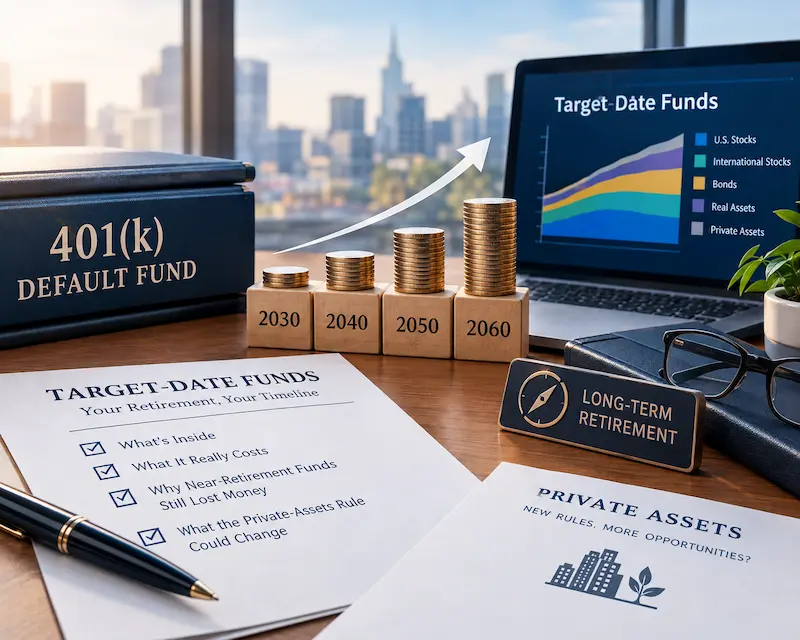
Quick answer: A target-date fund is a one-fund portfolio that moves from stocks toward bonds as your target year nears. In 401(k) plans it’s usually the default, costs about 0.27% on average, and isn’t guaranteed: 2025-dated funds lost a median 15.4% in 2022. A proposed Labor Department rule could ease adding private assets to these funds. It isn’t final and requires nothing.
What it holds, its fee, its glide path.
Who picked it, whether it’s a mutual fund or a CIT, and your right to move out.
What the SEC and the Labor Department require, and what’s only proposed.
See what fees do to your balance, including a private-assets sleeve →
Questions to send your plan administrator →
Figures and rule status verified October 30, 2026. The rule is proposed; check the Federal Register for any change.
Fee-Drag and Blended-Fee Calculator
Fund A uses one total annual fee. Fund B uses either one total fee or a blend of a base fee and a private-assets sleeve. Fill in the blend boxes only for a blend; leave them empty to use Fund B’s total fee. Nothing you type leaves this page.
What a Target-Date Fund Is
A target-date fund is a single fund that holds a mix of stocks and bonds and gradually shifts that mix as a chosen year, usually your expected retirement year, gets closer.
Most 401(k) plans use one as the default for people who don’t pick investments, which is why many savers hold one without having chosen it. The market is large and concentrated:
| Measure | Figure | Source |
|---|---|---|
| Total target-date assets, end of 2025 | $4.8 trillion | Morningstar, March 2026 |
| Share held in CITs | 54% | Morningstar, March 2026 |
| Average fee, target-date mutual funds | 0.27% | Morningstar, March 2026 |
| Share of assets held by five firms | 80% | Morningstar, March 2026 |
What’s Inside, and Who Chose It
Your fund is usually a “fund of funds”: it holds other stock and bond funds in proportions set by its glide path, and your plan’s committee, not you, picked it.
YOUR PLAN: Under the Labor Department’s default-investment rule (29 CFR 2550.404c-5), if your plan uses a qualifying default fund, you must get a notice 30 days before your first investment in it, and again each year.
YOUR FUND: It may be a mutual fund or a collective investment trust (CIT). The SEC’s investor bulletin covers mutual-fund and ETF versions and notes that target-date funds inside retirement plans may be CITs, which the SEC doesn’t regulate. CITs generally cost less and publish less public data. Ask for the fact sheet either way.
What It Really Costs
The asset-weighted average expense ratio for target-date mutual funds is 0.27%, down from 0.29% in 2024, but individual funds vary widely by provider and by index-versus-active style.
On a $100,000 balance, 0.27% is about $270 a year; a 1.00% fund is $1,000. Fees can also be layered: underlying-fund costs, plus any plan or recordkeeping charges shown separately. CITs are often cheaper for large plans. Ask for the total cost. For the math on how fees compound, see Investment Fees: What 1% Really Costs, and for the advice-fee side, Are Robo-Advisors Worth It.
Why Near-Retirement Funds Still Lost Money in 2022
In 2022 stocks and bonds fell together, so even funds built to be conservative lost money; Morningstar said 2025-dated funds all lost money regardless of glide path.
| Vintage | Median | Asset-weighted | Source |
|---|---|---|---|
| 2025 | −15.4% | −14.3% | Morningstar via InvestmentNews |
| 2055 | −18.3% | −16.8% | Morningstar via InvestmentNews |
YOUR FUND: A near-retirement date does not mean no stock risk, and bonds carry their own risk when interest rates rise. See How to Invest in Bonds.
Stress-year example: In Q1 2020, the average 2020-dated “to” fund lost 8.4%, versus 10.6% for “through” funds. Same year on the label, different results.
If you’re within a few years of retiring, the useful question is how much of your fund is in stocks at your target year and what a loss like 2022’s would mean for the money you need first. For income planning, see Retirement Income Planning.
To vs. Through: Why Two Funds With the Same Year Differ
A “to” fund finishes shifting at the target date; a “through” fund keeps shifting for years after it, so two 2040 funds can hold different mixes today.
| Feature | “To” | “Through” |
|---|---|---|
| Where the shift stops | At the target date | Years after it |
| Stock share at target date | Generally lower | Generally higher; varies by series |
| In a downturn | Q1 2020: −8.4% | Q1 2020: −10.6% |
| SEC note | Landing points sometimes fall years after retirement; same-date funds can differ in mix, results and fees. Not guaranteed. | |
Target-Year Check
For more on how allocations change with age, see Retirement Planning 2026 by Age. For one fund’s glide path in detail, see the VFORX review.
The Proposed Private-Assets Rule, Explained
The Labor Department has proposed a rule on how 401(k) fiduciaries pick investments, including private assets; as of October 30, 2026 it is proposed, not final, and it requires no plan to offer anything.
THE RULES: The proposal, Fiduciary Duties in Selecting Designated Investment Alternatives (91 FR 16088, RIN 1210-AC38), follows Executive Order 14330. It describes a process-based safe harbor: a fiduciary would weigh six factors, performance, fees, liquidity, valuation, benchmarking and complexity. It applies to all investment selections, not only alternatives.
| Date | Event | Status |
|---|---|---|
| Aug. 7, 2025 | Executive Order 14330 (90 FR 38921) | In effect; directs agencies |
| Aug. 12, 2025 | DOL rescinds its 2021 statement discouraging private equity in 401(k) menus | Done |
| Mar. 30–31, 2026 | Proposed rule announced and published | Proposed |
| June 1, 2026 | Comment period closed | Closed |
| Sept. 16, 2026 | BlackRock LifePath Solutions launched | A framework a plan sponsor can adopt |
| Oct. 30, 2026 | Final rule | Not final in sources reviewed; law-firm sources say a final rule is possible around year-end 2026 |
Public-Only Funds vs. Funds With a Private Sleeve
A private sleeve is a slice of a target-date fund held in private markets, so its cost is a blend of the base fee and the sleeve fee, not the sleeve fee alone.
Example: base fee 0.27%, a 10% sleeve at 1.30%, blended fee = 0.9 × 0.27 + 0.1 × 1.30 = 0.373%. Use the calculator to see the dollar effect.
Products so far: a State Street and Apollo fund with a 10% private-assets target (reported April 2025); Empower’s managed-account access; and BlackRock’s LifePath Solutions, which a sponsor can choose to adopt (not an automatic switch).
BlackRock has estimated private markets could add about 50 basis points a year to a target-date fund. That is a sponsor estimate, not a forecast. A sleeve must earn more than the public holdings it replaces just to cover its extra fee, and liquidity and valuation trade-offs remain.
What to look for: the sleeve’s share, how it’s valued, how quickly you can sell, and the total cost.
| Feature | Public-only fund | With a private sleeve |
|---|---|---|
| Liquidity | Daily trading | May be limited |
| Valuation | Market prices daily | Estimated, less often |
| Cost | Often lowest | Sleeve usually costs more |
| Transparency | High | Varies by product |
| Regulation | Mutual fund or CIT | Often a CIT; varies by product |
| Who decides | Your plan’s fiduciaries | |
Your Options
You can usually stay in the default, pick a different vintage, move to another plan option, or leave the default, and you generally can move at least quarterly without a penalty.
Before changing, check current limits in 401(k) Contribution Limits 2026. If you leave your employer, see How to Roll Over a 401(k) to an IRA.
Questions to Send Your Plan
These ten questions get you the fund’s fee, glide path, structure and any private holdings in writing. Tap the box to select it, then copy.
1. Which target-date series is our default, and is it index-based or actively managed?
2. Is it a mutual fund or a collective investment trust? Where is the fact sheet?
3. What is the total annual cost, including underlying funds and any other charges?
4. Is the glide path “to” or “through” retirement? Please send the glide-path chart.
5. What are the stock, bond, and other percentages at my target year and ten years after?
6. Does the fund hold, or is the plan considering adding, private assets or other alternatives? If so, how are they valued, how liquid are they, and what do they cost?
7. How will participants be told about changes to the default?
8. How often can I move out of the default, and are there any fees or limits?
9. How did this fund’s vintage for my age perform in 2022?
10. Does the plan offer a managed account or a lifetime-income option?
FAQ
What is a target-date fund?
A one-fund portfolio that gradually shifts from stocks toward bonds as a chosen year, usually your expected retirement year, approaches.
Why is it my 401(k) default?
Plans can designate a default for people who don’t pick investments. Target-date funds are the most common choice, selected by your plan’s fiduciaries.
How much do target-date funds cost?
Target-date mutual funds averaged 0.27% in 2025 (Morningstar). Individual funds vary, and CITs are often cheaper. Ask your plan for the total cost.
What’s the difference between a CIT and a mutual fund?
CITs are pooled trusts used inside retirement plans, generally cheaper with less public data. Mutual funds are SEC-regulated and widely available.
Can a target-date fund lose money near retirement?
Yes. Morningstar said 2025-dated funds all lost money in 2022. Near-retirement funds still hold stocks and bonds, and both can fall.
Why did mine lose about 15% in 2022?
Stocks and bonds fell together. The median 2025-dated fund lost 15.4% that year. Your fund’s result may differ.
What’s a “to” vs. “through” glide path?
A “to” fund stops shifting at the target date; a “through” fund keeps shifting for years afterward, so it generally holds more stock then.
Should I pick a date earlier or later than my retirement year?
An earlier date is generally more conservative; a later date generally holds more stock. This guide doesn’t recommend a date. Check your fund’s glide path.
Will the new Labor Department rule force my plan to hold private equity?
No. The proposal gives fiduciaries a selection process. It doesn’t require any plan to offer private assets.
Is the rule final?
Not in the sources reviewed as of October 30, 2026. It is proposed. Comments closed June 1, 2026; check the Federal Register for updates.
What is a private-assets sleeve?
A portion of a fund invested in private markets, such as private equity or private credit, alongside public stocks and bonds.
How would a private sleeve change my fee?
Your fee becomes a blend: (1 − sleeve share) × base fee + sleeve share × sleeve fee. Try the calculator.
Can I move out of my default fund?
Generally yes. Default-fund rules require that participants can transfer out without financial penalty. Confirm details with your plan.
How often can I change?
At least quarterly under the default-investment rule. Many plans allow more often; ask your plan administrator.
Can I find out what my fund holds?
Yes. Request the fact sheet and glide-path chart from your plan, or look up the fund’s holdings report if it’s a mutual fund.
Are target-date funds guaranteed?
No. The SEC notes they aren’t guaranteed. Funds can lose money at any time, including at and after the target date.
General information, not investment or legal advice. Fund features, fees and rule status change. The Labor Department’s rule is proposed, not final. Verified October 30, 2026. Read your plan’s documents. Last updated .

Daniel Hayes is the founder and sole researcher at AdvoraHQ. He covers U.S. personal finance, insurance, and consumer law — working directly from IRS publications, federal and state statutes, court opinions, and SEC filings rather than secondary summaries. His focus is the gap between what readers think they know and what the source documents actually say. Daniel is not a licensed attorney, CPA, or financial advisor; his articles are educational and not personalized advice. Reach him at Daniel.Hayes@advorahq.com.
