
-
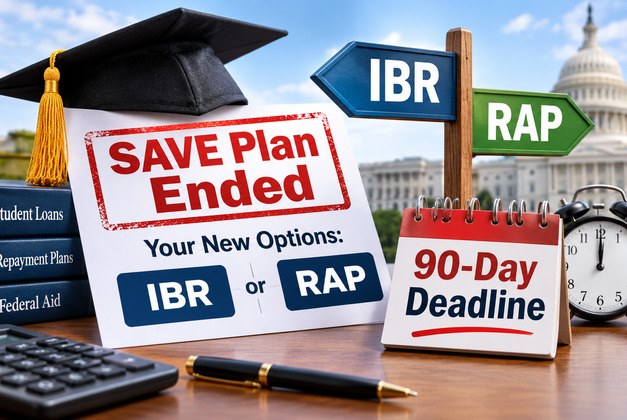
IBR
10–15% of income above 150% of poverty; can be $0; capped at the 10-year amount; forgiveness at 20–25 years.
-
RAP
1–10% of total AGI, minus $50 per dependent; minimum $10; unpaid interest waived; balance falls every month; forgiveness at 30 years.
-
Do nothing
A balance-based payment; Tiered Standard earns no PSLF credit.
Compare all three on your numbers →
- Find your deadline
- Day 91
- IBR vs. RAP
- Four examples
- PSLF & buyback
- Taxes
- How to switch
- Missed it?
- FAQ
Rules verified . 2026 poverty guidelines used for IBR.
SAVE Exit Calculator: IBR vs. RAP vs. Standard
This calculator estimates your monthly payment under IBR, RAP and the plan you would be moved to if you do nothing, using 2026 rules.
It runs in your browser. Nothing you type is stored or sent anywhere. Do not enter a Social Security number, FSA ID or account number; it never asks for one.
If this is you: Open your latest tax return and your loan list on studentaid.gov, then run the numbers once now and again if your income changes.
What Happened to SAVE (in 60 Seconds)
A federal court vacated the SAVE regulation on March 10, 2026, and the Department of Education announced on March 27 that SAVE borrowers must move to another plan.
About 7.7 million borrowers have been sitting in SAVE forbearance with no payment due. Interest has been accruing on those loans again since August 1, 2025.
Those forbearance months do not count toward PSLF or toward IDR forgiveness. Servicers began sending notices on July 1, 2026, each giving 90 days to choose.
If this is you: Treat the notice as a deadline and a chance to pick your plan. Go to the next section and find your date.
Find Your Real Deadline
Your deadline is 90 days after the date of your servicer's notice — not a date in your account dashboard.
Servicers notify borrowers in groups, so two people with the same servicer can have different deadlines. The notice tells you that you have 90 days, so you may have to count forward yourself.
Example: a notice dated July 1 runs out on September 29. A notice dated November 1 runs out on January 30, 2027.
How to find your date
- Search your email for the subject line "You Have 90 Days to Select a New Repayment Plan". Also check your servicer's message center and your postal mail.
- Write down the date on the notice and add 90 days.
- If you also find "Final Notice – You will be Placed into a New Repayment Plan in 30 Days", that is a follow-up sent after the first deadline passes. Do not plan around it. The Department has not said every borrower will get one.
- No notice yet? Notices are going out in waves. Some sources project the last deadlines in late March 2027, but no official end date has been published, so only your own notice counts.
You do not have to wait for your notice. You can apply for IBR or RAP today. Make sure your contact information is current both at studentaid.gov and with your servicer, and check your spam folder.
Early-wave deadlines passed around September 29–30, 2026. If yours has passed, go straight to Missed Your Deadline?
If this is you: Search your inbox for the notice right now and put the date plus 90 days in your calendar.
What Happens on Day 91
If you have not chosen a plan, your servicer moves you to a balance-based plan: Standard if all your loans predate July 1, 2026, or Tiered Standard if any loan was disbursed or consolidated on or after that date.
Both plans set your payment from your balance, not your income. Your servicer must tell you the new amount at least 21 days before the first due date, and an autopay withdrawal will rise to match.
Tiered Standard terms
| Balance | Term | Payments | PSLF |
|---|---|---|---|
| Under $25,000 | 10 years | 120 | No |
| $25,000–$49,999 | 15 years | 180 | No |
| $50,000–$99,999 | 20 years | 240 | No |
| $100,000 or more | 25 years | 300 | No |
Payment-shock example
Take $40,000 at 6.5% interest and a $50,000 AGI. IBR comes to about $217 a month and RAP to about $167. The 10-year Standard payment is about $454.
That gap is the cost of doing nothing. If your loans fall in Tiered Standard, the same balance would be about $348 over 15 years, and none of it counts toward PSLF.
Every option at a glance
| Plan | Payment based on | Minimum | Interest | Forgiveness | Counts for PSLF | Available if |
|---|---|---|---|---|---|---|
| IBR | 10% (first loans on or after July 1, 2014) or 15% (earlier) of income above 150% of the poverty guideline; capped at the 10-year Standard amount | $0 possible | Unpaid interest builds; not waived | 20 or 25 years | Yes | Direct and FFEL loans disbursed before July 1, 2026 |
| RAP | 1% to 10% of full AGI, divided by 12, minus $50 per dependent | $10 | Unpaid interest waived; principal match up to $50 | 30 years (360 payments) | Yes | Direct Loans; not Parent PLUS or consolidations that repaid Parent PLUS |
| Legacy 10-year Standard | Balance, over 10 years | Fixed by balance | Paid through the payment | None; paid off | Yes, with a 10-year term | Default when all loans predate July 1, 2026 |
| Tiered Standard | Balance, over 10 to 25 years | Fixed by balance | Paid through the payment | None; paid off | No | Default when any loan is disbursed or consolidated on or after July 1, 2026 |
| PAYE and ICR | Income-driven, older formulas | Varies | Varies | 20 to 25 years | Yes | Closing: closed to loans made on or after July 1, 2026 and ending no later than July 1, 2028 |
If this is you: If you work toward PSLF, make sure you are not drifting into Tiered Standard. Pick IBR or RAP before day 91.
IBR, Explained
IBR sets your payment at 10% or 15% of the income above 150% of the poverty guideline, never more than the 10-year Standard amount, and it can be $0.
The formula. (AGI minus 150% of the poverty guideline for your family size) times 10% or 15%, divided by 12. You get 10% if your first loan was on or after July 1, 2014, and 15% if it was earlier.
The poverty numbers. The 2026 guideline for the 48 states and D.C. is $15,960 for one person, plus $5,680 for each additional person. At 150% that protects $23,940 for one person, $32,460 for two, $40,980 for three and $49,500 for four. Alaska and Hawaii are higher.
Worked example. Single, $50,000 AGI: $50,000 minus $23,940 is $26,060. Times 10% is $2,606 a year, or about $217 a month.
The cap. Your payment can never exceed what you would pay on the 10-year Standard plan. On $60,000 at 6.5%, that is about $681. A single borrower earning $150,000 would owe about $1,051 by formula and pays the capped $681.
$0 payments. If your AGI is at or below 150% of the poverty guideline, your payment is $0, and a $0 payment still counts toward PSLF and IDR forgiveness.
Forgiveness. After 20 years (first loans on or after July 1, 2014) or 25 years, federally taxable unless it is PSLF.
What changed. The partial-financial-hardship test is gone. Congress removed it on July 4, 2025, so higher earners can now enroll, and the cap is what limits their payment. IBR stays open only for loans disbursed before July 1, 2026.
If this is you: Large family, low income, or a high income with a large balance? Check IBR first in the calculator.
RAP, Explained
RAP charges 1% to 10% of your full AGI, divided by 12, minus $50 per dependent, with a $10 minimum, and it waives unpaid interest.
The bands. AGI of $10,000 or less pays the $10 minimum. Above that, the rate rises 1 point for each $10,000: 1% for $10,001–$20,000, up to 9% for $90,001–$100,000, and 10% above $100,000.
Worked example. $50,000 AGI falls in the 4% band: $2,000 a year, or about $167 a month. With one dependent, subtract $50 for about $117.
Interest waiver. If your on-time payment does not cover the month's interest, the rest is waived rather than added to your balance.
Principal match. When your payment cuts principal by less than $50, the government reduces it further, up to $50 total (or your payment, if smaller). On $40,000 at 6.5%, the monthly interest is about $217. A $167 payment gets about $50 of interest waived and about $50 of principal matched, so the balance falls about $50 a month.
Forgiveness. After 360 payments (30 years), federally taxable unless it is PSLF. Advocates report that RAP has no payment cap, so high earners can pay more than they would on Standard; confirm with your servicer.
Who can use it. RAP is for Direct Loans. Parent PLUS loans, and consolidations that repaid them, are not eligible.
The full RAP math lives in our RAP plan guide.
If this is you: Single, middle income, and want your balance to shrink? Check RAP first in the calculator.
IBR vs. RAP: Four Borrowers, Four Answers
Neither plan wins for everyone: IBR is lower for very low incomes, large families and high earners, and RAP is lower for many single borrowers in the middle.
These examples use 2026 guidelines, the 48 states, 10% IBR and no income growth. The balance matters only for the cap and for what happens to your balance.
| Borrower | IBR | RAP | Takeaway |
|---|---|---|---|
| Single, $20,000 AGI | $0 | about $17 | IBR is lowest, and $0 counts for PSLF. RAP shrinks the balance. |
| Single, $50,000 AGI, $40,000 at 6.5% | about $217 | about $167 | RAP is lower. About $50 of interest is waived and the balance falls about $50 a month. |
| Family of 4, $70,000 AGI, 2 dependents | about $171 | about $250 | IBR is lower: the 150% poverty protection beats the $50 credits. |
| Single, $150,000 AGI, $60,000 at 6.5% | about $681 (capped) | about $1,250 | IBR is lower thanks to the 10-year cap, now open since the hardship test is gone. |
Single, $20,000 AGI
IBR: $0. RAP: about $17.
IBR is lowest, and $0 counts for PSLF. RAP shrinks the balance.
Single, $50,000 AGI, $40,000 at 6.5%
IBR: about $217. RAP: about $167.
RAP is lower. About $50 of interest is waived and the balance falls about $50 a month.
Family of 4, $70,000 AGI, 2 dependents
IBR: about $171. RAP: about $250.
IBR is lower: the 150% poverty protection beats the $50 credits.
Single, $150,000 AGI, $60,000 at 6.5%
IBR: about $681 (capped). RAP: about $1,250.
IBR is lower thanks to the 10-year cap, now open since the hardship test is gone. RAP is shown with no payment cap.
Source: this page's calculator, 2026 HHS guidelines, May 2026 final rule; verified November 1, 2026.
Older loans change the picture. If your first loan predates July 1, 2014, IBR uses 15%. The $50,000 example would be about $326 on IBR against $167 on RAP.
Rule of thumb for a single borrower with no dependents. At 10% IBR, the two plans cross near $30,000 AGI and again near $80,000. Between them RAP is lower, and outside them IBR is lower. This ignores the cap, so use the calculator for your own balance.
Two effects to weigh. Large families and very low incomes often pay less on IBR. But RAP's interest waiver and principal match make the balance fall, while IBR can let unpaid interest build.
A trade-off for forgiveness. Under the May 2026 final rule, RAP payments count toward RAP's 30-year clock and PSLF, but not toward IBR's 20 or 25-year clock. If you may move between the two plans, ask your servicer how your months would be counted.
If this is you: Find the row closest to your situation, then run your own numbers in the calculator.
If You're Going for PSLF
For PSLF, the lowest qualifying monthly payment wins, because forgiveness comes after 120 qualifying payments no matter how long the plan runs.
PSLF credit is cumulative and does not need to be consecutive. IBR and RAP qualify, a $0 IBR payment counts, and the legacy 10-year Standard plan qualifies. Tiered Standard never does.
| Plan | Counts? | Note |
|---|---|---|
| IBR | Yes | Includes $0 payments. |
| RAP | Yes | The May 2026 final rule confirms RAP qualifies when other PSLF rules are met. |
| Legacy 10-year Standard | Yes | Only with a 10-year term. |
| Standard on a consolidation loan, term over 10 years | No | Check with your servicer how your plan is classified. |
| Tiered Standard | No | No tier qualifies. |
| PAYE and ICR | Yes | Both end no later than July 1, 2028. |
| SAVE forbearance months | No | Only possible through buyback. |
What SAVE forbearance cost you
Months in SAVE forbearance did not earn PSLF credit. Switching to IBR or RAP now starts earning credit again going forward.
PSLF buyback
Buyback lets eligible borrowers pay to turn some forbearance months into qualifying months. The details below come from advocates' and servicers' reports, so confirm them at studentaid.gov before you rely on them.
- You generally cannot request it until you have 120 months of qualifying employment and buyback would get you to 120 payments.
- The request must include specific wording that studentaid.gov publishes.
- The price is based on what you would have owed under an eligible plan. Advocates report that since March 2026 SAVE-era months are priced from the plan you were on before SAVE, which can cost more.
- Processing has been slow. Members of Congress asked the Department about the backlog in May 2026.
Employer certification
Certify your employment with the PSLF Help Tool each year and whenever you change jobs. A separate Department rule that took effect July 1, 2026 may affect which employers qualify, so check yours in the employer search.
If this is you: Apply for IBR or RAP now so credit starts again, and save the buyback request for when you reach 120 months of qualifying employment.
Taxes on Forgiveness After 2025
Forgiveness through IBR or RAP is federally taxable again, while PSLF forgiveness stays tax-free.
The American Rescue Plan exclusion expired on December 31, 2025, so IDR forgiveness received from January 1, 2026 is generally taxable income at the federal level.
Illustration only: a forgiven $40,000 on top of a $50,000 salary would put $90,000 of income on that year's return.
State rules vary, and a few states do not follow the federal treatment. Some borrowers can reduce or avoid the tax through the insolvency exclusion, so ask a tax professional. For more detail see our guide to whether forgiveness is taxable and our overview of forgiveness programs.
If this is you: If you are not going for PSLF, plan for a possible tax bill in the year your balance is forgiven.
How to Switch, Step by Step
You switch by submitting the free income-driven repayment application at studentaid.gov.
- Find your notice. Check servicer messages, email and mail. Note the notice date and add 90 days.
- Log in to studentaid.gov. Confirm your loan types, disbursement dates and servicer.
- Gather income proof. Your latest tax return (AGI) or current pay stubs if your income dropped. Use IRS data sharing in the application.
- Run the Loan Simulator and this page's calculator, then compare.
- Apply for IBR or RAP in the online IDR application at studentaid.gov/idr. It is free.
- Going for PSLF? Certify your employment, then check whether a buyback request makes sense for your SAVE forbearance months.
- Confirm in writing. Save a screenshot of the confirmation and watch your first new bill.
- Set up autopay. Borrowers with Direct Loans disbursed on or after July 1, 2012 who enroll by December 31, 2026 get a 1% rate reduction through June 30, 2028. SAVE borrowers must choose a new plan first. Calendar your annual income recertification.
- Watch for scams. No one legitimate charges to switch plans.
If this is you: Do steps 1 to 5 this week. Applying early leaves time for your servicer to process it.
Missed Your Deadline?
If you missed it, you were most likely moved to Standard or Tiered Standard, and you can still apply for IBR or RAP.
The first step is a final 30-day notice, for borrowers who receive one. After that, your servicer places you in Standard or Tiered Standard. If you only had a pending SAVE application, you may have been returned to the plan you were on before.
The way back is the same application you would have used in the first place. Ask your servicer what to pay while it processes, and keep your confirmation.
How the months count. Months on the legacy 10-year Standard plan count for PSLF. Months on Tiered Standard do not.
If you cannot afford the new payment, apply for an income-driven plan immediately rather than skipping bills. Missed payments lead to delinquency and, eventually, default; see our wage garnishment guide for what that can mean.
If this is you: Apply for IBR or RAP today and ask your servicer what to pay in the meantime.
Other Situations
A few borrower types have special rules, so check your loan details before trusting any estimate, including ours.
Parent PLUS
RAP does not accept Parent PLUS loans or consolidations that repaid them, including double consolidations. Your options are narrower, and ED's SAVE FAQ describes a path through ICR for some of these loans. See our Parent PLUS guide and ask your servicer.
Consolidating after July 1, 2026
A consolidation loan made on or after July 1, 2026 is treated as a new loan. That sets your default plan to Tiered Standard and closes IBR for it. Do not consolidate just to simplify your bills without checking this first.
FFEL loans
SAVE covered Direct Loans only. IBR is open to FFEL loans disbursed before July 1, 2026, while RAP needs Direct Loans, and consolidating brings the issue above.
Married filing separately
Both formulas use only your income if you file separately, while filing jointly includes your spouse's. Changing filing status can cost you tax benefits, so talk to a tax professional first.
Private refinancing
Refinancing federal loans into a private loan permanently ends access to IDR, PSLF and RAP. This guide does not recommend it.
Fighting debt more broadly? See how to get out of debt.
If this is you: Ask your servicer which of your loans are Direct, FFEL, Parent PLUS or consolidated, and get the answer in writing.
FAQ
These are the questions we hear most from borrowers leaving SAVE.
What happens if I don't switch from SAVE?
After your 90 days, your servicer places you on Standard (all loans predate July 1, 2026) or Tiered Standard (any newer loan). Both set your payment from your balance, which is often much higher than an income-driven payment.
How do I find my SAVE deadline?
Find the notice, add 90 days to its date, and calendar the result. Search your email for "You Have 90 Days to Select a New Repayment Plan" and check your servicer's message center.
Why does my servicer say 2028?
A 2028 forbearance end date in your account is a system placeholder, not your deadline. Your notice date plus 90 days is what counts.
Is IBR or RAP better?
It depends on income, family size and goals. IBR tends to be lower for very low incomes, large families and high earners; RAP tends to be lower for many single borrowers in the middle and shrinks your balance. Run both in the calculator.
Can high earners get IBR now?
Yes. Congress removed the partial-financial-hardship test on July 4, 2025. IBR is open for loans disbursed before July 1, 2026, and the payment is capped at the 10-year Standard amount.
How is my IBR payment calculated?
AGI minus 150% of the poverty guideline for your family size, times 10% (first loans on or after July 1, 2014) or 15%, divided by 12, never above the 10-year Standard amount.
How is my RAP payment calculated?
1% to 10% of your full AGI by band, divided by 12, minus $50 per dependent, with a $10 minimum.
Can my payment be $0?
Under IBR, yes, when your AGI is at or below 150% of the poverty guideline. RAP has a $10 minimum even at $0 income.
Does RAP stop my balance from growing?
If you make full, on-time payments, unpaid interest is waived and the principal match reduces your balance. Late or missed payments lose those benefits.
What is the Tiered Standard plan?
A fixed-payment plan with a 10 to 25 year term set by your balance. It is the default for anyone with a loan disbursed or consolidated on or after July 1, 2026.
Does Tiered Standard count for PSLF?
No. No tier earns PSLF credit.
Does the 10-year Standard plan count for PSLF?
Yes, with a 10-year term. A Standard term longer than 10 years, as on some consolidation loans, does not. Check with your servicer.
Did SAVE forbearance count toward PSLF?
No. Those months do not count toward PSLF or IDR forgiveness unless you recover them through PSLF buyback.
How does PSLF buyback work?
You pay to convert eligible forbearance months into qualifying months. Reports say you generally need 120 months of qualifying employment first and must use the wording studentaid.gov publishes. Confirm the current process there.
Is forgiveness taxable in 2026?
IDR forgiveness is federally taxable from January 1, 2026. PSLF stays tax-free federally. State rules vary.
Will switching capitalize my interest?
Leaving SAVE does not by itself capitalize unpaid interest, according to advocates' summaries of the rules. Capitalization can happen later, for example when you leave IBR. Ask your servicer how much unpaid interest has built up before any later switch.
Can I change plans later?
Yes, you can apply to change. But moves have side effects: months may count differently between IBR and RAP, and interest can capitalize when you leave IBR, so plan the sequence before you move.
Should I refinance privately instead?
Refinancing into a private loan permanently ends IDR, PSLF and RAP protections. This guide does not recommend it.
Official Sources
These are the primary sources behind the numbers on this page, all checked November 1, 2026.
- studentaid.gov: SAVE Plan Borrowers: FAQs About Choosing a Different Repayment Plan
- studentaid.gov: court actions on SAVE
- studentaid.gov: Repayment Calculator and Loan Simulator
- HHS ASPE: 2026 poverty guidelines
- Federal Register: RISE final regulations (May 1, 2026)
- Department of Education: Dear Colleague Letter GEN-25-04
- Congressional Research Service: The Repayment Assistance Plan (IF13075)
- P.L. 119-21 (One Big Beautiful Bill Act)
- 34 CFR 685.219: Public Service Loan Forgiveness
Last updated: .
This article is general information, not legal or financial advice. Rules were verified on November 1, 2026 and are subject to change. Estimates may differ from your servicer's calculation. Confirm everything with studentaid.gov and your servicer.

Daniel Hayes is the founder and sole researcher at AdvoraHQ. He covers U.S. personal finance, insurance, and consumer law — working directly from IRS publications, federal and state statutes, court opinions, and SEC filings rather than secondary summaries. His focus is the gap between what readers think they know and what the source documents actually say. Daniel is not a licensed attorney, CPA, or financial advisor; his articles are educational and not personalized advice. Reach him at Daniel.Hayes@advorahq.com.
