
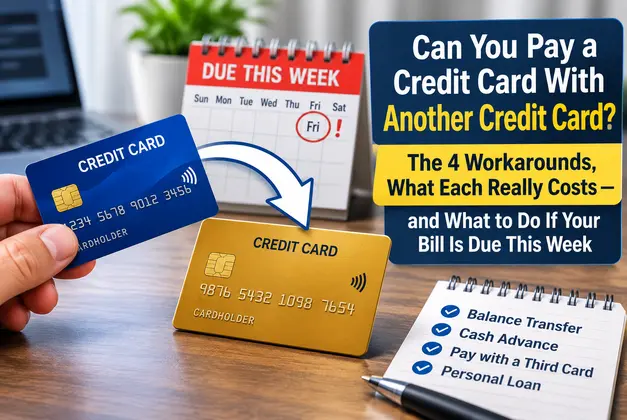
Quick answer: Not directly. Card issuers won’t accept another credit card as payment. But you can move the money indirectly with a balance transfer, a cash advance, a credit card check, or a payment app. Each one costs something, and they don’t all arrive in time.
If your bill is due within the next two weeks, a balance transfer may not post in time. Pay at least the minimum from your bank account first, even if you plan a transfer.
Missing the due date by a few days usually means a late fee, not a credit-score hit. Late payments generally aren’t reported until they’re 30 days past due.
Compare all four options on your own card’s terms →
Which situation are you in?
| Method | Typical cost | Interest starts | How fast | Biggest catch |
|---|---|---|---|---|
| Balance transfer | 3%–5% fee | After any promo period | Days to weeks | Same-issuer block; needs approval |
| Cash advance | 3%–5% or $5–$10 minimum, whichever is greater | Day one | Same day for the cash | Highest APR |
| Credit card check | Depends on the offer | Depends on the offer | Mail and deposit time | May be a cash advance |
| Payment app | About 3% | May be day one | Varies | Possible double fee |
Verified November 3, 2026. Fees and timelines vary by card. Check your own card agreement.
Which Option Arrives in Time — and What Does It Cost?
Enter your own card terms and get an estimate of cost and timing for each option. Nothing you type leaves this page, and you should never enter card numbers or bank details. Values marked (typical) are placeholders: replace them with your card’s terms.
Need help if you can’t cover the minimum? See Credit Card Hardship Programs.
Why You Can’t Pay a Card With a Card Directly
Issuers generally don’t accept one credit card as payment for another.
The usual accepted methods are a bank transfer (ACH), a check, or a money order. Some issuers accept debit cards under their own rules, so check yours.
The Clock Matters More Than the Method
Which workaround you use matters less than whether the money gets there before your cutoff.
Under 12 CFR §1026.10, an issuer’s cutoff for payments can be no earlier than 5 p.m. on the due date, at the location it specifies for receiving payments. In-person branch payments are an exception: the cutoff can be earlier if the branch closes before 5 p.m.
Transfer times are issuer-stated and vary. Chase puts most balance transfers at 2 to 21 days, and new accounts may face an initial waiting period. Some issuers, including American Express, can take up to six weeks. Issuers tell you to keep paying at least the minimum on the old card until the transfer posts.
A balance transfer can take 2–21 days or more. Keep paying the old card until it posts.
| Day | What can happen | Source |
|---|---|---|
| Day 1 after the due date | A late fee can apply. | Your card agreement |
| Day 30 | The late payment may be reported to the credit bureaus. | Experian (industry practice, not a statute) |
| Day 60 | A penalty APR may apply to your existing balance if the minimum payment hasn’t been received within 60 days after the due date. | 12 CFR §1026.55(b)(4) |
| Later | Collections and charge-off. See what happens if you don’t pay. | Issuer policy |
Option 1: Balance Transfer
A balance transfer moves what you owe to a new card, usually for a fee of 3%–5%, and it needs approval and time.
The transfer plus its fee generally can’t exceed your available credit on the new card. On $1,500, a 3% fee is $45 and a 5% fee is $75.
You typically can’t transfer a balance between two cards from the same bank. Chase’s own guidance says you can’t transfer a balance between two Chase-issued cards.
More: Balance Transfer Credit Cards, No Fee Balance Transfer Cards, Balance Transfer vs. Debt Consolidation, Your 0% APR Is Ending.
Clock: 2+ WEEKS AWAY. It can’t rescue a bill due this week.
Option 2: Cash Advance
A cash advance gets you money fast, but it’s usually the most expensive way to be on time.
The fee is typically 3%–5% or a $5–$10 minimum, whichever is greater. Interest starts the day you take it, with no grace period, often at a higher APR. Your cash advance limit is often lower than your total credit limit.
A cash advance starts charging interest the day you take it.
Example: a $1,000 advance with a 5% fee ($50) at a 29% APR, repaid in equal monthly principal payments, costs about $98 over 3 months and about $135 over 6 months.
More: Credit Card Cash Advance: The Real Cost.
Clock: DUE TODAY. The most expensive way to be on time.
Option 3: Credit Card Checks
A card check is processed as either a balance transfer or a cash advance, and only your offer letter says which.
U.S. Bank’s cardmember agreements list a convenience check fee of $5 to $10 or 3% to 5% of the advance, whichever is greater, and say the offer materials explain whether a check posts as an advance or as a balance transfer. Read the offer before you write one.
Clock depends on the offer: mailing and deposit time count.
Option 4: Payment Apps and Bill-Pay Services
Apps charge about 3% when funded by a credit card, and your issuer may charge a second fee on top.
Plastiq does not accept credit card payments.
Some issuers may code app payments as cash advances, which can mean a double fee. PayPal’s own fee page warns that your card company may charge a cash-advance fee on a card-funded personal payment. Ask your issuer before you use one.
| Service | Can it pay a credit card bill? | Fee when funded by a credit card | May your issuer treat it as a cash advance? |
|---|---|---|---|
| Plastiq | No. It doesn’t accept payments to credit cards. | Not applicable (2.99% as of January 2026 on payments it does allow) | Not applicable |
| PayPal (personal) | Not directly | 2.9% plus $0.30 (confirm on PayPal’s fee page) | May be; depends on the issuer |
| Venmo | Not directly | 3% | May be; depends on the issuer |
| Cash App | Not directly | 3% | May be; depends on the issuer |
| Zelle, Apple Cash, Google Pay | Can’t be funded by a credit card | Not applicable | Not applicable |
Clock: varies. Don’t count on an app for a bill due today unless the app and your issuer both confirm the timing.
Is Paying a Few Days Late Cheaper?
Sometimes, for a small bill and a short delay, but not always, and never past day 30.
The CFPB’s $8 late-fee rule was vacated on April 15, 2025 (N.D. Tex.), so the earlier Regulation Z safe-harbor framework applies: the safe-harbor amounts are $30 for a first late payment and $41 for a repeat within six billing cycles. Issuers can also justify higher fees with a cost analysis, so your agreement shows your actual fee. A late fee also can’t exceed your minimum payment due (§1026.52(b)(2)).
| Amount | Late fee (example) | Cash advance cost over 1 month | Cash advance cost over 3 months |
|---|---|---|---|
| $300 | $30 | about $22 | about $30 |
| $500 | $30 | about $37 | about $49 |
| $1,500 | $30 | about $111 | about $148 |
Honest read: at $300 for a month, the cash advance can cost a little less than the late fee. At $500 it costs a little more, and at $1,500 about four times more ($111 vs. $30). A late fee adds no new debt, and you can ask for a waiver. A repeat late payment costs more, and a cash advance doesn’t remove the original balance’s interest.
Late fee ≠ credit damage. Day 30 is the line that matters. Per Experian, late payments generally aren’t reported before then. That’s industry practice, not a law.
Call Your Issuer First
A five-minute call before the due date can cost nothing and may save you a fee.
Ask about moving your due date, waiving the late fee if you pay by a set date, a payment plan, and any hardship program. Nothing is guaranteed, but asking before you’re late helps. See Credit Card Hardship Programs.
The 72-Hour Plan
If your bill is due in the next three days, do these steps in order.
- Find your exact cutoff time on your statement or app. It can’t be earlier than 5 p.m. on the due date, except at a branch that closes earlier.
- Pay the minimum from any bank account you can, even if you plan a transfer later.
- Can’t cover the minimum? Call the number on the back of your card before the due date. Ask: Can my due date be moved? Will you waive the late fee if I pay by [date]? Do you have a hardship program?
- Don’t stack fees blindly. Before using a payment app, ask your issuer whether that app is treated as a cash advance.
- If you missed it, pay as soon as you can. Day 30 is the reporting line, and day 60 is when a penalty APR can apply to your existing balance.
- Write down who you spoke to, the date, and what they agreed to.
When Paying One Card With Another Is a Warning Sign
If you’re doing this every month, the workaround isn’t the problem; the gap between income and bills is.
Each round adds fees and interest. A nonprofit credit counselor can review your whole budget, and sometimes set up a payment plan, at low or no cost.
Next: Is a Debt Management Plan Worth It?, How to Pay Off Credit Card Debt Fast, What Happens If You Don’t Pay.
Can You Earn Rewards Doing This?
Generally no: cash advances and balance transfers usually don’t earn rewards, so check your card terms. The fees and interest cost more than anything you’d earn. See How Credit Card Interest Works.
FAQ
Can you pay a credit card with another credit card?
Not directly. You can move money indirectly with a balance transfer, cash advance, card check, or payment app, and each has costs.
Can I pay my credit card bill with a debit card?
Some issuers accept debit cards under their own rules. Bank transfer (ACH), check, and money order are the usual methods.
Can I do a balance transfer between two cards from the same bank?
Typically not. Chase states you typically can’t transfer balances among its cards. Check your issuer.
How long does a balance transfer take?
Chase puts most at 2 to 21 days, and some issuers, including American Express, can take up to six weeks. New accounts may face a waiting period.
Do I still need to pay my old card while a transfer is pending?
Yes. Issuers say to keep making at least the minimum payment until the transfer posts.
Does the balance transfer fee count toward my credit limit?
Generally yes. The transfer plus its fee generally can’t exceed your available credit.
Can I pay a credit card with a cash advance?
Yes, by taking the cash and paying from your bank. It costs a fee plus interest from day one.
Does cash advance interest start right away?
Yes. There’s no grace period, and the APR is often higher.
Is a convenience check a cash advance?
Sometimes. It’s processed as a balance transfer or a cash advance depending on the offer, so read the offer letter.
Can I use PayPal or Venmo to pay a credit card with a credit card?
Not directly. Funding them with a credit card costs about 3% (PayPal: 2.9% plus $0.30), and your issuer may also charge a cash advance fee.
Can I use Plastiq to pay my credit card bill?
No. Plastiq doesn’t accept payments to credit cards.
What time is my credit card payment due?
The cutoff can be no earlier than 5 p.m. on the due date at the location the issuer specifies, except at a branch that closes earlier. Check your statement.
Does paying a few days late hurt my credit score?
Usually you’ll face a late fee first. Per Experian, late payments generally aren’t reported until 30 days past due. That’s practice, not law.
When does a penalty APR apply?
On an existing balance, only when the issuer hasn’t received your minimum payment within 60 days after the due date (§1026.55(b)(4)), after sending you notice.
How much can a late fee be?
It can’t exceed your minimum payment due. Regulation Z’s safe-harbor amounts are $30 for a first late payment and $41 for a repeat within six billing cycles; your agreement shows your actual fee.
Can I change my credit card due date?
Some issuers allow it. Ask when you call.
Last updated:
This article is general information, not financial advice. Fees, rates, credit limits, and processing times depend on your card agreement and issuer. Calculator results are estimates. Facts verified on November 3, 2026.

Daniel Hayes is the founder and sole researcher at AdvoraHQ. He covers U.S. personal finance, insurance, and consumer law — working directly from IRS publications, federal and state statutes, court opinions, and SEC filings rather than secondary summaries. His focus is the gap between what readers think they know and what the source documents actually say. Daniel is not a licensed attorney, CPA, or financial advisor; his articles are educational and not personalized advice. Reach him at Daniel.Hayes@advorahq.com.
