
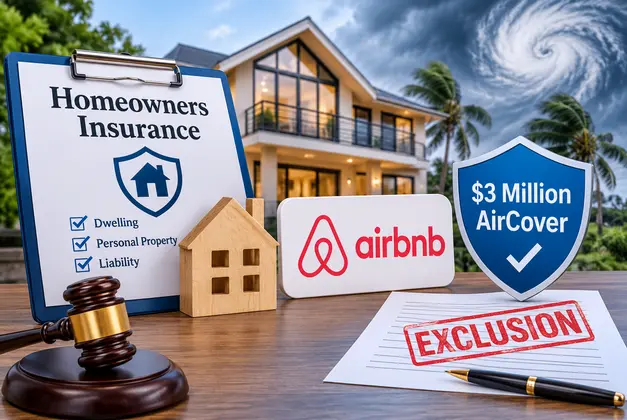
Quick answer. Usually not. Most homeowners policies treat paid hosting as a business activity and exclude it, unless you add a home-sharing endorsement or buy a policy built for rentals. Airbnb’s AirCover helps, but only half of it is insurance.
Where your listing is changes how that $3M is backed. In Washington it is secured by an insurance policy. In Arkansas it is backed only by Airbnb. In Virginia, regulators challenged it in 2026. Jump to the state table.
Not sure where you stand? Answer 7 questions to see which coverage to ask your insurer about.
Four ways hosts are protected, and where each one stops
Each protection below carries one of three labels: INSURANCE a regulated policy, GUARANTEE a platform promise that is not insurance, and NOT COVERED a gap you fill yourself.
Standard homeowners policy
INSURANCE for everyday living. For hosting, often NOT COVERED.
- Is it insurance?
- Yes, a regulated policy, but hosting may fall under its business wording.
- Your property?
- May be limited or excluded once it is rented. Read the business wording.
- Guest injury?
- A business exclusion can remove liability coverage for injury arising from hosting.
- Off-platform?
- The question turns on the activity, not where the guest booked.
Airbnb AirCover
INSURANCE Host liability. GUARANTEE Host damage protection.
- Is it insurance?
- Half of it. Liability is underwritten by insurers. Damage protection is a guarantee, not insurance.
- Your property?
- Only through the guarantee, up to $3M, after the responsible guest fails to pay.
- Guest injury?
- Host liability insurance, up to $1M per Airbnb stay, subject to exclusions.
- Off-platform?
- No. Airbnb bookings only.
Home-sharing endorsement
INSURANCE An add-on to a homeowners policy.
- Is it insurance?
- Yes, if your insurer offers one for your policy form and state.
- Your property?
- Can extend property coverage for hosting, within its terms and limits.
- Guest injury?
- Can extend liability coverage. Limits vary by insurer.
- Off-platform?
- ISO’s definition refers to an online platform, so ask how a direct booking is treated.
Short-term rental policy
INSURANCE Built for dedicated rentals.
- Is it insurance?
- Yes, a policy written around rental use.
- Your property?
- Ask what it includes for the building, contents and lost rent.
- Guest injury?
- Ask for the liability limit and exclusions in writing.
- Off-platform?
- Ask whether direct and other-platform bookings are included.
Checked November 3, 2026. Airbnb and Vrbo terms checked that day. Platform terms and the Virginia matter can change. Confirm your coverage with your insurer in writing.
Host Coverage Check
Answer seven questions to get an issue checklist: the gaps to look at, the policy types to ask about, and what your platform’s protection does for your setup. It never says you are or are not covered. Nothing you choose is stored or sent anywhere.
Your checklist
Why Your Homeowners Policy Usually Doesn’t Cover Hosting
Many homeowners policies treat paid hosting as a business activity, and business activities are commonly excluded or limited.
The National Association of Insurance Commissioners (NAIC) warns that listing a home on a rental platform with any frequency makes it likely the policy will treat the activity as a business. Its 2016 home-sharing paper says the activity may be “defined in the policy as a home-based business.”
The same paper explains that many policies carry a business exclusion that can remove liability coverage for injury or property damage connected to that activity. NAIC’s consumer guidance adds that an insurer may deny a claim tied to short-term renting even where the policy has no home-sharing exclusion.
What ISO’s home-sharing forms add
ISO is the advisory organization whose forms many insurers adapt. In 2017 it introduced home-sharing wording in two parts.
One part is an exclusion. It defines “home-sharing host activities” arranged through an online platform as a business activity, which takes them out of the base homeowners coverage.
The other part is optional. The broadened home-sharing endorsements (the HO 06 6x series) extend property and liability coverage for hosting. They match the base form: HO 06 63 attaches to the HO 00 03, HO 06 65 to the HO 00 05, and so on. The current edition is 09 22.
In ISO’s 2022 program, the exclusion was folded into the standard homeowners forms, and the standalone exclusion endorsement (HO 06 53) was withdrawn. Insurers file their own versions, so check the form numbers and wording printed on your own policy.
Trade-press analysis of the 09 22 broadened endorsement describes homeowners coverage as primary over platform-provided insurance, protection plans or guarantees. Other wording is possible, which is why “who pays first” has no single answer. Read your endorsement and the platform’s terms side by side.
How a storm claim can get pulled in
Business wording is not limited to liability. ISO’s Coverage B wording for other structures carves out structures from which a “business” is conducted, with a carve-back for structures used primarily for home-sharing. A rented guest house or ADU can raise that question even when a storm, not a guest, caused the loss.
Whether it does for you depends on your policy’s wording, your state and the facts of the loss.
Ask your insurer for the exact definition of “business” in your policy and where home-sharing is addressed. For the same exclusion family applied to other work done at home, see Running a Business From Home? Homeowners Limits. For other items that sit outside a standard policy, see Homeowners Insurance: Hidden Coverages.
AirCover Has Two Halves, and Only One Is Insurance
Host liability insurance is insurance; Host damage protection is a guarantee that Airbnb’s own terms say is not insurance.
AirCover for Hosts bundles several protections:
- $3 million Host damage protection (HDP)
- $1 million Host liability insurance (HLI)
- $1 million Experiences and Services liability insurance
- Guest identity verification and reservation screening
- A 24-hour safety line
Host liability insurance
INSURANCE Up to $1 million per Airbnb stay.
- Underwritten by third-party insurers. Airbnb’s program page (help article 3145, last updated June 30, 2026) names several carriers, which vary by jurisdiction.
- Responds when you are found legally responsible for bodily injury or property damage to a guest or others from an event during a stay. It also includes defense costs for formal complaints.
- Does not pay for damage to your own property.
- Many exclusions apply, including assault and battery, communicable disease, pollution (with exceptions) and punitive damages. Airbnb says its list is not exhaustive.
- Since March 1, 2025, a host with six or more active listings may find it requires contribution from other insurance or applies as excess, depending on that other policy’s wording.
Host damage protection
GUARANTEE Up to $3 million for losses from a stay.
- Section 2.5 of the Host Damage Protection Terms (help article 2869, last updated August 1, 2026) says the terms are not an insurance contract and the guarantee does not replace insurance.
- The responsible guest has the primary obligation to compensate you. Airbnb guarantees that obligation (Sections 2.1 and 2.3).
- Airbnb pays only if the guest fails to pay the amount in the damage report (Section 3.2).
- You must pursue the guest and notify Airbnb within 14 days of checkout, and file the payment request within 30 days of checkout (Sections 3.1 and 3.3).
- US claims go to binding individual arbitration with a class action waiver (Section 12). The terms also point to small claims court as an alternative.
- Applies only to accommodations on the Airbnb platform, and not to hosts who contract with Airbnb Travel, LLC. Japan has a separate program.
Airbnb’s terms recommend that hosts buy separate insurance for losses outside HDP. The practical difference between the halves is who regulates the promise and where a dispute goes: a regulated policy answers to your state’s insurance department, while a platform guarantee answers to the platform’s own terms and its arbitration clause.
Both halves apply only to Airbnb bookings, and neither replaces a policy on your own property.
Why AirCover Works Differently Depending on Your State
Airbnb’s terms back the damage guarantee differently in Washington, Minnesota and Arkansas, and Virginia’s insurance regulator challenged it in 2026.
Washington
- How it’s backed
- Secured by an insurance policy Airbnb purchased. Hosts are loss payees and the insurer pays them directly. Under the 2023 order, claim decisions are made by an adjuster licensed in Washington.
- Source
- Airbnb terms (article 2869), Section 1; Washington Insurance Commissioner; Insurance Journal
- Date
- 2023 order; terms updated August 1, 2026
Minnesota
- How it’s backed
- Backed by a reimbursement insurance policy. If Airbnb has not performed within 90 days after proof of loss is filed, the host may claim directly against the insurer.
- Source
- Airbnb terms (article 2869), Section 1
- Date
- Terms updated August 1, 2026
Arkansas
- How it’s backed
- Not covered by a reimbursement insurance policy. Backed only by Airbnb.
- Source
- Airbnb terms (article 2869), Section 1
- Date
- Terms updated August 1, 2026
Virginia
- How it’s backed
- Pending. The Bureau of Insurance maintains HDP is insurance offered without a license. Airbnb says it is lawful and not insurance. We found no outcome as of November 3, 2026.
- Source
- Insurance Journal, June 12, 2026; Claims Journal, June 15, 2026
- Date
- 2026 challenge; checked November 3, 2026
Other states
- How it’s backed
- An Airbnb guarantee, not insurance, backed by Airbnb under its terms.
- Source
- Airbnb terms (article 2869), Section 2.5
- Date
- Terms updated August 1, 2026
From Airbnb’s Host Damage Protection Terms (help article 2869, last updated August 1, 2026), accessed November 3, 2026, plus the sources named in each card.
| State | How it’s backed | Source | Date |
|---|---|---|---|
| Washington | Secured by an insurance policy Airbnb purchased. Hosts are loss payees and the insurer pays them directly. Under the 2023 order, claim decisions are made by an adjuster licensed in Washington. | Airbnb terms (article 2869), Section 1; Washington Insurance Commissioner; Insurance Journal | 2023 order; terms updated August 1, 2026 |
| Minnesota | Backed by a reimbursement insurance policy. If Airbnb has not performed within 90 days after proof of loss is filed, the host may claim directly against the insurer. | Airbnb terms (article 2869), Section 1 | Terms updated August 1, 2026 |
| Arkansas | Not covered by a reimbursement insurance policy. Backed only by Airbnb. | Airbnb terms (article 2869), Section 1 | Terms updated August 1, 2026 |
| Virginia | Pending. The Bureau of Insurance maintains HDP is insurance offered without a license. Airbnb says it is lawful and not insurance. We found no outcome as of November 3, 2026. | Insurance Journal, June 12, 2026; Claims Journal, June 15, 2026 | 2026 challenge; checked November 3, 2026 |
| Other states | An Airbnb guarantee, not insurance, backed by Airbnb under its terms. | Airbnb terms (article 2869), Section 2.5 | Terms updated August 1, 2026 |
Washington, 2023: the resolved precedent
In May 2023, Washington’s Insurance Commissioner fined Airbnb $20,000 for acting as an unauthorized insurer. The order required Airbnb to secure a surplus lines policy to keep offering the program in the state.
Airbnb also agreed to review previously denied Washington HDP claims filed since January 1, 2021, and to pay any covered costs that were improperly denied.
The state reported nearly 13,000 reimbursement requests from Washington hosts between January 2019 and March 2022. Of those, 5,525 went directly to Airbnb, and Airbnb paid 3,565 of them, a total of just over $2.3 million.
At the time, Airbnb said the program was a guarantee of a guest’s obligation and not an insurance policy. Washington’s order was a consent order, not a court ruling.
Minnesota and Arkansas
Under Airbnb’s terms, Minnesota hosts have a reimbursement insurance policy behind the guarantee, and may claim directly against the insurer if Airbnb has not performed within 90 days after proof of loss is filed.
For Arkansas, the terms say the obligations are not covered by a reimbursement insurance policy and are backed only by Airbnb.
Virginia, 2026: pending
In June 2026, the Virginia Bureau of Insurance told Airbnb it considers Host Damage Protection an insurance product offered without a license or certificate of authority. The Bureau notes that Host liability insurance is underwritten by a licensed carrier and HDP is not.
The Bureau’s reasoning, as reported by Insurance Journal, is that Airbnb contractually undertakes to indemnify hosts up to $3 million for contingent covered losses and controls the claims process. It reportedly seeks fines and a halt to HDP in the state unless Airbnb becomes licensed or engages a carrier.
Airbnb disputes this. It told Insurance Journal that the program “is lawful and is not – and has never been – insurance.”
This is a pending regulatory matter before the State Corporation Commission, not a lawsuit, and nothing has been decided. Reports say Airbnb was given until July 31, 2026 to respond by negotiating a settlement or agreeing to defend itself at a hearing starting December 14, 2026. We found no published outcome as of November 3, 2026. Check the Commission’s docket for the current status.
For a host, nothing changes today in how to read the program. Treat damage protection as a guarantee and keep your own coverage in place.
What AirCover Doesn’t Cover
AirCover applies only to Airbnb bookings and only within its terms, so it leaves gaps you fill with your own coverage.
- NOT COVERED Bookings made elsewhere. Vrbo, Booking.com and direct bookings fall outside both halves.
- NOT COVERED Not all damage. The terms list ineligible property and excluded losses. Examples include animals and most vehicles and watercraft as ineligible property, and mold, electronic data and natural events among excluded losses. Read the full lists in article 2869.
- NOT COVERED Losses that are not guest-caused. HDP responds to losses caused by guests as the terms define them. A burst pipe or a storm is a matter for your own property policy.
- NOT COVERED Your own property under the liability half. Host liability insurance pays for your legal liability to others, not for damage to your place.
- GUARANTEE The reporting windows. Fourteen days from checkout to pursue the guest and notify Airbnb, and 30 days from checkout to file the payment request. The terms do not say what happens if you miss a window, so treat both dates as firm.
- GUARANTEE The guest comes first. Airbnb pays only after the responsible guest fails to pay, and disputes go to arbitration.
- INSURANCE The liability half has exclusions too. Assault and battery, communicable disease and punitive damages are among them.
Your own policy is still needed for the building, your contents, and losses AirCover does not reach. For the claim process after damage, jump to the first 14 days.
Vrbo, Booking.com, and Direct Bookings
Vrbo provides liability insurance for eligible bookings but does not pay for damage to your own place, and direct bookings have no platform protection at all.
Vrbo
INSURANCE Vrbo’s $1 million Liability Insurance is serviced by Generali Global Assistance. Vrbo is the policyholder, and owners and property managers are the insured parties. Vrbo’s page describes the limit as $1 million per property, per policy year, for reservations processed through Vrbo checkout.
It covers liability and medical payments claims, such as a traveler’s injury or damage to someone else’s property. Vrbo says it works alongside your own liability policy. A deductible may apply in some situations, so read the program page.
For guest-caused damage to your property, Vrbo relies on a security deposit you require or a Property Damage Protection plan the guest buys through Generali. Plan options and amounts change, so check Vrbo’s current help page. Source: Vrbo, $1M Liability Insurance page, accessed November 3, 2026 (the page shows no update date).
Booking.com and other platforms
Each platform sets its own host protections and terms. This article does not summarize Booking.com’s program. Read its current host terms and ask your insurer how those bookings are treated.
Direct bookings
NOT COVERED A booking you take yourself comes with no platform protection. Any liability or damage coverage has to come from your own policies, so ask whether your policy or endorsement still applies to a stay that did not come through a platform. ISO’s home-sharing definition refers to an online platform.
Your Four Coverage Options
Four kinds of coverage are common for hosts, and which ones fit depends on whether you share your home, rent it out whole, or run a dedicated rental.
1. Home-sharing endorsement
An add-on to a homeowners policy, usually for a primary residence. It can extend property and liability coverage for hosting within its terms. Ask what limits apply to nights, rooms and guests, and how it treats bookings outside a platform.
2. Landlord or dwelling-fire (DP) policy
Built around longer-term tenants. Ask whether the insurer accepts short stays at all, and how it handles lost rent when stays are short.
3. Short-term rental policy
Written for dedicated rentals. Ask what it includes for the building, contents, liability and lost rent, and whether direct bookings count.
4. Umbrella policy
Adds liability above your underlying policies. Some exclude rental activity, so ask before relying on one. See Umbrella Insurance and Excess Liability vs. Umbrella.
Table 1: How hosts are protected, side by side
AirCover Host damage protection
GUARANTEE
- Damage to your property?
- Responds to guest-caused losses within the terms, up to $3 million, after the guest fails to pay.
- Guest injury claims?
- No.
- Off-platform bookings?
- No. Airbnb bookings only.
- Main catch
- Not insurance per Airbnb’s terms. The guest pays first, two reporting windows apply, and disputes go to arbitration.
AirCover Host liability insurance
INSURANCE
- Damage to your property?
- No. It does not pay for damage to your own property.
- Guest injury claims?
- Responds to your legal liability for bodily injury or property damage to guests or others, up to $1 million per stay.
- Off-platform bookings?
- No. Airbnb stays only.
- Main catch
- Many exclusions. With six or more active listings it may apply as excess.
Vrbo $1M liability
INSURANCE
- Damage to your property?
- No.
- Guest injury claims?
- Responds to liability and medical payments claims for eligible bookings.
- Off-platform bookings?
- Only bookings processed through Vrbo checkout.
- Main catch
- Does not pay for damage to your own place. Limit is per property, per policy year, per Vrbo’s page.
Standard homeowners policy
INSURANCE for everyday living. Hosting may be NOT COVERED.
- Damage to your property?
- Often limited or excluded once the home or an outbuilding is rented. Read the business wording.
- Guest injury claims?
- A business exclusion can remove liability coverage for injury arising from hosting.
- Off-platform bookings?
- Turns on the activity, not the channel. Read your wording.
- Main catch
- An insurer may deny a claim tied to short-term renting even without a home-sharing exclusion (NAIC).
Homeowners plus home-sharing endorsement
INSURANCE
- Damage to your property?
- Can extend property coverage for hosting, within its terms and limits.
- Guest injury claims?
- Can extend liability coverage. Limits vary by insurer.
- Off-platform bookings?
- ISO’s definition refers to an online platform. Ask how a direct booking is treated.
- Main catch
- Wording varies. Some forms make homeowners coverage primary over platform protection.
Landlord (DP) policy
INSURANCE
- Damage to your property?
- Built around longer-term tenants. Ask how it treats short stays.
- Guest injury claims?
- Ask for the liability terms in writing.
- Off-platform bookings?
- Ask.
- Main catch
- May not be designed for frequent turnover.
Short-term rental policy
INSURANCE
- Damage to your property?
- Built for dedicated rentals. Ask what it includes for the building, contents and lost rent.
- Guest injury claims?
- Ask for the limit and exclusions.
- Off-platform bookings?
- Ask whether direct and other-platform bookings are included.
- Main catch
- Wording varies by insurer. Compare in writing.
Sources: Airbnb help articles 2869 and 3145, Vrbo’s liability insurance page, the NAIC home-sharing publication and ISO form commentary, all listed under Sources and Access Dates. Checked November 3, 2026.
| Protection | INSURANCE or GUARANTEE? | Damage to your property? | Guest injury claims? | Off-platform bookings? | Main catch |
|---|---|---|---|---|---|
| AirCover Host damage protection | GUARANTEE | Responds to guest-caused losses within the terms, up to $3 million, after the guest fails to pay. | No. | No. Airbnb bookings only. | Not insurance per Airbnb’s terms. The guest pays first, two reporting windows apply, and disputes go to arbitration. |
| AirCover Host liability insurance | INSURANCE | No. It does not pay for damage to your own property. | Responds to your legal liability for bodily injury or property damage to guests or others, up to $1 million per stay. | No. Airbnb stays only. | Many exclusions. With six or more active listings it may apply as excess. |
| Vrbo $1M liability | INSURANCE | No. | Responds to liability and medical payments claims for eligible bookings. | Only bookings processed through Vrbo checkout. | Does not pay for damage to your own place. Limit is per property, per policy year, per Vrbo’s page. |
| Standard homeowners policy | INSURANCE for everyday living. Hosting may be NOT COVERED. | Often limited or excluded once the home or an outbuilding is rented. Read the business wording. | A business exclusion can remove liability coverage for injury arising from hosting. | Turns on the activity, not the channel. Read your wording. | An insurer may deny a claim tied to short-term renting even without a home-sharing exclusion (NAIC). |
| Homeowners plus home-sharing endorsement | INSURANCE | Can extend property coverage for hosting, within its terms and limits. | Can extend liability coverage. Limits vary by insurer. | ISO’s definition refers to an online platform. Ask how a direct booking is treated. | Wording varies. Some forms make homeowners coverage primary over platform protection. |
| Landlord (DP) policy | INSURANCE | Built around longer-term tenants. Ask how it treats short stays. | Ask for the liability terms in writing. | Ask. | May not be designed for frequent turnover. |
| Short-term rental policy | INSURANCE | Built for dedicated rentals. Ask what it includes for the building, contents and lost rent. | Ask for the limit and exclusions. | Ask whether direct and other-platform bookings are included. | Wording varies by insurer. Compare in writing. |
Airbnb Earnings Protection
Launched in 2026, Earnings Protection is an optional paid insurance plan offered with MIC Global. It covers lost hosting income from certain unexpected events, based on past earnings, with plans for one to three months of earnings.
Eligibility, per Airbnb: five or fewer listings, more than 50 nights reserved on a listing in the past year, and a year of hosting experience. At launch it was available in 45 states and the District of Columbia, with Indiana, Maine, Missouri, New Jersey and New York expected in early 2027. It protects income, not your property or your liability. Checked November 3, 2026.
Table 4: Which setup needs what
A room in your home
- Policy types to ask about
- Home-sharing endorsement. Umbrella (ask about rental exclusions).
- Watch for
- Whether the endorsement applies when you are home, and any limits on rooms, guests or nights.
Your whole home, occasionally
- Policy types to ask about
- Home-sharing endorsement. Short-term rental policy if bookings are frequent.
- Watch for
- How the policy treats the home while you are away, and any night limits.
A guest house or ADU
- Policy types to ask about
- Home-sharing endorsement (ask whether it reaches other structures). Landlord or short-term rental policy.
- Watch for
- Business wording for other structures, and local permit and zoning rules.
A second home
- Policy types to ask about
- Short-term rental policy. Landlord policy (ask about short stays).
- Watch for
- Vacancy rules, how the policy form differs for a second home, and local permit rules.
A dedicated rental
- Policy types to ask about
- Short-term rental or commercial policy. Landlord policy (ask about short stays).
- Watch for
- How lost rent is calculated, whether direct bookings count, and proof-of-insurance rules for your permit.
Several platforms plus direct bookings
- Policy types to ask about
- Short-term rental policy, or an endorsement not tied to one platform.
- Watch for
- Each platform protects only its own bookings, and ISO’s home-sharing definition refers to an online platform.
Questions to bring to your agent, not recommendations. Checked November 3, 2026.
| Your setup | Policy types to ask about | Watch for |
|---|---|---|
| A room in your home | Home-sharing endorsement. Umbrella (ask about rental exclusions). | Whether the endorsement applies when you are home, and any limits on rooms, guests or nights. |
| Your whole home, occasionally | Home-sharing endorsement. Short-term rental policy if bookings are frequent. | How the policy treats the home while you are away, and any night limits. |
| A guest house or ADU | Home-sharing endorsement (ask whether it reaches other structures). Landlord or short-term rental policy. | Business wording for other structures, and local permit and zoning rules. |
| A second home | Short-term rental policy. Landlord policy (ask about short stays). | Vacancy rules, how the policy form differs for a second home, and local permit rules. |
| A dedicated rental | Short-term rental or commercial policy. Landlord policy (ask about short stays). | How lost rent is calculated, whether direct bookings count, and proof-of-insurance rules for your permit. |
| Several platforms plus direct bookings | Short-term rental policy, or an endorsement not tied to one platform. | Each platform protects only its own bookings, and ISO’s home-sharing definition refers to an online platform. |
Should You Tell Your Insurer?
Yes, tell your insurer in writing, because hosting your insurer does not know about may lead to a denied claim or nonrenewal.
Tell your agent what you rent, how often, and through which channels. Ask what changes: an endorsement, a different policy, or a different insurer.
Get the answer in writing, and keep the email. A phone call that is not written down is hard to rely on after a loss.
If you have already been hosting without telling your insurer, tell them now rather than after a claim. What happens next depends on your policy and state. If an insurer declines to renew, see Home Insurance Non-Renewal.
If You Rent or Own a Condo
Tenants usually need their landlord’s permission before hosting, and both renters policies and condo unit-owner policies have limits of their own.
If you rent
Start with your lease, which may restrict subletting or short stays. Get your landlord’s permission in writing before you list.
The NAIC notes that renters policies, like homeowners policies, are not designed to cover accidents arising from renting out the property, and an insurer may deny the claim. Ask your insurer directly. See What Does Renters Insurance Cover?
If you own a condo
Check your HOA or building rules first, since many restrict short-term rentals. Then check whether your unit-owner policy contains a business-use exclusion.
Even if it does not, review the association’s master policy for common areas. Ask both the HOA and your insurer, in writing.
A Guest Damaged Your Place
Document first, pursue the guest through the platform, and count your deadlines from the guest’s checkout date.
Tool 3: A Guest Damaged My Place: The First 14 Days
- Document before you clean or repair. Take dated photos and video, and keep receipts and the original purchase records.
- Message the guest through the platform and ask for payment there. Under Airbnb’s terms, the guest is the first one responsible.
- Know your deadlines. Airbnb’s terms set 14 days from checkout to pursue the guest and notify Airbnb, and 30 days from checkout to file the payment request (Sections 3.1 and 3.3). Count from the guest’s checkout date, not from the day you found the damage.
- Give your own insurer notice if your policy requires prompt notice of a loss, even if you expect the platform to pay.
- Keep everything in one folder: messages, invoices, and the request reference number.
- If it’s denied, ask for the reason in writing, check the terms’ dispute process, and compare the outcome against your own policy.
Table 3: The damage-request clock (Airbnb)
| When | What to do |
|---|---|
| Day of checkout | Photograph and record the damage before cleaning or repair. Message the guest through the platform. The clock starts at the guest’s checkout date. |
| Within 14 days of checkout | Per Section 3.1.2, pursue the guest with your best efforts and notify Airbnb of your complaint. |
| Within 30 days of checkout | Per Section 3.3, file the Host Damage Protection Payment Request Form in the Resolution Center, with your evidence. |
| After a denial | Ask for the reason in writing. The terms describe a pre-dispute notice and arbitration, with small claims court as an alternative. Compare against your own policy. |
Deciding whether to use your own policy or pay out of pocket is a separate question: see Insurance Claim or Pay Out of Pocket?
A Guest Got Hurt: Who Pays?
It depends on which policies respond, your own liability coverage, the platform’s liability insurance, and any umbrella, and the order is not the same for everyone.
- INSURANCE Airbnb: Host liability insurance, up to $1 million per stay, responds to your legal liability and includes defense costs for formal complaints. Hosts with six or more active listings may find it applies as excess. Not disclosing other insurance may affect coverage.
- INSURANCE Vrbo: $1 million of liability insurance for eligible bookings, described as working alongside your own liability policy.
- NOT COVERED Your own homeowners policy, if its business exclusion applies to hosting. In that case there may be nothing underneath the platform’s coverage.
- INSURANCE A home-sharing endorsement can add liability coverage. Trade-press analysis of the ISO 09 22 form describes it as primary over platform-provided protection, but your insurer’s wording governs.
“Who pays first” has no single answer. Read your policy and the platform’s terms together, and ask your agent question 3 below. An umbrella policy sits above your underlying policies, and some exclude rental activity: see Umbrella Insurance and Excess Liability vs. Umbrella.
If someone is hurt, report it to your insurer and the platform promptly, and talk to a licensed attorney if you receive a demand letter or a lawsuit. Other platforms create similar gaps: see The Rideshare Insurance Gap.
Local Permits, Mortgages, and HOAs
Many cities require a permit to host, and some require proof of liability insurance before they issue it.
For example, the City of Indio, California’s municipal code requires proof of general liability insurance covering short-term rental use of not less than $1,000,000, at both initial and renewal permit issuance, and says a failure to maintain it results in suspension of the permit. Requirements differ by city, so read your own local code. Source: Indio Municipal Code, short-term rentals, accessed November 3, 2026.
Keep a certificate of insurance with your permit file, and ask your insurer to confirm in writing that the policy covers short-term rental use.
Check your mortgage terms and any HOA covenants before you list, since both can restrict rental use. Never hide hosting from a lender or an HOA. If a guest refuses to leave, see Squatters’ Rights by State.
Insurance for a business that grows past hosting is covered in Small Business Insurance.
Questions to Ask Your Agent
These six questions get you written answers about how your own policy treats hosting.
Tool 2: Questions to ask your insurer or agent
- Does my policy treat paid home-sharing as a business activity? Where is that wording?
- Is there a home-sharing endorsement for my home and state? What does it add, and what limits apply (nights, rooms, guests)?
- If a guest damages my property or is injured, which coverage responds first: my policy or the platform’s?
- Are bookings outside Airbnb (Vrbo, direct) treated the same way?
- Does my umbrella policy exclude rental activity?
- Can you confirm my answers in writing?
Frequently Asked Questions
Does homeowners insurance cover Airbnb?
Usually not as written. Many policies treat paid hosting as a business activity and exclude or limit it. A home-sharing endorsement or a rental-specific policy can change that, so ask your insurer in writing.
Does homeowners insurance cover short-term rentals?
It depends on the policy wording, how often you host and the endorsements you have. The NAIC says hosting with any frequency may be treated as a home-based business.
Is Airbnb AirCover real insurance?
Half of it. Host liability insurance is underwritten by insurers. Host damage protection is a guarantee that Airbnb’s terms say is not insurance.
What’s the difference between Host liability insurance and Host damage protection?
Host liability insurance pays for your legal liability when a guest or someone else is hurt or their property is damaged, up to $1 million per stay. Host damage protection reimburses damage to your own property after the responsible guest fails to pay, up to $3 million.
Is AirCover enough?
It depends on your setup. It applies only to Airbnb bookings, damage protection is a guarantee that follows the guest’s non-payment, and Airbnb’s terms recommend separate insurance for losses outside it. It does not replace a policy on your property.
What doesn’t AirCover cover?
Bookings made outside Airbnb, losses the terms exclude or ineligible property, losses that are not guest-caused, and damage to your own property under the liability half. See the section above for details.
Does AirCover cover direct bookings?
No. AirCover applies only to Airbnb bookings. Direct bookings need coverage from your own policies.
Why is AirCover different in Washington state?
Airbnb’s terms say its damage obligations in Washington are secured by an insurance policy Airbnb purchased, with hosts as loss payees. This followed a 2023 order in which the state fined Airbnb $20,000 and required a surplus lines policy.
What did Virginia say about Airbnb in 2026?
Virginia’s Bureau of Insurance maintains that Host Damage Protection is an insurance product offered without a license. Airbnb says the program is lawful and is not insurance. The matter is pending before the State Corporation Commission, and nothing has been decided.
How long do I have to report guest damage to Airbnb?
Under the terms updated August 1, 2026, you must pursue the guest and notify Airbnb within 14 days of the guest’s checkout, and file the payment request within 30 days of checkout.
What is a home-sharing endorsement?
An add-on to a homeowners policy that can extend property and liability coverage for hosting. ISO’s versions are the HO 06 6x series, and each insurer’s wording and limits differ.
Can I use landlord insurance for an Airbnb?
Only if your insurer confirms in writing that the policy accepts short stays. Landlord policies are built around longer-term tenants.
Do I have to tell my insurance company I host?
Tell them in writing. Hosting your insurer does not know about may lead to a denied claim or nonrenewal, and what your policy requires depends on its wording and your state.
Can my insurer drop me for hosting?
An insurer may decline to renew or take other action depending on your policy terms and state law. Telling them up front lets you ask about alternatives. See Home Insurance Non-Renewal.
Does Vrbo provide insurance for hosts?
Vrbo provides $1 million of liability insurance for eligible bookings. It does not pay for damage to your own property, which goes through a deposit or the guest’s damage plan.
Who pays if an Airbnb guest is injured?
Possibly Airbnb’s Host liability insurance, your own liability coverage, and an umbrella, in an order that depends on the wording of each. Ask your agent which responds first.
Does an umbrella policy cover my Airbnb?
Some umbrella policies exclude rental activity. Ask your insurer in writing.
Can I host if I rent my apartment?
Check your lease and get your landlord’s written permission first. Renters policies generally are not designed to cover hosting, so ask your insurer too.
Sources and Access Dates
All pages accessed November 3, 2026. Terms and filings change.
- Airbnb, Host Damage Protection Terms (help article 2869), last updated August 1, 2026.
- Airbnb, Host liability insurance (help article 3145), last updated June 30, 2026.
- Airbnb, Earnings Protection insurance for US home hosts (help article 4021) and Airbnb Newsroom announcement.
- Washington Office of the Insurance Commissioner, press release on the Airbnb fine and consent order, May 2023.
- Insurance Journal, Washington Commissioner Fines Airbnb for Acting as Unauthorized Insurer, May 16, 2023.
- Insurance Journal, Virginia Says Airbnb Lacks Insurance License to Offer Host Damage Protection Plan, June 12, 2026, and Claims Journal, June 15, 2026.
- NAIC, Insurance Implications of Home-Sharing: Regulator Insights and Consumer Awareness, adopted December 13, 2016, and the NAIC consumer insight on home-sharing rentals.
- ISO home-sharing forms (HO 06 6x series), as analyzed by PropertyCasualty360: broadened coverage analysis, endorsement list and the 2017 endorsement analysis.
- Vrbo, $1M Liability Insurance.
- City of Indio, California, short-term rental code.
Last updated:
This article is general information from AdvoraHQ, not insurance or legal advice. Coverage depends on your policy wording, endorsements, state law, and each platform’s current terms. Airbnb and Vrbo terms and the Virginia matter were checked on November 3, 2026 and can change. Confirm your coverage with your insurer or a licensed agent, in writing.

Daniel Hayes is the founder and sole researcher at AdvoraHQ. He covers U.S. personal finance, insurance, and consumer law — working directly from IRS publications, federal and state statutes, court opinions, and SEC filings rather than secondary summaries. His focus is the gap between what readers think they know and what the source documents actually say. Daniel is not a licensed attorney, CPA, or financial advisor; his articles are educational and not personalized advice. Reach him at Daniel.Hayes@advorahq.com.
