
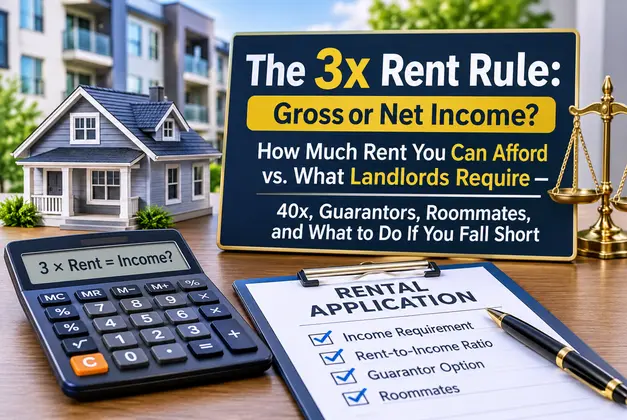
You have two rent limits: what a landlord will approve, and what your budget can carry. They’re rarely the same. The calculator below shows both, plus the cash you’ll need on move-in day.
Rules and examples verified November 5, 2026. Landlord requirements vary. Always ask for the exact rule before you pay an application fee.
Rent Calculator: Comfortable, Approval, Move-In Cash
Enter what you know and skip what you don’t. Nothing you type leaves this page.
Your COMFORTABLE, APPROVAL, and MOVE-IN CASH numbers appear here.
Two Rent Limits, Plus Day-One Cash
Every renter has two rent numbers and one cash number. Landlords only look at one of them.
COMFORTABLE
What your budget can carry. Based on take-home pay. Our range: 25% to 30% of take-home.
APPROVAL
What a landlord’s income test allows. Based on gross income and the landlord’s multiple.
MOVE-IN CASH
What you need on day one: first month, deposit, fees, and moving costs.
Your bank account lives with all three. This guide covers each one, starting with the question that trips up most renters.
Gross or Net: Which Income Do Landlords Use?
Landlords typically run the income test on gross income, which is your pay before taxes and deductions.
That surprises a lot of renters. One rental source calls it the most common misunderstanding about the rule.
Worked example. You earn $60,000 a year. That’s $5,000 a month gross. After taxes and a health premium, maybe $3,900 lands in your account (your number will differ). A 3x landlord measures the $5,000, so rent up to about $1,667 clears the test. Run 3x on the $3,900 and the cap would be $1,300.
When landlords look at take-home or bank statements
“Typically” is not “always.” Some landlords also review bank statements, deposit history, or take-home pay. That’s more likely if you’re self-employed, paid in cash, or have pay that varies.
Ask which they use before you pay an application fee.
What counts as income
Policies differ on bonuses, overtime, tips, gig income, Social Security, alimony, and child support. Steady income you can document is easier to count than occasional income. Ask what counts, and get the answer in writing if you can.
Why your budget should use take-home anyway
You pay rent from take-home pay, not gross. In the example above, rent at the 3x limit ($1,667) is about 43% of $3,900 take-home ($1,667 ÷ $3,900 = 42.7%). That passes the landlord’s test and still squeezes your budget.
Approval isn’t affordability: a landlord may approve more than your budget can carry.
3x vs. 40x vs. 2.5x: The Rules Aren’t the Same
3x the monthly rent equals 36x the annual rent, not 40x, so a 3x landlord and a 40x landlord are running different tests.
The math. Under 3x, maximum rent is monthly gross ÷ 3. Under 40x, maximum rent is annual gross ÷ 40. Because 3 × 12 = 36, 3x lets rent reach 33.3% of gross income. 40x stops at 30%. (Multiplying income by 0.3 and dividing by 12 gives the same answer as ÷ 40.)
Worked example. At $60,000 a year, 3x allows $1,667 and 40x allows $1,500. That $167 gap can decide whether you qualify for a particular unit.
3x the monthly rent is 36x the annual rent, not 40x.
| Rule | Annual multiple | Max rent as % of gross | Rent allowed on $60,000 |
|---|---|---|---|
| 2x monthly (Colorado cap) | 24x | 50% | $2,500 |
| 2.5x monthly | 30x | 40% | $2,000 |
| 3x monthly | 36x | 33.3% | $1,667 |
| 40x annual | 40x | 30% | $1,500 |
| 45x annual | 45x | 26.7% | $1,333 |
| 50x annual | 50x | 24% | $1,200 |
| Guarantor 80x | 80x | 15% | $750 (rent a $60,000 guarantor can back) |
Where each rule shows up
These are patterns, not laws. Always ask the building.
- 3x monthly / 36x annual: a common screening standard in many markets. One Boston guide describes 36x as the standard there, with 40x used by a minority of newer, professionally managed buildings.
- 40x annual: the conventional standard in New York City.
- 2.5x: used by some landlords. It was the rule at issue in a 2025 Maryland Supreme Court voucher case, covered below.
- 50x: some buildings require 50 times the monthly rent.
- 2x: Colorado’s statewide cap on what a landlord can require.
Where the 30% benchmark comes from
The Brooke Amendment of 1969 capped rent in public housing at 25% of a resident’s income, and Congress raised the cap to 30% in 1981 (HUD USER; Congressional Research Service). It was written to protect low-income tenants from extreme rent burdens. It was never a screening rule, and it can’t tell you what you can afford. 40x happens to equal 30%. 3x equals 33.3%.
How Much Rent You Can Get Approved For, by Salary and Hourly Wage
Your gross income divided by the landlord’s multiple gives the most rent that landlord’s income test allows.
Worked example. $20 an hour at 40 hours a week for 52 weeks is $41,600 a year. At 3x, that’s $41,600 ÷ 36 = $1,156 a month. At 40x, it’s $1,040.
See the full table
| Income | Annual gross | At 2.5x | At 3x | At 40x |
|---|---|---|---|---|
| $15/hr | $31,200 | $1,040 | $867 | $780 |
| $20/hr | $41,600 | $1,387 | $1,156 | $1,040 |
| $25/hr | $52,000 | $1,733 | $1,444 | $1,300 |
| $30/hr | $62,400 | $2,080 | $1,733 | $1,560 |
| $40,000 | $40,000 | $1,333 | $1,111 | $1,000 |
| $50,000 | $50,000 | $1,667 | $1,389 | $1,250 |
| $60,000 | $60,000 | $2,000 | $1,667 | $1,500 |
| $75,000 | $75,000 | $2,500 | $2,083 | $1,875 |
| $100,000 | $100,000 | $3,333 | $2,778 | $2,500 |
How each column is computed
At 2.5x: annual gross ÷ 30.
At 3x: annual gross ÷ 36.
At 40x: annual gross ÷ 40.
Hourly: rate × hours × 52.
Compare the 3x and 40x columns with the conversions in Table 1 above.
Approval Isn’t Affordability: Your Comfortable Rent
Your comfortable rent is based on take-home pay, and it is usually lower than what a landlord will approve.
The calculator uses 25% to 30% of take-home as a guideline. It’s a guideline, not a law, and it knows nothing about your debts, commute, or city.
Worked example. Take-home is $3,900 a month. 25% is $975 and 30% is $1,170. Say you also pay $400 a month toward a car and a student loan. At $975 rent, you keep $2,525 for everything else ($3,900 − $400 − $975). At $1,170, you keep $2,330.
Now compare. A 3x landlord on $5,000 gross allows up to $1,667. Your COMFORTABLE range tops out at $1,170. That $497 gap is the space where a rent can be approved and still hurt.
What eats the rest
Utilities, renters insurance, groceries, and your commute all come out of the same take-home. Build the whole picture in How to Make a Budget, and see what food realistically costs in How Much to Spend on Groceries.
Thinking about buying instead of renting? See How Much House Can I Afford. Adding a car payment on top of rent? See How Much Car Can You Afford.
Roommates and Couples: Combined or Individual Income?
Some landlords combine everyone’s income, and others make each person qualify on their own share, so ask which one applies.
A landlord typically expects each person on the lease to earn 40x their share of the rent. Other landlords add the household’s income together.
| Approach | Income needed | Who qualifies |
|---|---|---|
| Combined | $96,000 total | The household as a whole, in any mix that adds up (for example $60,000 + $36,000). |
| Individual | $48,000 each | Each person on their own $1,200 share. $60,000 passes; $36,000 does not. |
Worked example. Roommate A earns $60,000 and roommate B earns $36,000. Combined, they hit $96,000 exactly, so a combined-income landlord’s 40x test passes. A per-person landlord needs $48,000 each, so B fails.
What happens if one roommate leaves
On many leases, everyone is responsible for the full rent, so the remaining roommate may owe all of it. The landlord may also want to screen a replacement, or re-run the test on the remaining income.
Ask before you sign what happens if someone moves out, and get the answer in writing.
What Landlords Check Besides Income
Income is one check among several; landlords typically also look at credit, rental history, and sometimes a tenant screening report.
- Credit: payment history and, often, a score. New to the US? See How to Build US Credit as an Immigrant.
- Rental history: references from past landlords and any eviction records.
- Screening reports: a company compiles credit, rental, and background data for the landlord.
Check your own credit first, free, with How to Check Your Credit Score Free, so nothing surprises you.
If you’re denied because of a screening report
Federal law requires a landlord who denies your application because of information in a tenant screening report to tell you so. This is called an adverse action notice (CFPB; FTC, checked November 5, 2026).
The notice must name the company that supplied the report. You can get a free copy of that report if you ask within 60 days. You also have the right to dispute anything inaccurate in it. If the denial was based on your income alone, this notice may not apply.
Short of 3x? Legitimate Ways to Qualify
If you fall short, there are legal ways to close the gap, and every one of them involves showing real numbers.
Never alter a pay stub or use a fake employment letter; it’s fraud. It can get an application denied, a lease terminated, and worse. Everything below is legitimate.
Short of the Income Requirement? Your Legitimate Options
- Ask the exact rule first. Get the multiple, whether it’s gross or net, whether roommates combine or qualify individually, and what counts as income (bonuses, overtime, gig, Social Security, alimony, child support).
- Add every lawful income source and document it. Offer letter, last 2 to 3 pay stubs, tax returns or 1099s if you’re self-employed, benefit letters.
- Split the lease with a roommate if the landlord combines incomes, or check whether each person must qualify on their own share.
- Use a guarantor or co-signer. Expect a much higher multiple (80x is common in NYC). Make sure they understand they are legally on the hook.
- Ask about an institutional guarantor, if the building accepts one. Compare the fee to what you’d save.
- Offer proof of savings or assets. Some landlords accept them in place of income. Get any prepaid-rent arrangement in writing, and check whether your state limits upfront payments.
- Show rent history: a letter from a past landlord or 12 months of on-time payment records.
- Look at the rent, not just the building: a lower-priced unit, a different floor plan, or a longer lease.
- If you have a voucher, ask that the income test be applied to your share, and check your state or city source-of-income law.
- Never alter pay stubs, use “novelty” documents, or inflate income on an application.
Guarantors: how high the bar goes
In NYC, a personal guarantor typically needs income of 80 times the monthly rent. On a $2,000 rental, that’s $160,000. Elsewhere the multiple varies, so ask.
A guarantor promises to pay if you don’t. That is a real legal obligation, so make sure they understand it.
Institutional guarantors
Some institutional guarantors will qualify renters whose income is as low as 27.5 times the monthly rent, or who hold cash or securities of 45 to 50 times the rent. On a $2,000 rental, that’s $55,000 in income instead of $80,000 at 40x, or $90,000 to $100,000 in cash or securities.
They charge a fee, and not every landlord accepts them. We don’t recommend any company. Ask the landlord which, if any, they take.
Housing Vouchers and State Rules
With a housing voucher, the income test may apply only to the part of the rent you pay yourself, if your state or city protects source of income.
Worked example. Rent is $1,800 and your voucher pays $1,200. Your tenant’s share is $600. A 3x test on your share needs $1,800 a month in income, not the $5,400 a 3x test on the full rent would need.
Washington
Washington law requires a landlord who sets an income threshold to subtract any rent voucher or subsidy from the total monthly rent before applying it (RCW 59.18.255(3), effective September 30, 2018; checked November 5, 2026). Washington’s own tenant guide uses the same $1,800 and $1,200 example at 2x: $1,200 a month of income, not $3,600.
Maryland
In Hare v. David S. Brown Enterprises, Ltd. (Md. July 28, 2025), a landlord denied a voucher holder because her voucher and SSI combined fell short of 2.5 times the full $1,590 rent. The Supreme Court of Maryland held the landlord was not entitled to judgment just because it counted voucher income like any other income, and sent the case back to the trial court. Her income had been weighed against the full rent instead of the share she would owe.
Colorado
Colorado SB 23-184, effective August 7, 2023, bars a landlord from requiring annual income above 200% of the annual rent. That’s 2x the monthly rent, or rent up to 50% of gross. It also caps security deposits at two months’ rent. For voucher holders, the 2x standard applies only to the tenant’s portion of the rent. Some funded or subsidized properties follow other program rules.
Worked example. Rent is $1,000 and your tenant portion is $300. A Colorado landlord can require income of $600 a month, not $2,000. (Colorado General Assembly; Larimer County fact sheet; checked November 5, 2026.)
Colorado is the only statewide income cap we’ve verified. Don’t assume your state has one.
With a housing voucher, the income test may apply only to your share. Rules vary by state and city. Check your local fair housing agency and your housing authority, and read the HUD voucher program basics.
Move-In Cash: What You Need on Day One
Move-in cash is everything you pay before you get the keys, and it is usually several times your monthly rent.
Worked example. On $1,800 rent, first month plus a one-month deposit is already $3,600. Add the assumed fees and movers below and you’re at $4,065. If the landlord also wants last month’s rent, it’s $5,865.
| Item | Example amount | Where state or city law limits it |
|---|---|---|
| First month’s rent | $1,800 | It’s the rent itself. |
| Security deposit | $1,800 (1 month) | California: generally 1 month since July 1, 2024; up to 2 for some small landlords, never for service members. Colorado: max 2 months since August 7, 2023. Other states vary. |
| Last month’s rent (if required) | $1,800 | California counts it toward the deposit cap. Other states vary. |
| Application fees | $50 (assumed) | Some states cap or regulate them. Check yours. |
| Broker or admin fee | $0 (assumed) | NYC: since June 11, 2025, brokers who represent landlords can’t charge tenants. A broker you hire is your cost. Elsewhere varies. |
| Movers or truck | $400 (assumed) | None. |
| Renters insurance, first payment | $15 (assumed) | None. Some landlords require it. |
| Total without last month | $4,065 | $1,800 + $1,800 + $50 + $0 + $400 + $15 |
| Total with last month | $5,865 | $4,065 + $1,800 |
The rules behind the table
- California: since July 1, 2024, landlords can generally charge a security deposit of only one month’s rent, with exceptions for smaller landlords. The small-landlord exception (no more than two properties with four or fewer units) allows up to two months’ rent, but never for military service members (Civil Code § 1950.5, AB 12; checked November 5, 2026).
- Colorado: deposits are capped at two months’ rent (SB 23-184, effective August 7, 2023).
- New York City: since June 11, 2025, the FARE Act bars brokers who represent landlords from charging tenants broker fees, and landlords must disclose all required fees before the lease is signed. You can still hire your own broker and pay them (NYC DCWP FAQ; checked November 5, 2026).
Deposit questions later on? See Landlord Won’t Return Security Deposit. For other charges that may show up in a lease, see Are Rental Junk Fees Legal. Budget for a policy with How Much Is Renters Insurance.
FAQ
Is the 3x rent rule based on gross or net income?
Typically gross, which is pay before taxes. Some landlords also review bank statements or take-home pay, so ask which they use. For your own budget, use take-home.
Is 3x the rent the same as 40x?
No. 3x the monthly rent is 36x the annual rent. It allows rent up to 33.3% of gross income, while 40x allows 30%. On $60,000 a year, that’s $1,667 versus $1,500.
How much do I need to make to rent a $1,500 apartment?
At 3x, $4,500 a month gross, or $54,000 a year. At 40x, $60,000 a year. At 2.5x, $3,750 a month or $45,000 a year. In Colorado, a landlord can’t require more than 2x: $3,000 a month, or $36,000 a year.
How much rent can I afford making $20 an hour?
At 40 hours a week, $20 an hour is $41,600 gross a year. Landlord income tests would allow about $1,387 at 2.5x, $1,156 at 3x, or $1,040 at 40x. What you can comfortably pay depends on take-home pay and debts, so run the calculator.
How much rent can I afford on $50,000 a year?
A landlord’s income test would allow about $1,667 at 2.5x, $1,389 at 3x, or $1,250 at 40x. The 30% guideline on gross income also gives $1,250. Your comfortable rent may be lower once you account for take-home pay and debts.
Do landlords count overtime, bonuses, or tips?
Policies differ. Income you can document over time, such as pay stubs and tax returns, is easier to count than occasional income. Ask the landlord what counts before you apply.
How do self-employed renters prove income?
Landlords often ask for tax returns or 1099s, bank statements, and sometimes a letter from an accountant. Some look at income after business expenses. Ask which they use. A guarantor or proof of savings can help if your income is hard to document.
Does roommate income combine for the 3x rule?
It depends on the landlord. Some combine everyone’s income. Others expect each person to qualify on their own share, such as 40x their part of the rent. See Table 4 above, and ask.
What if I make 2.5 times the rent?
You’d meet a 2.5x rule but not a 3x rule. On $1,800 rent, 2.5x is $4,500 a month and 3x is $5,400. Ask what the landlord’s actual rule is, then look at the options in the checklist above: a guarantor, savings, a roommate, or a lower rent.
How much does a guarantor need to make?
In NYC, a personal guarantor typically needs income of 80 times the monthly rent: $160,000 on a $2,000 rental. Some institutional guarantors qualify renters at 27.5 times the rent in income, or 45 to 50 times in cash or securities. Not every landlord accepts them, and multiples elsewhere vary.
Can I rent with savings but no income?
Some landlords accept savings or assets in place of income, and others prefer steady income. Get any arrangement in writing. An institutional guarantor may qualify you on cash or securities of 45 to 50 times the rent, such as $90,000 to $100,000 on a $2,000 rental, if the building accepts it.
Can I pay several months upfront instead?
Some landlords will take prepaid rent. Get the terms in writing, including whether it’s refundable, and check your state’s limits. California, for example, generally counts last month’s rent toward its deposit cap, with a narrow rule for prepaying six months or more on a lease of six months or longer.
Is it legal for a landlord to require 3x the rent?
In most places, landlords can set their own income requirements, within fair housing and source-of-income laws. The 3x rule is a screening practice, not a federal rule. Colorado caps it at 2x (SB 23-184). Check your state and city.
Does the income rule apply to the full rent if I have a voucher?
Where source-of-income protections apply, it may apply only to your tenant portion. Washington subtracts the voucher first, Colorado applies its 2x standard to the tenant’s portion, and Maryland’s Supreme Court sent a full-rent income test back for further review in 2025. Rules vary by state and city.
What’s Colorado’s income limit for renters?
Landlords can’t require annual income above 200% of the annual rent, which means rent up to 50% of gross (SB 23-184, effective August 7, 2023). Security deposits are capped at two months’ rent.
How much money do I need to move into an apartment?
Add first month’s rent, the deposit, last month’s rent if required, application and broker or admin fees, and moving costs. On $1,800 rent with assumed fees, that’s about $4,065, or $5,865 if last month is due. See Table 3, or use the calculator.
Sources Checked
- Colorado General Assembly, SB 23-184 (income cap, security deposit cap, C.R.S. § 38-12-102.5); checked November 5, 2026.
- California Civil Code § 1950.5, as amended by AB 12; checked November 5, 2026.
- NYC Department of Consumer and Worker Protection, FARE Act FAQ; checked November 5, 2026.
- Supreme Court of Maryland, Hare v. David S. Brown Enterprises, Ltd., No. 32, Sept. Term 2024 (July 28, 2025); checked November 5, 2026.
- Washington RCW 59.18.255; checked November 5, 2026.
- CFPB, What should I do if my rental application is denied due to a tenant screening report?; FTC, Using Consumer Reports: What Landlords Need to Know; checked November 5, 2026.
- HUD, Housing Choice Voucher program; HUD USER, Rental Burdens: Rethinking Affordability Measures; Congressional Research Service, Measuring Housing Affordability (R49457); checked November 5, 2026.
Last updated:
This article is general information, not financial or legal advice. Landlords set their own screening criteria within federal, state, and local law. Examples are estimates, and the calculator does not approve or deny anything. Rules verified November 5, 2026.

Daniel Hayes is the founder and sole researcher at AdvoraHQ. He covers U.S. personal finance, insurance, and consumer law — working directly from IRS publications, federal and state statutes, court opinions, and SEC filings rather than secondary summaries. His focus is the gap between what readers think they know and what the source documents actually say. Daniel is not a licensed attorney, CPA, or financial advisor; his articles are educational and not personalized advice. Reach him at Daniel.Hayes@advorahq.com.