
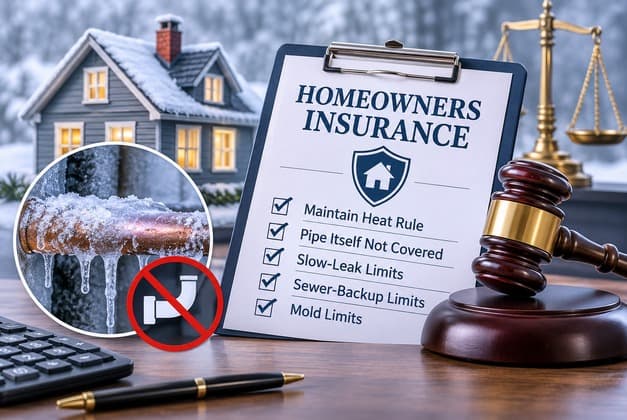
Quick answer: Usually yes for the water damage a burst pipe causes — not for fixing the pipe itself. Coverage can disappear in one situation: the house was empty, and you neither kept the heat on nor shut off and drained the water.
- COVERED
From your plumbing: usually covered - ADD-ON NEEDED
Backing up from a sewer or sump: only with an add-on - SEPARATE POLICY
Flood water from outside: needs flood insurance
Check your situation in 30 seconds →
Pipe burst right now? Do these first →
Verified November 2026. Based on the ISO HO-3 model form — your policy’s wording controls.
Water Claim Screener: Which Kind of Water Is It?
Answer a few questions and you get a plain-language read on which clause is likely to matter. Nothing you enter leaves this page, and there is no place for names or policy numbers.
Your result
After you check: first-hour checklist · file a claim or pay yourself · flood insurance · home warranty
Screening only, based on the ISO HO-3 model form. Your insurer’s policy wording and your state’s law decide coverage. Verified November 2026. Not insurance advice.
What Homeowners Insurance Pays When a Pipe Bursts
COVERED A standard homeowners policy usually pays for the water damage a pipe causes when it bursts suddenly, but it does not pay to replace the pipe.
In the ISO HO-3 form, the house itself (Coverage A) is protected against sudden, accidental loss unless something is excluded. Your belongings (Coverage C) are protected against named perils, and accidental discharge or overflow from plumbing, heating, air conditioning, sprinkler systems, and household appliances is one of them. Your insurer’s form controls.
A sudden burst usually brings three kinds of payment:
- The building: drywall, flooring, cabinets, insulation, and the cost of opening a wall to reach the leak.
- Your belongings: furniture, clothing, electronics.
- Loss of use (Coverage D): extra living costs, such as a hotel, if the home isn’t livable while it’s repaired.
How common is this?
Water damage and freezing claims run at 1.50 per 100 insured homes, about 1 in 67, each year. The average claim is $15,400 (Insurance Information Institute, from ISO data, 2019–2023 average).
One large insurer, State Farm, reported more than 20,000 frozen-pipe and winter water claims and over $628 million in paid losses between January 2024 and June 2025 (Carrier Management, Jan. 27, 2026).
Who Pays for Which Water?
This table sorts the common water sources by what a standard HO-3 does. The labels follow the three kinds of water above.
| Water source | Standard HO-3 | What you’d need | Note |
|---|---|---|---|
| Burst pipe (not freezing) | COVERED for the water damage, not the pipe | Nothing extra | Sudden and accidental discharge. The pipe repair itself is excluded. |
| Frozen pipe, occupied | COVERED | Nothing extra in the ISO model form | Some company forms attach a heat condition to every home. Read your freezing clause. |
| Frozen pipe, vacant or away | CONDITION Heat on, or water shut off and drained | Proof of heat or of draining | Neither done: usually excluded. Either one is enough. |
| Appliance or water heater leak | COVERED for the damage, not the appliance | Nothing extra | Hoses, supply lines, and tanks: the resulting damage yes, the part itself no. |
| Slow leak over weeks | DEPENDS | Check for a hidden-leak exception | Many company forms exclude constant or repeated seepage. The ISO model form has no standalone exclusion. |
| Slab leak | DEPENDS | Check slab tear-out wording | The pipe is not paid. Water damage depends on sudden vs. gradual, and tear-out through a slab varies. |
| Sewer or drain backup | ADD-ON NEEDED | Water back-up endorsement (HO 04 95 or HO 06 95) | Pays up to a scheduled limit, not the full policy. |
| Sump pump failure | ADD-ON NEEDED | Water back-up endorsement (HO 04 95 or HO 06 95) | Same endorsements as sewer backup. |
| Surface or flood water | SEPARATE POLICY | NFIP or private flood insurance | Typically a 30-day wait before a new flood policy starts. |
| Roof leak or ice dam | DEPENDS | Depends on cause and wording | Belongings are covered by named perils. See Roof Payment Schedules. |
| A neighbor’s water | DEPENDS | Usually nothing extra | Your own policy usually responds first; your insurer may try to recover from the neighbor’s. |
Burst pipe (not freezing)
Standard HO-3: COVERED for the water damage, not the pipe
What you’d need: Nothing extra
Note: Sudden and accidental discharge. The pipe repair itself is excluded.
Frozen pipe, occupied
Standard HO-3: COVERED
What you’d need: Nothing extra in the ISO model form
Note: Some company forms attach a heat condition to every home. Read your freezing clause.
Frozen pipe, vacant or away
Standard HO-3: CONDITION Heat on, or water shut off and drained
What you’d need: Proof of heat or of draining
Note: Neither done: usually excluded. Either one is enough.
Appliance or water heater leak
Standard HO-3: COVERED for the damage, not the appliance
What you’d need: Nothing extra
Note: Hoses, supply lines, and tanks: the resulting damage yes, the part itself no.
Slow leak over weeks
Standard HO-3: DEPENDS
What you’d need: Check for a hidden-leak exception
Note: Many company forms exclude constant or repeated seepage. The ISO model form has no standalone exclusion.
Slab leak
Standard HO-3: DEPENDS
What you’d need: Check slab tear-out wording
Note: The pipe is not paid. Water damage depends on sudden vs. gradual, and tear-out through a slab varies.
Sewer or drain backup
Standard HO-3: ADD-ON NEEDED
What you’d need: Water back-up endorsement (HO 04 95 or HO 06 95)
Note: Pays up to a scheduled limit, not the full policy.
Sump pump failure
Standard HO-3: ADD-ON NEEDED
What you’d need: Water back-up endorsement (HO 04 95 or HO 06 95)
Note: Same endorsements as sewer backup.
Surface or flood water
Standard HO-3: SEPARATE POLICY
What you’d need: NFIP or private flood insurance
Note: Typically a 30-day wait before a new flood policy starts.
Roof leak or ice dam
Standard HO-3: DEPENDS
What you’d need: Depends on cause and wording
Note: Belongings are covered by named perils. See Roof Payment Schedules.
A neighbor’s water
Standard HO-3: DEPENDS
What you’d need: Usually nothing extra
Note: Your own policy usually responds first; your insurer may try to recover from the neighbor’s.
Based on the ISO HO-3 model form; your insurer’s form controls. Verified November 2026.
Renting rather than owning? A ceiling leak is a different question. See Ceiling Leaking: Landlord or Renters Insurance.
The Freezing Rule: Heat On or Water Off
In the ISO HO-3 form, a frozen-pipe loss is excluded while the home is vacant, unoccupied, or being constructed unless you used reasonable care to keep the heat on or to shut off and drain the water. Your insurer’s form controls.
The wording
The ISO HO-3 (edition 05 11) says the freezing provision does not apply if you used reasonable care to “Maintain heat in the building,” or to turn off the water supply and empty every system and appliance of water.
The exact spot where the empty-home trigger sits differs by coverage part and edition, and company forms often say it more plainly. Maine’s filed form HO-ME (08-16) applies its freezing exclusion “only while the dwelling is vacant, unoccupied or being constructed.”
So find the freezing clause in your own policy. It is usually listed under the perils or exclusions for the building and again for your belongings.
Which homes does the rule reach?
| Situation | Does the heat-or-drain condition apply? | What the ISO wording requires |
|---|---|---|
| Living there | Generally no in the ISO model form. Some company forms apply it to every home. | Nothing extra. If your form does apply a condition, keep the heat on. |
| Away on a trip | Possibly. A furnished home with people away can be treated as unoccupied. | Reasonable care to keep the heat on, or to shut off and drain the water. Either one. |
| Vacant (moved out, for sale) | Yes. | Reasonable care to keep the heat on, or to shut off and drain the water. Either one. Check vacancy limits too. |
| Under construction | Yes. | Reasonable care to keep the heat on, or to shut off and drain the water. Either one. |
Fire sprinkler systems
If your building has an automatic fire sprinkler system, the ISO wording changes. You must use reasonable care to keep the water supply on and maintain heat, because draining a sprinkler system switches off the protection. Heat alone, or draining alone, is not the test.
What “reasonable care” looks like
Reasonable care is judged on the facts. A furnace that failed despite a working thermostat reads very differently from a fuel tank left to run empty, and trade-press coverage analyses have treated the second as a failure of care.
The number matters too. 55°F is common guidance from insurers and the Red Cross, not ISO policy text. A few company forms do write a number into the policy, so read yours.
How to prove the heat was on
- Smart-thermostat or app history showing the setpoint and temperatures.
- Utility bills, gas or electric usage, and fuel delivery receipts for the period.
- Power-outage records from your utility, if the heat failed because the grid did.
- Dated photos of the thermostat, and notes from whoever checked on the house.
- The furnace or boiler service record, and the plumber’s written note on the cause.
The Pipe Isn’t Covered — Reaching It Usually Is
In the ISO HO-3 form, the policy pays for the water damage and for opening the building to repair the plumbing, but not for the failed pipe, fitting, or appliance itself. Your insurer’s form controls.
The accidental-discharge provision includes the cost to “tear out and replace any part of a building” when that is necessary to repair the system or appliance (ISO HO 00 03, 03 22 edition). The same provision leaves out loss to the system or appliance that the water escaped from.
Here is how that plays out on a burst pipe behind a wall.
- Not paid: the cost of the new section of pipe and the plumber’s labor to install it.
- Usually paid: cutting open the wall to reach it, patching and repainting, and the water-damaged flooring and drywall.
Slab leaks
A leak under a concrete slab is the hard case. The pipe isn’t covered, and reaching it can mean breaking up flooring or concrete.
The ISO form is written broadly, but some company forms limit or exclude tear-out through a slab or foundation. One filed example is the Texas FAIR Plan’s HO-400 endorsement (Feb. 2017 edition). Slab leaks are also often gradual, which brings in the seepage wording in the next section.
Water heaters and appliance hoses
The same split applies. If a water heater tank fails or a washer hose bursts, the damage the water causes is usually covered. The heater or hose is not. Whether leak detection (finding the source) is paid varies by form.
What gets paid in a burst-pipe claim
| Item | Usually paid? | Why |
|---|---|---|
| The pipe repair | No | The system the water escaped from is excluded. |
| Tear-out to reach it | Usually | The ISO form pays to tear out and replace part of the building when necessary to repair the system. |
| Drywall, floors, cabinets | Yes | Direct damage from a sudden discharge. |
| Belongings | Yes | Accidental discharge is a named peril for personal property. |
| Water extraction and drying | Yes | Protecting the property from further damage is both a duty and a cost the policy generally covers. |
| Hotel and extra costs | Yes (Coverage D) | Additional living expenses if the home isn’t livable during repairs. |
| Mold | Limited | Excluded in the base form with narrow exceptions; a fungi endorsement may add a limit. |
| The water heater itself | No | It is an appliance the water escaped from. |
| Leak detection | Varies | Depends on the form; ask your insurer. |
A home warranty may cover the pipe repair itself. See Is a Home Warranty Worth It.
Slow Leaks: The Exclusion Behind Many Water Damage Denials
A leak that drips for weeks or months is where many water claims go wrong, because policies are built to pay for sudden discharge and many exclude seepage over time.
The wording varies. Some forms say seepage “over weeks, months or years.” Others set a clock: Maine’s HO-ME (08-16) excludes constant or repeated seepage or leakage “over a period of 14 days or more” from plumbing, heating, and similar systems, or from a household appliance.
That Maine form also carves back one case. The exclusion doesn’t apply if the leak and the damage were unknown to all insureds and hidden inside walls, beneath floors, above ceilings, or behind a stationary appliance. Many forms have a version of this hidden-leak exception, and some have dropped it, so read yours.
What the ISO model form does
According to Insurance Journal (Dec. 5, 2022), the ISO HO 00 03 has had no “repeated seepage or leakage” exclusion for about 30 years. ISO relies on other provisions instead, such as neglect, and the author notes that promptly reported hidden damage is generally covered. Many non-ISO insurers use the seepage exclusion, and some ISO carriers add it by endorsement.
Wear and tear is also excluded for the pipe itself. Your insurer’s form controls.
The 13-day ruling
In Hicks v. American Integrity Insurance Co. of Florida, 241 So. 3d 925 (Fla. 5th DCA 2018), the court held that a “14 days or more” exclusion “does not unambiguously exclude” leakage of 13 days or less. Damage that happened in the first 13 days could therefore still be covered.
That is one Florida appellate decision about one wording. Other states and other wording can come out differently, so don’t treat it as a rule for your claim.
If you find a hidden leak
- Report it promptly and stop the water.
- Get the plumber’s written opinion on how long it was leaking, if they can say.
- Keep water-bill history, dated photos, and moisture readings.
Sewer Backup and Sump Pumps: The Add-On You May Not Have
ADD-ON NEEDED The standard water exclusion removes water that backs up through sewers or drains and water that overflows from a sump, so a back-up endorsement is the only way a standard policy pays for it.
In the ISO HO-3 form, the water exclusion covers flood and surface water, water below the ground, and backup and sump overflow. Your insurer’s form controls.
The two ISO endorsements
- HO 04 95 (Limited Water Back-Up and Sump Discharge or Overflow Coverage) buys back backup and sump overflow up to a scheduled limit. It generally requires that the water originate within the dwelling.
- HO 06 95 (Broadened), added in the 2022 ISO program, removes the “within the dwelling” requirement.
Neither one covers flood.
Limits and deductibles
Backup limits are scheduled on your declarations page and are often a fraction of your dwelling limit. Commonly offered amounts run from roughly $5,000 to $25,000, but they vary by insurer, and the endorsement may carry its own deductible. Check your own policy.
Why it isn’t flood
Backup comes up through your plumbing, from a sewer line or a failed sump. Flood is water that arrives from outside, from the surface or from rising water. They are separate exclusions and separate fixes.
| Endorsement | What it adds | Limit | Deductible | Not included |
|---|---|---|---|---|
| HO 04 95 (Limited) | Water that backs up through sewers or drains, or overflows from a sump, when it originates within the dwelling. | Scheduled limit on your declarations page. | May carry its own. | Flood and surface water. |
| HO 06 95 (Broadened) | The same, without the requirement that the water originate within the dwelling. New in the 2022 ISO program. | Scheduled limit; higher options may be offered. | May carry its own. | Flood and surface water. |
| Flood insurance (for comparison) | Rising or surface water from outside, through NFIP or a private flood insurer. | NFIP residential maximums: $250,000 building, $100,000 contents. | Separate flood deductible. | Plumbing leaks inside the home; mold that could have been avoided. |
Flood Water Needs a Different Policy
SEPARATE POLICY Water that comes from outside your home is flood, and it needs a flood policy, either from the National Flood Insurance Program (NFIP) or a private flood insurer.
Flood insurance generally takes effect 30 days after you buy it, with narrow exceptions such as a mortgage closing (FEMA). Buying it after the water is already rising is too late.
The NFIP’s authority is currently set to expire on Dec. 11, 2026 unless Congress extends it (Congressional Research Service, updated Sept. 11, 2026). A lapse would stop new policies and renewals from being issued. For what that means and how to check its status, see NFIP Flood Lapse.
Mold After a Burst Pipe
Mold coverage after a burst pipe is often limited or excluded, so dry the area fast and check your declarations page for a fungi limit.
The ISO base form excludes fungi, wet or dry rot, and bacteria, with narrow exceptions. In an older edition (HO 00 03 10 00), mold hidden inside walls, ceilings, or under floors was covered when it came from an accidental discharge of plumbing water. Later editions and company forms vary.
A limited fungi endorsement may add a fixed amount. ISO publishes versions HO 04 26, HO 04 27, and HO 04 28, keyed to different base forms. ISO’s original basic option in 2002 was $10,000 per year for property damage, but insurers set their own amounts. Check yours.
Why fast drying protects the claim
- The policy asks you to protect the property from further damage.
- Mold can begin within roughly 24 to 48 hours of wetting, according to commonly cited EPA guidance.
- Mold that grows after weeks of delay is the damage most likely to be argued as not covered or as neglect.
Away for the Winter: Trips, Empty Houses, and Rentals
Leaving a home empty in winter is the situation where the heat-or-drain condition can decide your claim, so pick one and keep proof of it.
“Unoccupied” generally means the people are gone but the home is furnished. “Vacant” generally means it’s empty of both. A two-week trip can make a home unoccupied, and the freezing condition covers both words.
Vacancy has other effects, too. The ISO model form limits some coverages, such as vandalism, once a home has been vacant for more than 60 consecutive days. Second homes and seasonal homes are often written on different forms with their own winter conditions.
- Landlords: a rented house needs a landlord policy. See Renting Out Your House.
- Tenants: see Ceiling Leak: Landlord or Renters.
- Short-term rentals: see Airbnb and Homeowners Insurance.
The First Hour After a Pipe Bursts
Stop the water, stay safe, document everything, and call your insurer. Those steps line up with the duties your policy asks of you after a loss.
- Shut off the main water valve. Know where it is before winter. If it won’t turn or you can’t reach it safely, call your water utility.
- Electricity: if water is near outlets or the panel, don’t touch it. Call the utility or an electrician.
- Photograph and video everything before moving anything: the water source, the rooms, belongings, and the thermostat setting.
- Stop the damage from spreading: remove standing water, move belongings, and start drying. The policy requires you to protect the property, and reasonable costs to do so are generally part of the claim.
- Keep the broken pipe section and the plumber’s written note on the cause.
- Call your insurer promptly. Write down the claim number, the date, and the name of the person you spoke with.
- Keep every receipt: plumber, drying company, hotel, meals.
- Don’t throw out damaged items until the adjuster has seen them, or you have photos and a list.
The duties behind the list
In the ISO HO-3 form, the duties after loss include giving prompt notice, protecting the property from further damage, making reasonable and necessary repairs and keeping records of what they cost, preparing an inventory of damaged property, and showing the damage to the insurer. If the insurer asks for it, you also send a signed proof of loss within 60 days of the request. Your insurer’s form controls.
Loss of use (Coverage D) pays additional living expenses if the home isn’t livable during repairs, so keep those receipts too.
File an Insurance Claim or Pay It Yourself?
Filing makes sense when covered damage is well above your deductible, and paying yourself is worth weighing when it is close, because a claim can follow you at renewal.
The math starts simply. Estimated payout is the covered damage minus your deductible. A $2,000 loss with a $1,000 deductible pays at most $1,000 and still goes on your claim history.
Two cautions before deciding. Notice is supposed to be prompt, and the ISO model form sets a two-year window to sue after a loss, though state law can change that. And a small claim you skip today can look different if the damage turns out to be bigger.
The break-even math lives in Claim or Pay Out of Pocket. For how claims can affect your renewal, see Non-Renewal After Claims.
Related: Roof Payment Schedules for ice dams and roof leaks, Hidden Homeowners Coverages, and Tree Fell on House.
If Your Water Claim Is Denied
Ask for the exact policy clause in writing, build your own evidence of what caused the loss, and use the dispute routes your policy and your state give you.
- Get the reason in writing. Ask which clause was applied and which facts the insurer relied on.
- Get a plumber’s written cause of loss. A sudden break and a long-term seep lead to different results.
- Read the clause against your facts. Check the freezing wording, the seepage wording, and the exceptions.
- Use the appraisal clause for disputes over the amount. It addresses how much a covered loss is worth, not whether the loss is covered.
- File a complaint with your state insurance department. Every state has one, and you can find yours through the NAIC.
Keep copies of everything, and watch the deadlines in your policy and under state law. For a coverage dispute with real money at stake, a licensed attorney can tell you how your state treats the wording.
Frequently Asked Questions
Does homeowners insurance cover frozen pipes?
Usually it covers the water damage a frozen, burst pipe causes, but not the pipe itself. The main exception is an empty home with neither heat on nor water shut off and drained.
Does it cover burst pipes that didn’t freeze?
Usually yes for the resulting damage, if the discharge was sudden and accidental. A slow leak or a worn-out pipe raises the seepage and wear-and-tear questions.
Am I covered if pipes freeze while I’m on vacation?
It depends on whether you kept the heat on or shut off and drained the water. In the ISO HO-3, doing either one meets the condition. Your insurer’s form controls.
What if the house was empty?
Vacant, unoccupied, and under-construction homes are exactly where the freezing condition applies. Without heat or draining, the freezing loss is usually excluded.
What temperature should I keep the heat at?
Many insurers and the Red Cross suggest 55°F or higher when you’re away. That’s guidance, not ISO policy text, though some company forms name a number. Check yours.
Does insurance pay to fix the pipe itself?
Usually no. The ISO form leaves out loss to the system or appliance the water escaped from. A home warranty may cover the repair.
Does it pay to tear out walls or floors to reach the leak?
Usually yes, when it’s necessary to repair the system. The ISO form pays the reasonable cost to tear out and replace part of the building. Some company forms limit it.
Is a slab leak covered?
The resulting water damage may be, if the discharge was sudden. The pipe is not, and tear-out through a slab is limited in some forms.
Is a slow leak covered?
It depends on your wording. Many company forms exclude seepage over weeks or over 14 days or more, often with a hidden-leak exception. The ISO model form has no standalone seepage exclusion.
Is sewer backup covered?
Only with a water back-up endorsement. The standard form excludes water that backs up through sewers or drains.
Is a sump pump failure covered?
The same applies. Overflow or discharge from a sump is excluded unless you’ve added the endorsement, and then only up to its limit.
Is sewer backup the same as flood?
No. Backup comes up through plumbing and needs an endorsement. Flood arrives from outside and needs a flood policy.
Is mold from a burst pipe covered?
Often limited. The base form excludes mold with narrow exceptions, and a fungi endorsement may add a fixed amount. Check your declarations page.
Will insurance pay for a hotel while repairs are done?
If the home isn’t livable because of a covered loss, Loss of Use (Coverage D) pays additional living expenses. Keep receipts.
Should I file a claim for $2,000 of water damage?
Compare it with your deductible. If the deductible is $1,000, the most you’d get is $1,000, and the claim goes on your history. The break-even math is in Claim or Pay Out of Pocket.
Will a water claim raise my premium?
It can. Insurers handle claim history differently, and some non-renew after repeated claims. See Non-Renewal After Claims.
What should I do if my claim is denied?
Ask for the clause in writing, get a plumber’s written cause of loss, consider the appraisal clause for amount disputes, and file a complaint with your state insurance department if needed.
Sources
- Insurance Information Institute: Facts + Statistics, Homeowners and Renters Insurance (ISO data, 2019–2023)
- Carrier Management: State Farm frozen-pipe and winter water claims (Jan. 27, 2026)
- Maine Bureau of Insurance: filed form HO-ME (08-16)
- Insurance Journal: freezing exclusion in ISO HO 00 03 05 11 (Sept. 18, 2020)
- Insurance Journal: “Water Damage Isn’t Always Excluded” (Dec. 5, 2022)
- Hicks v. American Integrity Insurance Co. of Florida, No. 5D17-1282 (Fla. 5th DCA 2018)
- PropertyCasualty360 (FC&S): HO 06 95 03 22 analysis (Dec. 19, 2022)
- Insurance Journal: HO 04 95 and HO 06 95 compared (May 14, 2021)
- PropertyCasualty360 (FC&S): ISO limited fungi endorsements HO 04 26, 04 27, 04 28 (Oct. 7, 2024)
- PropertyCasualty360: ISO limited mold coverage (May 13, 2003)
- FEMA: flood insurance and the 30-day waiting period
- FloodSmart.gov: what flood insurance covers
- Congressional Research Service: What Happens If the NFIP Lapses? (updated Sept. 11, 2026)
Last updated:
This article is general information, not insurance or legal advice. Coverage depends on your insurer’s policy form, endorsements, and state law. Examples refer to the ISO HO-3 model form. Verified November 2026.

Daniel Hayes is the founder and sole researcher at AdvoraHQ. He covers U.S. personal finance, insurance, and consumer law — working directly from IRS publications, federal and state statutes, court opinions, and SEC filings rather than secondary summaries. His focus is the gap between what readers think they know and what the source documents actually say. Daniel is not a licensed attorney, CPA, or financial advisor; his articles are educational and not personalized advice. Reach him at Daniel.Hayes@advorahq.com.
