
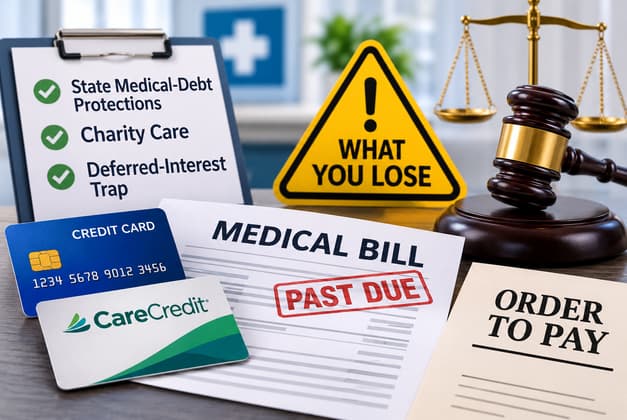
Putting a medical bill on a regular credit card turns it into credit card debt. Protections that apply to medical debt in many states, and the credit bureaus’ medical-debt policies, generally no longer apply.
CareCredit’s “no interest” offers are usually deferred interest. Leave any balance at the deadline and you’re charged back interest from day one (32.99% APR for new accounts).
Already paid a nonprofit hospital? You can usually still apply for financial assistance, and get a refund if you qualify.
- Check what you’d lose and what each option really costs →
- At the billing desk right now? What to say →
- Already paid? How to apply for assistance and get money back →
- What you lose
- Already paid?
- CareCredit math
- Your state
- The right order
- When a card is smart
- Card on file
- Stuck with CareCredit?
Verified November 14, 2026. State laws are changing; check your state below.
Before You Swipe: Cost & Protection Check
This check shows what your state protects, what each way of paying would cost, and whether a deferred-interest offer would catch you. Nothing you type is saved or sent anywhere.
Step 1: The basics
Step 2: Income, household and payment options
Your results
Leave a monthly payment blank and the check assumes a payment that clears the balance within the plan or promotion. APRs shown are starting points: replace them with the numbers on your offer.
What Changes the Moment You Swipe
Paying a medical bill with a regular credit card pays the provider and leaves you owing the card issuer, so card rules replace medical-debt rules.
The credit bureaus’ policies
Equifax, Experian and TransUnion voluntarily leave off paid medical collections, unpaid medical collections in their first year, and medical collections under $500, according to the CFPB.
Those policies cover medical collection accounts. A balance on your credit card isn’t one, and the CFPB says its summary doesn’t include credit card collections.
Newer scoring models (FICO Score 9 and VantageScore 3.0 and 4.0) also weigh medical collections less, per Experian. Which model a lender uses varies.
No federal rule fills the gap
A federal rule that would have kept medical bills off credit reports was vacated in July 2025. Judge Sean Jordan (E.D. Tex.) ruled that the CFPB exceeded its authority in Cornerstone Credit Union League v. CFPB, No. 4:25-cv-00016-SDJ (July 11, 2025).
State reporting laws, interest caps and collection rules
Some states bar or limit medical-debt credit reporting, cap interest or restrict collection tools. Each state’s definition of medical debt decides whether a card-paid balance is covered.
Virginia and Louisiana exclude debt charged to a credit card. California’s reporting ban leaves medical credit card debt outside it. See what your state protects.
The CFPB also warned that financing medical debt on a credit card can expose patients to collection actions providers would not usually pursue (CFPB, 2023). Time limits for lawsuits also differ by state and type of debt, so a medical bill and a card balance can run on different clocks.
| Protection | Bill stays with the provider | Same bill paid on a regular card |
|---|---|---|
| Bureaus’ medical-collection policies (paid, under $500, first year) | Apply to medical collection accounts. | Don’t apply: a card balance isn’t a medical collection. |
| State reporting bans | Apply where the state’s definition of medical debt covers it. | Often excluded. Virginia and Louisiana exclude card debt; California’s ban leaves medical credit card debt outside it. |
| State interest caps | Apply to covered facilities and buyers (Virginia and Louisiana: 3% a year). | Not for card debt in those two states. |
| Financial assistance and refund (nonprofit hospital) | Apply, within the 240-day window or later if the hospital accepts. | Still apply. Paying doesn’t end them, and the refund comes to you. |
| Disputing a mistake | Itemized bill, then the provider’s own appeal process. | Billing errors can go to the card issuer within 60 days of the statement. Quality-of-care disputes aren’t billing errors. |
| Interest | Ask for an interest-free plan. Terms vary. | The card’s APR applies from the first unpaid day. |
Does it hurt your credit?
It can. A big balance raises your credit utilization. Experian’s example: a $7,500 bill on a $10,000 limit uses 75% of the card, which may lower your score (Experian).
You’re not alone in wanting to swipe: Experian reports 54% of consumers in its survey prefer paying for medical services by card. It adds that other options usually make more financial sense.
Already Paid? You Can Still Get Help
Yes: at a nonprofit hospital, paying by card or any other way doesn’t end your right to apply for financial assistance, and if you qualify the hospital must refund what you paid above what you owe.
Ask for assistance and a refund (copy and use)
1. Ask for the hospital’s financial assistance policy and application, by name, and note the dates of service.
2. Check you’re within 240 days of the first post-discharge bill (nonprofit hospitals). Hospitals may accept later applications, so ask.
3. Apply with income documents, and get a dated receipt.
4. If you’re approved, request a refund of amounts you paid above your assistance amount (unless the excess is under $5). It goes back to you even if you paid by card.
5. Keep paying your card meanwhile to avoid interest and late marks. The refund doesn’t pause your card bill.
Tap the box to select everything, then copy.
The refund rule
If a nonprofit hospital finds you eligible, it must refund what you paid, to the hospital or to a party it referred or sold the debt to, above what you owe under its policy. The exception is an excess under $5 (26 CFR 1.501(r)-6).
The refund comes from the hospital to you. It doesn’t cancel what you owe your card issuer, so keep paying the card. Ask how the refund will be issued: back to the card or by check.
Who this covers
The federal rule covers hospital facilities run by tax-exempt (501(c)(3)) hospital organizations. For-profit hospitals follow state charity-care laws and their own policies, not this rule.
Doctor and dentist offices usually aren’t hospital facilities. Ask any provider for an itemized bill, a discount and an interest-free plan anyway.
Policies vary widely. One national review found free-care income limits from 41% to 600% of the federal poverty level (Health Affairs, 2024).
The full how-to, including who qualifies and how to apply, is in our hospital charity care guide.
CareCredit and Other Medical Credit Cards: The Real Math
CareCredit’s “no interest if paid in full” offers are deferred interest: interest builds from the purchase date at 32.99% (new accounts) and is charged if any promotional balance remains at the end.
CareCredit lists deferred-interest offers of 6, 12, 18 or 24 months on purchases of $200 or more (CareCredit). Its cardholder agreement gives a 32.99% purchase APR and a 39.99% penalty APR for new accounts.
The $5,000 example
Take a $5,000 bill on a 12-month deferred-interest offer at 32.99%, paying $350 a month. After 12 months you have paid $4,200 and still owe $800.
Back interest of about $1,650 (32.99% on the original $5,000 for a year) is then added. Finishing at $350 a month, you pay about $6,958 in all, of which $1,958 is interest.
A true 0% card with the same 12-month promotion and the same $350 payments charges interest only on the $800 left, about $28 in total. These are ballpark figures from the tool above: it uses simple daily interest on the original amount, and your issuer’s exact method may differ.
The same $350 a month on a regular card at 24% costs about $947 in interest.
Other CareCredit terms to know
- Minimum payments: the agreement’s formula (the greatest of $30, 3.25% of the balance, or 1% of the balance plus interest and fees) may not pay off a promotional purchase in time.
- Extra payments: the agreement applies them to higher-APR balances first. If you also have regular purchases on the card, ask how extra money is applied.
- Penalty APR: 39.99% can apply if the minimum isn’t received by the due date two or more times in any 12 consecutive billing cycles, and it may last indefinitely. Late fees are $30 or $41, and the minimum interest charge is $2.
- Reduced-APR plans: fixed monthly payments over 24, 36 or 48 months on $1,000 or more, or 60 months on $2,500 or more. CareCredit’s page lists rates from 17.90% to 20.90%, and your offer may differ, so read it. Interest runs at the reduced rate from the purchase date, so there’s no deferred lump sum (CareCredit).
- Credit reporting: it’s a credit card account. The agreement says the issuer may report account information, and late or missed payments may appear on your credit report.
How often does it bite?
The CFPB found people paid $1 billion in deferred interest on medical cards and loans from 2018 to 2020, and that interest was charged on about 20% of healthcare purchases on deferred-interest products between 2015 and 2020. It put the typical medical card APR at 26.99%, against about 16% for general-purpose cards (CFPB, May 2023).
| Option | Monthly payment | Interest paid | Total paid | Catch |
|---|---|---|---|---|
| Provider plan, 24 months, 0% | about $208 | $0 | $5,000 | Stays medical debt. Ask what a missed payment does. |
| True 0% card, 12-month promo, then 24% | $350 | about $28 | about $5,028 | Interest only on the $800 left after the promo. |
| Regular card at 24% | $350 | about $947 | about $5,947 | Interest from the first month. |
| Deferred-interest card, 12 months, 32.99% | $350 | about $1,958 | about $6,958 | About $1,650 of back interest lands when the promo ends. |
| Check | Where to find it | Why it matters |
|---|---|---|
| Promo end date for each purchase | Your statement or online account. | Each purchase can have its own deadline. |
| Promotional balance still owed | Your statement. | This is the amount that must reach zero by the deadline. |
| Monthly amount that clears it | Balance ÷ months left, rounded up. | The minimum payment may be lower than this. |
| Standard and penalty APR | Your cardholder agreement. | Back interest uses the standard APR. The penalty APR can follow late payments. |
| Other balances on the card | Your statement. | Extra payments can go to higher-APR balances first. |
| Payment due date and autopay | Your account. | Pay a billing cycle early so a delay doesn’t cost you. |
Already carrying a balance? Go to Stuck With a Medical Card Balance?
What Your State Protects
Your state’s protections depend on how it defines medical debt, and in the states we verified, card-paid debt generally falls outside that definition or is unclear. Status as of November 14, 2026.
The reporting states
Coverage of the 2025 ruling named 15 states with laws banning or restricting medical-debt credit reporting: California, Colorado, Connecticut, Delaware, Illinois, Maine, Maryland, Minnesota, New Jersey, New York, Oregon, Rhode Island, Vermont, Virginia and Washington (AP via Fox 11).
Counts vary by source and date (some mid-2026 reports say 17), and what counts as a “ban” differs. In that ruling the judge remarked that such state laws would be voided. That remark has no legal effect on them, according to the National Consumer Law Center, though some state laws face separate legal challenges. State-by-state reporting detail lives in our medical debt and credit reports guide.
Virginia (law)
Virginia has barred certain facilities and collection entities from reporting medical debt since July 1, 2024. The Medical Debt Protection Act (HB 1725) took effect July 1, 2026: large health care facilities and medical debt buyers can’t charge interest or late fees until 90 days after the final invoice’s due date, then no more than 3% a year (Va. Code ch. 59).
The definition of medical debt excludes debt charged to a credit card (§ 59.1-444.1). It appears to include some credit usable solely for health care, so whether a medical card such as CareCredit is covered is unclear, and sources conflict.
Louisiana (law)
Act 897, signed June 9, 2026, caps interest on medical debt from medically necessary care at 3% a year. Its definition excludes debt charged to a credit card and credit from federally insured financial institutions (enrolled text).
California (law, plus a stalled bill)
SB 1061 has barred furnishing most medical debt to credit bureaus since January 1, 2025 (CA Attorney General). Assembly committee analyses in April 2026 say it doesn’t reach medical credit card debt (Banking and Finance analysis).
AB 2746 would have changed that. It is a bill, not law: its first committee hearing was canceled at the author’s request on April 23, 2026 (LegiScan), and we found no later action as of November 14, 2026. The loophole remains.
On April 17, 2026 the Attorney General issued a consumer alert on deferred-interest medical cards. It notes that under California law only the consumer may apply for one, directly with the lender (alert).
Connecticut (law, operative January 1, 2027)
Public Act 26-6, signed May 7, 2026, will bar providers from promoting third-party financing while a patient is receiving care or is sedated, from completing or submitting your application, and from taking incentives for promoting it. It also bars charging your financing account before the service is provided, unless the provider has already incurred the cost.
The Attorney General enforces it under the state’s unfair trade practices act. It regulates providers, not the card’s terms (Act text, OLR analysis).
New York (law)
General Business Law § 519-a bars hospitals and providers from requiring credit card pre-authorization or a card on file before emergency or medically necessary services, and requires them to tell patients the risks of paying by credit card (statute). Law-firm summaries of the state’s guidance say patients may volunteer a card on file, but providers can’t require it.
Massachusetts (proposal, not law)
A proposed regulation announced June 30, 2026 would bar licensed providers and debt collectors from reporting medical debt (governor’s office). We could not confirm it is final.
| State | Reporting ban | Interest cap | Card-paid debt covered? | Also worth knowing |
|---|---|---|---|---|
| California | Law: SB 1061, since January 1, 2025. | None found. | No. | AB 2746 (to close the gap) is a stalled bill, not law. |
| Connecticut | Listed among reporting states. | None found. | Unclear. | Public Act 26-6 (law): provider financing rules start January 1, 2027. |
| Illinois | Listed among reporting states. | None found. | Unclear. | Dental financing disclosure law in effect since January 1, 2025. |
| Louisiana | None found. | Law: Act 897, 3% a year (signed June 9, 2026). | No. | Excludes debt charged to a credit card. |
| Massachusetts | Proposed regulation, not law. | None found. | Unclear. | Announced June 30, 2026; not confirmed final. |
| New York | Listed among reporting states. | None found. | Unclear. | GBL 519-a (law): no card on file required for emergency or necessary care. |
| Oregon | Law: SB 605, since January 1, 2026. | None found. | Unclear. | |
| Rhode Island | Law: S 0169, since January 1, 2026. | Law: S 0172, signed June 26, 2025 (check the rate). | Unclear. | |
| Virginia | Law: HB 1370, since July 1, 2024. | Law: HB 1725, 3% a year from July 1, 2026. | No for a regular card. Unclear for a medical-only card. | Applies to large facilities and medical debt buyers. |
| Colorado, Delaware, Maine, Maryland, Minnesota, New Jersey, Vermont, Washington | Listed among reporting states (details not reviewed). | Not reviewed. | Unclear. | Check your state attorney general. |
We re-check these rows every quarter and again on January 1, 2027, when Connecticut’s provider rules take effect.
The Right Order to Pay a Medical Bill
Work down this list before a card touches the bill: itemized bill, insurance, financial assistance, an interest-free provider plan, a true 0% card, and only then a regular or medical card.
- YOUR RIGHT: Get the itemized bill and check it for errors. Surprise-billing rules may apply (No Surprises Act guide).
- YOUR RIGHT: Confirm insurance processed the claim, and appeal a denial (insurance appeal guide).
- YOUR RIGHT: Ask for the financial assistance application (charity care guide).
- YOUR CHOICE: Ask for an interest-free payment plan directly with the provider, and the lowest monthly payment.
- YOUR CHOICE: If you need a card, use a true 0% intro card you can pay off before the promotion ends (balance transfer guide).
- YOUR RISK: A regular card or a medical card comes last.
When a Credit Card Is the Smart Move
A card makes sense when you’ll pay the statement in full before interest starts, when the bill is accurate and final, or when you hold a true 0% offer with a payoff plan.
- You’ll pay in full before the statement due date. No interest is charged, and you keep a clean record. Check first that insurance has processed the claim and that you’ve asked about assistance.
- A sign-up bonus you’d hit anyway. Experian notes that a rewards card can earn points on a medical bill if you pay it off. Don’t open a card only for the bonus while cheaper options are open.
- Dispute protection when a provider won’t fix an error. For billing errors such as a wrong amount or a duplicate charge, send your card issuer a written billing error notice within 60 days of the statement (CFPB). Disagreeing with the quality of care isn’t a billing error. See our credit card dispute guide.
- A true 0% card with a payoff plan. Divide the bill by the promotion’s months and pay at least that each month, with a cushion.
The California Attorney General’s advice on medical cards is worth following for any financing: don’t apply while you’re undergoing treatment, don’t be rushed, and compare other lenders, including your credit union.
At the Billing Desk
At the desk, ask for the itemized bill and the assistance application first, ask whether the provider offers its own payment plan, and keep a card off file unless you choose to.
What to say (copy and use)
1. “Before I pay, can I see an itemized bill and get your financial assistance application?”
2. “Do you offer an interest-free payment plan directly with the hospital? What’s the lowest monthly payment?”
3. “I’d prefer not to keep a card on file. Is that required for this service?”
4. “Is this offer a credit card from a third-party lender, or your own payment plan?”
5. “Has my insurance processed this claim yet?”
Tap the box to select everything, then copy. Some states, such as New York, restrict card-on-file requirements for emergency or necessary care.
Card on file
Whether a provider can require a card on file depends on your state, the service and the provider’s policy.
In New York a hospital or provider can’t require one before emergency or medically necessary services. Connecticut’s new limits on charging your financing account start January 1, 2027.
If you’re told a card is required, ask for the policy in writing, ask to speak to a supervisor, and check your state’s rules above. In an emergency, the screening and stabilization duty applies regardless.
Stuck With a Medical Card Balance?
If you already carry a CareCredit-type balance, find each promotion’s end date, work out the monthly amount that clears it in time, and compare a true 0% transfer before the deadline.
- Find the promo end date for each purchase. They can differ.
- Calculate the monthly amount needed to clear each one by then, using the check above.
- Can’t make it? Compare a balance transfer to a true 0% card before the deadline (balance transfer guide), and count the transfer fee.
- Ask the provider whether charges you thought insurance would cover were billed correctly.
- Never miss the minimum. Under CareCredit’s agreement, missing it two or more times in 12 billing cycles can trigger the 39.99% penalty APR. CareCredit’s own page says a missed payment doesn’t cancel the promotional APR on its card, but confirm in your agreement.
Falling behind? Ask your issuer about hardship options (credit card hardship programs). If the bill came from a nonprofit hospital, you may still apply for assistance and a refund (how).
FAQ
Short answers to the questions people ask most, with a link to the section that covers each.
Should I pay medical bills with a credit card?
Usually not first. Check the bill, insurance and financial assistance, and ask for an interest-free provider plan before a card. A card can make sense if you’ll pay in full before interest starts or hold a true 0% offer you can clear. See when a card is smart.
What happens to medical debt when I pay it with a card?
The provider is paid and you owe the card issuer instead. The bureaus’ medical-collection policies and state medical-debt rules generally attach to medical debt, not a card balance. Your state’s definition decides. See what you lose.
Does paying with a card hurt my credit?
It can. A large balance raises your utilization, a new card can add an inquiry, and late payments are reported like any card account. Experian’s example is a $7,500 bill on a $10,000 limit, which uses 75% of the card.
Can I still apply for charity care after paying?
At a nonprofit hospital, usually yes. The IRS rules set the application period by date: it runs at least until the 240th day after the first post-discharge bill, and hospitals may accept later applications. Paying doesn’t close it. See Already paid?
Will the hospital refund me if I qualify later?
A nonprofit hospital that finds you eligible must refund amounts you paid above what you owe under its policy, unless the excess is under $5. The refund doesn’t cancel your card balance, so keep paying the card.
Is CareCredit a good idea?
It depends on whether you can clear the balance before the promotional deadline. If not, interest at 32.99% (new accounts) is charged from the purchase date. Compare assistance, a provider plan and a true 0% card first. We don’t recommend any card.
How does CareCredit deferred interest work?
Interest builds from the purchase date at the standard APR. Pay the promotional balance in full within the period (6, 12, 18 or 24 months) and it’s waived. If any balance remains, the accrued interest is charged. See the real math.
What happens if I don’t pay CareCredit off in time?
The accrued interest is added in one lump and the remaining balance keeps accruing at the standard APR. In our $5,000 example at $350 a month, the back interest is about $1,650.
Does CareCredit show up on my credit report?
It’s a credit card account. The cardholder agreement says the issuer may report account information, and late or missed payments may appear on your report.
Is CareCredit debt medical debt in my state?
Often not. California’s reporting ban leaves medical credit card debt outside it, Louisiana’s Act excludes credit card debt, and Virginia’s status for medical cards is unclear. See the state table.
Can I transfer a CareCredit balance to a 0% card?
Often, if you’re approved for a card with a balance transfer offer. Check the transfer fee and the new promotion’s length, and finish the transfer before the CareCredit promotion ends. See our balance transfer guide.
Which states ban medical debt on credit reports?
Coverage of the 2025 court ruling named California, Colorado, Connecticut, Delaware, Illinois, Maine, Maryland, Minnesota, New Jersey, New York, Oregon, Rhode Island, Vermont, Virginia and Washington. Counts vary by source and date. See our credit report guide.
Does Virginia’s 3% cap apply if I paid by card?
Not for a regular card: Virginia’s definition of medical debt excludes debt charged to a credit card. For a medical-only card it’s unclear. The cap also applies only to large health care facilities and medical debt buyers.
What did Connecticut’s new law change?
Public Act 26-6 (signed May 7, 2026) limits how providers promote third-party financing and when they can charge your financing account. The provider rules start January 1, 2027. See your state.
Can a hospital require a card on file?
In New York, not before emergency or medically necessary services. Elsewhere it depends on state law and the provider’s policy, so ask for the policy in writing. See card on file.
Can a hospital refuse emergency care if I can’t pay?
No. EMTALA requires a Medicare-participating hospital with an emergency department to screen you and stabilize an emergency condition regardless of ability to pay. Sort out the bill afterward.
Can I dispute a medical charge on my credit card?
For billing errors such as a wrong amount or duplicate charge, send a written billing error notice within 60 days of the statement. Disputing the quality of care isn’t a billing error. See our dispute guide.
What’s the best way to pay a $5,000 medical bill without interest?
Follow the order: verify the bill and insurance, ask for assistance, ask for an interest-free provider plan, then a true 0% card you can clear before the promotion ends. A deferred-interest card only if you’re certain you’ll finish early.
Last updated: .
This article is general information, not legal, medical or financial advice. Hospital policies, card agreements and state laws vary and change; laws and terms were verified on November 14, 2026. Emergency care should never be delayed over payment.

Daniel Hayes is the founder and sole researcher at AdvoraHQ. He covers U.S. personal finance, insurance, and consumer law — working directly from IRS publications, federal and state statutes, court opinions, and SEC filings rather than secondary summaries. His focus is the gap between what readers think they know and what the source documents actually say. Daniel is not a licensed attorney, CPA, or financial advisor; his articles are educational and not personalized advice. Reach him at Daniel.Hayes@advorahq.com.
