
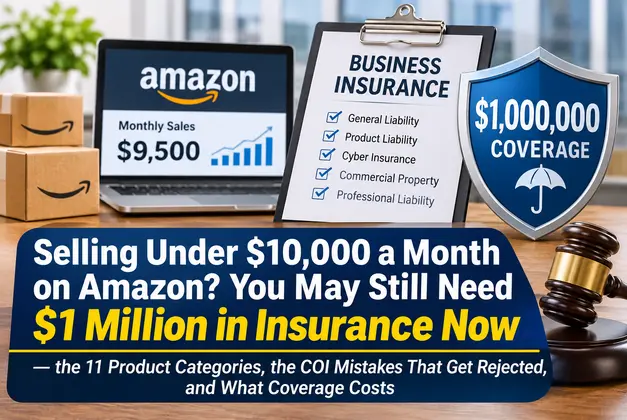
Quick answer: Yes — possibly, even if you’ve never had a $10,000 month. Since November 2, 2026, if any product you list on Amazon.com falls in one of Amazon’s enhanced-safety categories, you need at least $1 million in commercial liability coverage for it, at any sales level. Every other seller still needs coverage within 30 days of a month with more than $10,000 in gross proceeds, or when Amazon asks.
The sales trigger
CONFIRMED
More than $10,000 gross proceeds in any month → policy within 30 days.
The category trigger (new)
CONFIRMED
Any listing in an enhanced-safety category → policy required, at any sales level, including old listings.
Answer 6 quick questions to see which trigger applies to you → Open the checker
The additional-insured wording your insurer must use:
Amazon.com Services LLC and its affiliates and assignees, P.O. Box 81226, Seattle, WA 98108-1226
The name is the wording Amazon’s rejection messages quote. The Seattle P.O. box is the address Amazon’s seller agreements give for certificates of insurance. Run your COI through the 13-point pre-upload check →
- Do I need it?
- The 11 categories
- What the policy needs
- Why COIs get rejected
- China sellers
- What happens if you don’t
- Cost
- Walmart & TikTok
Checked November 14, 2026, using Amazon’s published requirements as quoted in Amazon’s own forum notice and in trade coverage. Amazon says its category list can change.
How to read the labels in this guide. CONFIRMED means it comes from Amazon’s published requirements. REPORTED means third-party accounts say so and Amazon’s own text doesn’t. UNKNOWN means nobody has published an answer yet.
Do I Need Amazon Seller Insurance? A 6-Question Check
This tool lists which rules likely apply to you and what to check next. It never tells you that you are compliant. Nothing you enter leaves your browser.
The Two Triggers: Sales vs. Category
Amazon now has two separate reasons to require a $1 million liability policy, and either one is enough.
The older rule sits in Section 9 of the Amazon Services Business Solutions Agreement. A U.S. seller must obtain commercial liability insurance within 30 days of exceeding $10,000 in gross proceeds on Amazon.com in a single month, or earlier if Amazon requests it. That rule has not gone away.
The new rule was announced in a U.S. Seller Forums notice on September 3, 2026 and took effect on November 2, 2026. Sellers with products in categories that carry enhanced safety listing requirements must hold a policy covering those products, whether or not they ever reach $10,000 in a month.
| Trigger | Who it applies to | Deadline | Status |
|---|---|---|---|
| Sales trigger | Any seller with more than $10,000 in gross proceeds on Amazon.com in one month | Within 30 days, or when Amazon requests it | CONFIRMED |
| Category trigger | Any seller with products in an enhanced-safety category, new and existing listings | Effective November 2, 2026. Your own proof deadline is reported as 45 days after an email. | CONFIRMED effective date REPORTED deadline |
The category rule applies even to listings you created years ago.
Amazon’s notice says the change covers both new and existing listings. A product that sells twice a month still counts.
Insurance may not be the only requirement attached to these categories. REPORTED Trade coverage says enhanced-safety listings carry other requirements too, such as testing documentation. This guide covers insurance only.
The 11 Enhanced-Safety Categories (With Examples)
The category trigger covers 11 groups of products, and the list reaches well past toys into small kitchen appliances, mattresses, and tires.
Amazon’s own category page sits behind a Seller Central sign-in. The list below was reproduced by SellerEssentials on September 4, 2026 and reported by PPC Land. REPORTED Amazon’s notice names children’s products, cosmetic and ingestible products, and lithium battery products, and says the categories are not limited to those.
Examples marked “illustrative” are ours, to help you recognize your own listings. They are not Amazon’s classification. Your exact product classification in Seller Central decides.
| Category | Example products | Check note |
|---|---|---|
| 1. Children’s products | Toys, baby products (illustrative) | Check how Seller Central classifies each ASIN. |
| 2. Consumable and ingestible products | Dietary supplements, other ingestibles (illustrative) | Cosmetics are named in Amazon’s notice. See the cosmetics note below. |
| 3. Fire-related products | Carbon monoxide detectors (named in the reported list) | Check smoke, CO, and fire-safety items. |
| 4. General household devices, including small kitchen appliances | Air fryers, blenders (illustrative); small kitchen appliances are named in the reported list | Check any plug-in or battery-powered home device. |
| 5. Home medical devices | Home blood-pressure monitors (illustrative) | Check items sold for personal health use at home. |
| 6. Lithium battery products | Power banks, other lithium-battery items (illustrative) | Check whether the product is sold with or powered by lithium batteries. |
| 7. Outdoor power and heating equipment | Portable generators, patio heaters (illustrative) | Check outdoor fuel-, electric- or battery-powered equipment. |
| 8. Personal safety equipment | Protective eyewear (illustrative) | Check protective gear sold for safety use. |
| 9. Sleep products | Mattresses (named in the reported list) | Check beds, mattresses and related sleep items. |
| 10. Transport-related products | Tires (named in the reported list) | Check vehicle and road-use parts. |
| 11. Water and marine safety products | Life jackets, pool safety products (illustrative) | Check items sold for swimming, boating, or pool safety. |
1. Children’s products
Examples: Toys, baby products (illustrative).
Check your exact classification: look at how Seller Central classifies each ASIN.
2. Consumable and ingestible products
Examples: Dietary supplements, other ingestibles (illustrative).
Check your exact classification: Amazon’s notice names cosmetics. See the cosmetics note below.
3. Fire-related products
Examples: Carbon monoxide detectors (named in the reported list).
Check your exact classification: check smoke, CO, and fire-safety items.
4. General household devices, incl. small kitchen appliances
Examples: Air fryers, blenders (illustrative). Small kitchen appliances are named in the reported list.
Check your exact classification: check any plug-in or battery-powered home device.
5. Home medical devices
Examples: Home blood-pressure monitors (illustrative).
Check your exact classification: check items sold for personal health use at home.
6. Lithium battery products
Examples: Power banks, other lithium-battery items (illustrative).
Check your exact classification: check whether the product is sold with or powered by lithium batteries.
7. Outdoor power and heating equipment
Examples: Portable generators, patio heaters (illustrative).
Check your exact classification: check outdoor fuel-, electric- or battery-powered equipment.
8. Personal safety equipment
Examples: Protective eyewear (illustrative).
Check your exact classification: check protective gear sold for safety use.
9. Sleep products
Examples: Mattresses (named in the reported list).
Check your exact classification: check beds, mattresses and related sleep items.
10. Transport-related products
Examples: Tires (named in the reported list).
Check your exact classification: check vehicle and road-use parts.
11. Water and marine safety products
Examples: Life jackets, pool safety products (illustrative).
Check your exact classification: check items sold for swimming, boating, or pool safety.
List reproduced by SellerEssentials on September 4, 2026, as reported by PPC Land. Amazon’s own page requires a Seller Central sign-in. Confirm in Seller Central. Checked November 14, 2026.
The cosmetics note.
Amazon’s notice says “cosmetic” products, but the reported list of 11 has no separate cosmetics line. Some trade summaries file cosmetics under consumable and ingestible products. That is their reading, not an Amazon statement we could confirm. If you sell skincare or beauty items, check the exact classification in Seller Central.
CONFIRMED Amazon says the list can grow. Re-check it whenever you add products.
What Your Policy Must Include: Amazon’s 13 Criteria
Amazon’s requirements page lists 13 criteria, and a policy has to meet all of them unless law or regulation says otherwise.
Trade reporting says the two newest items, the category rule and the Mainland China rule, are numbered 12 and 13. We could not read the live page behind the sign-in, so the order of the first 11 below is ours and Amazon’s numbering may differ. Read the live page before you buy.
- Policy type. Commercial general, umbrella, or excess liability.
- Occurrence basis. Written on an occurrence basis, with claims-made allowed only where occurrence cover isn’t available for certain categories. See the occurrence vs. claims-made section.
- Limits. At least $1 million per occurrence and $1 million aggregate. Amazon allows you to combine a general liability policy with umbrella or excess coverage to get there, with specific additional-insured wording. See our guide to excess liability vs. umbrella insurance.
- Deductible. $10,000 or less, and the amount must appear on the certificate of insurance.
- Scope. The policy covers all sales of products you list on Amazon.com, not only your best sellers or the regulated ones.
- Additional insured. “Amazon.com Services LLC and its affiliates and assignees.” Certificate holder is not enough.
- Named insured. Matches the legal entity on your seller account. Single-member LLCs may use a trade name.
- Insurer rating and claims handling. An S&P rating of A- or an AM Best rating of A- or better (or a local equivalent where those agencies aren’t used), with global claims handling. A- sits in the “A” band on both rating scales.
- No sunset clause.
- Notice. At least 30 days’ notice to Amazon of cancellation, modification, or non-renewal.
- Completed and signed. The policy documents are filled in fully and signed.
- Category rule (new). Sellers with products in enhanced-safety categories must hold the policy at any sales level. REPORTED as item 12.
- Mainland China rule (new). Mainland China-based sellers must get new policies through the Amazon Insurance Accelerator. REPORTED as item 13.
REPORTED PPC Land’s reading of the requirements page adds that Amazon “will consider exceptions on a case-by-case basis” for sellers who can’t get a compliant policy. The page gives no timeline or criteria for that. If you can’t get coverage, ask Amazon in writing instead of letting the date pass.
Why Amazon Rejects Your COI, and How to Fix It
Most rejections come from a handful of fixable mismatches between the certificate and Amazon’s list, and the most common one is naming Amazon as certificate holder instead of additional insured.
For what a certificate of insurance is and how to request one, see our COI guide. This section covers only why Amazon sends them back.
| What went wrong | What Amazon requires | How to fix it |
|---|---|---|
| Amazon is listed only as certificate holder | Amazon named as additional insured: “Amazon.com Services LLC and its affiliates and assignees” | Ask your broker for an additional-insured endorsement with the exact wording, not just a certificate-holder box. |
| Wrong entity name | Named insured matches the legal entity on your seller account | Match the policy to the business name in your account, or update the account. Single-member LLCs may use a trade name. |
| Deductible missing or over $10,000 | $10,000 or less, shown on the certificate | Ask for a lower deductible and for the amount to print on the COI itself. |
| Claims-made policy outside an allowed category | Occurrence basis, with claims-made only where Amazon allows it | Ask for an occurrence form. If your category is one Amazon allows claims-made for, keep proof of that. |
| Limit under $1 million, or no aggregate shown | $1 million per occurrence and $1 million aggregate | Raise limits or add umbrella/excess coverage, and make sure both numbers appear. |
| Expired or future-dated policy | Current coverage | Upload a certificate whose policy period includes today’s date. |
| Policy doesn’t cover all your products | All sales of products listed on Amazon.com | Get written confirmation that every listed product is covered, not only one category. |
Certificate holder vs. additional insured
Certificate holder is not the same as additional insured.
A certificate holder receives a copy of the certificate and, sometimes, notices. An additional insured is added to the policy itself, usually by an endorsement, and gets coverage rights under it. Amazon asks for the second one. A certificate that only lists Amazon as holder is a top rejection cause.
REPORTED Some sellers posting in Amazon’s Seller Forums say a certificate was rejected even though the policy documents did name Amazon. Others report rejections citing limits or a deductible rule that isn’t in the published criteria. These are individual accounts. If a rejection message cites something not on the list above, reply asking which criterion it refers to.
COI Pre-Upload Checker
Tick everything that is true of your certificate and policy documents. The tool lists what is left as likely rejection causes. Amazon makes the final decision.
Additional-insured wording:
Amazon.com Services LLC and its affiliates and assignees, P.O. Box 81226, Seattle, WA 98108-1226
Occurrence vs. Claims-Made: Which One Amazon Accepts
Amazon wants an occurrence policy by default and allows claims-made only for certain categories where occurrence cover isn’t available.
| Which claims it covers | When it fits | Amazon’s position | |
|---|---|---|---|
| Occurrence | Incidents that happen during the policy period, even if the claim arrives after the policy ends | Products that stay in customers’ homes for years, which is most physical goods | The default requirement CONFIRMED |
| Claims-made | Claims first made while the policy is active, usually for incidents after a set retroactive date | Categories where insurers won’t write occurrence forms | Allowed only for certain categories CONFIRMED; the category list is REPORTED |
Why occurrence matters: a product you sold two years ago can hurt someone today. An occurrence policy responds based on when the injury happened. A claims-made policy responds only if it is still in force when the claim is made.
REPORTED Amazon’s FAQ, as reproduced by a consulting firm, allows claims-made for pharmaceuticals; nutraceuticals and dietary supplements; ingestible products; chemicals; critical automotive parts; children’s consumable products that can’t be insured on an occurrence form; and other products Amazon deems acceptable. Products outside those still need an occurrence policy.
REPORTED One seller posted a July 3, 2026 Amazon message confirming claims-made is permitted for children’s products. It is UNKNOWN whether that carve-out applies to sellers brought in by the category trigger alone. Verify in Seller Central before buying a claims-made form.
How to Upload Your Insurance in Seller Central
Upload your certificate under Settings → Account Info → Business Insurance in Seller Central.
That menu path is reported consistently across trade coverage. Amazon changes menus, so confirm yours.
- Gather the certificate and the additional-insured endorsement.
- Run them through the pre-upload checker above.
- Open Settings → Account Info → Business Insurance and add the policy.
- Screenshot the status and note the date you uploaded.
- Keep copies of the policy, certificate and endorsement.
- Set a reminder before the policy renews.
We could not verify what each status label means. A “submitted” status most likely means received, not accepted. Wait for an accepted or verified status before assuming you’re done.
If you store inventory at home, see whether homeowners insurance covers a home business. Amazon’s requirement is for commercial liability.
Mainland China Sellers: The AIA Rule
If your business is based in Mainland China, Amazon rejects newly submitted policies that did not come through the Amazon Insurance Accelerator (AIA), starting November 2, 2026.
CONFIRMED A valid third-party policy that meets the coverage requirements and was submitted before November 2 can be used until it expires. After that, replacement coverage has to come through AIA.
AIA is Amazon’s network of vetted insurers, administered by Marsh. You reach it in Seller Central on the Business Insurance page. Sellers elsewhere, including U.S. sellers, may still use any insurer that meets Amazon’s standards. AIA is optional for them.
Seller location is not product origin.
The AIA rule depends on where your business is based. It says nothing about where your products are made. Insurers may still ask about product origin when they price a policy.
REPORTED PPC Land says Amazon’s requirements page adds that the AIA rule applies unless otherwise agreed in writing by Amazon, and gives no criteria for such agreements. UNKNOWN What happens to a Mainland China seller whom AIA’s insurers decline is not addressed in what we reviewed.
What Happens If You Don’t Have It
Amazon’s notice doesn’t state a penalty, and what is known about enforcement comes from third-party accounts.
CONFIRMED
The requirement itself is in force since November 2, 2026. Amazon’s notice states no penalty for missing it.
REPORTED
SellerEssentials says Amazon emails affected sellers and gives them 45 days to submit proof. After that, listings in the enhanced-safety categories may be deactivated, while other categories are unaffected.
A forum-quoted email sets November 2 as the proof deadline. The 45-day window and that fixed date don’t obviously match, so go by the date in your own email.
UNKNOWN
How fast Amazon will act, and how it will treat a policy it rejects, are not published.
Enforcement details are reported, not confirmed by Amazon.
In 2021, when Amazon first added its insurance requirement, sellers widely described enforcement as loose. That history may not predict how a category-wide rule is enforced.
We don’t advise removing listings to avoid the requirement. If you have truly stopped selling a product, ending that listing is your business decision. Whether that clears the requirement for your account is UNKNOWN, so ask Amazon before relying on it.
What Amazon Seller Insurance Costs
There is no reliable price for a small seller yet, so this guide gives the one sourced figure and what moves the price.
REPORTED
EcomCrew reported AIA quotes of $837 to $2,200 a year for sellers with $500,000 to $1 million in revenue. That reporting came before the November change. One provider reportedly declined to insure products manufactured in China.
UNKNOWN
That figure says nothing about sellers with small sales. We have no sourced price for them and we don’t estimate one.
What drives the price
- Category risk, such as children’s, ingestible or battery products
- Revenue, or the sales forecast the insurer uses
- Where the products are made
- Claims history
- Occurrence vs. claims-made form
- Limits and deductible
10 Questions to Ask a Broker Before You Buy
- Does this policy cover every product I list on Amazon.com, including my enhanced-safety items?
- Is it occurrence-based? If claims-made, is my category one where Amazon allows it?
- What’s the deductible, and will it appear on the COI?
- Will you add Amazon as additional insured by endorsement, with the exact wording and address?
- Does the named insured match my seller-account legal entity exactly?
- What’s the insurer’s AM Best or S&P rating? Does it handle claims globally?
- Is there a sunset clause? Will Amazon get 30 days’ notice of cancellation?
- Is pricing based on annual sales forecasts or actual sales, and what happens if my sales jump in Q4?
- Are China-manufactured products excluded?
- If I also sell on Walmart or TikTok Shop, does this policy meet their limits too, or do I need changes?
For coverage beyond Amazon’s requirement, see our small business insurance guide. For questions about which entity name goes on the policy, see business insurance for LLCs.
Why Sellers Are Liable Even If They Didn’t Make the Product
In general, anyone in a product’s chain of distribution, including a reseller, can face a claim when the product injures someone.
How that works depends on your state and the facts. This guide makes no state-specific claims. Amazon’s notice says the insurance rule is meant to help protect customers and to help you protect your business from a product-related loss.
If someone has already been hurt by something you sold, read our guide to product liability claims.
Amazon vs. Walmart vs. TikTok Shop vs. Shopify
Each marketplace sets its own rules, and an Amazon-compliant policy is not automatically compliant elsewhere.
The Amazon rule applies to Amazon.com listings only.
| Platform | When insurance is required | Limits | Additional insured | Source date |
|---|---|---|---|---|
| Amazon.com | Within 30 days of a month over $10,000, when Amazon asks, and since Nov. 2, 2026 for enhanced-safety categories at any sales level | $1M per occurrence and $1M aggregate | Amazon.com Services LLC and its affiliates and assignees | Amazon requirements, checked Nov. 14, 2026 |
| Walmart Marketplace | COI with general and product liability once GMV exceeds $100,000 in any 12-month period, or if Walmart notifies the seller. Insurance is encouraged below that. | $1M per occurrence and $2M aggregate, worldwide | Walmart Inc., its subsidiaries and its affiliates | Walmart Marketplace Learn, checked Nov. 14, 2026 |
| TikTok Shop | Commercial general liability is described as recommended on TikTok’s Insurance Center page. We found no published mandate. | No limit found on that page | BD TikTok USA LLC and its affiliates and assignees | TikTok Seller University, checked Nov. 14, 2026 |
| Shopify, Etsy, eBay | No platform insurance mandate in the reporting we reviewed. Liability still sits with the seller. | Not applicable | Not applicable | Not confirmed against each platform’s own terms |
Amazon.com
- When insurance is required
- Within 30 days of a month over $10,000, when Amazon asks, and since Nov. 2, 2026 for enhanced-safety categories at any sales level
- Limits
- $1M per occurrence and $1M aggregate
- Additional insured
- Amazon.com Services LLC and its affiliates and assignees
- Source date
- Amazon requirements, checked Nov. 14, 2026
Walmart Marketplace
- When insurance is required
- COI with general and product liability once GMV exceeds $100,000 in any 12-month period, or if Walmart notifies the seller. Insurance is encouraged below that.
- Limits
- $1M per occurrence and $2M aggregate, worldwide
- Additional insured
- Walmart Inc., its subsidiaries and its affiliates
- Source date
- Walmart Marketplace Learn, checked Nov. 14, 2026
TikTok Shop
- When insurance is required
- Commercial general liability is described as recommended on TikTok’s Insurance Center page. We found no published mandate.
- Limits
- No limit found on that page
- Additional insured
- BD TikTok USA LLC and its affiliates and assignees
- Source date
- TikTok Seller University, checked Nov. 14, 2026
Shopify, Etsy, eBay
- When insurance is required
- No platform insurance mandate in the reporting we reviewed. Liability still sits with the seller.
- Limits
- Not applicable
- Additional insured
- Not applicable
- Source date
- Not confirmed against each platform’s own terms
An Amazon-compliant policy isn’t automatically Walmart-compliant.
Walmart asks for a $2 million aggregate, Amazon for $1 million, and each names itself as additional insured. Ask your broker to add every platform you sell on.
UNKNOWN Whether TikTok Shop requires coverage for specific higher-risk categories, or sets a minimum limit, is not stated on the page we found. Check Seller Center → Finances → Insurance for your account’s current status.
One policy, several platforms: what to check
- Limits: $1M/$1M for Amazon vs. $1M/$2M for Walmart
- Each platform named as additional insured, with its own wording
- Worldwide coverage, which Walmart asks for
- Every product you list on each platform
FAQ
Do I need insurance to sell on Amazon if I make under $10,000 a month?
Possibly. If any listing falls in one of Amazon’s enhanced-safety categories, yes, since November 2, 2026. If none do, the sales trigger starts only after a month over $10,000, or when Amazon asks.
What are Amazon’s enhanced-safety categories?
Eleven groups as reported: children’s products; consumable and ingestible products; fire-related products; general household devices; home medical devices; lithium battery products; outdoor power and heating equipment; personal safety equipment; sleep products; transport-related products; and water and marine safety products. Amazon says the list isn’t limited to its examples.
Does the new rule apply to my old listings?
Yes. Amazon’s notice says it applies to new and existing listings.
When did the new rule take effect?
November 2, 2026. Amazon announced it in a U.S. Seller Forums notice on September 3, 2026.
How long do I have to upload proof?
Amazon’s notice doesn’t say. SellerEssentials reports 45 days after an email, and a forum-quoted email cites November 2. Both are reported, not confirmed. Use the date in your own email.
What exact additional-insured wording does Amazon require?
“Amazon.com Services LLC and its affiliates and assignees.” Amazon’s seller agreements give P.O. Box 81226, Seattle, WA 98108-1226 as the address for certificates.
What’s the difference between certificate holder and additional insured?
A certificate holder gets a copy of the certificate. An additional insured is added to the policy, usually by endorsement, and has coverage rights under it. Amazon asks for additional insured.
Why does Amazon keep rejecting my certificate of insurance?
The usual causes are certificate holder instead of additional insured, a name mismatch, a missing or high deductible, the wrong policy form, low limits, wrong dates, or incomplete product coverage. Run the pre-upload checker above.
Can I use a claims-made policy?
Only in categories where Amazon allows it, such as supplements and certain other products. Check the occurrence vs. claims-made section and verify in Seller Central.
Can I combine general liability and umbrella insurance to reach $1 million?
Yes. Amazon allows combining them, with specific additional-insured wording. Both the per-occurrence and aggregate limits need to reach $1 million.
What deductible does Amazon allow?
$10,000 or less, and the amount must be shown on the certificate.
Do I have to buy through the Amazon Insurance Accelerator?
Only if your business is based in Mainland China and you are submitting a new policy. Sellers elsewhere can use any insurer that meets Amazon’s standards.
What happens if I don’t get insurance?
Amazon’s notice states no penalty. Reports say affected enhanced-safety listings may be deactivated after the window in your email. Enforcement pace is unknown.
How much does Amazon seller insurance cost?
The only sourced figure is $837 to $2,200 a year in AIA quotes for sellers with $500,000 to $1 million in revenue, reported before the change. There is no sourced figure for small sellers.
Does my Amazon policy cover Walmart or TikTok Shop sales?
Not automatically. Check limits, additional-insured names and what the policy covers with your broker.
Is product liability insurance the same as general liability?
Not always. Product liability is often included in a commercial general liability policy, but confirm that your policy actually covers products you sell, not only premises or operations.
Sources
Checked November 14, 2026. Amazon’s own Seller Central pages require a sign-in, so several are cited through trade coverage.
- Amazon Seller Central: Commercial Liability Insurance Requirements and Business Insurance FAQ (sign-in); Amazon Services Business Solutions Agreement, Section 9
- Amazon U.S. Seller Forums notice, “New Commercial Liability Insurance Requirements effective November 2, 2026,” September 3, 2026
- PPC Land: Amazon forces $1M insurance on safety-category sellers regardless of sales
- PPC Land: Amazon forces $1M cover on small safety-category sellers from November 2
- EcomCrew: Amazon’s New Insurance Rules Hit Small Sellers in 11 Categories
- Marsh: Amazon Insurance Accelerator administrator page
- Walmart Marketplace Learn: Liability insurance policy
- TikTok Shop Seller University: Insurance Center and Commercial Liability Insurance
Last updated:
This guide is general information, not insurance or legal advice. The requirements are Amazon’s and can change. Coverage depends on the policy issued. Based on sources verified on November 14, 2026.

Daniel Hayes is the founder and sole researcher at AdvoraHQ. He covers U.S. personal finance, insurance, and consumer law — working directly from IRS publications, federal and state statutes, court opinions, and SEC filings rather than secondary summaries. His focus is the gap between what readers think they know and what the source documents actually say. Daniel is not a licensed attorney, CPA, or financial advisor; his articles are educational and not personalized advice. Reach him at Daniel.Hayes@advorahq.com.
