
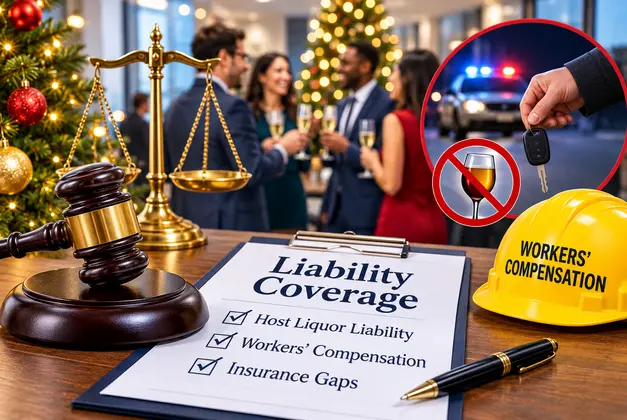
Quick answer. Many general liability policies, including the liability part of many business owner’s policies (BOPs), typically cover a business that serves free alcohol at its own party. This is called host liquor liability. It responds to lawsuits from people a guest injures.
Three things can break that coverage:
- being in the alcohol business
- charging for drinks
- a liquor exclusion on your policy
Injuries to your own employees are a workers’ comp question. Harassment is an EPLI (employment practices liability insurance) question.
- LIKELY COVERED
Free drinks at your own party, if you’re not in the alcohol business and there’s no liquor exclusion.
- CHECK YOUR POLICY
Drink tickets, a cash bar, an admission fee, a party at your home, a guest list beyond employees.
- SEPARATE POLICY
Employee injuries (workers’ comp), harassment claims (EPLI), errands in personal cars (hired and non-owned auto, or HNOA).
- Who can be sued
- Host liquor
- Drink-ticket trap
- Workers’ comp
- Venue & caterer
- EPLI & HNOA
- Party plan
- Templates
Verified November 18, 2026. Your policy wording and your state’s law control.
Holiday Party Coverage Checker
Answer the questions below to see which policy may respond to each part of your party.
Who Can Be Sued When a Guest Drives Drunk
Anyone who furnished the alcohol, which can include your company, may be named in a lawsuit after a drunk-driving crash, depending on your state’s law.
Two legal ideas matter here. Dram shop laws let an injured person sue a business that sells alcohol, such as a bar. Social host rules, from statutes or court decisions in some states, let them sue someone who gives alcohol away, such as a party host.
The driver is usually sued first. People who served or paid for the drinks may be named too.
When the employer counts as the host
In Delfino v. Griffo, 2011-NMSC-015, pharmaceutical representatives entertained a doctor’s-office employee at several bars. She later caused a fatal crash. The New Mexico Supreme Court reversed a dismissal and said the representatives could be treated as social hosts. The suit also named their employers.
The court looked at three things:
- who controlled the alcohol
- whether the gathering served the host’s own purpose, such as business goodwill
- whether the host meant to host by arranging and paying for the drinks
Three limits matter. That case was business entertainment, not a holiday party. The court ruled only that the claim could proceed. And New Mexico’s statute reaches social hosts only for reckless service, so other states’ standards differ.
An older New Mexico case points the same way. In MRC Properties v. Gries, 98 N.M. 710 (1982), a 19-year-old employee drank at his employer’s Christmas party, where a hotel ran the food and a cash bar. The court let claims against the sponsoring employer proceed. It decided that case under the law of its day, and New Mexico has since passed a Liquor Liability Act (discussed in Delfino).
Social host patterns
States differ a great deal. The table shows common patterns, not a state-by-state list.
| Pattern | What it means for an employer |
|---|---|
| No liability to adult guests | In some states, a host isn’t liable to third parties for serving an adult guest. Your exposure may be lower. Confirm your state’s rule. |
| Liability limited to minors | Serving anyone under the legal drinking age, such as a young employee or a guest, is where many states do impose liability. Check ID. |
| Liability for serving visibly intoxicated adults | Some states hold a host liable for continuing to serve someone who is visibly intoxicated. Cutoffs and a manager watching the bar matter more here. |
| A common-law negligence claim | Where no statute covers social hosts, an injured person may argue ordinary negligence. Outcomes vary by court. |
Does Your General Liability Policy Cover It? Host Liquor Liability Explained
For most businesses, usually yes: a general liability policy typically includes host liquor liability for an occasional party with free drinks, unless you’re in the alcohol business or the policy carries a liquor exclusion.
The standard liquor liability exclusion in a commercial general liability (CGL) policy is aimed at businesses that make, sell, serve or furnish alcohol. If that isn’t you, it doesn’t apply. That leaves host liquor coverage for exposures like a company picnic or customer open house, as IRMI explains.
A company holiday party with free drinks doesn’t trigger the exclusion, so host liquor liability stays in place.
Business owner’s policies (BOPs)
A BOP bundles property and liability coverage. The liability part of a BOP usually works like general liability insurance, but forms and endorsements differ by insurer. Ask your agent to confirm in writing. For the bigger picture, see our small business insurance guide.
Limits and your umbrella
Host liquor claims typically fall inside your general liability limits. Ask whether those limits fit a serious injury, and whether your umbrella follows host liquor claims. Our guides on umbrella insurance and excess vs. umbrella liability explain the difference.
Host liquor liability vs. liquor liability insurance vs. event insurance
| Coverage | Who needs it | When it applies | Common exclusions |
|---|---|---|---|
| Host liquor liability (inside a general liability policy) | Businesses that are not in the alcohol business and host an occasional event | Free alcohol at your own event; claims from third parties a guest injures | A liquor exclusion endorsement; being in the alcohol business; charging for drinks or admission. Read your wording. |
| Liquor liability insurance (a separate policy) | Businesses that make, sell, serve or furnish alcohol: bars, restaurants, breweries, liquor stores, caterers | Day-to-day alcohol operations that the general liability exclusion removes | Varies by policy. Ask your agent about classification and limits. |
| One-day event policy | Hosts with no general liability policy, a home party, a public guest list, or a venue that requires one | One named event, on the dates and at the location shown on the policy | Varies. Some are written for true host situations only, so ask whether charging for drinks is allowed. |
The Drink-Ticket Trap and Other Ways to Lose Coverage
Selling drinks or charging admission is where host liquor coverage can get shaky, because the standard policy never defines what being “in the business” of serving alcohol means.
The undefined phrase
The standard liquor exclusion applies only to businesses “in the business” of selling or serving alcohol. According to IRMI, the unendorsed policy doesn’t define that phrase. Some courts have required a commercial enterprise with a profit motive. Others have found the wording ambiguous.
So a one-time sale at your party sits in a gray area. It isn’t an automatic loss of coverage. It is a reason to ask your insurer before you sell anything.
Amended liquor exclusions
Some policies carry an amended liquor exclusion. IRMI describes a version that drops the “in the business” test. It applies when alcohol is served for a charge, whether or not anyone profits. Under that wording, paid tickets or an admission that includes drinks could fall inside the exclusion.
Other policies add a liquor-related endorsement that removes host liquor coverage entirely. Endorsements differ by insurer, so read the wording.
Other ways coverage can slip
- Selling drink tickets. Free tickets are still free. Keep them free, and don’t let anyone sell or trade them.
- A cash bar. If a licensed venue sells drinks under its own license and insurance, the sale is the venue’s. Ask your agent how your policy views that arrangement, and get the venue’s certificate.
- An admission fee or “suggested donation.” If the fee includes drinks, treat it as a charge for alcohol.
- Being in the alcohol business. Bars, restaurants, breweries and caterers usually need a separate liquor liability policy.
- A party at an owner’s or manager’s home. Your business policy may not respond to a social event at a private home, and a homeowner’s policy may be where a claim lands. Ask both insurers.
- A guest list beyond employees. Clients or the public can change how an insurer sees the event. Ask.
How to check your policy
- Find the forms list or endorsement schedule for your general liability policy or BOP.
- Look for the word “liquor” in the endorsement titles.
- Email your agent the questions in the template below.
- Ask for the answers in writing.
- If you plan to sell tickets or charge admission, ask before you do.
When a Party Injury Becomes a Workers’ Comp Claim
If an employee is hurt at or after your party, it’s a workers’ comp question, not a general liability one, and whether it’s compensable depends on your state and the facts.
The Larson test
Many states use a three-part test from Larson’s Workers’ Compensation Law for social and recreational events. Courts describe it in decisions that quote the treatise. A social event is within the course of employment when:
- it happens on the employer’s premises during a lunch or recreation period, as a regular part of the job;
- the employer, by expressly or impliedly requiring participation or making it part of an employee’s services, brings it within the job; or
- the employer gets a substantial, direct benefit beyond the general health and morale value of any social event.
Courts that follow the test generally treat the three as independent links. Meeting one can be enough.
California’s statute
Labor Code §3600(a)(9) excludes injuries from voluntary participation in off-duty recreational, social or athletic activity that isn’t part of work duties. The exception: the activity is a reasonable expectancy of the job, or the job expressly or impliedly requires it.
McCarty: a California case
In McCarty v. Workmen’s Comp. Appeals Bd., 12 Cal.3d 677 (1974), the court awarded death benefits to the widow of an employee killed driving home from his employer’s office Christmas party. The court found his intoxication arose in the course of his employment.
Read it with care. It was decided in 1974, and the party was at the employer’s office. California’s legislature later tightened the voluntary-activity rule. Hughes Aircraft v. WCAB (1983) describes a 1978 amendment.
Required attendance
If you require or strongly expect attendance, a claim becomes easier to bring. In Regalado v. F&B Garage Door (N.J. App. Div. 2021, unpublished), an employee hurt in a crash after a holiday party said her bonus depended on attending. The judge found the party was optional and the bonus was already paid. Benefits were denied.
The same opinion notes that when an employer compels participation, a judge may treat the event like any other work assignment. What you say about attendance can decide the claim.
Other states
Many states have their own statutes or case law on recreational and social activities. Check your state’s workers’ comp agency for the rule that applies to you.
The questions that matter
- On premises or off-site? A party at your office fits the first Larson link more easily than one at a restaurant.
- Required, expected, or optional? Invitations, manager comments and bonuses all count.
- Paid time or after hours? A party during paid hours looks more like work.
- Business purpose? Inviting clients or discussing deals can support a direct-benefit argument.
- The drive home. Rules vary widely. Ask your agent how your state treats it.
| Factor | Makes coverage more likely when… | Source |
|---|---|---|
| Required or expected attendance | The employer requires attendance, expressly or by implication, for example by tying a bonus to it or through manager pressure | Larson, second link; Cal. Lab. Code §3600(a)(9); Regalado (N.J. App. Div. 2021) |
| On premises, during work time | The event is at the workplace during a lunch or recreation period or paid time, as a regular part of the job | Larson, first link |
| Business purpose | The employer gets a substantial, direct benefit beyond general morale, such as client contact | Larson, third link |
| California’s voluntary off-duty rule | Participation is not purely voluntary: it is a reasonable expectancy of the job or required by it | Cal. Lab. Code §3600(a)(9) |
| Intoxication and the drive home | State law treats the intoxication as arising in the course of employment, as in California in 1974 | McCarty, 12 Cal.3d 677 (1974) |
Venue and Caterer Contracts: What to Ask For
Ask every venue and caterer for a certificate of insurance showing general liability and liquor liability, with your company named as additional insured.
A certificate is a snapshot of coverage. It doesn’t change the policy, and the policy wording controls. Our certificate of insurance guide covers how to read one.
| Ask for | Why it matters | Red flag |
|---|---|---|
| A certificate showing general liability and liquor liability | It shows the vendor carries coverage for serving alcohol | General liability only, no liquor liability, or “we’re covered” with no paper |
| Your company named as additional insured | It can give you rights under the vendor’s policy for claims tied to their work. Ask your agent what it does and doesn’t do. | The vendor lists you only as certificate holder, or refuses the request |
| Licensed servers and an over-service policy | Trained servers who follow a written policy reduce the chance of over-service | Your own staff pour, or the vendor has no written policy |
| The contract’s indemnity and insurance clauses | They decide who pays if a claim arises and what coverage you must carry | A clause making you responsible for claims caused by the venue’s own staff. Have your agent or an attorney review it. |
The Other Gaps: Harassment, Errands, and Damage to the Venue
Harassment claims, party errands in personal cars, and damage to a rented venue each sit on a different policy than host liquor.
Harassment: EPLI
Party harassment claims generally fall under employment practices liability insurance (EPLI), not general liability. The Insurance Information Institute has advised businesses to check that EPLI includes third-party coverage. Harassment by or of a client, vendor or guest may need specific policy wording.
If a complaint is filed, tell your agent promptly and consider speaking with an employment lawyer.
Errands: HNOA
If an employee drives their own car to pick up cake, ice or decorations, a crash can lead to a claim against your business. Hired and non-owned auto (HNOA) coverage is the policy for that. We cover it in What happens when an employee crashes their own car on a work errand.
Damage to the venue
Many general liability policies include a limited coverage for damage to premises rented to you. Ask your agent how much it is and whether it applies to a party. Your venue contract may add its own requirements.
Who Covers What: Incident by Incident
No single policy covers everything that can go wrong at a party, and the table shows which one usually responds to what.
A GAP means no policy on your list responds. The labels below show the usual answer. The Coverage Checker above tells you which applies to you.
| Incident | Policy that may respond | Label | What to check |
|---|---|---|---|
| A guest’s DUI crash injures someone | General liability (host liquor liability); liquor liability or a one-day event policy | LIKELY COVERED | Only if drinks are free, you’re not in the alcohol business and there’s no liquor exclusion. If you charge for drinks, it becomes CHECK YOUR POLICY. |
| An employee is hurt at the party | Workers’ compensation | SEPARATE POLICY | Whether your state treats the event as work-related: attendance, premises, paid time, business benefit. |
| An employee is hurt driving home | Workers’ compensation, depending on state law | SEPARATE POLICY | Your state’s rules on travel home and intoxication. If the employee injures someone else, host liquor liability is the question. |
| A guest slips | General liability | LIKELY COVERED | That you carry general liability. If the person hurt is an employee, workers’ comp applies instead. |
| A harassment complaint | Employment practices liability (EPLI) | SEPARATE POLICY | That you have EPLI, and whether it includes harassment by or of non-employees. |
| Damage to the venue | General liability (damage to premises rented to you); the venue contract | CHECK YOUR POLICY | The limit, and what the contract requires you to carry or repay. |
| An employee’s errand crash | Hired and non-owned auto (HNOA) | SEPARATE POLICY | That you carry HNOA. See our errand crash guide. |
| A vendor’s bartender over-serves | The vendor’s liquor liability; your general liability as backup | CHECK YOUR POLICY | The vendor’s certificate with liquor liability and additional insured status, and the indemnity clause. You can still be named in a lawsuit. |
Do You Need a One-Day Event Policy?
A one-day event policy, a form of event insurance, can make sense when your regular policy won’t respond, such as a home party, a public guest list, or a venue that demands one.
It tends to fit when:
- you don’t carry general liability insurance;
- the party is at a private home;
- the public or clients are invited;
- the venue’s contract requires one; or
- your policy carries a liquor exclusion.
Questions to ask before you buy:
- Does it include host liquor liability, and is charging for drinks allowed?
- Which dates and location does it name?
- Does it require licensed servers?
- Can the venue be added as additional insured?
- What are the limits and exclusions?
Prices and terms vary by insurer and event, so ask your agent for quotes. We don’t recommend insurers or products here.
A Safer Party Plan
The safest party is one where guests eat, have good non-alcoholic choices, and have a ride home arranged before the first drink is poured.
Before
- Choose a licensed venue or licensed bartenders if you can.
- Arrange rideshare codes or a shuttle and put the details in the invitation.
- Plan real food, served before and with the drinks.
- Decide on a drink limit or a last-call time.
- Plan non-alcoholic options.
- Make attendance genuinely optional, and say so.
- Check IDs if anyone under the legal drinking age might attend.
- Email your agent and the venue (see the templates below).
During
- Put food out before the bar opens.
- Assign a manager who isn’t drinking to watch for over-service.
- Stop serving anyone who appears visibly intoxicated.
- Announce last call and stick to it.
- Remind people about the ride codes or shuttle.
- Don’t pressure anyone to drink.
After
- Make sure everyone has left safely.
- If anything happens, write down what you saw while it’s fresh: the time, who was involved, what staff did.
- Most policies ask you to report incidents promptly, so tell your agent.
Copy-Ready Emails and Checklists
Copy any block below, fill in the brackets, and send it.
1. Email to your insurance agent
Subject: Holiday party on [date]: host liquor liability questions

Hi [Agent name],

We're planning a company holiday party on [date] at [venue or our office]. We expect about [number] guests. Alcohol will be [free for guests / other: describe].

Could you confirm the following in writing?

1. Does my general liability or BOP policy include host liquor liability?
2. Is there any liquor exclusion endorsement on my policy?
3. Would drink tickets, a cash bar, or an admission fee change coverage?
4. Are my limits adequate, and does my umbrella sit over it?
5. Does my EPLI cover harassment by or of non-employees?
6. Do I have hired and non-owned auto coverage?
7. Should I add a one-day event policy?

I'd like your answers before we send invitations on [date].

Thank you,
[Your name]
[Company]
2. Email to the venue or caterer
Subject: Insurance and contract documents for our event on [date]

Hi [Venue contact],

We're booking [event] on [date] for about [number] guests. Before we sign, please send:

1. A certificate of insurance showing general liability and liquor liability, with [Company legal name] listed as additional insured.
2. Confirmation that alcohol will be served by licensed servers, and a copy of your over-service policy.
3. The contract's indemnity and insurance clauses, so my insurance agent can review them.

Thank you,
[Your name]
[Company]
3. Party announcement wording
Subject: Join us for the [Company] holiday party

You're invited to the [Company] holiday party on [date] at [time] at [place].

Attendance is optional. Come for as long as you like, or skip it. It has no effect on your job, schedule or pay.

Food will be served all evening, and there will be non-alcoholic drinks.

Getting home: we've arranged [rideshare codes / a shuttle]. Details: [how to use them]. Please plan your ride before you arrive.

Questions? Contact [name].
Only say that attendance has no effect on pay or schedule if it’s true, and keep it true. This is plain wording, not a legal waiver.
4. Day-of checklist
[ ] Ride codes or shuttle confirmed
[ ] Food served before drinks
[ ] Last-call time set and announced
[ ] A manager assigned to watch for over-service
[ ] Incident notes sheet ready, in case anything happens
FAQ
Short answers to the questions owners ask most about holiday party liability.
Does general liability insurance cover alcohol at a company party?
Often, yes, as host liquor liability. That holds if you serve free drinks, aren’t in the alcohol business and the policy has no liquor exclusion. Check your wording.
Does a BOP include host liquor liability?
The liability part of a BOP typically works like general liability insurance, but forms differ. Ask your agent to confirm in writing, and look for liquor endorsements.
What’s the difference between host liquor liability and liquor liability insurance?
Host liquor liability is coverage inside a general liability policy for occasional hosts. Liquor liability insurance is a separate policy for businesses that make, sell, serve or furnish alcohol.
Do drink tickets count as selling alcohol?
Free tickets are still free. Sold tickets, a cash bar or admission that includes drinks can raise the “in the business” question, or trigger an amended exclusion, depending on your wording. Ask your insurer first.
Can my company be sued if an employee drives drunk after the party?
Yes, it can be named in a lawsuit. Whether it is liable depends on your state’s law and the facts. Insurance may pay a claim but doesn’t prevent the suit.
If we hire a licensed bartender, are we still liable?
You can still be named. The vendor’s insurance may help, so get a certificate with liquor liability and additional insured status.
Is a party at the owner’s home covered?
Not necessarily by your business policy. Ask your business insurer and the homeowner’s insurer which would respond. A licensed venue or a one-day event policy may be simpler.
Are employees covered by workers’ comp at a holiday party?
Possibly. It depends on your state and facts such as required attendance, premises, paid time and business benefit. See the workers’ comp section.
Does it matter if attendance is voluntary?
In many states, yes. A truly voluntary, off-duty event is less likely to be compensable, and California’s statute says so, with exceptions. What you say about attendance counts.
What if an employee is hurt driving home from the party?
It depends on your state. Some treat the trip home as outside workers’ comp, and others have awarded benefits on particular facts, as California did in McCarty.
Does EPLI cover harassment at a company party?
EPLI is the policy that generally responds to workplace harassment claims. Harassment by or of non-employees may need specific wording.
What if an employee picks up supplies in their own car?
Hired and non-owned auto (HNOA) coverage is the policy for that. See our work errand crash guide.
What should a caterer’s certificate of insurance show?
General liability and liquor liability, current policy dates, and your company as additional insured. See our certificate of insurance guide.
What does “additional insured” mean for my party?
It adds you to the vendor’s policy for some claims tied to their work. The scope depends on the endorsement. A certificate holder isn’t automatically an additional insured.
Do I need a one-day event policy?
Maybe. It tends to fit a home party, a public guest list, a business with no general liability policy, or a venue that requires one.
Does my umbrella policy cover liquor claims?
Whether an umbrella follows host liquor claims depends on its wording and your underlying coverage. Ask your agent. See our guides on umbrella insurance and excess vs. umbrella liability.
Can a waiver protect my business?
Waivers have limits. A waiver only reaches people who sign it, and courts can limit what one may waive. A crash victim never signed anything. We don’t provide waivers, so talk to an attorney. Rides home, food and cutoffs protect people better.
Will a claim raise my premiums?
It can. The effect depends on the insurer, the claim and your state. Ask your agent how claims affect renewal.
Sources
These are the sources behind the facts in this article.
- IRMI: Liquor Liability Exclusion in the CGL
- Delfino v. Griffo, 2011-NMSC-015 (N.M. Apr. 8, 2011)
- MRC Properties, Inc. v. Gries, 98 N.M. 710, 652 P.2d 732 (1982)
- McCarty v. Workmen’s Comp. Appeals Bd., 12 Cal.3d 677 (1974)
- California Labor Code §3600
- Hughes Aircraft Co. v. Workers’ Comp. Appeals Bd. (1983)
- Decision quoting Larson’s recreational and social activities test (U.S. Dept. of Labor, ECAB)
- Regalado v. F&B Garage Door, A-0083-20 (N.J. App. Div. 2021, unpublished)
- Insurance Journal: Insurance Information Institute holiday host guidance (Nov. 23, 2011)
- Insurance Information Institute: 10 ways to protect your business (Dec. 2011)
- Ward and Smith: Social Hosts Beware
- Your state’s dram shop and social host statutes, and your state workers’ comp agency.
Last updated: .
This article is general information, not legal or insurance advice. Coverage depends on your policy wording and endorsements. Liability and workers’ comp rules vary by state. Verified November 18, 2026.

Daniel Hayes is the founder and sole researcher at AdvoraHQ. He covers U.S. personal finance, insurance, and consumer law — working directly from IRS publications, federal and state statutes, court opinions, and SEC filings rather than secondary summaries. His focus is the gap between what readers think they know and what the source documents actually say. Daniel is not a licensed attorney, CPA, or financial advisor; his articles are educational and not personalized advice. Reach him at Daniel.Hayes@advorahq.com.
