
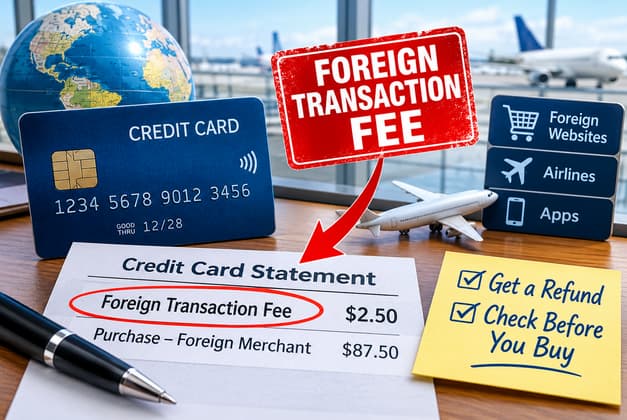
Quick answer. You can be charged a foreign transaction fee on a purchase priced in U.S. dollars — even from home — if the merchant or its payment processing is outside the U.S. Federal rules count three things as “foreign”: a foreign currency, a purchase in dollars made outside the U.S., and a purchase with a foreign merchant, including on its website. Whether your card charges for all three depends on its wording.
- FOREIGN CURRENCY
Foreign currency
You pay in euros, yen or any non-dollar currency, and it’s converted to dollars.
- YOUR CARD’S FINE PRINT
Dollars, but outside the U.S.
You pay in dollars while physically abroad. Many cards charge; some don’t.
- FOREIGN MERCHANT, U.S. DOLLARS
Dollars, but a foreign merchant (including online)
You pay in dollars from home, but the seller or its processing is abroad.
Check your card’s wording. Your card agreement’s “Foreign Transaction” line says what triggers your fee — some cards charge only on foreign currency.
- Check whether a purchase will trigger the fee, and what it costs →
- Already charged? Copy our refund request →
Verified November 19, 2026. Card terms change — check your own agreement.
Foreign Fee Check: Will This Purchase Trigger It?
Tell the check what you’re buying, how you’re paying and what your card’s agreement says, and it estimates how likely a fee is and what it would cost.
Find it on the “Foreign Transaction” line of your agreement.
Result
Related: Credit Card Cash Advance (for ATM withdrawals on a credit card).
Why You Paid a “Foreign” Fee on a Dollar Purchase
Because federal rules define a foreign transaction fee by where the merchant and the transaction are, not just by the currency on your receipt.
The CFPB’s official interpretation of Regulation Z (12 CFR 1026.4, comment 4(a)-4) says a foreign transaction fee includes three kinds of fees:
- Fees on transactions “made in a foreign currency and converted to U.S. dollars.”
- Fees on transactions made in U.S. dollars outside the U.S. The CFPB’s own example is a dollar purchase in Bermuda.
- Fees on transactions made — in a foreign currency or in U.S. dollars — with a foreign merchant, such as through the merchant’s website.
The third one is the surprise. The price can be in dollars, you can be on your couch, and the fee can still count as “foreign.”
The rule also covers a fee passed along from a third party that does the conversion, such as a network. The CFPB’s example: a 1% network charge that the issuer passes on to you is a foreign transaction fee. If the issuer absorbs it instead, it isn’t.
One limit worth knowing. The rule tells issuers what counts as a foreign transaction fee and how to disclose it. It does not make any issuer charge one. Whether yours does, and for which of the three cases, is in your card agreement.
Paying in dollars doesn’t guarantee there’s no fee.
The path a surprise fee takes
- You pay a U.S.-looking site.
- Its payment is processed abroad.
- The network charges your bank a cross-border fee.
- Your bank charges you its fee.
Visa calls its charge an International Service Assessment; Mastercard calls its a cross-border fee. These are charged to banks and merchants’ processors, and they typically land around 1% depending on how the transaction settles.
Your bank then sets its own consumer fee. On cards that charge one, 3% is common, which is why the fee can be several times the network’s cost.
Your Card’s Wording Decides
Your card agreement, not the receipt, decides which of the three triggers you actually pay for.
Where to find the line
Card issuers must disclose transaction charges, including this fee, in the rates-and-fees table at account opening (12 CFR 1026.6(b)(2)(iv); the application table is 1026.60(b)(4)). Look for the “Foreign Transaction” line. Then read the exact words next to it.
Two kinds of wording matter most:
Almost always triggers a fee on fee-charging cards.
Often triggers it on cards whose wording reaches foreign merchants or foreign locations. This is the surprise case.
Decides the rest. Is it “foreign currency” only? “Any transaction outside the U.S.”? “With a foreign merchant”? Those are different promises.
Some cards charge only on foreign currency — read your card’s wording.
Two real examples show how far apart the wording can be. Robinhood’s FAQ ties its fee to when you “transact in a foreign currency.” U.S. Bank’s Altitude Go page lists 3% on foreign purchases whether they’re in U.S. dollars or a foreign currency.
So a dollar purchase from a foreign merchant may not trigger the first card’s fee. Confirm in your current terms.
| Card or issuer | Fee | What triggers itWhat triggers it / 2026 note | Effective date | Source |
|---|---|---|---|---|
| Robinhood Gold Card | 3% | Foreign currency. Accounts opened on or after July 1, 2026 pay 3% if they transact in a foreign currency; earlier accounts pay none. A U.S.-dollar purchase from a foreign merchant may not trigger it; confirm in your current terms.
Effective: July 1, 2026 (accounts opened on or after). Source: Robinhood Gold Card FAQ. |
July 1, 2026 (accounts opened on or after) | Robinhood Gold Card FAQ |
| U.S. Bank Altitude Go | 3% | Foreign purchases and foreign ATM advances, in U.S. dollars or in a foreign currency, per U.S. Bank’s product page. Added for new cardholders in September 2024 and, per reports, for existing cardholders from August 15, 2025. Verify with U.S. Bank.
Effective: Sept. 2024 (new); Aug. 15, 2025 (existing). Source: U.S. Bank; dates via Doctor of Credit. |
Sept. 2024 (new cardholders); Aug. 15, 2025 (existing) | U.S. Bank Altitude Go page; dates via Doctor of Credit |
| Capital One | None | Capital One states that none of its U.S.-issued credit cards charge a foreign transaction fee.
Current as of Nov. 19, 2026. Source: Capital One. |
Current as of Nov. 19, 2026 | Capital One |
| PenFed credit cards | None | PenFed’s published credit card pricing lists no foreign transaction fee.
Current as of Nov. 19, 2026. Source: PenFed. |
Current as of Nov. 19, 2026 | PenFed credit cards |
| Discover | Reported none | Industry sources report no foreign transaction fee on any Discover card. The Discover page we checked doesn’t say so directly, so confirm in your cardmember agreement.
Reported; not confirmed on Discover’s own site. Source: The Points Guy. |
Reported; not confirmed on Discover’s site | The Points Guy |
| Verified November 19, 2026. Card terms change; check current terms. Not a ranking or recommendation. | ||||
Where It Usually Happens
It tends to happen where the storefront looks domestic but the money moves through a business or processor abroad.
- Foreign-processed shopping sites. The prices say “$,” but the company taking your payment may be in another country.
- Foreign airlines and hotels booked in dollars. The ticket or room may be sold by the airline’s or hotel’s local business, not a U.S. one.
- Apps and subscriptions. The “merchant of record” — the business that actually takes your payment — can differ from the brand you see.
- Marketplaces. One order can be charged by the marketplace, another by an overseas seller’s entity.
No store or brand is a guaranteed trigger. The same brand can be processed in different places for different purchases, and your card’s wording decides what happens next.
How to tell
- At checkout: a currency different from your own, a company name and country near the pay button, or a note about who processes payment.
- In the terms of sale: the legal name and country of the seller.
- In your card app: transaction details after the purchase, often including merchant location and any separate fee line.
How to Check Before You Buy
Spend two minutes on four checks before you pay a site you don’t know.
- Read your card’s fee line and its wording. “Foreign currency” only is very different from “outside the U.S.” or “foreign merchant.”
- Find the merchant’s country. Check the terms of sale, the “contact us” page, the footer and the returns address.
- Look for the merchant of record. Terms, receipts or checkout often name the company that takes payment.
- Try a small purchase first if the amount is large or recurring. Then look at the transaction details in your card app and see whether a fee line appears.
If checkout offers a choice of currency, pick the merchant’s own currency, not a converted one. More in Pay in Dollars or Local Currency?
Not sure what the answers mean for your card? Run the Foreign Fee Check.
How to Get the Fee Refunded
Ask first, in writing and politely: issuers can credit a fee as a courtesy, and you can dispute it only when it contradicts your card’s own terms.
If the fee follows your terms
A properly disclosed fee is generally not a billing error, even when it surprised you. Ask for a one-time courtesy refund through your issuer’s secure message or chat, and keep a copy. Nothing guarantees a yes, but a clean payment history helps your case.
If the fee breaks your terms
If you have a no-fee card, or a card that charges only on foreign currency and it charged you on a dollar purchase, the fee contradicts your agreement. That can be raised as a billing error under 12 CFR 1026.13. Send written notice so it reaches the issuer within 60 days of the first statement showing the charge.
The issuer must acknowledge your notice within 30 days and resolve it within two billing cycles, no later than 90 days. Step-by-step: How to Dispute a Credit Card Charge.
A fee that breaks your card’s own terms is a billing error you can dispute.
Before you write, gather the statement date, the amount, the merchant name and a screenshot of your agreement’s “Foreign Transaction” line.
Copyable refund request
Pick the version that fits. Paste it, then fill in the [brackets].
Returned the Item? What Happens to the Fee
Sometimes the fee comes back and sometimes it doesn’t, because whether it’s reversed when a merchant credits the purchase varies by issuer.
- Look at the statement. See whether the credit and a fee reversal both posted. They can post on different days.
- If only the purchase came back, ask the issuer to reverse the fee tied to the returned purchase. Give the original date, amount and merchant.
- If the purchase was in a foreign currency, the credit may convert at a different rate than the charge did, so the dollar amounts may not match.
- Keep records: the receipt, the return confirmation, tracking and statement screenshots.
Returning the item may not return the fee — ask.
Debit Cards, PayPal and Mobile Wallets
The way you pay changes who may charge you, so check the right fee schedule for that method.
Debit cards. Many banks charge a foreign transaction fee on debit purchases and on international ATM withdrawals. That fee lives in your deposit account’s fee schedule, not in a credit card agreement. Debit also protects you differently; see Credit or Debit for Online Shopping.
PayPal. When you pay with a linked card, whether your issuer adds a fee depends on how and where the transaction is processed. If PayPal converts the currency, PayPal applies its own exchange rate with a spread built in. Check PayPal’s consumer fees page for the current figure, and if PayPal offers to convert, compare its rate with your card’s.
Mobile wallets. Apple Pay and Google Pay charge the underlying card, so that card’s fee rules apply.
| Method | Who may charge | What to check |
|---|---|---|
| Credit card | Your card issuer, under its foreign transaction fee | The “Foreign Transaction” line and its wording |
| Debit card | Your bank, under the deposit account’s fee schedule; may also charge for international ATM withdrawals | The bank’s fee schedule, for purchases and ATMs |
| PayPal with a card | PayPal, if it converts the currency; possibly your card issuer, depending on how and where it’s processed | Your card statement, and PayPal’s current consumer fees page |
| PayPal with a bank balance | PayPal, if it converts the currency. No card is used, so no card fee | The currency of the payment and PayPal’s current fees page |
| Mobile wallet | The underlying card in the wallet | Which card is selected, and that card’s fee line |
Traveling Abroad: Card Fees, DCC and ATMs
Abroad, three separate costs can stack: your card’s foreign transaction fee, a merchant’s own currency conversion, and ATM fees.
Trip & Shopping Fee Calculator
Add up what a trip or a foreign shopping spree could cost in fees.
Your fees
Dynamic currency conversion (DCC). When a terminal or checkout asks whether to pay in dollars or local currency, choosing dollars means the merchant does the conversion, with a markup built into its rate. The CFPB’s commentary notes that an issuer doesn’t have to disclose a fee the merchant itself adds, and your card’s own fee may still apply on top. Pay in the local currency. Full explanation: Pay in Dollars or Local Currency?
ATMs. A withdrawal abroad can carry your bank’s fee, the ATM operator’s fee and a percentage fee. On a credit card, an ATM withdrawal is usually a cash advance, with its own costs: see Credit Card Cash Advance.
Acceptance and extras. Which network works where is covered in Visa vs. Mastercard vs. Amex vs. Discover. Before you go, it’s also worth checking your card’s travel benefits.
| Cost | Who charges it | When | Typical form | How to avoid |
|---|---|---|---|---|
| Foreign transaction fee | Your card issuer | Foreign currency, dollars outside the U.S., or a foreign merchant, depending on your card’s wording | A percentage of the purchase, often 3% on cards that charge one | Use a card whose agreement lists no foreign transaction fee |
| Currency conversion fee | Whoever converts: sometimes PayPal, sometimes an issuer that bundles it | The money changes currency | A spread above the base exchange rate, or a stated percentage | Compare the rates offered; read the fees page of whoever converts |
| Dynamic currency conversion (DCC) | The merchant or its processor | You’re offered a choice to pay “in dollars” abroad or online | A markup built into the rate the merchant shows you | Choose the merchant’s local currency |
FAQ
Short answers to the questions people ask right after the fee shows up.
Why was I charged a foreign transaction fee when I paid in U.S. dollars?
Federal rules count three things as “foreign”: a foreign currency, a dollar purchase made outside the U.S., and a purchase with a foreign merchant, including on its website. If the merchant or its processing was abroad and your card’s wording reaches that case, the fee applies. Read your card’s “Foreign Transaction” line.
Can I be charged a foreign transaction fee without leaving the U.S.?
Yes, if the purchase was with a foreign merchant and your card’s terms cover that. A card that charges only on foreign currency shouldn’t charge on a dollar purchase.
Do Temu, Shein or AliExpress purchases trigger foreign transaction fees?
It depends on how that purchase was processed and on your card’s terms. No brand triggers a fee every time. Check the seller’s country at checkout, look at the transaction details after a small test purchase, and compare with your card’s wording.
Do foreign airlines charge foreign transaction fees on U.S.-dollar tickets?
The airline doesn’t charge it; your card issuer might. It depends on which business sold and processed the ticket, and on whether your card’s wording covers foreign merchants.
Does PayPal avoid foreign transaction fees?
Not automatically. With a linked card, whether your issuer adds a fee depends on how and where the transaction is processed. If PayPal converts the currency, PayPal’s own rate applies. Check PayPal’s current consumer fees page.
Does Apple Pay or Google Pay avoid them?
No. The wallet charges the underlying card, so that card’s fee rules apply.
Do debit cards charge foreign transaction fees?
Many banks charge them on debit purchases and international ATM withdrawals, under the deposit account’s fee schedule. Check yours.
Where do I find my card’s foreign transaction fee?
In the rates-and-fees table of your card agreement, on the “Foreign Transaction” line. Your issuer’s website or app usually shows the same terms. Read the wording beside the percentage.
Can I get a foreign transaction fee refunded?
Often you can ask for a one-time courtesy refund, though it isn’t guaranteed. Use the copyable request above.
Can I dispute a foreign transaction fee?
Only when it contradicts your card’s terms, for example a no-fee card, or a currency-only card charging on a dollar purchase. A properly disclosed fee is generally not a billing error. Written notice generally has to reach the issuer within 60 days of the statement that showed it. See How to Dispute a Credit Card Charge.
If I return the item, do I get the fee back?
It varies by issuer. Check your statement for a fee reversal and ask if it’s missing.
Is a foreign transaction fee the same as a currency conversion fee?
No. The foreign transaction fee is your issuer’s charge. Under Regulation Z’s commentary, it’s measured as the amount above a conversion done at a rate outside the issuer’s control, such as a wholesale market rate. A conversion fee or spread comes from whoever converts, and DCC comes from the merchant. See Table 3.
Why did my Robinhood Gold Card start charging a foreign transaction fee?
Robinhood’s FAQ says accounts opened on or after July 1, 2026 pay 3% if they transact in a foreign currency, while accounts opened before that date pay no foreign transaction fee. If your account is older and you were charged, ask Robinhood to review it. If the purchase was in dollars, compare it with the “foreign currency” wording in your current terms.
Did the U.S. Bank Altitude Go add a foreign transaction fee?
Yes, in 2024 and 2025, not in 2026. It added a 3% fee for new cardholders in September 2024 and, per reports, for existing cardholders from August 15, 2025. U.S. Bank’s product page lists 3% on foreign purchases in dollars or a foreign currency. Verify with U.S. Bank.
Which issuers don’t charge foreign transaction fees?
Capital One says none of its U.S.-issued credit cards do, and PenFed’s published credit card pricing lists none. Discover is reported to charge none, but we couldn’t confirm that on Discover’s own page. See Table 1, and check current terms before you rely on any of it. This is not a recommendation.
How much does a 3% fee cost on a trip?
On $3,000 of card spending, 3% is $90. Add three $300 ATM withdrawals with a $5 bank fee, a 1% international fee and a $3 operator fee each, and ATM costs come to $33, for $123 in all. Try your own numbers in the calculator.
This article is general information, not financial or legal advice. Fees depend on your card agreement and on how and where a merchant processes payments, and card terms change. Verified November 19, 2026. Last updated: .

Daniel Hayes is the founder and sole researcher at AdvoraHQ. He covers U.S. personal finance, insurance, and consumer law — working directly from IRS publications, federal and state statutes, court opinions, and SEC filings rather than secondary summaries. His focus is the gap between what readers think they know and what the source documents actually say. Daniel is not a licensed attorney, CPA, or financial advisor; his articles are educational and not personalized advice. Reach him at Daniel.Hayes@advorahq.com.
