
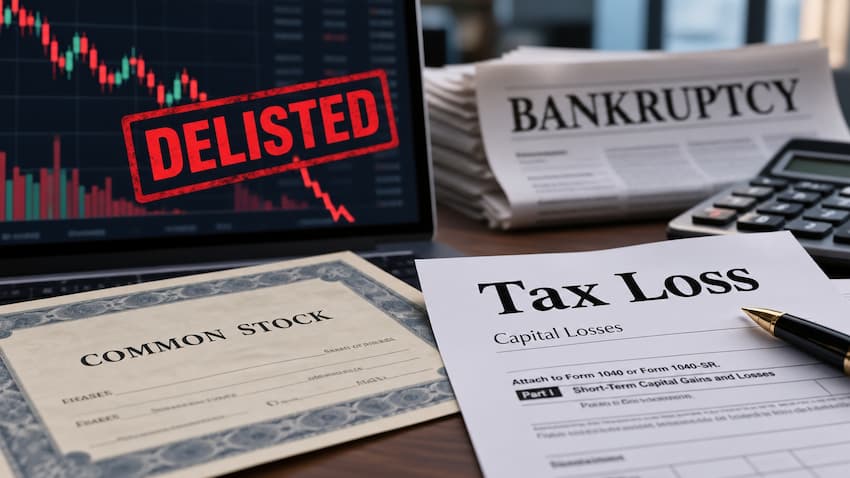
The short answer: A delisting doesn’t automatically make your shares worthless — they may still trade over the counter, and until they’re completely worthless, you generally can’t deduct them as a worthless-stock loss. If they do become worthless, the IRS treats them as sold on December 31 of that year, and you have up to seven years from that year’s return due date to claim a missed loss.
Delisted ≠ Worthless
- Delisted: shares may trade OTC, so you can sell to realize a loss.
- Bankrupt: depends on Chapter 11 versus Chapter 7.
- Worthless: claim it on Form 8949.
Which situation are you in?
- STILL TRADING
The shares have a quote, or they trade over the counter. Path: sell to realize the loss.
- FROZEN IN MY APP
The position shows but won’t sell, or it disappeared. Path: find out why, then sell, transfer, or document.
- CANCELED OR WORTHLESS
A plan canceled the shares, or the company dissolved with nothing for shareholders. Path: claim it on Form 8949.
Short on time? Jump to the tool, which sorts your situation and does the date math — and the deadline most people don’t know is longer than they think: seven years, not three.
Delisted, Bankrupt, or Worthless? Check Your Situation
Answer what you know, then press the button. This tool separates trading status from bankruptcy status and gives a simplified tax-loss illustration. Nothing you enter is stored or sent anywhere.A Delisted Stock Isn't Automatically Worthless
A delisting means an exchange has removed the stock from its list. That changes where the shares trade. It doesn't cancel them, erase your ownership, or set their value to zero.
Companies get delisted for different reasons: the share price or market value fell below exchange standards, required filings were late, the company filed for bankruptcy, or it chose to leave. Only some of those point toward worthless shares.
One more case: if the company was acquired, your shares may have been converted into cash or other stock. That is a sale, not a worthless-stock situation, and your broker should show what you received.
For taxes, the line is sharp. A loss from a security is allowed under IRC § 165(g) and 26 CFR § 1.165-5 only when the security becomes wholly worthless. A drop in market value doesn't count. A security that still trades or has value isn't wholly worthless.
| Status | What it means | Can you sell? | Tax loss now? |
|---|---|---|---|
| Delisted | Removed from an exchange. Shares still exist. | Often. They may trade OTC, but it isn't guaranteed and trading can be thin. | Not for the delisting itself. A sale realizes a loss. |
| Bankrupt, Chapter 11 | Reorganization. Old shares may keep trading and may be canceled under the plan. | Sometimes, depending on the market and your broker. | A sale realizes a loss. Worthlessness depends on facts. |
| Bankrupt, Chapter 7 | Liquidation. Shareholders are last in line. | Sometimes for a while. Often little or no market. | Possible if facts show the shares have no value. |
| Worthless | Wholly without value, for example canceled for nothing. | Usually no market. | Yes. Treated as sold December 31 of that year. |
What Happens After a Delisting
Where the shares may trade
Delisted securities may continue to trade over the counter (OTC). OTC trading runs through broker-dealers rather than an exchange, so quotes can be sparse, spreads wide, and company information thinner than you're used to. Per FINRA and the SEC, trading isn't guaranteed.
What can change
- The ticker may change, and a fifth letter may be added (see the Q note in the Chapter 11 section).
- The company may stop publishing regular reports, which makes it harder to know what's happening.
- The company may be acquired, reorganized, or liquidated.
If you want out: selling for pennies
If the shares still trade, you can sell them. A sale at a loss realizes a capital loss in the year of the sale, and you don't have to prove the shares were worthless.
One rule to know: if you buy substantially identical shares within 30 days before or after a sale at a loss, the wash-sale rule may disallow the loss for now (IRS Pub. 550). This isn't a suggestion to buy more of a company in trouble. It's only a reminder that the rule exists.
Why Your Shares May Be Frozen in Your App
A frozen or missing position feels like the shares are gone. Often they aren't. Common reasons:
- No quote, no buyers. The app may show a blank or $0 price because nobody is bidding. The shares still exist.
- Broker limits on OTC or delisted securities. Policies vary. Some brokers restrict what you can do with these securities.
- A corporate action in progress. A bankruptcy plan, merger, reverse split, or ticker change can temporarily restrict or rename a position.
- The position was converted or removed. After a merger or a plan that cancels shares, the broker may have converted or removed it. Check your activity history and notices.
What to do, in order:
- Open the position details and your account notices. Look for a corporate action, a symbol change, or a restriction message.
- Search the company's recent filings and news for a delisting, bankruptcy, or cancellation notice.
- Ask your broker, in writing: Can this security be sold? If not, why? What documents can you give me about its status?
- If you want to move it, ask the receiving broker whether it accepts this kind of security before you start a transfer.
- Save every notice, letter, and statement.
Brokers differ in how they handle OTC and delisted securities, one of the factors covered in our Best Online Brokers guide.
Chapter 11: Reorganization
Chapter 11 is reorganization. The company keeps operating while it restructures its debts under court supervision (SEC, "Corporate Bankruptcy"). For common shareholders, these are the main possibilities:
- The old shares keep trading for a time, often at very low prices.
- The plan cancels the old shares, sometimes for nothing and sometimes for a small recovery such as new shares or warrants.
- Less often, existing shareholders keep a stake in the reorganized company.
"Always zero" isn't accurate. What the plan says decides it. Look for the plan of reorganization, the disclosure statement, and the notice of the plan's effective date.
What the Q on a ticker means
FINRA's list of fifth-letter identifiers for OTC symbols describes a Q as "involved in bankruptcy proceedings." Treat it as a clue rather than proof. Nasdaq says it now uses a separate financial status indicator for its own listings, and brokers display symbols in different ways.
If your shares are canceled with nothing in return, keep the plan or notice and note the date. That is one of the strongest facts supporting worthlessness.
Chapter 7: Liquidation
Chapter 7 is liquidation. A trustee sells the company's assets and pays creditors in priority order. Stockholders are last in line, so the shares are usually worthless (SEC, "Corporate Bankruptcy"). "Usually" is not "always," so check the trustee's reports and the court docket for what's actually distributed.
The shares may still trade for a while, and your broker may keep showing the position. Neither fact settles the tax question on its own. The next section covers how the IRS looks at it.
| Feature | Chapter 11 | Chapter 7 |
|---|---|---|
| Purpose | Reorganize and keep operating | Liquidate and wind down |
| Who runs it | Usually the company, under court supervision | A trustee sells the assets |
| Common shareholders | Behind creditors. Often wiped out, sometimes some recovery under the plan. | Last in line. Usually nothing is left. |
| Old shares | May keep trading for a time. May be canceled under the plan. | May trade briefly. Usually end up with no value. |
| Tax-loss timing | Sale realizes a loss. Worthlessness if canceled for nothing and the facts support it. | Worthlessness possible when liquidation leaves nothing. Facts decide. |
When the IRS Considers a Stock Worthless
The rule comes from IRC § 165(g) and 26 CFR § 1.165-5. You may deduct a loss on a security only when it becomes wholly worthless. There is no deduction for a partial decline.
Worthlessness is a facts-and-circumstances question. Facts that can support it include:
- A bankruptcy liquidation that leaves nothing for shareholders.
- Cancellation of the shares under a plan, with no consideration paid.
- The company ended its business and has no value left for shareholders.
Facts that cut the other way include shares that still trade or have value, a business that is still operating, or a pending plan that might give shareholders something.
Near zero isn't the same as worthless.
A stock at a fraction of a cent that still trades has value to someone. You can sell it and realize the loss. You generally can't call it wholly worthless while it still has value.
Records that help show the year it became worthless: court filings, the cancellation notice, broker letters, and trading history showing when the market ended. Keep them for seven years.
Nothing on this page can tell you that a particular stock is worthless. That depends on the company's facts and your situation, so confirm with a tax professional.
The December 31 Rule
When a security becomes worthless, the tax code treats it as if you sold it on the last day of the tax year it became worthless (IRS Pub. 550). That's December 31, even if the company collapsed in February.
Two things follow. First, the loss belongs to that year, so you can't pick a more convenient one. Second, that date decides whether the loss is short-term or long-term.
Short-Term or Long-Term?
Count from the day after you bought the shares through December 31 of the worthless year. Held more than one year: long-term. One year or less: short-term. The holding period is figured the same way as for an actual sale.
- Bought March 15, 2025; worthless in 2026. Deemed sold December 31, 2026. Long-term.
- Bought November 10, 2026; worthless in 2026. Deemed sold December 31, 2026. Short-term.
- Bought December 31, 2025; worthless in 2026. Held exactly one year. Short-term.
How to Report It on Form 8949
Worthlessness of a security is reported on Form 8949 (Part I for short-term, Part II for long-term), which feeds Schedule D (IRS Pub. 550). Because no real sale happened, you may not get a Form 1099-B for it.
- Column (a): the company name and number of shares. Tax-software help pages commonly add the word "worthless" here.
- Column (b): the date you acquired the shares.
- Column (c): December 31 of the year the shares became worthless.
- Column (d): $0 in proceeds.
- Column (e): your cost basis.
- Column (h): the resulting loss. Choose Part I or II by holding period. With no 1099-B, that's usually box C (short-term) or box F (long-term).
A note on wording: the 2025 Form 8949 instructions (the version checked for this article on September 30, 2026) list worthlessness of a security among the items reported on the form. They don't spell out special wording for it, so check the instructions for the year you're filing. For how losses net against gains, see our Capital Gains Tax 2026 guide.
Missed It? The 7-Year Rule
Seven years from the return due date.
A refund claim based on a worthless security can be filed within 7 years from the due date of the return for the year the security became worthless (IRC § 6511(d)(1); Form 1040-X instructions).
The usual amendment window is 3 years from the filing date or 2 years from the date the tax was paid, whichever is later. Some tax-software help pages mention only that general window. For worthless securities the rule is longer.
Example: shares became worthless in 2024. The 2024 return was due April 15, 2025. Seven years from that date is April 15, 2032.
How to claim a missed loss:
- Figure out the year the shares became worthless. The claim is for that year.
- File Form 1040-X for that year, with a Form 8949 and Schedule D showing the loss.
- Include the reason the stock is worthless and the approximate date it became worthless (IRS Pub. 550).
- Check later years. A carryforward can change those returns too.
If the date falls on a weekend or legal holiday, deadlines generally move to the next business day. Confirm the exact date, and talk to a tax professional for a late or complicated claim.
Abandonment: When You Can't Sell
For abandonments after March 12, 2008, a security can be treated as worthless if you permanently surrender and relinquish all rights in it and receive no consideration (T.D. 9386; 26 CFR § 1.165-5(i)). The facts decide whether a transaction is truly an abandonment or something else, such as a sale, gift, or contribution.
That has limits:
- The conditions are legal ones. Asking your broker to "delete" a position doesn't automatically meet them.
- You can't abandon shares and keep any right to them or get anything back.
- If the shares still trade, selling is usually simpler than abandoning.
The regulations describe the conditions rather than a step-by-step process, so what you can do in practice depends partly on your broker. Keep written proof of what you did and when.
Your Broker Won't Sell or Remove the Shares
A position can stay on your screen long after you've concluded it's worthless. The broker may be waiting on a corporate-action notice, or its system may not support the security.
- Ask whether the security is still tradable and whether it is pending a corporate action.
- Ask whether the broker has a process for worthless or non-tradable securities, and how to start it. Procedures differ, so look for the steps on your broker's own support pages.
- Ask for a written statement of the position's status and the date of any removal.
- If it can't be sold or removed, ask a tax professional whether abandonment fits your facts.
The position showing in your account doesn't, by itself, decide the tax year. The facts about when the shares became worthless do.
The $3,000 Limit and Carryforward
Net capital losses first offset capital gains. If losses are left over, you can deduct up to $3,000 per year ($1,500 if married filing separately) against other income. The rest carries forward to later years (IRS Pub. 550). Carried-over losses keep their short-term or long-term character. For more on using losses, see Tax-Loss Harvesting.
A $20,000 loss isn't a $20,000 deduction this year.
It's a $20,000 loss that gets used up against gains and then $3,000 at a time.
| Item | Amount |
|---|---|
| Cost basis (proceeds $0) | $20,000 |
| Other capital gains this year | $5,000 |
| Loss used against those gains | $5,000 |
| Net loss remaining | $15,000 |
| Deducted against other income (limit) | $3,000 |
| Carried forward to next year | $12,000 |
Company Bankruptcy vs. Broker Bankruptcy
These are different events. When a company goes bankrupt, you own stock in a failed business, and the rules above decide what happens to it. When a brokerage firm fails, your shares in healthy companies are a separate matter: SIPC may help return missing securities and cash, but it doesn't cover losses from a company's collapse or from falling prices. See What Happens If Your Brokerage Firm Fails? for how that works.
Checklist & FAQ
Records to gather
- Trade confirmations or statements showing your purchase date, shares, and total cost.
- Any delisting, bankruptcy, or cancellation notice, and the plan or court order if there is one.
- Broker letters or messages about the position's status.
- A note of the date the market for the shares ended.
Does delisting mean a stock is worthless?
No. Delisting removes the stock from an exchange. The shares may still trade OTC and may still have value.
Can you still sell a delisted stock?
Often, yes. Delisted securities may continue trading over the counter, but it isn't guaranteed, and some brokers limit what you can do with them.
Where does a delisted stock trade?
Usually over the counter, through broker-dealers rather than an exchange. Quotes can be thin.
Why is my delisted stock not showing in my brokerage account?
It may have been converted in a merger, removed after a plan canceled it, or renamed after a corporate action. Check your activity history and notices, then ask your broker.
Why can't I sell my delisted stock?
Possible reasons: no buyers, a broker restriction, or a pending corporate action. Ask the broker in writing which one applies.
Can I transfer delisted stock to another broker?
Sometimes. Acceptance depends on the receiving broker, so ask before starting a transfer.
What happens to common stock in Chapter 11?
It may keep trading for a time, and the plan may cancel it, with or without a small recovery. The plan decides.
What happens to stock in Chapter 7 bankruptcy?
Stockholders are last in line, so the shares are usually worthless. Check what the trustee actually distributes.
Are old shares canceled after Chapter 11?
Often, but not always. Read the plan of reorganization and the notice of its effective date.
Can bankrupt stock still trade OTC?
It may. Trading isn't guaranteed, and a stock that still trades isn't wholly worthless for tax purposes.
What does Q mean after a stock ticker?
FINRA's OTC identifiers list a fifth-letter Q as involved in bankruptcy proceedings. Treat it as a clue, not proof.
When is a stock considered worthless for tax purposes?
When it becomes wholly worthless, judged on the facts. Declines in market value don't count.
Can I deduct worthless stock without selling?
Yes, if it is truly wholly worthless. You report it as a deemed sale on December 31 of that year. If it still has value, sell it instead.
My stock is worthless but still in my brokerage account. What now?
The tax year depends on when it became worthless, not on when the broker removes it. Document the facts, ask the broker about its process, and ask a tax professional about abandonment if it can't be removed.
Is a worthless stock deemed sold on December 31?
Yes. It's treated as sold on the last day of the tax year it became worthless.
Is a worthless stock loss long-term or short-term?
It depends on the holding period through that December 31. More than one year is long-term.
How do I report worthless stock on my tax return?
On Form 8949, then Schedule D. Use December 31 as the date sold, $0 proceeds, and your cost basis.
How far back can I claim a worthless stock loss, and is it 3 years or 7?
For worthless securities the refund-claim window is 7 years from the due date of the return for the year it became worthless. The 3-year window applies to most other amended returns. Use Form 1040-X.
How do I abandon worthless stock?
You must permanently surrender all rights for no consideration, and the facts must fit an abandonment. Ask your broker about its process and talk to a tax professional.
Is there a limit on deducting the loss?
Yes. Losses offset capital gains, then up to $3,000 a year ($1,500 if married filing separately) against other income. The rest carries forward.
Is a company bankruptcy the same as a broker bankruptcy?
No. SIPC covers missing customer assets at a failed broker, not a company's stock losses.
My 1099-B shows odd proceeds or basis for a delisted stock. What do I do?
Compare it with your own records and see IRS Says You Owe Tax on Your Entire Stock Sale? for how basis mismatches work.
Sources: IRS Publication 550 (irs.gov/publications/p550); Instructions for Form 8949 (irs.gov/instructions/i8949); 26 CFR § 1.165-5 and T.D. 9386 (abandonment); IRC § 6511(d)(1) and the Form 1040-X instructions; SEC, "Corporate Bankruptcy"; FINRA, fifth-character identifiers (otce.finra.org) and OTC equities trading.
Last updated:
Disclaimer: This article is for educational purposes only and is not tax, legal, or investment advice. Whether a particular security is worthless, and in which year, depends on facts specific to you. Consult a qualified tax professional.

Daniel Hayes is the founder and sole researcher at AdvoraHQ. He covers U.S. personal finance, insurance, and consumer law — working directly from IRS publications, federal and state statutes, court opinions, and SEC filings rather than secondary summaries. His focus is the gap between what readers think they know and what the source documents actually say. Daniel is not a licensed attorney, CPA, or financial advisor; his articles are educational and not personalized advice. Reach him at Daniel.Hayes@advorahq.com.