
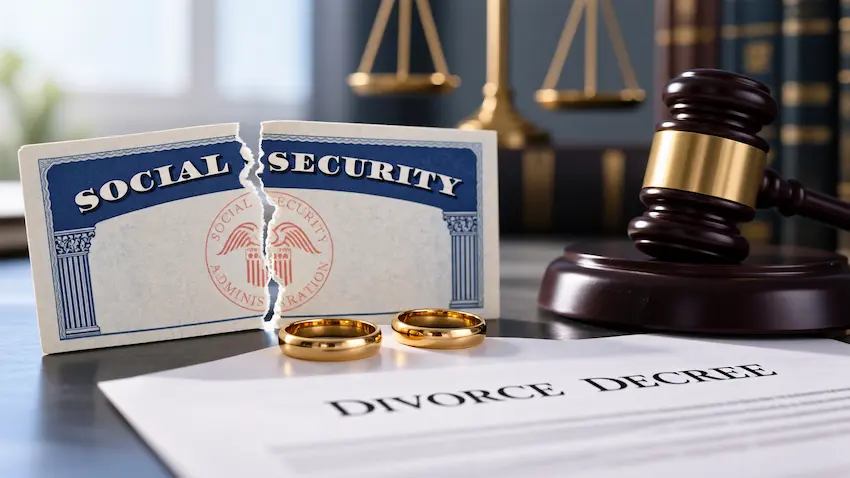
The short answer: A divorce court generally can’t split your Social Security benefit the way it splits a house or a 401(k). But if your marriage lasted at least 10 years before the divorce became final, your ex-spouse may qualify for a separate benefit on your record, and you may qualify on theirs, without reducing either person’s own check.
Three Things to Know First
DIVIDE
Courts can’t directly divide benefits. Some states let a judge consider them when dividing other assets, and benefits can be garnished to enforce child support or alimony.
DATE
The 10 years run to the date the divorce becomes final, not the date you separated or filed.
NOTICE
In some cases SSA notifies your ex when you claim on their record. Your claim doesn’t reduce their benefit.
Jump to the 10-year calculator to test your own dates.
And here is the detail that has cost real people their benefits: a marriage that ended days short of ten years.
Does Your Divorce Meet the 10-Year Rule?
Enter your dates. Nothing you type is stored or sent anywhere; the result appears on this page only.
Can a Divorce Court Divide Social Security?
Not directly. Federal law, 42 U.S.C. § 407, bars the transfer or assignment of Social Security benefits. A state divorce court therefore can’t treat your monthly benefit as marital property and award a share of it to your ex-spouse.
DIVIDE
A court can’t hand your ex a slice of your check. That doesn’t mean the court ignores it.
Some state courts consider actual or expected Social Security benefits when dividing other assets or assessing each person’s financial circumstances. In Danielson v. Danielson, 2024 WI App 57, the Wisconsin Court of Appeals held that while benefits themselves can’t be divided in a divorce, a trial court may take the difference in the spouses’ expected benefits into account in dividing property and in setting held-open maintenance. Other states restrict this approach, so the answer depends on where you divorce.
One more point: a decree clause that purports to waive one spouse’s right to claim on the other’s record generally doesn’t control whether SSA finds someone eligible. Eligibility is set by Social Security law.
| Action | Allowed? | Source |
|---|---|---|
| Divide the benefit as marital property | No | 42 U.S.C. § 407 |
| Consider actual or expected benefits when dividing other assets or setting support | Depends on the state | Example: Danielson, 2024 WI App 57 (Wisconsin); other states restrict |
| Withhold benefits to enforce child support or alimony | Yes, under federal law | 42 U.S.C. § 659 |
| Pay a separate benefit to an eligible ex-spouse | Yes, if SSA’s requirements are met | 20 CFR § 404.331 |
Table checked against the cited sources in October 2026. State law varies, and this table covers only the examples named.
The Exception: Child Support and Alimony
Social Security isn’t shielded from every legal claim. Under 42 U.S.C. § 659, benefits can be withheld, or garnished, to enforce an obligation to pay child support or alimony. This is separate from dividing property: it’s a way to collect support that a court has already ordered.
For how support amounts are set, see How Is Child Support Calculated? For how alimony is treated now that the old deduction is gone, see The Alimony Tax Break Disappeared in 2019.
The 10-Year Rule
A divorced person may be able to collect a benefit based on an ex-spouse’s earnings record. SSA’s operating manual (POMS RS 00202.005) and 20 CFR § 404.331 set the requirements. The marriage must have lasted at least 10 years immediately before the divorce became final. In addition:
- You are currently unmarried.
- You are at least 62.
- Your ex-spouse is entitled to retirement or disability benefits, or is eligible and meets the extra conditions covered below in the section on an ex who hasn’t filed.
- The benefit you’d receive on your own record is less than the divorced-spouse benefit.
The divorced-spouse benefit is up to 50% of your ex-spouse’s full-retirement-age amount. It is reduced if you claim before your own full retirement age. Unlike a retirement benefit on your own record, it doesn’t grow if you wait past full retirement age.
| Benefit | Earliest age | Notes |
|---|---|---|
| Divorced spouse (living ex) | 62 | About 32.5% of the ex’s full benefit at 62 when full retirement age is 67; up to 50% at full retirement age |
| Divorced spouse, ex hasn’t filed | 62, and the ex must be 62 or older | Requires at least 2 continuous years of divorce |
| Surviving divorced spouse (deceased ex) | 60 (50 if disabled) | Married 10+ years; SSA applies additional conditions for the disabled benefit |
| Full retirement age | 66 and 2 months to 67 | 67 for anyone born in 1960 or later |
Checked against SSA materials in October 2026.
Why the Final Divorce Date Matters
DATE
Ten years means ten years, to the final decree. The test is met if the divorce becomes final on or after the 10th anniversary of the marriage.
This is the part people most often get wrong. The clock doesn’t stop when you separate, when one of you files, or when a settlement is signed. It stops on the date the divorce becomes final.
An illustration, with made-up dates: a couple marries on June 15, 2015. Their 10th anniversary is June 15, 2025. If the divorce becomes final on June 3, 2025, the marriage lasted 9 years, 11 months, and 19 days. That is 12 days short, and there is no rounding up. If it becomes final on June 15, 2025 or later, the marriage has lasted ten years.
Courts apply the line strictly. In Albertson v. Apfel, 247 F.3d 448 (2d Cir. 2001), an applicant for surviving-divorced-wife benefits was denied because, even on her best reading, the divorce took effect three days before the tenth year was complete. The rule there is the same 10-years-immediately-before-the-divorce standard.
Which date is “final”? That depends on your state and your paperwork. In some places a judgment becomes effective only after a waiting period or a further court entry. Check the decree itself, and ask your attorney what date your state treats as the effective date.
A note on timing. This article describes how the rule works. It doesn’t recommend that anyone delay or accelerate a divorce, and nobody should misstate their marital status to SSA or a court. Divorce timing involves safety, finances, children, and law that differ by state, so talk it through with a family-law attorney. Our guides to what a divorce costs and to choosing a divorce lawyer can help you prepare.
Does Legal Separation Count?
The 10 years are measured from the marriage date to the final divorce date. A legal separation doesn’t end the marriage, so the years you spend separated but still legally married generally count toward the total. Living apart informally doesn’t change the math either.
The flip side matters just as much: a separation by itself isn’t a divorce, so it doesn’t create divorced-spouse eligibility. Until a divorce is final, SSA generally treats you as married. Don’t assume separation stops or starts anything; confirm how your state’s separation order works with an attorney.
Claiming on Your Ex’s Record at 62
If you meet the requirements above, you can apply for a divorced-spouse benefit once you turn 62. You don’t need your ex-spouse’s permission, and you don’t need a court order. SSA typically asks for proof of the marriage and the divorce, such as the marriage certificate and divorce decree, plus identifying information for your ex.
SSA pays the higher of your own retirement benefit or the divorced-spouse benefit, not both stacked together. Claiming before full retirement age permanently reduces the benefit, and if you work while under full retirement age, the earnings test can temporarily withhold benefits. For how claiming age affects your own record, see When to Take Social Security: 62 vs 67 vs 70.
If Your Ex Hasn’t Filed Yet
Your ex-spouse doesn’t have to be collecting for you to claim. Under SSA’s rule for an “independently entitled divorced spouse” (POMS RS 00202.100, updated September 18, 2025), you may claim if your ex is 62 or older and eligible for retirement benefits, and you have been divorced for at least 2 continuous years. The 2-year waiting period doesn’t apply when your ex has already started benefits.
Will SSA Notify Your Ex?
NOTICE
SSA may tell your ex you filed.
Plenty of guides say your ex is never told. SSA’s own manual says otherwise for at least one situation. In independently entitled cases, when SSA locates the ex and needs to contact them, the manual directs SSA to tell them the name of the person filing on their record, the type of benefit involved, the evidence needed, and that the claim won’t reduce their benefit amount. SSA also tells them it won’t give you their current whereabouts.
That provision covers claims where the ex hasn’t filed. We didn’t find an equivalent SSA rule describing what happens when the ex is already receiving benefits, so don’t assume notice either will or won’t happen. If privacy matters to you, ask SSA how it handles your situation before you file.
Does It Reduce Your Ex’s (or Their New Spouse’s) Benefit?
NOTICE
Your claim doesn’t shrink your ex’s check.
A divorced-spouse benefit is paid on top of, not out of, the ex-spouse’s benefit. It doesn’t reduce your ex’s benefit, and SSA’s rules say it doesn’t adversely affect benefits payable to the ex’s current spouse or other family members. The divorced-spouse amount isn’t subject to the family maximum. Multiple ex-spouses can each qualify, as long as each marriage met the 10-year requirement on its own. Your ex’s later remarriage doesn’t block your claim.
Remarriage While Your Ex Is Living
If your ex is living, remarriage generally ends your divorced-spouse benefit on that ex’s record. Remarrying at 60 or later doesn’t change that for a divorced-spouse benefit; the age-60 exception belongs to survivor benefits, covered next. If the later marriage ends through death, divorce, or annulment, benefits on the earlier record may become available again, provided you still meet the requirements.
Report marriages and divorces to SSA promptly. Benefits paid after an event that should have ended them can be recovered; see Social Security Says You Were Overpaid? for how overpayment letters work.
Survivor Benefits After an Ex Dies
If your ex has died, different rules apply. A surviving divorced spouse who was married at least 10 years can claim a survivor benefit from age 60 (50 if disabled). The 2-year divorce waiting period doesn’t apply, and the ex doesn’t need to have filed for retirement before dying. A survivor benefit can be as much as 100% of the ex’s benefit amount at your full retirement age, reduced if you claim sooner. Different rules can apply if you are caring for the deceased ex’s young or disabled child; SSA can explain those.
Remarriage works differently here too. Remarrying at or after age 60 doesn’t end eligibility. Remarrying before 60 generally does, unless that later marriage ends.
| Rule | Living ex | Deceased ex |
|---|---|---|
| Earliest age | 62 | 60 (50 if disabled) |
| Marriage length | 10+ years before the final divorce | 10+ years before the final divorce |
| Wait after divorce if ex hasn’t filed | 2 continuous years | None |
| Maximum amount | Up to 50% of ex’s full-retirement-age amount | Up to 100% of ex’s benefit amount at your full retirement age |
| Effect of remarriage | Generally ends the benefit while remarried, at any age | Doesn’t end it if at or after 60; generally ends it if before 60 |
Checked against SSA materials in October 2026.
The 2025 GPO Repeal and Government Pensions
For decades, the Government Pension Offset (GPO) cut spouse and survivor benefits, divorced spouses included, for people who received a government pension from work not covered by Social Security. It often wiped out the benefit entirely. The Social Security Fairness Act, signed January 5, 2025, repealed the GPO and the Windfall Elimination Provision (WEP) for benefits payable for January 2024 onward.
The repeal doesn’t affect everyone. It matters for some, not all, teachers, firefighters, police officers, and other public employees whose pensions come from non-covered work. Some online guides still describe the GPO as active, so check the publication date of anything you read. If you were denied or reduced because of the GPO or WEP before the repeal, ask SSA how the change applies to your record.
What This Isn’t
This guide covers retirement, survivor, and divorced-spouse benefits under Social Security. It isn’t legal or financial advice, it doesn’t cover how a court divides pensions or retirement accounts, and state law on property and support varies. Questions about how trust-fund projections could affect future checks are a separate topic; see Social Security’s 2032 Cut, Calculated.
Frequently Asked Questions
Is Social Security divided in a divorce?
Not directly. Federal law bars a court from assigning part of your benefit to your ex-spouse. Some states may consider it in dividing other assets, and benefits can be garnished for child support or alimony.
Can my ex take my Social Security in a divorce?
A court can’t award your ex a share of your check as property. Your ex may, however, qualify for their own benefit on your record if the marriage met the 10-year rule, and that benefit doesn’t reduce yours.
Is Social Security marital property?
It isn’t divisible as marital property. Some states still let a judge consider expected benefits when dividing other property or setting support, while others restrict that.
Can a divorce court consider my Social Security when dividing other assets?
It depends on the state. Wisconsin’s appeals court said yes in Danielson (2024); other states limit it. Ask a local family-law attorney.
Can Social Security be garnished for alimony or child support?
Yes. 42 U.S.C. § 659 allows withholding to enforce child support and alimony obligations.
What is the 10-year rule?
To claim as a divorced spouse, your marriage must have lasted at least 10 years immediately before the divorce became final.
What if I was married 9 years and 11 months?
That doesn’t meet the requirement. There’s no rounding, and courts have upheld denials where the marriage fell short by only days.
Which date counts: filing, separation, or final?
The final divorce date. Check your decree or judgment for the effective date, and confirm with an attorney how your state treats it.
Does legal separation count toward the 10 years?
The count runs to the final divorce date, so years of legal separation while still married generally count. A separation by itself doesn’t create divorced-spouse eligibility.
Does living apart count toward the 10 years?
Living apart doesn’t stop the clock. What matters is the marriage date and the final divorce date.
Can I collect Social Security from my ex-spouse?
Possibly, if the marriage lasted 10+ years, you are 62+, unmarried, your ex is entitled to benefits (or meets the independently entitled rules), and your own benefit is lower than the divorced-spouse amount.
How much can I get?
Up to 50% of your ex’s full-retirement-age benefit, less if you claim before your own full retirement age. SSA pays the higher of that or your own benefit.
Can I claim if my ex hasn’t filed?
Yes, if your ex is 62 or older and eligible, and you’ve been divorced at least 2 continuous years.
Will SSA notify my ex if I claim?
Possibly. In independently entitled cases where SSA contacts the ex, it tells them who filed and the type of benefit, and that their benefit won’t be reduced. Don’t assume your ex won’t be told.
Does claiming reduce my ex’s benefit?
No. A divorced spouse’s entitlement doesn’t reduce the ex’s benefit.
Does my claim reduce my ex’s new spouse’s benefit?
No. It doesn’t reduce a current spouse’s or other family members’ benefits.
Can multiple ex-spouses claim on the same record?
Yes, if each marriage independently lasted 10 years and each person meets the other requirements.
Does remarriage stop divorced-spouse benefits?
If your ex is living, remarriage generally ends the benefit while you’re remarried. It may become available again if the later marriage ends.
What if my ex dies?
You may qualify for survivor benefits from age 60 (50 if disabled) if the marriage lasted 10+ years. No post-divorce waiting period applies.
Can I remarry after 60 and keep survivor benefits?
Yes. Remarriage at or after 60 doesn’t end eligibility for a surviving divorced spouse. Remarriage before 60 generally does, while the new marriage lasts.
Does the GPO repeal help divorced spouses?
It can, if you receive a government pension from non-covered work. The Social Security Fairness Act repealed the GPO for benefits payable from January 2024.
Should I time my divorce around the 10-year mark?
This article can’t advise on that. Timing involves many legal and personal factors that vary by state; discuss it with a family-law attorney, and never misstate your marital status.
Sources
- 42 U.S.C. § 407 and 42 U.S.C. § 659 (Cornell LII)
- 20 CFR § 404.331
- SSA POMS: RS 00202.005 (Divorced Spouse) and RS 00202.100 (Independently Entitled Divorced Spouse, 09/18/2025)
- SSA FAQ on marriage requirements for spouse’s benefits
- Danielson v. Danielson, 2024 WI App 57 (Wisconsin Court of Appeals)
- Albertson v. Apfel, 247 F.3d 448 (2d Cir. 2001)
- Social Security Fairness Act (signed January 5, 2025) and SSA’s remarriage and survivor guidance
This article is for educational purposes only and isn’t legal or financial advice. Divorce and property law vary by state, and the Social Security Administration makes the final determination of eligibility and benefit amounts. Consult a licensed family-law attorney about your situation.

Daniel Hayes is the founder and sole researcher at AdvoraHQ. He covers U.S. personal finance, insurance, and consumer law — working directly from IRS publications, federal and state statutes, court opinions, and SEC filings rather than secondary summaries. His focus is the gap between what readers think they know and what the source documents actually say. Daniel is not a licensed attorney, CPA, or financial advisor; his articles are educational and not personalized advice. Reach him at Daniel.Hayes@advorahq.com.