
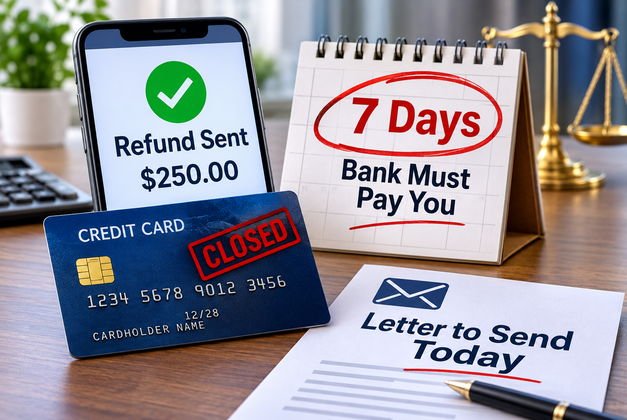
Find where your refund is and get the right letter, with every deadline →
Refund not issued yet? Ask the merchant to send it another way first. Under Visa’s rules it may use a different Visa card. See how to ask →
Rules quoted from Regulation Z (12 CFR 1026) and Visa’s published guidance; verified November 13, 2026.
Refund Finder + Letter Builder: Where Is Your Refund and What Do You Send?
Answer three questions to see where your refund probably is, then add dates for exact deadlines. Nothing you type leaves your browser, and the tool never needs a full card number.
Add dates for exact deadlines
Your result and letter will appear here.
General information, not legal advice. Deadlines are estimates. Your issuer’s business days and your cardholder agreement control. Rules verified November 13, 2026.
First: Is the Account Actually Closed, or Was the Card Only Replaced?
A replaced or expired card is usually the same account with new details, while a closed account is one that has actually ended.
The fastest check is to log in or call the number on your last statement and ask: “Is the account still open, and what happened to the card ending in these four digits?” Then find your situation below.
| Situation | What it usually means | Where the refund goes | What to do |
|---|---|---|---|
| Replaced (lost or stolen) | New card number, same account | Usually matched to the same account | Check after one statement cycle |
| Expired | A renewal card on the same account | Usually the same account | Check the current statement |
| You closed it | The account has ended | CREDIT BALANCE, or BOUNCED back to the merchant | Ask the issuer which; send Letter A |
| Issuer closed it | The issuer ended the account | CREDIT BALANCE, or BOUNCED back to the merchant | Same as above |
| Product change or portfolio transfer | The account moved to a new card product or a new issuer | Often follows the account; practices vary | Ask the current issuer whether the old number was mapped to your account |
| Charged off | The lender wrote off the debt, but you may still owe it | APPLIED TO DEBT first; any excess is a CREDIT BALANCE | Ask for a statement showing how the credit was applied |
| In collections | The debt was sold or placed with a collector | Depends on who holds the account | Ask in writing who holds it |
| Debit card or bank account | A deposit account, not a credit account | Likely BOUNCED back to the merchant | Ask the merchant to reissue by check |
| Cardholder has died | The estate deals with the account | A credit balance belongs to the estate | The estate administrator makes the request |
| Business card | A commercial account | The cardholder agreement controls | Read the agreement; ask the issuer |
Still deciding whether to close? Read How to Cancel a Credit Card. If the issuer closed your account without telling you, see Credit Card Closed Without Notice.
Replaced, Expired, or Lost Card: Usually Automatic
When a card is replaced or renewed you usually keep the same credit account, so a refund sent to the old number is usually matched to it.
Issuer practices vary, which is why this section says “usually.” Look at your current statement and online account for the credit.
If you see nothing after one full statement cycle, ask the merchant for the refund date and ARN, then use the billing-error route.
If the card was replaced because of charges you didn’t make, see Unauthorized Credit Card Charges.
Refund to a Closed Account: The 3 Outcomes
When a merchant refunds a closed account, the money ends up in one of three places: owed to you, sent back to the merchant, or applied to a debt.
CREDIT BALANCE. The issuer accepted it and now owes you.
BOUNCED. The issuer rejected it, so it went back to the merchant.
APPLIED TO DEBT. The account owed money, so the credit reduced it.
How to tell which one happened
- Your statement or online account. A negative balance or a credit line means CREDIT BALANCE.
- A call to the issuer. Ask: “Did the refund of this amount post, or was it rejected?”
- The merchant’s ARN. The Acquirer Reference Number is a tracking number for the refund. With it, your issuer can trace where the credit went.
| Outcome | How to tell | Who has your money | Your next step |
|---|---|---|---|
| CREDIT BALANCE | The account shows a negative balance | The card issuer | Mail Letter A. Some issuers send a check without being asked. |
| BOUNCED | No credit on the account; the merchant can show the refund returned | The merchant or its payment processor | Ask the merchant to reissue by check (Letter C) |
| APPLIED TO DEBT | The account was charged off or had a balance, and that balance went down | No one. Your debt is smaller. | Ask for a statement; request any excess |
The 7-Business-Day Rule: How to Force a Credit Balance Refund
Once a credit balance over $1 sits on your credit account, the issuer must refund it within seven business days after it receives your written request.
This is Regulation Z, 12 CFR §1026.11(a). Here is the text:
“When a credit balance in excess of $1 is created on a credit account (through transmittal of funds to a creditor in excess of the total balance due on an account, through rebates of unearned finance charges or insurance premiums, or through amounts otherwise owed to or held for the benefit of the consumer), the creditor shall:
(1) Credit the amount of the credit balance to the consumer’s account;
(2) Refund any part of the remaining credit balance within seven business days from receipt of a written request from the consumer;
(3) Make a good faith effort to refund to the consumer by cash, check, or money order, or credit to a deposit account of the consumer, any part of the credit balance remaining in the account for more than six months. No further action is required if the consumer’s current location is not known to the creditor and cannot be traced through the consumer’s last known address or telephone number.”
A merchant refund fits the phrase “amounts otherwise owed to or held for the benefit of the consumer.”
| Rule | What it says | Source |
|---|---|---|
| Over $1 | The rule applies to a credit balance in excess of $1 | §1026.11(a) |
| Credited to the account | The issuer must first credit the balance to your account | §1026.11(a)(1) |
| 7 business days | Refund within seven business days from receipt of your written request | §1026.11(a)(2) |
| Good-faith refund after 6 months | The issuer must make a good-faith effort to refund any part remaining in the account for more than six months | §1026.11(a)(3) |
| Methods (the issuer’s choice) | Cash, check, money order, or credit to your deposit account. “Cash” is a method the issuer may use, not something you withdraw at an ATM. | §1026.11(a)(3) |
| Intervening debits allowed | The issuer may count intervening purchases or debits, even ones not yet on a statement, that reduce the balance | Official commentary, Supp. I (11(a)) |
| Standing orders not required | The issuer need not honor a standing request to refund future credit balances | Official commentary, Supp. I (11(a)) |
Written request vs. a phone call or email
The official commentary lists “Refunding any credit balance upon the consumer’s oral or electronic request” as something an issuer may do. It also lists refunding immediately, before any request.
Those are permitted options, not triggers. A mailed written request is what reliably starts the seven-day clock, so make both: call or message, and mail a letter.
When the clock starts
A business day is defined in §1026.2(a)(6) as a day on which the creditor’s offices are open to the public for carrying on substantially all of its business functions. That depends on the issuer, so the tool skips weekends and federal holidays and labels its date an estimate.
The issuer may subtract purchases that were pending or not yet on a statement when it works out how much is left to refund.
If you do nothing: the 6-month good-faith duty
After six months the issuer must make a good-faith effort to refund what remains. That includes trying to find you through your last known address or phone number.
If it can’t locate you, Regulation Z requires nothing more. What happens to the balance is then left to other law, usually state unclaimed property law (see below).
Letter A: credit balance refund request (static version)
The tool fills this in for you. Here is the plain template.
[Date]

[Card issuer name]
[Correspondence address from your statement, not the payment address]

Re: Request for refund of credit balance - account ending in [1234]

To whom it may concern:

My account ending in [1234] has a credit balance of $[amount]. [Describe what happened, for example: "I closed this account, and a merchant refund posted after closure, creating this credit balance."]

Under 12 C.F.R. § 1026.11(a)(2) (Regulation Z), I am requesting a refund of this credit balance. Please send it by [check to the address on file / direct deposit to the bank account I will provide] within seven business days after you receive this request.

Please confirm in writing when and how the refund was issued.

Sincerely,
[Your name]
Ask Before the Refund Goes Out: Visa’s Alternate-Account Rule
If the refund hasn’t been issued yet, ask the merchant to send it another way, because Visa’s rules let a merchant refund to a different Visa account when the original is no longer valid.
Visa’s purchase-return guidance says that when the original account is no longer available or valid, or the issuer declines the refund, “a merchant may process the refund onto a different(alternate) Visa account.” The merchant must first confirm that the original purchase was made on a Visa account.
If that fails, the guidance says the merchant may offer another form of credit, such as a check, in-store credit or a prepaid card.
This is permitted, not required. The merchant decides. Mastercard, American Express and Discover have their own rules, so don’t assume they match. Ask the merchant what it can do.
Copyable merchant script (before and after the refund)
Before it’s issued:
The card I used is closed. Can you issue the refund by check, or to a different [Visa] card? Visa's purchase-return rules allow a refund to an alternate Visa account when the original is no longer valid, after you confirm the original purchase.
After it’s issued:
Please send me the refund date, amount, and the Acquirer Reference Number (ARN) so my card issuer can trace it.
If it bounced back to you:
My issuer rejected the refund. Please reissue it by check to [address] and confirm the date in writing.
Refunding a canceled trip? See Cancelled Flight Refund Rules and Hotel Overbooked: Your Rights.
Refund Issued but Not Showing? The 60-Day Billing-Error Route
A merchant saying “refunded” only means its half is done, and if your issuer never posts the credit, you can send a written billing-error notice.
A refund has two halves. The merchant sends a credit statement to your issuer, then the issuer posts it to your account. Under §1026.12(e), a merchant that accepts a return must send the credit statement within 7 business days, and the issuer must credit your account within 3 business days of receiving it.
Real-world timing varies by merchant, so a credit can show as pending first. Pending items can change before they post. For the full timeline, see How Long Does a Credit Card Refund Take?
Under §1026.13, a billing error includes “the creditor’s failure to credit properly a payment or other credit issued to the consumer’s account.” A missing refund fits.
Your notice must reach the billing-error address on your statement no later than 60 days after the issuer sent the first statement that reflects the error. For a missing refund, that is the statement that should have shown it. The issuer must acknowledge within 30 days and resolve the matter within two complete billing cycles, and in no event later than 90 days.
| Problem | Send to | Deadline | Rule |
|---|---|---|---|
| Credit balance refund | The issuer’s correspondence address | 7 business days after the issuer receives it | §1026.11 |
| Missing credit | The issuer’s billing-error address | Within 60 days of the statement that should have shown it | §1026.13 |
| Merchant never refunded | The merchant first, then your issuer’s dispute process | Per issuer; act soon | See the dispute guide |
If the merchant never issued the refund at all, start with the merchant, then use How to Dispute a Credit Card Charge.
Letter B: billing-error notice (static version)
[Date]

[Card issuer name]
[Billing-error address from your statement, not the payment address]

Re: Billing error notice - account ending in [1234] - failure to credit a refund

To whom it may concern:

I am giving notice of a billing error under 12 C.F.R. § 1026.13 (Regulation Z) on the account of [Your name]. Account number: [write the full number by hand; do not type it online].

The error is a failure to credit properly a credit issued to my account. [Merchant name] told me it issued a refund of $[amount] on [date]. The statement dated [statement date] does not show it. [ARN, if you have it: ]

Please credit the refund to my account, investigate, and acknowledge this notice in writing.

Sincerely,
[Your name]

Enclosed: [the merchant's confirmation of the refund date and amount]
Charged-Off Card or Account in Collections: Credits Reduce the Debt First
A charge-off is an accounting step by the lender, not forgiveness, so a refund that posts to an account with a balance generally reduces what you owe first.
- Hypothetical: you owe $1,000 and a $300 refund posts. You generally owe $700 afterward.
- Hypothetical: you owe $100 and a $300 refund posts. You generally owe $0 and the $200 left over is a credit balance owed to you.
If the debt was sold or placed with a collector, where the refund goes depends on who holds the account now. Ask in writing who holds it and for a statement showing how the credit was applied. Whether §1026.11 reaches a debt buyer depends on the facts, so ask the original issuer too.
For background, see What Happens If You Don’t Pay Your Credit Card and Debt Collector Rights.
Closed Debit Card or Bank Account: Different Rules
The credit balance rule covers credit accounts, so it does not give you the seven-day refund right on a debit card or bank account.
If the bank account is still open and only the card was replaced, the refund may still reach the account, so confirm with your bank. If it bounced, ask the merchant to reissue it by check or another method.
For a closed or frozen account, see Bank Froze My Account.
Special Cases: Deceased Cardholders, Business Cards, PayPal and BNPL
Each of these changes who asks for the money or which rules apply.
Deceased cardholder
A credit balance on a deceased person’s account belongs to the estate, and the estate’s administrator makes the request.
Under §1026.11(c), card issuers must have procedures so an estate administrator can find out the balance and pay it. On request the issuer must give the balance, and 30 days is treated as timely. After that request it generally can’t add fees or raise the rate.
See Credit Card Debt After Death.
Business and commercial cards
Regulation Z’s consumer credit balance rule doesn’t cover business cards. Your cardholder agreement controls, so read it and ask the issuer how it handles credit balances.
PayPal and digital wallets
If you paid through PayPal or another wallet, the refund usually goes back to the original funding source. If that source can’t take it, it may land in the wallet balance instead. Check your wallet’s activity page and help center, because policies differ and change.
Buy now, pay later
A refund on a BNPL purchase usually reduces the loan or your remaining installments instead of going to a card. See Does BNPL Affect Your Credit Score?
Chargeback credits
A credit that comes from a dispute or chargeback generally follows the same rules. If it posts to a closed account, it is treated like any other credit balance.
Can an Old Credit Balance Go to the State? Yes, and You Can Still Claim It
If a credit balance sits unclaimed and the issuer can’t find you, state unclaimed property law can send it to the state, which holds it for you.
Dormancy periods vary by state, often from one to five years. For example, New York treats consumer credit card credit balances as abandoned after three years, according to the state comptroller’s reporting guidance. Check your own state.
What to Do Today: 5 Steps
Most refunds are recovered with a call, two letters at most, and a calendar reminder.
- Check the account status. Is it open, closed, charged off, or in collections? Did the refund post or bounce?
- Get the ARN. Ask the merchant for the refund date, amount and ARN, in writing.
- Send Letter A or B by mail with proof of delivery. Add a secure message. Use the tool to build the right one.
- Calendar the deadlines. Seven business days from receipt, 60 days from the statement, six months from the refund.
- Escalate to the CFPB. If the deadline passes with no refund, use the template below.
CFPB complaint template
File at consumerfinance.gov/complaint. Attach your letter and proof of delivery.
Product: Credit card
Issue: Problem with a credit balance refund

On [date] you received my written request to refund my $[amount] credit balance on the account ending [1234], under 12 CFR 1026.11(a)(2). More than seven business days have passed and I have not received it. I'm requesting the refund by [check/deposit] and written confirmation.
Frequently Asked Questions
Can a refund go to a closed credit card?
A merchant can send it, and the issuer decides what happens next. It may post as a credit balance owed to you, or be rejected back to the merchant.
What happens to a refund sent to a closed card?
One of three things: it becomes a CREDIT BALANCE, it BOUNCES back to the merchant, or it is APPLIED TO DEBT if the account owed money. Check your statement, ask the issuer, and get the ARN from the merchant.
Will my refund go to my replacement card?
Usually it reaches the same account, since a replacement is generally the same account with a new number. If it hasn’t shown up after one statement cycle, ask the issuer, then use the billing-error route.
What if my card expired?
A renewed card is usually the same account, so the refund normally posts there. If the refund was declined, ask the merchant to retry or send a check.
Can a merchant refund to a different card?
Visa’s guidance lets a merchant refund to a different Visa account when the original is unavailable, after confirming the original purchase. It is permitted, not required. For other networks, check with the merchant.
Why does my closed card show a negative balance?
A negative balance is a credit balance, meaning the issuer owes you. It usually comes from a refund larger than your balance or from an overpayment.
How do I get a negative balance refunded?
Mail a written request to the issuer’s correspondence address and send a secure message too. For a credit balance over $1, the issuer must refund it within seven business days of receiving your written request. The tool writes the letter.
How long does the bank have to refund it?
Seven business days from receipt of your written request, under 12 CFR §1026.11(a)(2). With no request, it must make a good-faith effort once the balance has remained more than six months.
Does the 7-day clock start when I mail the letter?
No. It runs from the issuer’s receipt, so use mail with proof of delivery. Business days are counted by the issuer’s open days, so any calendar date is an estimate.
Does a phone call or email count?
The commentary says an issuer may refund on an oral or electronic request, but that is a permitted option, not a rule that starts the clock. Mail a letter and send a secure message as well.
What if the merchant says it refunded but I don’t see it?
“Refunded” usually means the merchant sent it. Ask for the date and ARN, wait one statement cycle, then send a billing-error notice within 60 days of the statement that should have shown it.
What is an ARN?
An Acquirer Reference Number is a tracking number attached to a card transaction or refund. The merchant or its payment processor can look it up, and your issuer can use it to trace the credit.
What happens on a charged-off card?
A credit generally reduces the balance you owe first. Any excess is a credit balance owed to you. Ask for a statement showing how it was applied.
What if the account is in collections?
It depends on who holds the account. Ask in writing who holds it and how the credit was applied, and ask the original issuer too.
What about a closed debit card?
The credit balance rule doesn’t apply. A refund to a closed deposit account may be returned to the merchant, who can reissue it by check.
What if the cardholder has died?
A credit balance belongs to the estate, and the administrator makes the request. Issuers must give the estate the balance on request. See Credit Card Debt After Death.
Can an old refund go to the state?
Yes, under state unclaimed property law. Dormancy periods vary (New York uses three years for consumer credit card credit balances). Search for free at unclaimed.org or your state treasurer.
Should I keep a card open while waiting for a refund?
If the card has no annual fee, keeping it open until the refund posts is usually simpler. If you close it, request any credit balance afterward.
This article is general information, not legal advice. Regulation Z applies to consumer credit accounts. Network rules and issuer procedures vary. Rules verified November 13, 2026. All dollar examples are hypothetical.

Daniel Hayes is the founder and sole researcher at AdvoraHQ. He covers U.S. personal finance, insurance, and consumer law — working directly from IRS publications, federal and state statutes, court opinions, and SEC filings rather than secondary summaries. His focus is the gap between what readers think they know and what the source documents actually say. Daniel is not a licensed attorney, CPA, or financial advisor; his articles are educational and not personalized advice. Reach him at Daniel.Hayes@advorahq.com.
