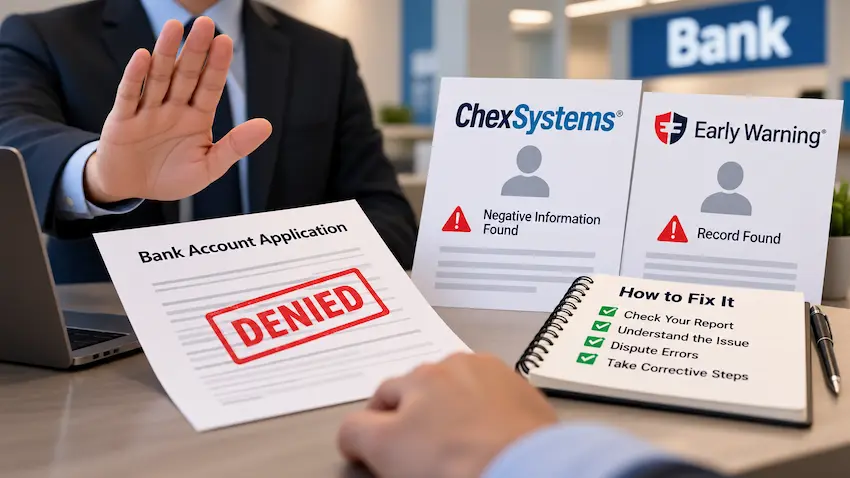
Short answer: If a bank turned you down, it almost certainly checked a banking-history report, not your credit score. The denial notice should name which company supplied it: ChexSystems or Early Warning Services. Get that report free, fix what is wrong with both the reporting company and the bank that reported you, and do not apply anywhere else until you know what is in your file.
| Your situation | Do this first |
|---|---|
| Denial notice names ChexSystems | Get your free ChexSystems report |
| Notice names Early Warning | Get your EWS file disclosure |
| ChexSystems is clean, still denied | Check EWS — it is a separate file |
| Report shows an error | Dispute with the agency and the bank |
| Report is accurate, you owe money | Pay, get proof, send it for an update |
| Account is not yours | Treat it as identity theft |
→ Use the “Who Flagged Me?” checker
→ Go to the letter kit (5 letters + phone script)
You will also learn about the report most people never check: Early Warning Services, the same company behind Zelle.
Who Flagged Me? Checker and Record Clock
Answer two questions and this tool points you to the right path, the right report, and the right letter. Nothing you type here is stored or sent anywhere, and it never asks for a Social Security number or account number.
Every path in this guide falls into one of three tiers. The tier name is always written out, so you never have to rely on the border color.
DISPUTE IT
Something on a report is wrong or incomplete. Dispute it with the agency and with the bank that reported it.
PAY & UPDATE
The balance is accurate and you owe it. Pay, get proof, and ask for the status to be updated.
REAPPLY SMART
Your file is clean, a record is aging off, or you have fixed what you can. Ask about a review before you apply again.
Stop: Don’t Apply Anywhere Else Yet
Pause new account applications until you know what is in your files. Both ChexSystems and Early Warning list recent inquiries on a file, and how much weight a bank gives them varies. Another denial also leaves you with one more decision you cannot yet explain.
Use the pause for three things: find your denial notice, request the report it names, and write down every date you can find, including when each account was opened, closed, and reported.
Your Denial Notice Tells You Who Flagged You
When a bank denies an account based in whole or in part on a consumer report, the Fair Credit Reporting Act requires it to tell you so (15 U.S.C. § 1681m). The notice names the reporting company, gives its contact details, says the company did not make the decision, and explains your right to a free report within 60 days and your right to dispute.
The reporting company didn’t deny you — the bank did. ChexSystems and Early Warning cannot explain the decision or reverse it. They can only show you what the bank saw and correct what is wrong.
The notice names the company; it does not necessarily give a detailed reason. Check your mail, email, and online-banking inbox for it, because many banks deliver it electronically.
If you never received a notice, ask in writing. A simple request works: “Please tell me whether my application was denied based on information from a consumer reporting agency, and if so, which one.” If the bank says it relied on something else, such as its own records or identity verification, read the section on clean reports.
ChexSystems vs. Early Warning Services
They are two separate companies with two separate files, and a clean record at one tells you nothing about the other. Both are consumer reporting agencies under the FCRA, and neither is a credit bureau.
ChexSystems
Its file holds forcibly closed checking and savings accounts, returned checks reported through Certegy, inquiries, and check orders.
Per its FAQ, it does not include your credit score, criminal records, open or active account information, rental history, or accounts you closed voluntarily without mishandling.
Phone: 800-428-9623. Reported information is generally kept five years.
Early Warning Services
Its file holds identity information, checking and savings history (bank name, account status, balance, and transactions), and recent inquiries. Neutral and positive information can be reported on an ongoing basis.
Negative records older than five years are not included.
Phone: 1-800-745-1560. The company also operates Zelle and Paze, which is a separate matter from your account-screening file (see our Zelle scam refund guide for payment problems).
| Feature | ChexSystems | Early Warning |
|---|---|---|
| What it is | Specialty consumer reporting agency for deposit accounts | Specialty consumer reporting agency owned by a group of banks |
| What it tracks | Closed-account problems, returned checks, inquiries, check orders | Identity details, account history and status, balances, transactions, inquiries |
| Free report | Once every 12 months, and within 60 days after a denial that used it | Free file disclosure after a denial that used it; ask about other times on its site |
| How to dispute | Request for Reinvestigation form by mail, portal, or phone; include your consumer ID | Written dispute by mail, fax, or secure portal; a separate signed paper for each dispute |
| How long negatives last | Generally five years from the report date; retail returned-check data from Certegy is kept four years | Negative records older than five years are not included |
| Credit report? | No | No |
Why Banks Deny Accounts (Usually Not Your Credit Score)
The most common reasons are a past banking problem on file, not a low credit score. The CFPB lists unpaid negative balances (often from overdrafts), involuntary account closure, suspected fraud, and a joint account with someone who had those problems.
- Unpaid balance from an old account. A reversed deposit can create one; see what happens when provisional credit is reversed.
- Involuntary closure. If a bank closed or froze an account on you, our frozen or closed account guide covers that side.
- Returned checks reported by a retailer.
- Suspected fraud, which may be a mistaken flag or a real identity-theft problem.
- A joint account where the other owner caused the problem.
- Identity verification that did not match, and at some banks a credit check. Good credit does not protect you from either one; see how to check your credit score free.
For context, a report from the National Consumer Law Center and the Cities for Financial Empowerment Fund, published in the mid-2010s, found that over 80% of banks used account-screening reports. That figure is historical, so treat it as a reason to expect screening, not as a current statistic.
How to Get Your Free Reports — and What to Look For
Request the report named in your notice, and request the other company’s report too. A denial entitles you to a free copy if you ask within 60 days of the notice.
ChexSystems checklist
- Request online through the ChexSystems consumer portal, by phone at 800-428-9623, or by mail (Letter 1A below).
- Keep the consumer ID number it gives you; you need it for every dispute.
- Check the ChexSystems dispute page for the current mailing address before you send anything.
Early Warning checklist
- Request your file disclosure on the Early Warning “declined” page, by phone at 1-800-745-1560 (9 a.m. to 8 p.m. ET, Monday to Friday), or by mail (Letter 1B below).
- Mail: Early Warning, Attn: Consumer Services, 5801 N Pima Road, Scottsdale, AZ 85250. Fax: 480-656-6850. A secure document portal is also available.
- Keep the consumer ID on the first page of your disclosure.
What to look for in either report
- Names, addresses, and dates of birth that are not yours, or a record mixed in from someone with a similar name.
- Accounts you do not recognize.
- Wrong balances, fees, or dates.
- An account shown as unpaid that you paid.
- A joint-account item for an account you never owned.
- A fraud notation you cannot explain.
- Inquiries from banks you never applied to.
| Report shows | Tier | Next step | Letter |
|---|---|---|---|
| Accurate unpaid balance | PAY & UPDATE | Get a written payoff, pay, get a paid letter, send proof | 5 |
| Balance, fees, or dates look wrong | DISPUTE IT | Dispute with the agency and the bank; try to contest fees first | 2 or 3, and 4 |
| Paid, but still shows unpaid | PAY & UPDATE | Send proof of payment; dispute as incomplete if it is not updated | 5, then 2 or 3 |
| Account you do not recognize | DISPUTE IT | Treat as identity theft and attach a report | 2 or 3, and 4 |
| Fraud flag you believe is wrong | DISPUTE IT | Ask the bank what triggered it, then dispute with both sides | 2 or 3, and 4 |
| Joint-account problem | DISPUTE IT or PAY & UPDATE | Dispute if you were never an owner; pay and update if you were and it is accurate | 2, 3, 4, or 5 |
| Accurate but old record | REAPPLY SMART | Wait for it to age off and bank in the meantime | 7 (optional) |
| Nothing negative | REAPPLY SMART | Check the other company’s file; ask about identity verification, a credit check, and review | 1A or 1B, and 6 |
ChexSystems Is Clean — Why Was I Still Denied?
A clean ChexSystems report does not mean a clean Early Warning file, and it does not rule out other reasons.
A clean ChexSystems report doesn’t mean a clean EWS file. They are separate companies that collect separate data.
- Early Warning. Request its file disclosure. Its file can include account history beyond problems, which ChexSystems says it does not carry.
- Identity verification. A mismatch in your name, address, or other identifying details can stop an application. A security freeze you placed on a report can also prevent a bank from completing its check; ask the company how to lift it temporarily.
- The bank’s own records. A bank may rely on its past dealings with you, which may not appear in either report.
- A credit check. Some banks run one in addition to account screening.
- Timing. A recent payment or correction may not have reached the file when you applied.
Ask the bank these questions, in writing or by phone: Which report or source did you use? Was identity verification or a credit check involved? Is there a manual review process, and how do I send documents? The phone script below walks through it.
How to Dispute an Error — With Both Sides
Dispute real errors with both the reporting company and the bank that reported the information. The CFPB recommends both, and the letters below are built for exactly that.
DISPUTE IT is for information that is wrong or incomplete. It is not a way to remove an accurate debt; if the balance is accurate, use PAY & UPDATE.
- Find the error. Compare each item on your report with your own records.
- Dispute with the agency. Send Letter 2 (ChexSystems) or Letter 3 (Early Warning) with your consumer ID and copies of your proof.
- Dispute with the bank. Send Letter 4 to the bank that reported the item, using the contact details on your report or the bank’s website.
- Attach proof. ChexSystems lists identity theft affidavits, police reports, account statements, paid or settled-in-full letters, and death certificates as supporting documents.
- Wait for the investigation. The agency generally has 30 days from receiving your dispute. That can extend by up to 15 days if you send relevant information during the 30 days (15 U.S.C. § 1681i).
- Review the results and your updated report.
- Reapply only after the file reflects the correction.
| Step | Who | Typical timing |
|---|---|---|
| Send your dispute by certified mail or portal | You | As soon as you find the error |
| Agency notifies the bank that reported it | Agency | Within 5 business days of receiving your dispute |
| Investigation | Agency and bank | Generally 30 days; up to 15 more if you send relevant information during the 30 days |
| Written results | Agency | Within 5 business days after the investigation ends |
| Description of how it investigated (if you ask) | Agency | Within 15 days of your request |
| If the item stays and you disagree | You | Add a consumer statement; file a CFPB complaint |
If the dispute fails
You can add a consumer statement to your ChexSystems file of up to 100 words (200 in Maine). It cannot name other people or businesses, must relate to your file, and cannot contain profanity. Early Warning also accepts a written statement; ask its consumer services team about length.
You can also file a complaint with the CFPB. Keep your certified-mail receipts, copies, and dates; they are your evidence.
The Letter Kit
Five letters, one phone script, and one statement template, all free and ready to fill in. Replace every [bracket], keep copies, and never write a full Social Security number or full account number in a letter.
1A. Free report request after a denial: ChexSystems
Use this within 60 days of the denial notice. Confirm the address on chexsystems.com/dispute before mailing.
Before you send: Send by certified mail, return receipt requested, or through the company’s official portal; keep copies.
[Your full name]
[Street address]
[City, State ZIP]
[Phone] | [Email]
[Date]

Chex Systems, Inc.
Attn: Consumer Relations
PO Box 583399
Minneapolis, MN 55458

Re: Request for my free consumer disclosure after a bank account denial

To Consumer Relations:

On [date on the denial notice], [name of bank or credit union] denied or limited my application for a [checking / savings] account. The notice says the decision was based in whole or in part on information from ChexSystems. I received that notice on [date received], which is within the last 60 days.

Under the Fair Credit Reporting Act, I am entitled to a free copy of my consumer disclosure when I ask within 60 days of an adverse action notice. Please send me a complete copy of my file, including the consumer ID number I will need for any dispute.

To confirm my identity, I am enclosing the identification documents your company requires: [list what you are enclosing, such as a copy of a government ID and proof of current address]. I have not written my Social Security number in this letter. If you need it, please tell me how to send it securely.

Enclosed: copy of the denial notice; identification documents.

Sincerely,
[Signature]
[Typed name]
1B. Free report request after a denial: Early Warning
Use this within 60 days of the denial notice. You can also request your file disclosure through the Early Warning website or by phone.
Before you send: Send by certified mail, return receipt requested, or through the company’s official portal; keep copies.
[Your full name]
[Street address]
[City, State ZIP]
[Phone] | [Email]
[Date]

Early Warning
Attn: Consumer Services
5801 N Pima Road
Scottsdale, AZ 85250

Re: Request for my free file disclosure after a bank account denial

To Consumer Services:

On [date on the denial notice], [name of bank or credit union] denied or limited my application for a [checking / savings] account. The notice says the decision was based in whole or in part on information from Early Warning Services, LLC. I received that notice on [date received], which is within the last 60 days.

Under the Fair Credit Reporting Act, I am entitled to a free copy of my file when I ask within 60 days of an adverse action notice. Please send me a complete copy of my file disclosure, including the consumer ID number I will need for any dispute.

To confirm my identity, I am enclosing the identification documents you require: [list what you are enclosing]. I have not written my Social Security number in this letter. If you need it, please tell me how to send it securely.

Enclosed: copy of the denial notice; identification documents.

Sincerely,
[Signature]
[Typed name]
2. Dispute letter to ChexSystems
Use only for information you believe is inaccurate or incomplete. If the information is accurate and you owe the money, use Letter 5 after you pay.
Before you send: Send by certified mail, return receipt requested, or through the company’s official portal; keep copies. ChexSystems also has a Request for Reinvestigation form; you can enclose it with this letter.
[Your full name]
[Street address]
[City, State ZIP]
[Phone] | [Email]
[Date]

Chex Systems, Inc.
Attn: Consumer Relations
PO Box 583399
Minneapolis, MN 55458

Re: Dispute of inaccurate or incomplete information
Consumer ID: [your ChexSystems consumer ID, from your report]

To Consumer Relations:

I am writing to dispute information on my ChexSystems consumer disclosure that I believe is inaccurate or incomplete. I am asking for a reasonable reinvestigation under the Fair Credit Reporting Act, 15 U.S.C. section 1681i.

Item disputed:
- Reported by: [bank or credit union name as shown on the report]
- Account (last 4 digits only, if shown): [XXXX]
- What the report says: [for example: unpaid balance of $___; account closed on [date]; status unpaid]
- Why it is wrong or incomplete: [state plain facts that apply: this is not my account; the balance is wrong because ___; the dates are wrong because ___; the account shows unpaid but I paid it in full on [date]; I was never an owner of this joint account]
- What I am asking you to do: [correct it to ___ / delete it because it cannot be verified]

Enclosed (copies only): [list what applies: identity theft affidavit; police report; account statements; paid-in-full or settled-in-full letter; other proof; the page of my report showing the item]

Please investigate, send me the written results, and send me an updated copy of my file. If you cannot verify the item, please delete it. On request, please also send me a description of how you carried out the investigation and the contact details of the bank that supplied the information.

I am also disputing this item directly with [bank name].

Sincerely,
[Signature]
[Typed name]
3. Dispute letter to Early Warning Services
Use only for information you believe is inaccurate or incomplete. If the information is accurate and you owe the money, use Letter 5 after you pay.
Before you send: Send by certified mail, return receipt requested, or through the company’s official portal; keep copies. Early Warning asks for a separate signed paper for each dispute, so send one letter per item.
[Your full name]
[Street address]
[City, State ZIP]
[Phone] | [Email]
[Date]

Early Warning
Attn: Consumer Services
5801 N Pima Road
Scottsdale, AZ 85250

Re: Dispute of inaccurate or incomplete information
Consumer ID: [from the first page of your file disclosure]

To Consumer Services:

I am writing to dispute information in my Early Warning file disclosure that I believe is inaccurate or incomplete. I am asking for a reasonable reinvestigation under the Fair Credit Reporting Act, 15 U.S.C. section 1681i.

Item disputed:
- Reported by: [bank or credit union name as shown on the file disclosure]
- Account (last 4 digits only) or contribution reference number: [XXXX or reference number from the disclosure]
- What the file says: [describe the entry]
- Why it is wrong or incomplete: [state plain facts that apply: this is not my account; the balance is wrong because ___; the dates are wrong because ___; the account was paid in full on [date]; I was never an owner of this joint account]
- What I am asking you to do: [correct it to ___ / delete it because it cannot be verified]

Enclosed (copies only): [list what applies: identity theft affidavit; police report; account statements; paid-in-full letter from the bank; other proof; the page of my disclosure showing the item]

Please investigate, send me the written results, and send me an updated copy of my file. If you cannot verify the item, please delete it. Please also send me a description of your reinvestigation procedures, including the contact information for any bank involved in the investigation.

I am also disputing this item directly with [bank name].

Sincerely,
[Signature]
[Typed name]
4. Dispute letter to the bank that reported you
Use only for information you believe is inaccurate or incomplete. This letter is modeled on the CFPB’s sample dispute letter to a bank or credit union.
Before you send: Send by certified mail, return receipt requested, or through the bank’s official portal; keep copies. Find the bank’s dispute address on your report or the bank’s website.
[Your full name]
[Street address]
[City, State ZIP]
[Phone] | [Email]
[Date]

[Bank or credit union name]
Attn: [dispute or customer relations department]
[Address]

Re: Dispute of information you reported to [ChexSystems / Early Warning Services]
Account (last 4 digits only): [XXXX]

To whom it may concern:

I am disputing information that you reported about me to [ChexSystems / Early Warning Services]. I believe it is inaccurate or incomplete, and I am asking you to investigate and correct it.

What was reported: [describe the entry, such as the balance, closure date, or status]
Why it is inaccurate or incomplete: [state plain facts, such as: this is not my account; the balance is wrong because ___; the account was paid in full on [date]; I was never an owner of this account]
What I am asking you to do: [correct the information to ___ / stop reporting it] and notify [ChexSystems / Early Warning Services] of the correction.

Enclosed (copies only): [list what applies: statements; paid-in-full letter; identity theft affidavit; police report; other proof]

I have also sent a dispute to [ChexSystems / Early Warning Services] on [date]. Please tell me the result of your investigation in writing.

Sincerely,
[Signature]
[Typed name]
5. Paid-in-full update request
Use this after you have paid an accurate balance and have a receipt or a letter from the bank. Paying updates the status of the record; it does not delete it.
Before you send: Send by certified mail, return receipt requested, or through the company’s official portal; keep copies. Delete the address block you do not need.
[Your full name]
[Street address]
[City, State ZIP]
[Phone] | [Email]
[Date]

[Keep one address block and delete the other]
Chex Systems, Inc.
Attn: Consumer Relations
PO Box 583399
Minneapolis, MN 55458

Early Warning
Attn: Consumer Services
5801 N Pima Road
Scottsdale, AZ 85250

Re: Request to update the status of a paid account
Consumer ID: [your consumer ID]

To whom it may concern:

An account on my file shows an unpaid balance. I paid it in full on [date].

Account details:
- Reported by: [bank or credit union name]
- Account (last 4 digits only): [XXXX]
- Balance shown on my report: [$___]
- Amount paid and date: [$___ on date]

Enclosed is [a receipt / a letter from the bank confirming the balance was paid in full or settled in full]. Please contact the bank to verify the payment and update my file to show the account as paid or settled in full. I understand the entry may remain on file for the standard reporting period; I am asking that its status be updated.

I have also asked [bank name] to report the update to you. Please send me a copy of my updated file.

Sincerely,
[Signature]
[Typed name]
6. Phone script: asking a bank to reconsider
This script asks questions and makes a request. A bank may review your application again, but it does not have to, and nothing here is a promise of approval.
BEFORE YOU CALL
Have your denial notice, the date you applied, and your report(s) in front of you. Write down the date, time, the name of the person you speak with, and anything they tell you.

OPENING
"Hello, my name is [name]. I applied for a [checking / savings] account on [date] and was denied. My notice says the decision used information from [ChexSystems / Early Warning Services]. I would like to ask a few questions."

QUESTIONS
1. "Can you confirm which report or source was used in the decision on my application?"
2. "Did the decision involve anything else, such as identity verification or a credit check?"
3. "I [found an error and have disputed it / paid the balance and have a paid letter]. Is there a manual review or reconsideration process I can use?"
4. "Which department handles that, and how do I send documents: mail, secure message, or in a branch?"
5. "If my report is updated, how soon can I apply again, and will a new application count as a new inquiry?"
6. If the bank reported the account: "Can you confirm what was reported to [agency], and whether you can update it to show the balance as paid?"

CLOSING
"Thank you. Could I have your name and a reference number for this call? And could you confirm in writing how to request a review?"

IF THE ANSWER IS NO
"I understand. Can you tell me what I would need to change for a future application to be considered?"
7. 100-word consumer statement template (ChexSystems)
ChexSystems allows a statement of up to 100 words (200 in Maine). It must relate to your file, cannot name other people or businesses (so leave the bank’s name out), and cannot contain profanity. Edit the text and keep it at or under the limit.
Before you send: Submit through the company’s official portal or by certified mail, return receipt requested; keep copies.
The negative balance reported on this file in [month and year] resulted from [one factual sentence, such as: a deposit that was later returned, which I did not know was fraudulent / a fee I disputed with the bank]. I [paid the balance in full on [date] / have disputed this item with the company that reported it]. I have kept my banking accounts in good standing since [date]. Please contact me at [phone or email] if more information is needed.
If You Really Owe the Money: Pay, Get Proof, Update
If the balance is accurate, paying changes the status of the record but does not erase it.
Paying updates the record — it doesn’t erase it. ChexSystems says that when it receives a closure status update from the bank, the report is updated but the reported account stays on file until its retention period ends.
PAY & UPDATE is for accurate balances. The goal is a file that shows the account as paid or settled, with proof in your hands.
- Check the amount. If fees look wrong, try to contest them before you pay; see how to get overdraft fees refunded.
- Get the payoff in writing and ask the bank to confirm it will report the account as paid or settled.
- Pay in a way you can trace and keep the receipt.
- Get a paid-in-full or settled-in-full letter from the bank.
- Send proof to the company holding the record with Letter 5. Early Warning verifies with the bank and updates the file.
- Ask for an updated copy of your file to confirm the change.
If the bank sold the balance to a collector, the collector may contact you, and paying the collector may not change what the bank reported. See our guides on the debt validation letter, the statute of limitations on debt, and debt collector rights, and ask both the bank and the collector to confirm the status in writing.
Identity Theft, Fraud Flags, and Joint Accounts
If an account is not yours, treat it as identity theft and dispute it as an error; if a joint account is the problem, the answer depends on whether you were an owner.
- Identity theft. File a report at IdentityTheft.gov and consider a police report, then send both as proof with your disputes (Letters 2 to 4). ChexSystems lists identity theft affidavits and police reports among its supporting documents. Our guide on what to do when someone opens a credit card in your name covers the order of operations.
- The federal block rule. The FCRA has an identity-theft block provision (15 U.S.C. § 1681c-2) with a four-business-day deadline once a company receives proof of your identity, an identity theft report, the identification of the item, and your statement that it is not yours. It also contains an exception for check services companies, so do not assume it applies to either company here. Ask each one what identity-theft process it uses, and dispute under the normal rules in the meantime.
- Fraud flags. Ask the bank what triggered the flag. If it is wrong, dispute it with both sides.
- Joint accounts. A balance can be accurate even when the other owner caused it. If you were never an owner, dispute it. If you were, consider PAY & UPDATE and ask the bank about its options.
How Long Records Last
Both companies state a five-year practice for negative records, though how the five years is counted differs slightly in the wording.
- Early Warning: negative records older than five years are not included.
- ChexSystems: reported information is generally kept for five years. Its FAQ describes the five years from the report date in one answer and from the date of closure in another, so check the dates printed on your own report. It may remove information sooner if the bank asks or the law requires.
- Retailer returned checks that ChexSystems receives through Certegy are kept for four years, according to its sample disclosure.
- Bankruptcy: Early Warning updates your file when you send discharge paperwork showing the account was included. See our bankruptcy guide for the bigger picture.
The checker above adds five years to a date you enter. It is an estimate based on each company’s stated practice, not a guarantee.
REAPPLY SMART applies when your file is clean, a record is close to aging off, or you have corrected or paid everything you can and want to ask for another look.
Can a Bank Reconsider?
A bank may reconsider a denial, but it is never required to, and you cannot count on it. The most useful thing you can bring is a corrected or updated report.
Ask politely and factually whether a manual review or reconsideration process exists, what documents it accepts, and who handles it. The phone script in the letter kit covers it. If the bank is the one that reported the record, you can also ask whether it will update what it reported.
How to Bank While You Fix It
You still have options while you fix your file, and they come down to account types rather than particular banks.
- Second-chance accounts. These are designed for people with banking-history problems. Terms vary, such as monthly fees, limited features, and whether you can later move to a standard account, so read the fee schedule first.
- Bank On-certified accounts. Under the 2025 to 2026 national standards, certified accounts have an opening deposit of $25 or less and no overdraft or NSF fees. They are supposed to deny new customers only for past actual fraud. The standards run through 2026, so check joinbankon.org for the current version. Some institutions with certified accounts still review screening reports, so ask before you apply.
- Accounts that do not screen these reports. Some institutions say they do not use them. Policies change, so ask directly and get the answer in writing if you can.
- Credit unions. They have membership rules and their own screening policies. Ask what they check.
- Prepaid cards. They are not deposit accounts and often carry fees. Check the fee schedule and whether your money is held in an insured account.
Before any application, ask whether the institution checks ChexSystems or Early Warning, or only verifies your identity. One short question can save you an inquiry.
Beware “ChexSystems Removal” Services
No company can force accurate information off your file, and you should not pay anyone to try.
No one can force accurate information off your file for a fee. ChexSystems says in its own sample disclosure that it does not remove accurate information, even if paid. The one exception is the bank that reported it, which can choose to ask for removal.
Everything legitimate here is free to do yourself: requesting your reports, disputing errors, sending proof of payment, and adding a statement. A service that promises to delete accurate records is promising something the companies themselves say they will not do.
FAQ
Why was I denied a checking account?
The most common reasons are an unpaid balance, an involuntary closure, suspected fraud, or a joint account problem on a banking-history report. Identity verification and, at some banks, a credit check can also play a part. Your denial notice should name the reporting company, if one was used.
Does a bank account denial hurt my credit score?
ChexSystems and Early Warning reports are not credit reports. A banking-history denial does not itself lower your credit score, though a bank that also pulled a credit report may have logged an inquiry.
How do I know if ChexSystems or EWS caused my denial?
Check your denial notice, which names the company. If you did not get one, ask the bank in writing which consumer reporting agency, if any, it used.
Is Early Warning Services the same as ChexSystems?
No. They are separate companies with separate files and separate request and dispute processes. Check both.
Why was I denied if my ChexSystems report is clean?
The bank may have used Early Warning, failed to verify your identity, relied on its own records, or run a credit check. See the clean-but-denied section.
Why was I denied with good credit?
Account screening looks at banking history, not your credit score. Good credit does not offset an unpaid account balance or a mismatch in identity details.
How do I get my ChexSystems report free?
Request it online through the ChexSystems consumer portal, by phone at 800-428-9623, or by mail. You can get one free copy every 12 months, and a free copy within 60 days after a denial that used it. Use Letter 1A if you want to write.
How do I get my Early Warning file disclosure?
Request it on the Early Warning website, by phone at 1-800-745-1560, or by mail to Attn: Consumer Services, 5801 N Pima Road, Scottsdale, AZ 85250. Use Letter 1B if you want to write.
How do I dispute an error on ChexSystems?
Complete a Request for Reinvestigation, include your consumer ID and proof, and send it by certified mail or the portal. Also dispute with the bank that reported it. Letter 2 and Letter 4 are built for this.
How do I dispute an Early Warning report?
Send a written dispute with your consumer ID and copies of your proof, one signed paper for each dispute, by mail, fax, or its secure portal. Also dispute with the bank. Letter 3 and Letter 4 are built for this.
How long does a dispute take?
The company generally has 30 days from receiving your dispute, extendable by up to 15 days if you send relevant information during the 30 days. It must send written results within five business days after finishing.
Will paying the balance remove it?
No. Paying updates the status to paid or settled, but accurate information stays until it ages off. See the pay-and-update section.
How long does ChexSystems keep negative records?
Generally five years. ChexSystems describes this as five years from the report date in one FAQ answer and from the closure date in another, so check the dates on your report.
How long does Early Warning keep negative records?
Negative records older than five years are not included in its files.
Can identity theft put me in ChexSystems?
It can, if someone opened or misused an account in your name. Dispute the record as an error and send an identity theft report. See the identity theft section.
Can a joint account hurt my report?
Yes, if you were an owner and the other owner caused the problem. If you were never an owner, dispute it.
Can a bank reconsider my denial?
It may, but it is not required to. Ask whether a manual review exists and bring a corrected or updated report. The phone script in the letter kit shows how.
Can I open any bank account while I’m in ChexSystems?
Often you can open certain types, such as second-chance or Bank On-certified accounts, though some institutions still review screening reports. Ask before applying. See how to bank while you fix it.
Do ChexSystems removal companies work?
Anything they can legitimately do, you can do free yourself. ChexSystems says it does not remove accurate information, even if paid.
What if my old bank sold the balance to a collector?
Ask the collector for validation and ask both the collector and the bank to confirm what is reported. See our guides on debt validation letters and debt collector rights.
Last updated:
This guide is for educational purposes only and is not legal or financial advice. Bank policies vary, laws and company procedures change, and nobody can promise a bank will approve or reconsider an application. Verify contact details on each company’s official site before you send anything.

Daniel Hayes is the founder and sole researcher at AdvoraHQ. He covers U.S. personal finance, insurance, and consumer law — working directly from IRS publications, federal and state statutes, court opinions, and SEC filings rather than secondary summaries. His focus is the gap between what readers think they know and what the source documents actually say. Daniel is not a licensed attorney, CPA, or financial advisor; his articles are educational and not personalized advice. Reach him at Daniel.Hayes@advorahq.com.