
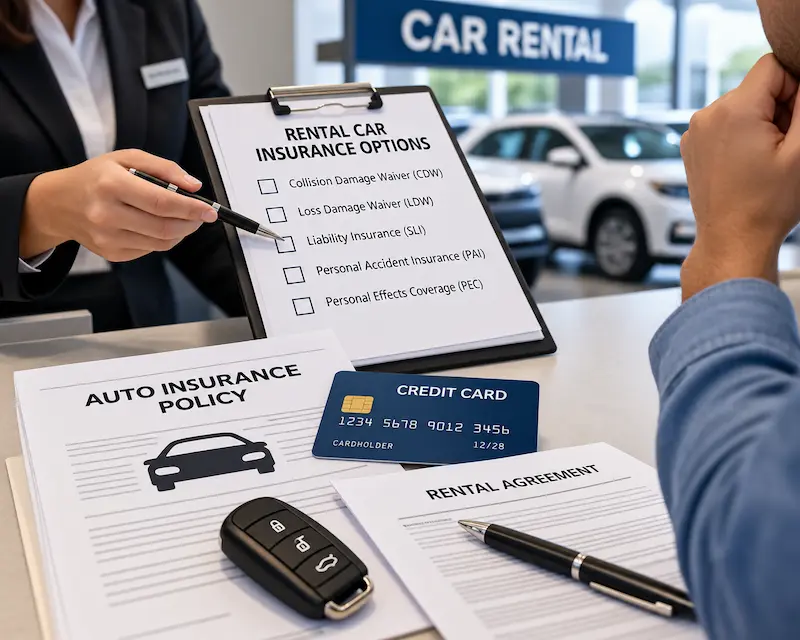
The short answer: If you carry liability, collision, and comprehensive, your policy usually extends to a rental car in the U.S. and Canada, so you may not need the counter’s damage waiver. But “covered” isn’t the same as “owe nothing”: your deductible still applies, and the rental company can bill for loss of use, administrative fees, and diminished value that your policy may not fully pay. A card with rental coverage, or the waiver itself, can close those gaps.
| Your situation | At the counter |
|---|---|
| Full coverage, personal trip in U.S./Canada | Damage waiver often optional — check gaps |
| Liability-only policy | Damage waiver worth considering |
| No car insurance | Buy liability + damage waiver |
| Card with primary rental coverage | Decline the CDW, pay with that card |
| Business trip, Turo, or abroad | Check first — personal coverage may not apply |
| Low liability limits | Consider supplemental liability |
→ Use the Rental Counter Decision Checker.
Then there’s the charge most renters never see coming: “loss of use,” which means paying the rental company for the days the car sat in the shop. If you’re booking holiday travel, it’s worth fifteen minutes now.
Rental Counter Decision Checker
Answer the questions and get a result for each counter product, plus the calls to make before you go. Nothing you enter is stored or sent anywhere.
Your result
Does Full Coverage Cover a Rental Car?
Often yes for the damage itself, but “full coverage” is a shorthand, not a legal term, and it doesn’t promise you’ll owe nothing.
Most people use “full coverage” to mean liability plus collision plus comprehensive. Your insurer’s contract doesn’t use the phrase, so what matters is which of those coverages you carry, at what limits, and with what deductible. For the longer explanation, see Full Coverage vs Liability.
Hypothetical example: You carry collision with a $1,000 deductible and rent a car for a week. Someone backs into it in a parking lot and the repair estimate is $2,400. If you claim on your own policy, you would typically pay the first $1,000. Then the rental company bills $55 a day for the 8 days the car was out of service ($440) and a $150 administrative fee. Whether your policy pays those last two items depends on its wording. That gap is what the rest of this guide is about.
Covered isn’t the same as owing nothing
Your policy can pay for the repair and still leave you with a deductible, loss of use, fees, and a possible diminished-value claim.
What Carries Over From Your Policy — and What Doesn’t
Liability coverage generally extends to a rental, and collision and comprehensive usually do too if you carry them, subject to your deductible, limits, and policy terms.
Insurers and consumer finance sites describe the same basic pattern: your liability coverage generally follows you into a rental, and so do collision and comprehensive if you carry them. Coverage generally applies in the U.S. and Canada; outside that, terms vary (see Experian, State Farm, and AAA). That is a general pattern, not a promise about your policy.
LIKELY COVERED
- Liability for injury or property damage you cause to others, up to your limits.
- Collision or comprehensive damage to the rental, after your deductible, if you carry those coverages.
GAP TO CHECK
- Your deductible, which you still pay first if you claim.
- Loss of use, administrative fees, and diminished value billed by the rental company.
- Towing and storage charges.
- Limits by vehicle type, vehicle value, rental length, or use (business, car-sharing, delivery).
BUY AT COUNTER
- Damage protection, if you carry liability only and no card covers the rental.
- Liability, if you carry no auto insurance, or your limits are low for the risk.
Check your policy’s transportation-expenses section. Some policies cap what they pay for loss of use or transportation costs, either in total or per day. One Maine policy form, for example, pays verifiable and actual loss of use up to 30 days. Other forms differ. Ask your insurer which wording applies to a rental.
How much liability you carry matters too. If you’re unsure whether your limits are enough, see How Much Car Insurance Do You Need?
The Counter Products, Decoded
Car rental insurance at the counter usually means four products: a damage waiver, extra liability, personal accident coverage, and personal effects coverage. Some are insurance and some are not, and each can overlap with coverage you already have.
Damage waiver (CDW/LDW)
GAP TO CHECK for most drivers with full coverage; BUY AT COUNTER if no collision coverage or card benefit applies.
The rental company’s agreement not to bill you for damage or theft, per its contract. It is not insurance in the traditional sense.
Supplemental liability
LIKELY COVERED by your own policy if you carry liability with solid limits; BUY AT COUNTER if you carry none or your limits are low.
Extra protection for injuries and property damage you cause to others. For scale, Enterprise’s U.S. page describes its version as up to $300,000 combined single limit ($1,000,000 at its truck locations).
Personal accident insurance (PAI)
GAP TO CHECK against your health insurance and any medical-payments or personal-injury-protection coverage.
Accident-related medical and death benefits for you and your passengers. Availability varies: Enterprise’s U.S. page lists it at truck locations only.
Personal effects coverage (PEC)
GAP TO CHECK against your homeowners or renters policy.
Covers your belongings if they are stolen from the rental. Credit card rental benefits generally don’t cover belongings.
A waiver isn’t insurance — it’s a promise not to bill you
Enterprise’s U.S. help page says its damage waiver isn’t insurance and is optional. It describes the waiver as a contractual agreement to waive all or part of your responsibility for damage, loss, or theft of the vehicle, subject to listed actions that can void it (it doesn’t apply to damage in Mexico, for example). The page also tells renters to check their own insurance and card for their deductible and out-of-pocket risk (Enterprise U.S. help page, as a contract example).
What a waiver does or doesn’t waive beyond the repair, such as loss of use, administrative fees, and diminished value, is set by the rental agreement. Enterprise’s Canadian help page lists those items among what its waiver may reduce, and an older Enterprise U.S. agreement filed with the Vermont legislature in 2018 listed them as charges (2018 agreement). Read your own agreement; it controls.
| Product | What it covers | You may skip it if… |
|---|---|---|
| Damage waiver (CDW/LDW) | The rental company agrees not to bill you for damage or theft, and may waive loss of use, fees, and diminished value, per contract | Your policy or a primary card covers damage and the fees, or you’ve confirmed what remains is a risk you accept |
| Supplemental liability | Extra liability for injury or property damage to others | Your own liability limits are high and you’ve confirmed they apply to rentals |
| Personal accident (PAI) | Medical and accidental death benefits for you and passengers | Your health insurance and any medical-payments or PIP coverage already cover you |
| Personal effects (PEC) | Belongings stolen from the car | Your renters or homeowners policy covers belongings away from home, with limits you accept |
| Roadside assistance | Lockouts, flat tires, dead batteries, towing to a shop | Your insurer, auto club, or card already includes roadside help |
Who Pays What: Your Policy vs. Your Card vs. the Waiver
No single source pays everything, which is why the gaps matter more than the headline coverage.
| Expense | Your auto policy | Credit card | Counter waiver |
|---|---|---|---|
| Damage to the rental | Usually, if you carry collision, after your deductible | Usually, if you meet its terms | Usually, per contract |
| Theft | Usually, if you carry comprehensive | Usually, if you meet its terms | Varies |
| Liability to others | Usually, up to your limits | Rarely | Rarely (sold separately) |
| Your deductible | Rarely (you pay it) | Varies | Usually |
| Loss of use | Varies | Varies | Usually |
| Administrative fees | Varies | Varies | Usually |
| Diminished value | Varies | Rarely | Usually |
| Towing and storage | Varies | Varies | Usually |
Credit Card Rental Coverage: Primary vs. Secondary
Some cards provide rental coverage when you pay with them, and whether it is primary or secondary decides who you call first.
Benefits vary by card, so treat everything here as an example of how these benefits tend to work, not a ranking or recommendation. Chase’s Sapphire guide, for instance, describes primary coverage for damage, theft, valid loss-of-use charges, administrative fees, and reasonable towing when you decline the rental company’s CDW and pay with the card (Chase guide). Many other cards are secondary; Experian describes credit card rental coverage as typically secondary and notes common exclusions such as trucks, large vans, motorcycles, and expensive or exotic cars (Experian). For the bigger picture on card perks, see The Hidden Credit Card Benefits Nobody Uses.
Primary vs. secondary decides who you call first
Primary pays first. Secondary pays what your own insurance doesn’t. Secondary coverage often covers the deductible; the difference is who you claim with first. Verify per card.
| Point | Primary | Secondary |
|---|---|---|
| Who pays first | The card benefit | Your own insurance |
| Your own insurer | You may not need to involve it for covered damage | You file with it first, and a claim can affect your rates |
| Your deductible | Typically avoided, since your insurer isn’t first payer (verify) | Often reimbursed by the card (verify) |
| Typical requirements | Decline the CDW, pay with the card, be the primary renter | Decline the CDW, pay with the card, be the primary renter |
| Liability and injuries to others | Rarely covered | Rarely covered |
Requirements checklist
- Pay for the entire rental with the card.
- Decline the rental company’s CDW/LDW. Accepting it can cancel the card benefit.
- Be the primary renter named on the agreement.
- Rent an eligible vehicle. Card terms commonly exclude some luxury vehicles, trucks, vans, and rentals not from a rental agency.
- Stay within the rental-length limit. Thirty-one consecutive days is one example.
- Check the country list if you’re traveling abroad.
- Know the claim deadlines and paperwork before you need them.
Card benefits generally don’t include liability, injuries to others, or your belongings (CNBC’s Chase Sapphire example). If your card is your damage protection, your liability protection still has to come from somewhere else.
State Laws That Limit What You Owe
A few states limit what rental companies can charge or what your policy must cover, and the rules differ by state, so check yours.
The two examples below are labeled by state and are examples only. This guide doesn’t claim that most states work the same way.
Maine: what your policy must cover
Under 24-A M.R.S. § 2927, a personal auto policy that includes liability plus collision and/or comprehensive must cover the insured’s obligation for actual damage to a covered rental vehicle, including charges for “verifiable and actual loss of use” of up to 30 days. It applies to rentals of 45 continuous days or fewer in the U.S., its territories, or Canada. The deductible can’t exceed the highest applicable collision or comprehensive deductible on your policy.
This protects renters; it doesn’t require anyone to buy insurance.
California: what a renter can be charged
California Civil Code § 1939.03 lists what a rental company and renter may agree the renter is responsible for: damage up to fair market value, theft under conditions, vandalism up to $500 when unrelated to theft, towing, storage and impound, and an administrative charge. Loss of use isn’t on that list. Section 1939.05 caps the administrative charge: $50, $100, or $150 depending on the estimated cost of parts and labor, and no administrative charge at $100 or less.
If you’re billed for loss of use in California, you can ask the company to identify the legal basis. This guide can’t say how a court would treat it.
| State | Rule | Source |
|---|---|---|
| Maine | Personal auto policies with liability plus collision and/or comprehensive must cover the insured’s obligation for actual damage to a covered rental, including verifiable and actual loss of use up to 30 days, for rentals of 45 days or less; the deductible is capped at the highest applicable collision/comprehensive deductible | 24-A M.R.S. § 2927 |
| California | Renter liability limited to listed items; loss of use isn’t listed (§ 1939.03). Administrative charge capped at $50, $100, or $150 by repair-cost tier (§ 1939.05) | Cal. Civ. Code ch. 1.5 |
| California | A damage waiver means no renter liability for damage, loss, loss of use, or related costs, except listed exclusions (§ 1939.09). A rental company can’t require you to buy a damage waiver or other optional product (§ 1939.13). After damage, it needs your express permission to charge or block your card (§ 1939.15) | § 1939.09, § 1939.13, § 1939.15 |
Your state insurance department can tell you what applies where you live and where you rent. This isn’t legal advice.
When Your Personal Policy May Not Be Enough
Your policy may fall short when you carry liability only, have a high deductible or low limits, or rent something unusual, for an unusual purpose, or for a long time.
- Liability-only policy. There is no collision or comprehensive to extend, so nothing on your policy pays for the rental car itself. BUY AT COUNTER (or use a card that covers it).
- High deductible. A deductible over $1,000 comes out of your pocket first. GAP TO CHECK.
- Low liability limits. State-minimum limits may not stretch far after a serious crash. GAP TO CHECK; consider supplemental liability or higher limits on your own policy.
- Luxury or exotic vehicles. Policies and card benefits commonly limit or exclude them. GAP TO CHECK.
- Business trips. A personal policy or card benefit may not apply; ask your employer and insurer. GAP TO CHECK.
- Long rentals. Card benefits commonly cap rental length (31 days is an example), and some state rules are written for shorter rentals. GAP TO CHECK.
- Moving trucks and large vans. These are often outside personal-policy and card terms. GAP TO CHECK.
- Renting to drive for Uber, Lyft, or delivery. Personal coverage often excludes it. See The Rideshare Insurance Gap. BUY AT COUNTER unless confirmed in writing.
- Abroad. Personal policies generally cover the U.S. and Canada; elsewhere terms vary. Waivers have exclusions too: Enterprise’s U.S. page says its damage waiver doesn’t apply in Mexico. Consider a travel plan with rental damage coverage (see Best Travel Insurance Plans). GAP TO CHECK.
Turo and Peer-to-Peer Rentals
Peer-to-peer rentals like Turo work differently from a traditional rental, and your policy and card may not treat them the same way.
Turo isn’t a rental company — your card probably knows that
Turo’s own help pages tell guests not to assume credit card coverage applies to person-to-person bookings. Turo describes itself as a car-sharing platform, not a rental car company, and issuer terms often limit coverage to vehicles rented from a rental agency. A Chase guide is one example of that wording.
- Ask your insurer in writing whether your policy applies to a car-sharing trip.
- Read the protection plan you’re offered, including your responsibility for damage and any deductible.
- Ask your card issuer whether the benefit covers the booking. Many don’t.
Sources: Turo help and The Points Guy’s summary of Turo’s guidance. Check Turo’s current help page before you book.
No Car Insurance? Your Options
If you don’t own a car, you can buy liability and a damage waiver at the counter, or look at a non-owner policy.
- Counter liability plus a damage waiver. The most direct route if you rent only occasionally.
- A card with rental coverage. It can cover damage, but generally not liability.
- A non-owner policy. Typically provides liability, not damage to the rental (Experian). Confirm it applies to rentals, at what limits, and whether it sits on top of the rental company’s coverage.
Visiting from another country without a U.S. policy? See Car Insurance for Tourists in USA or Car Insurance for International Drivers.
Rental Reimbursement Is Something Else
Rental reimbursement pays for a substitute car while your own car is being repaired after a covered loss, which makes it different from coverage for a car you rent on a trip.
It isn’t rental car insurance, and it doesn’t cover damage to a rental you pick up for a vacation. Experian makes the same distinction: it won’t cover you if you rent a car for leisure or business. If you’re comparing policies, don’t let the similar names mislead you.
Before You Rent: Call Scripts and Counter Checklist
Two short calls and a clear line at the counter will answer most of what this guide covers. Open each script, tap Copy, and paste it into your notes.
1. Call your insurer before the trip
2. Call your card issuer
3. At the counter
If You Damage a Rental: Step by Step
Report it right away, document everything, and ask for itemized proof before you agree to pay any bill.
- Report it. Tell the rental company as soon as you can, and follow the instructions in your rental agreement.
- Take photos and video. Capture the damage, the scene, and the other vehicle or property involved.
- File a police report if needed. Do this if anyone is hurt, another party is involved, the car is stolen or vandalized, or your rental agreement, insurer, or card benefit asks for one.
- Choose the claim order. If your card is primary, call its benefit administrator first. If it is secondary, your insurer usually goes first and the card covers what remains, per its terms. If you bought the waiver, follow the contract. Card benefits have notice and paperwork deadlines, so call early.
- Request itemized documentation. Use the letter below.
- Decide whether to file or pay. See Insurance Claim or Pay Out of Pocket? A claim on your own policy can affect your rates.
In California, a rental company needs your express permission after the damage before it charges or blocks your card for a claim (Civ. Code § 1939.15). In any state, ask for the paperwork before you agree to a charge.
If you disagree with a charge
Send the letter below and keep the whole exchange in writing. Share the documents you receive with your insurer or card benefit administrator, since they may need them to pay. If the company doesn’t answer or the charge still looks unsupported, you can ask your card issuer about its dispute process and contact your state attorney general’s consumer protection office or your state insurance department. Deadlines apply, so act early. This isn’t legal advice.
4. Damage-bill documentation request letter
Fill in the brackets, delete any optional paragraph that doesn’t apply, and send it by email with delivery tracking, or by certified mail. Keep a copy.
FAQ
Do I need rental car insurance if I have full coverage?
You may not need the counter’s damage waiver, but covered isn’t the same as owing nothing. Your deductible applies, and loss of use, administrative fees, and diminished value may not be fully paid by your policy. Your liability limits and trip type matter too. Use the decision checker.
Does my car insurance cover rental cars?
Generally yes for personal trips in the U.S. and Canada: liability usually extends, and collision and comprehensive do too if you carry them, subject to your deductible, limits, and terms. Liability-only policies don’t pay for damage to the rental itself.
Does my deductible apply to a rental car?
Generally yes. If you claim collision or comprehensive damage on the rental under your own policy, your deductible applies as it would on your own car. Maine caps the deductible for covered rentals at the highest applicable collision or comprehensive deductible on the policy.
What happens if I decline rental car insurance?
You stay responsible for damage, theft, and related charges as your rental contract and state law provide. Your policy or card may pay some or all of that, so confirm before you decline, and make sure you have liability coverage from somewhere.
Is a collision damage waiver insurance?
No, not in the traditional sense. It is the rental company’s agreement not to hold you responsible for certain damage or loss. Enterprise’s U.S. help page states that its damage waiver isn’t insurance.
What’s the difference between CDW and LDW?
Companies use the terms loosely. LDW is often the label for a waiver that also mentions loss or theft of the vehicle, but your contract’s wording controls what’s waived and what’s excluded.
Should I buy insurance from the rental car company?
Only for the gaps. Enterprise’s own help pages say its products may duplicate coverage you already have and tell renters to check their insurance and card first. Buy what closes a real gap, such as liability if you have none or a damage waiver if nothing else pays for damage, and decline what you’ve confirmed you have.
Is rental car insurance worth it?
It depends on your gaps: your deductible, whether your policy or card pays loss of use and fees, your liability limits, and the type of trip. There’s no blanket answer. Compare the cost against what you’d owe in the hypothetical examples above.
Does liability-only insurance cover a rental car?
Your liability coverage generally extends to damage you cause to others while driving a rental. It doesn’t pay to repair or replace the rental car itself, because you carry no collision or comprehensive coverage.
What is a loss-of-use charge?
It’s the rental company’s claim for revenue lost while a damaged car is out of service, usually a daily rate times days in the shop. A damage waiver may waive it; your policy and card may or may not pay it.
Can a rental company charge me for loss of use?
Your rental contract and state law control. In California, loss of use isn’t among the items a renter may agree to be responsible for under § 1939.03, while a damage waiver under § 1939.09 covers it except for listed exclusions. Ask for the company’s supporting records. This isn’t legal advice.
Does insurance cover rental car administrative fees?
It varies. Some policies pay them, some card benefits list them as covered (a Chase guide does), and a waiver typically waives them. California caps the charge at $50, $100, or $150 depending on the repair-cost tier.
Can a rental company charge for diminished value?
Some contracts allow it; an older Enterprise U.S. agreement listed it as a charge. Your policy and card may not pay it, and a waiver may waive it, depending on the contract. For diminished value on your own car, see the Diminished Value Claim Guide.
Does my credit card cover rental car insurance?
Some cards provide rental coverage, usually when you decline the CDW and pay for the whole rental with the card. It generally covers damage and theft, not liability. See The Hidden Credit Card Benefits Nobody Uses.
Is credit card rental coverage primary or secondary?
It depends on the card. One Chase Sapphire guide describes primary coverage, and other card guides describe secondary coverage. Call the number on your card and ask.
Does credit card coverage include liability?
Generally no. Card rental benefits typically cover damage to the rental, not injuries or damage to other people, and not your belongings. Liability has to come from your own policy or the counter.
Does my insurance cover a rental car for a business trip?
Maybe not. Personal policies can treat business use differently, so ask your insurer, and ask your employer whether it carries rental coverage.
Does my insurance cover a rental outside the U.S.?
Personal auto coverage generally applies in the U.S. and Canada; elsewhere terms vary. Some card benefits work abroad but exclude certain countries. A travel plan with rental damage coverage is another option; see Best Travel Insurance Plans.
Does my car insurance or credit card cover Turo?
Don’t assume either does. Turo says credit card coverage is unlikely to apply because it isn’t a traditional rental company, and your insurer may treat car-sharing differently. Get the answers in writing.
Do I need insurance to rent a car?
You don’t necessarily need your own policy, but you do need some form of coverage, which can come from your policy, a card benefit, or the rental company (Experian). Requirements vary by company and place, so ask when you book. In California, a company can’t require you to buy the damage waiver or other optional products (§ 1939.13). Either way, you’re responsible for damage and for harm to others, so liability coverage has to come from your policy, a non-owner policy, or the counter. Visitors without a U.S. policy should see Car Insurance for Tourists in USA.
What’s the difference between rental reimbursement and rental car insurance?
Rental reimbursement pays for a substitute car while your own car is repaired after a covered loss. Rental car insurance, as people use the term, concerns the car you rent on a trip: damage to it and liability for what you do with it.
Last updated:
This article is for educational purposes only and is not insurance or legal advice. Coverage depends on your policy, card terms, rental contract, and state law.

Daniel Hayes is the founder and sole researcher at AdvoraHQ. He covers U.S. personal finance, insurance, and consumer law — working directly from IRS publications, federal and state statutes, court opinions, and SEC filings rather than secondary summaries. His focus is the gap between what readers think they know and what the source documents actually say. Daniel is not a licensed attorney, CPA, or financial advisor; his articles are educational and not personalized advice. Reach him at Daniel.Hayes@advorahq.com.