
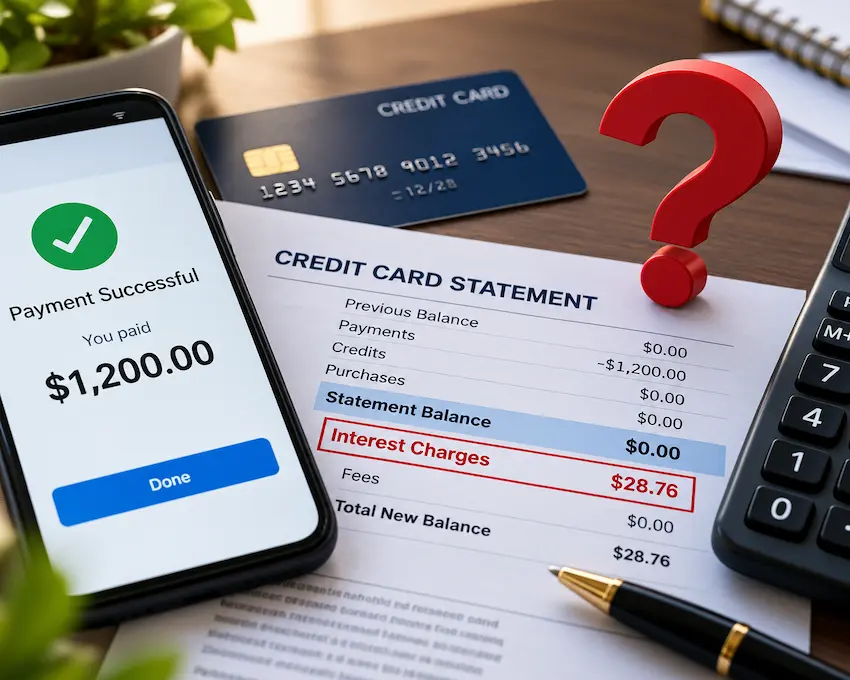
Paid Your Statement Balance and Still Got Charged Interest? Which Credit Card Balance to Pay — and When
Short answer: Pay your full statement balance by the due date and — if you weren’t already carrying a balance — you won’t pay interest on purchases. If you see interest anyway, it’s usually residual interest: you carried a balance last month, so interest kept running until your payment arrived. To stop it, pay the full payoff amount (not just the statement balance) and keep paying in full until your grace period is restored.
| Your situation | Pay this |
|---|---|
| You paid in full last month | Statement balance by the due date |
| You carried a balance last month | Payoff amount for your payment date |
| Applying for a loan soon | Pay down before the closing date |
| You took a cash advance | Pay it ASAP — interest generally started on day one |
| You can’t pay the full statement | As much as you can, at least the minimum |
→ Use the Balance & Interest Estimator, and read about the federal rule most cardholders never hear about: if you pay part of your bill, the bank generally can’t charge interest on the part you paid (conditions apply; see Partial payments).
Balance & Interest Estimator
Enter what’s on your statement and the tool tells you which tier you’re in, what to pay, and roughly how much residual interest to expect.
Hypothetical example: a $2,000 balance carried at closing, a 22.15% APR, and a payment that posts 20 days after closing comes to about $24 in residual interest ($2,000 × 22.15% ÷ 365 × 20). Nothing you type here is stored or sent anywhere.
Your estimate
Which Balance Should You Pay? (The 30-Second Answer)
If you paid last month’s statement in full, pay this month’s statement balance by the due date; if you didn’t, ask for a payoff amount for the day your payment will post.
Your card shows at least two numbers: a statement balance and a current balance. They answer different questions. The statement balance decides whether you keep your grace period. The current balance tells you what you’d owe if you wanted to be at zero today.
- Paying in full every month: the statement balance, by the due date, is enough to avoid interest on purchases, if your card offers a grace period on purchases (most do).
- Carrying a balance: the statement balance won’t stop interest from accruing between the closing date and the day your payment arrives. A payoff amount for your payment date covers that.
- Can’t pay it all: pay as much as you can, never less than the minimum, and read the partial payment rule.
Terms vary by issuer. Check your card agreement for how your card handles grace periods and interest.
Statement Balance vs. Current Balance
Your statement balance is what you owed on the closing date; your current balance is what you owe right now, including everything that has happened since.
Hypothetical example: your statement closes with $500 owed. You then spend $50 more, so your current balance is $550. The $500 is due by the due date. The extra $50 shows up on your next statement.
Statement balance
Example: $500, as of the closing date.
Fixed until the next statement.
The amount to pay in full by the due date to keep a grace period on purchases.
Current balance
Example: $550 after $50 of new purchases.
Changes with purchases, payments, credits and interest.
Not required by the due date, and it may not yet include interest that hasn’t posted.
| Feature | Statement balance | Current balance |
|---|---|---|
| What it is | Total owed on the closing date | Total owed right now |
| Changes during the month? | No | Yes |
| Includes purchases since closing? | No | Yes |
| Must you pay it by the due date? | Only the minimum is required; the full amount keeps your grace period | No |
| Often the reported balance? | Often, but it varies by issuer | Usually not |
Paying the statement balance isn’t always paying it off.
If you were carrying a balance, interest kept building after the closing date. A payment equal to the statement balance can leave a small amount behind, and that leftover is what shows up as an interest charge on your next statement.
Why You Paid in Full and Still Got Charged Interest
Most “paid in full but charged interest” surprises come down to a handful of causes, and the most common is that you carried a balance the month before.
Every statement is in one of three situations. Find yours first, then match it to a cause below.
GRACE PERIOD ON
You paid last month’s statement in full by the due date, and the new statement holds only purchases.
Pay the full statement balance by the due date and you generally owe no interest on those purchases.
GRACE PERIOD LOST
You carried a balance past a due date.
Interest generally runs on the unpaid portion, and on new purchases from the day you make them, until your issuer restores the grace period. Ask for a payoff amount.
CHECK YOUR CARD
Cash advances, balance transfers, promotional rates and deferred-interest offers follow their own terms.
Interest may start on the transaction date or be charged back later. Read your card agreement.
The usual causes:
- You carried a balance last month (GRACE PERIOD LOST). Paying the statement balance didn’t cover the interest that built up between closing and the day your payment arrived. That leftover is residual interest. More below.
- A cash advance is on the statement (CHECK YOUR CARD). Cash advances generally accrue interest from the transaction date, with no grace period. They often carry a higher APR than purchases.
- A balance transfer is on the statement (CHECK YOUR CARD). Grace periods typically apply only to purchases. Transfers follow the terms of the offer, such as a fee and a promotional APR.
- A promotion ended (CHECK YOUR CARD). When an introductory or promotional rate expires, what’s left is charged at your regular APR. With deferred interest, interest can be charged back to the purchase date if the balance isn’t cleared in time.
- Your payment posted late (GRACE PERIOD LOST). What matters is when your issuer receives and credits the payment, not when you started it. A payment that lands after the due date can cost you the grace period for that cycle, and may bring a fee. See Credit Card Late Fee.
- You paid part of the statement (depends). Interest is charged on the unpaid portion. Whether it’s charged on the part you paid depends on the rule below.
To see which cause applies, find the interest charge section of your statement. It lists interest by balance type, such as purchases, cash advances and balance transfers, each with its own APR.
Residual (Trailing) Interest, Explained
Residual interest is the interest that accrues between your statement date and the date your payment is received, when you were already carrying a balance.
It’s also called trailing interest. It appears on the next statement, which is why a card you “paid off” can show a small balance the following month.
Hypothetical example: you carried a $2,000 balance at closing, your APR is 22.15%, and your payment posts 20 days after the closing date. The estimate is $2,000 × 22.15% ÷ 365 × 20 days, or about $24. You paid the $2,000 statement balance, yet the next statement shows roughly $24 in interest.
Issuers calculate interest in different ways, usually daily on the average daily balance, so treat that figure as an estimate. For the APR and daily-rate math, see How Credit Card Interest Works. See also the CFPB’s explanation of how interest is calculated.
Did You Lose Your Grace Period?
A grace period is the stretch between the end of your billing cycle and your due date; you keep it by paying your balance in full, and you can lose it by paying anything less.
Federal law doesn’t require issuers to offer one, though most cards give one on purchases. If you lose it, you’re charged interest on the unpaid portion of the balance, and on new purchases from the date you make each one.
The CFPB offers a warning: if you pay in full some months and not others, you can lose your grace period for the month you didn’t pay in full and for the month after. Cash advances generally accrue interest from the transaction date no matter what.
Check your card agreement for how your issuer defines the grace period and what restores it.
Paid Part of Your Statement? The Rule That Protects You
If you were eligible for a grace period and you pay part of your balance by the due date, your issuer generally may not charge interest on the portion you paid.
This comes from Regulation Z, 12 CFR § 1026.54(a)(1)(ii), and its official interpretation. When a balance is eligible for a grace period and you pay part of it before the grace period expires, the issuer may not charge interest on the part you paid, and may not charge interest on that balance for days in the previous billing cycle.
Hypothetical example, based on the official one: you owe a $600 purchase balance and pay $500 on time. Interest applies only to the remaining $100, starting at the beginning of the new cycle, plus any new purchases from their dates. At a 22.15% APR over a 30-day cycle, that’s roughly $100 × 22.15% ÷ 365 × 30, or about $1.82.
This corrects a common myth. “Pay $1 short and you’re charged interest on everything” is wrong when this protection applies. Pay $599 of $600 and interest is limited to the $1 you left unpaid, not the whole $600.
Partial payments still count — by law.
This applies only if you were eligible for the grace period at the end of that cycle. If you had already lost it, interest can run from each transaction date. And paying part of a bill doesn’t keep your grace period for new purchases; that takes paying in full.
How to Get Your Grace Period Back
No federal rule says how many billing cycles it takes, so the answer is in your card agreement.
Issuers set their own conditions. As one example of a single issuer’s stated policy, Chase’s grace period page says it may reinstate a grace period after the balance is paid in full for two consecutive billing cycles. Other issuers’ terms differ, and none of this is a promise about your account.
- Pay the payoff amount to bring the balance to zero.
- Pay each following statement balance in full by the due date.
- Until your issuer confirms the grace period is back, assume new purchases may accrue interest from the purchase date.
- Ask your issuer what your account needs. The phone script below includes this question.
How to Stop Residual Interest for Good
Get a payoff amount for the exact day your payment will post, pay that, and then pay each statement in full.
- Ask for a payoff quote. It includes interest that will accrue up to your payment date. Your app’s current balance often doesn’t.
- Pay soon after the statement closes. The fewer days a balance sits, the less interest it earns.
- Consider paying twice a month. Earlier payments lower the balance interest is calculated on.
- Ask for a waiver. The official interpretation of Regulation Z includes an example in which a consumer asks for a waiver of trailing interest and the issuer agrees. Waivers are discretionary, so never count on one.
Phone script: four things to ask your issuer
What is my payoff amount if my payment posts on [date]?
I paid in full and see residual interest. Would you consider a one-time courtesy waiver?
On what day do you report my balance to the credit bureaus?
What does my account need to restore the grace period on purchases?
Waivers are at the issuer’s discretion.
Residual Interest vs. Double-Cycle Billing
Residual interest is legal and normal; double-cycle billing, a method that could charge interest on balances you’d already paid, is banned for credit cards.
Under 12 CFR § 1026.54(a)(1)(i) and its official commentary, issuers can’t use the two-cycle average daily balance method when a consumer loses a grace period. Seeing residual interest on your statement doesn’t mean your issuer used it.
| Point | Residual interest | Double-cycle billing |
|---|---|---|
| What it is | Interest that builds between the statement date and the day your payment is received | Interest calculated on the average daily balance across two billing cycles |
| When it comes up | You were carrying a balance | You lost a grace period |
| Is it allowed? | Yes | No, banned for credit cards |
| What to do | Pay a payoff amount; ask about a waiver | If you think it happened, contact your issuer and, if needed, the CFPB |
Residual interest is legal; double-cycle billing isn’t.
The two get confused because both can show up after a month when you carried a balance. They are different calculations.
The 21-Day Rule: What It Does — and Doesn’t — Mean
The 21-day rule says your statement must be mailed or delivered at least 21 days before the payment due date; it does not promise 21 days of interest-free time.
Under 12 CFR § 1026.5, issuers must have procedures to deliver statements by then. That protects the time you have to pay. Whether interest accrues during those days depends on whether your grace period applies. If you were carrying a balance, interest keeps running the whole time. See the CFPB’s grace period page.
Balances With No Grace Period
Cash advances, balance transfers and deferred-interest promotions follow their own terms, so check your card agreement for each one.
| Balance type | When interest starts | Link |
|---|---|---|
| Cash advance | Generally the transaction date | Credit Card Cash Advance |
| Balance transfer | Per the offer, often the transfer date at a promotional or regular APR; check your terms | Best Balance Transfer Credit Cards |
| Deferred-interest promotion | Interest accrues from the purchase date and is charged if the balance isn’t paid by the end of the promotion | Deferred Interest |
Payment allocation. Under 12 CFR § 1026.53, payments above the minimum generally go to the balance with the highest APR first. If you have a cash advance on the card, a large payment can pay that down while your purchase balance stays unpaid. The issuer generally decides which balance the minimum portion goes to. That’s another way to be charged interest on purchases after sending what felt like a big payment. See § 1026.53.
Which Balance Gets Reported to the Credit Bureaus?
There’s no single rule: many issuers report the statement balance or a balance near the closing date, but some report on other schedules, so check with your issuer.
myFICO says the balance on your credit report will usually be the balance on your last statement. Experian says most reports reflect the balance as of the end of the last billing cycle. That can surprise people who pay in full: you can pay everything off every month and still have a balance reported, because the statement balance was reported before you paid it. Experian adds that a few lenders update more often than once a month, which is one more reason to ask your issuer. See myFICO support and Experian.
For utilization targets, see Credit Utilization Ratio.
When to Pay to Lower Your Reported Balance
To lower the balance that’s reported, get your payment posted before your statement closing date, and confirm when your issuer reports.
A payment made before closing can reduce the statement balance, and with many issuers that is the balance that gets reported. Allow time for it to post. No payment timing guarantees a particular score.
1Closing date
The billing cycle ends and your statement balance is set.
2Statement
Your statement is mailed or delivered at least 21 days before the due date.
3Reporting (varies)
Your issuer reports a balance on its own schedule. Dashed border means it varies by issuer.
4Due date
Pay the full statement balance to keep your grace period.
5Payment posted
Interest accrues until your payment is received and credited.
Your closing date may matter more than your due date.
The due date decides whether you pay interest. The closing date often decides what balance gets reported. If you’re applying for credit soon, pay down before closing.
Autopay: Minimum, Statement Balance, or Current Balance?
If you pay in full every month, set autopay to the statement balance; use the minimum only as a safety net while you pay manually.
| Setting | Avoids interest? | Best for |
|---|---|---|
| Minimum payment | No. Interest accrues on what’s left | A backstop against a late fee while you pay manually |
| Statement balance | On purchases, yes, if you weren’t carrying a balance and your card offers a grace period | Paying in full every month |
| Current balance | Often, but not guaranteed. Interest can accrue before the payment posts | Keeping the balance near zero; make sure the cash is there |
| Fixed amount | Only if it covers the full statement balance | Paying down debt on a set budget |
If you’re carrying a balance, autopay set to the statement balance won’t stop residual interest. Get a payoff amount first. Also check which date your autopay runs, and keep it ahead of the due date.
Can’t Pay the Full Statement Balance?
Pay as much as you can, never less than the minimum, and expect interest on what’s left.
Missing the minimum can bring a late fee and hurt your account standing. See Credit Card Late Fee and What Happens If You Don’t Pay Your Credit Card?. If you were in a grace period, the partial payment rule limits interest on the part you paid. For a payoff plan, read How to Pay Off Credit Card Debt Fast.
FAQ
Short answers to the most common questions; your card agreement controls.
Should I pay my statement balance or current balance?
If you paid last month’s statement in full, pay the statement balance by the due date. If you carried a balance, ask for a payoff amount for the day your payment will post. Paying the current balance is fine if you can, but it isn’t required.
Why was I charged interest after paying my statement balance?
Usually it’s residual interest from a balance you carried last month. Other causes include a cash advance, a balance transfer, an expired promotion, or a payment that posted late.
Why was I charged interest after paying in full?
“Paid in full” may not have covered the interest that built up after the statement closed. Look at the interest charge section of your statement to see which balance type was charged.
What is residual interest?
Interest that accrues between your statement date and the date your payment is received, when you were already carrying a balance. It appears on the next statement.
Is trailing interest the same as residual interest?
Generally yes. The terms are used for the same idea. Your statement may use either wording.
How do I stop residual interest?
Request a payoff amount for your payment date, pay it, and then pay each statement in full. You can also ask for a courtesy waiver, though waivers are discretionary.
How long does residual interest last?
It typically shows up on the next statement. If you pay the full payoff amount and stop carrying a balance, it generally stops, but your issuer’s terms control.
Is residual interest legal?
Yes. Regulation Z’s official interpretation even includes an example of a consumer asking for a waiver of trailing interest. It’s different from double-cycle billing, which is banned.
What is double-cycle billing, and is it allowed?
It’s a method that averages balances over two billing cycles and could charge interest on balances you’d already paid. Regulation Z bars issuers from using it when a consumer loses a grace period.
Do I have to pay my current balance by the due date?
No. You must pay at least the minimum by the due date. To avoid interest on purchases, pay the full statement balance.
Does paying the current balance avoid interest?
Not automatically. If you were carrying a balance, interest can accrue between the day of the quote and the day your payment posts. Use a payoff amount for a specific date.
If I pay part of my statement, is interest charged on the whole balance?
Not if you were eligible for the grace period. In that case, interest is generally charged only on the unpaid part. If you had already lost the grace period, interest can run from each transaction date.
How do I get my grace period back?
Pay your balance in full as your issuer requires. There’s no federal rule on how long it takes, so ask your issuer.
Do I need two months of full payments to restore it?
Not by federal law. Some issuers state two consecutive billing cycles, and others differ. Check your card agreement.
Do cash advances have a grace period?
Generally no. Interest typically starts on the transaction date.
Do balance transfers accrue interest immediately?
Often yes, at the offer’s promotional or regular rate. Grace periods typically apply only to purchases, so read the terms of your offer.
Which balance is reported to the credit bureaus?
There’s no single rule. Many issuers report the statement balance or a balance near the closing date. Ask your issuer.
Should I pay before the statement closing date?
You don’t need to in order to avoid interest. You might if you want a lower balance reported, for example before applying for credit. It doesn’t guarantee a score change.
Should autopay be set to the statement balance or the minimum?
If you pay in full each month, the statement balance. The minimum is a safety net, not a way to avoid interest.
What happens if I overpay my credit card?
You’ll have a credit balance, and you can ask your issuer for a refund. Timing and method vary. See Refund Sent to a Closed Credit Card?
Sources
- 12 CFR § 1026.54 and official interpretation (CFPB)
- 12 CFR § 1026.5 (CFPB) and § 1026.53 (CFPB)
- CFPB: What is a grace period for a credit card?
- CFPB: How does my credit card company calculate the amount of interest I owe?
- Federal Reserve G.19 Consumer Credit (Sept. 8, 2026 release)
- myFICO support: balances on credit reports
- Experian: balance on report vs. statement
- Chase: credit card grace period (one issuer’s stated policy, as an example)
Disclaimer: This article is for educational purposes only and is not financial or legal advice. Card terms vary, and your card agreement controls. The estimator's results are estimates, not quotes, and no outcome such as a waiver, a grace-period restoration date or a credit score change is promised.

Daniel Hayes is the founder and sole researcher at AdvoraHQ. He covers U.S. personal finance, insurance, and consumer law — working directly from IRS publications, federal and state statutes, court opinions, and SEC filings rather than secondary summaries. His focus is the gap between what readers think they know and what the source documents actually say. Daniel is not a licensed attorney, CPA, or financial advisor; his articles are educational and not personalized advice. Reach him at Daniel.Hayes@advorahq.com.