
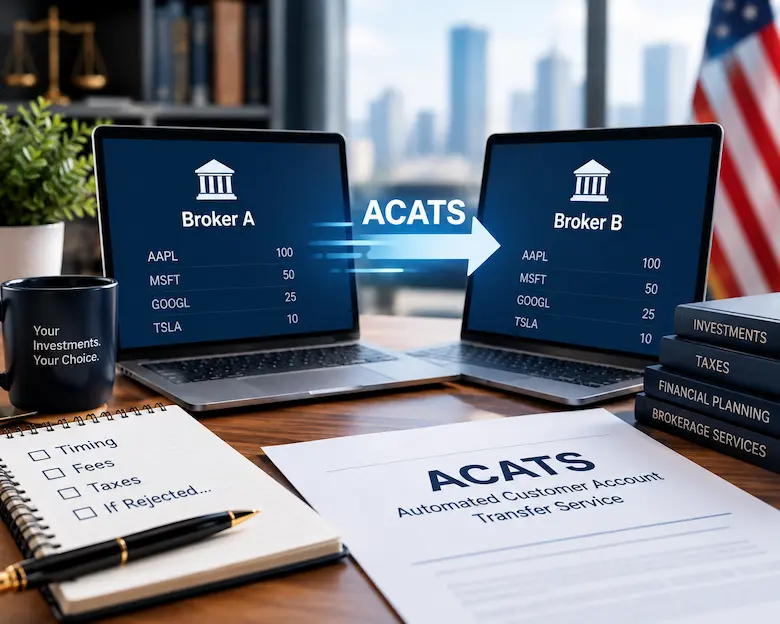
Yes — you can usually move stocks, ETFs, and many funds to a new broker without selling them, using an ACATS transfer you start at the new broker. A standard full transfer now typically settles in about 3–4 business days. The trouble spots are fractional shares (usually sold for cash), funds the new broker can’t hold, cost basis that arrives late, and rejections caused by small mismatches like your account title.
| You hold | During ACATS |
|---|---|
| Whole shares and ETFs | Move in kind — no sale |
| Fractional shares | Usually sold; cash sent |
| Broker’s own funds | You choose: sell, keep, re-register |
| Open orders | Canceled when the transfer validates |
| Options expiring within 7 business days | Exception to the freeze |
| Dividends after the move | Forwarded as residual credits |
→ Use the Transfer Readiness & Cost Checker.
And the rule most guides get wrong: your old broker can’t hold up the transfer over a dispute about your balances.
Transfer Readiness & Cost Checker
Answer a few questions about the account you plan to move, and this checker sorts your transfer into READY TO SEND, FIX FIRST, or CALL BOTH BROKERS, estimates your net cost, and builds a pre-flight checklist.
It never asks for account numbers or Social Security numbers, makes no network calls, and stores nothing.
Your result
Can You Transfer Stocks Without Selling?
Yes: an in-kind transfer moves the securities themselves from one broker to another, so the transfer is not a sale.
“In kind” means the same shares arrive at the new broker. The alternative is a cash transfer, where you sell everything, send the proceeds, and buy again. In a taxable account, that sale can create capital gains or losses, and your money sits out of the market while the cash moves. An in-kind ACATS transfer avoids both problems for whatever the new broker can hold.
The transfer is not what triggers tax. Tax comes from sales: fractional shares your broker sells for cash, or funds you choose to liquidate because the new broker can’t hold them. For how those gains are taxed, see our Capital Gains Tax 2026 guide.
Hypothetical example: you hold 120 whole shares of a broad-market ETF and 0.4 of a share of a single stock. In a full ACATS transfer the 120 shares typically arrive unchanged, while the 0.4 share is typically sold and its value sent as cash.
Still choosing a new broker? Start with Best Online Stock Brokers 2026, then come back here.
How ACATS Works, Step by Step
ACATS (the Automated Customer Account Transfer Service) works because you start the transfer at the receiving broker, which sends your transfer instruction through the system to the old (carrying) broker.
Start at the new broker, not the old one
The receiving firm initiates ACATS. If you only tell the old broker you want to leave, no ACATS transfer starts, and closing the account first can mean your holdings are sold.
- Open a matching account at the new broker. Same account type, same owners, same title as the old account.
- Start the transfer at the new broker. You provide the old firm’s name, the account’s title, type, and number, and the owner’s tax ID, and say whether the transfer is full or partial. The new firm submits your transfer instruction (often called a TIF) through ACATS. Details that don’t match the old firm’s records are among the most common causes of delay.
- The old firm validates or takes exception. Under FINRA Rule 11870, it has one business day to do one or the other.
- The account freeze begins (full transfers). On validation, open orders are canceled and no new orders are accepted, with a narrow options exception. More in the account freeze section.
- Settlement. The old firm has three business days after validation to complete the transfer, and positions and cash move in kind.
- Follow-up. Dividends that arrive later are forwarded as residual credits, and the old firm sends cost-basis information to the new one.
Investor.gov’s bulletin on transferring an investment account suggests asking your new firm, before you start, which assets may not transfer, and making sure you understand the fees you will pay.
How Long It Takes Now
A standard full ACATS transfer now typically settles in about 3–4 business days after the new firm submits it, and that is one day shorter than the cycle before October 2025.
Two sources describe the schedule. Under FINRA Rule 11870(b) and (e), the old firm must validate or take exception within one business day, then complete the transfer within three business days after validation (the rule notes that NSCC can change these time frames). In September 2025, DTCC announced that it was removing one day from the ACATS cycle starting that October, so a full transfer can now be processed in about 3–4 business days, and mutual funds and options no longer need an extra day.
Those figures describe a transfer where nothing goes wrong. Yours can take longer if the old firm cites an exception, if an asset can’t move and needs a decision, if a partial transfer is handled manually, or if either firm is slow on its own processing. Business days also exclude weekends and market holidays. Treat the numbers as typical, not promised.
- Day 0Submit. The new firm sends your transfer instruction.
- Day 1Validate. The old firm validates or takes exception.
- Days 2–4Settle. Positions and cash move if nothing is flagged.
- After the moveResiduals. Late dividends and cash are forwarded.
- About 15 days after settlementCost basis. The old firm’s transfer statement is generally due.
Hypothetical example: the new firm submits your request on a Monday. If the old firm validates it on Tuesday and nothing is flagged, positions could settle somewhere between Wednesday and Friday. If the old firm cites an exception on Tuesday instead, the clock effectively restarts once you fix the issue and resubmit.
| Step | Who | Typical timing |
|---|---|---|
| Submit the transfer instruction | You and the new firm | Day 0, the business day the new firm submits |
| Validate or take exception | Old (carrying) firm | Within 1 business day (Rule 11870(b)) |
| Account freeze begins (full transfers) | Old firm | On validation (Rule 11870(d)(1)) |
| Settlement | Both firms through NSCC | Within 3 business days after validation (Rule 11870(e)); about 3–4 business days overall (DTCC) |
| Residual credits | Old firm to new firm | As dividends or cash arrive after the move |
| Cost-basis transfer statement | Old firm to new firm | Generally within 15 days after the settlement date (IRS) |
Full vs. Partial Transfers
A full transfer moves everything in the account, while a partial transfer moves only the positions you list and leaves the old account open.
Full transfer
- The account freeze applies once the transfer validates.
- Assets that can’t move get a disposition decision (see the four choices).
- You affirm that you’ve destroyed or returned any debit cards and unused checks tied to the account.
- The new firm may reject a full transfer only for credit-policy or minimum-asset reasons, and only the whole account.
Partial transfer
- You list each position and share count, so copy them from your statement.
- The old account stays open, and fractional shares stay behind unless you sell them.
- Some partial transfers are processed manually, which can take longer than a standard full transfer.
What Moves — and What Doesn’t
Whole shares, ETFs, and cash typically move in kind, while fractional shares, a broker’s own funds, crypto, and some specialty assets usually don’t.
Moves in kind
Whole shares, ETFs, cash, and third-party funds the new broker can hold.
Usually becomes cash
Fractional shares, which brokers typically sell and send as cash.
You choose
The old broker’s own funds and third-party funds the new broker can’t hold: sell, keep, re-register, or send to the fund company.
Ask both brokers
Crypto, CDs, annuities, margin and short positions, 529 plans, and anything unusual.
| Asset | Usually moves? | What can happen |
|---|---|---|
| Whole shares of stocks | Yes | Move in kind, with no sale. |
| ETFs | Yes | Move in kind, with no sale. |
| Cash | Yes (full transfer) | Moves with the account; later dividends follow as residual credits. |
| Third-party mutual funds | If the new broker can hold them | Otherwise you choose: sell, keep at the old firm, re-register, or send to the fund company. |
| The old broker’s own funds | No | Proprietary products are non-transferable; you choose what happens. |
| Fractional shares | No | Usually sold, with cash sent. Handling varies by broker. |
| Options | Often | The new firm must accept them; options expiring within 7 business days are an exception to the freeze. |
| Margin debits and short positions | Depends | The receiving firm’s credit policy decides, for the whole account only. |
| Crypto | Generally no | Typically outside ACATS. Ask both brokers; handling varies. |
| Limited partnership interests (retail accounts) | No | Listed as non-transferable in Rule 11870. |
| CDs and annuities | Often handled separately | Ask both firms how each one will be processed. |
| 529 plan | Some firms | Depends on whether both firms adopted the 529 data in ACATS. |
Crypto
ACATS is a securities transfer system. Crypto held at a broker generally isn’t carried through it, so ask both firms whether a separate crypto transfer exists or whether you should sell first. Don’t assume it will travel with your stocks.
529 plans
DTCC added 529 plan data to ACATS in 2024, but it only works if both firms have adopted it. Some firms support it; many may not. Confirm with both before you start.
Fractional Shares: Why They Turn Into Cash
ACATS doesn’t move fractional quantities, so brokers typically sell the fractional piece and send the proceeds as cash, which can create a small taxable gain or loss in a taxable account.
The whole shares transfer in kind; only the fraction is sold. How and when the sale happens varies by broker, so ask the old firm whether it sells fractions before the transfer or as part of it. Your gain or loss is the sale proceeds minus your cost basis for those fractions. Holding period decides whether it is short-term or long-term, and a loss may offset other gains. Our Capital Gains Tax 2026 guide covers how.
Hypothetical example: your fractional shares are worth $62.40 and cost you $48.10. The gain is $14.30. At an assumed 15% rate, the tax would be about $2.15. The checker above does this arithmetic if you enter the value, basis, and rate.
Accounts that invest by dollar amount can hold many fractional shares, so a transfer can generate more small sales than you expect. If that describes you, see Are Robo-Advisors Worth It?
Funds Your New Broker Can’t Hold: Your Four Choices
When an asset can’t move, you get four choices — liquidate it, keep it at the old firm, re-register it in your name, or (for third-party funds) transfer it to the fund company — and it isn’t automatically sold.
Not transferable doesn’t mean sold
Rule 11870(c) gives you options for assets that can’t move. Put your choice in writing so both firms know what you want.
Rule 11870(c)(1)(D) lists what can be non-transferable: the carrying firm’s proprietary products, third-party funds the receiving firm can’t hold, assets barred by regulation, certain bankrupt issues, certain foreign securities, and limited partnership interests in retail accounts.
| Option | What happens | Tax note |
|---|---|---|
| Liquidate | The old firm sells the asset and sends the money. Any fees must be disclosed. | In a taxable account, a realized gain or loss. A sale inside an IRA is generally not taxed when it happens. |
| Keep at the old firm | The asset stays where it is, so you keep an account there. | No sale, so no gain or loss from the move. Ask about account fees. |
| Ship or re-register in your name | The asset is delivered or registered directly to you. | No sale, so no gain or loss from the move itself. |
| Transfer to the fund company (third-party funds) | The fund shares are re-registered with the fund company. | No sale, so no gain or loss from the move itself. |
If you authorize a liquidation or a transfer, the old firm must send the money or start the transfer within five business days of your instructions. Put your choice in writing (the message kit below has a template) so the date is on record.
The Account Freeze: Open Orders, Options, Cards, and Checks
When a full transfer validates, the old firm cancels open orders and stops accepting new ones, except for options expiring within seven business days.
- Open orders: canceled on validation, including limit orders and stop orders you set earlier. Place any trades you need before you submit.
- New orders: not accepted on a full transfer, except for options expiring within seven business days, which you can still manage.
- Debit cards and checks: on a full transfer, you affirm that you’ve destroyed or returned them. Cancel any automatic payments tied to the account first.
- Recurring buys and deposits: cancel recurring buys and automatic investments, and check for pending deposits or withdrawals before you submit.
Margin, Short Positions, and Options
Margin debits, short positions, and options aren’t universal rejection reasons: the receiving firm’s credit policy decides, and it can reject only the whole account.
- Margin debit: the receiving firm can reject a full transfer for credit-policy or minimum-asset reasons under Rule 11870(d)(8), and only the whole account. The old firm can also cite “violates credit policy.” Ask the new firm whether it will take the account with the balance, or pay the balance down first.
- Short positions: same logic. They usually need a margin account at the new firm, so ask before you submit.
- Options: confirm the new firm will accept your options positions and trading level. Options expiring within seven business days are the exception to the freeze, so plan around those dates.
IRAs, Joint, Custodial, Trust, and 529 Accounts
Special accounts transfer the same way, but the type, title, and registration must match exactly and some need extra approval.
IRAs and Roth IRAs
The receiving firm needs its custodian’s approval, and outstanding custodian fees can be deducted or covered by selling assets. An IRA-to-IRA ACATS is a trustee-to-trustee transfer, not a rollover, so you never take possession of the money. Plan-to-IRA moves such as a 401(k) work differently; see How to Roll Over a 401(k) to an IRA. Investor.gov also notes that some firms charge a transfer-out fee plus a prorated custodial fee for retirement accounts.
Joint accounts
Owners, order of names, and registration type should match on both sides. Every owner may need to sign, because missing or improper authorization is a listed exception reason.
Custodial (UTMA/UGMA) accounts
Keep the custodian’s and minor’s names exactly as registered, and don’t move to a plain individual account. See The “College Fund” You Opened Isn’t One for how these accounts work.
Trust accounts
The title must match the trust as registered, and either firm may ask for trust documents, which falls under “additional documents required.”
529 plans
Some firms support 529 plans in ACATS; availability depends on whether both firms adopted it. For the plan itself, see 529 Plans in 2026.
Why ACATS Transfers Get Rejected
The old firm can cite one of 12 exception reasons under FINRA Rule 11870(d)(3), and many of them come down to a detail that doesn’t match its records.
Only the old (carrying) firm uses these 12 reasons. The new (receiving) firm can reject a full transfer only for credit-policy or minimum-asset reasons, and only the whole account. Pull your latest statement, find the reason your new broker reports, and match it below. Each reason carries a tier: READY TO SEND (correct and resubmit), FIX FIRST (settle something before you resubmit), or CALL BOTH BROKERS (the firms have to agree).
A balance dispute can’t stop your transfer
Position disputes can’t block a transfer; the old firm must transfer what’s on its books. If you think a balance is wrong, let the transfer settle, then raise it with the old firm in writing afterward. The old firm can still cite any of the 12 listed reasons, but disagreeing about your balance isn’t one of them.
Additional documents required
What it means. The old firm needs paperwork it doesn’t have, such as trust, estate, or custodian documents, or a signature page.
Fix. Ask the old firm exactly which documents it needs, supply them through the new firm, and resubmit once the old firm confirms it has them.
Contact. Both brokers
“Flat” account
What it means. The old firm’s records show nothing to transfer in that account: no positions and no cash.
Fix. Check your statement for the right account. If assets were sold or moved earlier, there is nothing to transfer; if the old firm’s records look wrong, ask it to review them in writing.
Contact. Old firm
Invalid account number
What it means. The account number on the request doesn’t exist at the old firm, often from a typo or the wrong account.
Fix. Copy the number from your latest statement, give it to the new firm, and resubmit.
Contact. New firm
Duplicate request
What it means. A request for this account is already in progress, so the new one was refused as a repeat.
Fix. Don’t submit again. Ask the new firm for the status of the earlier request, and cancel it first if you need to change it.
Contact. New firm
Violates credit policy
What it means. The old firm says the account has a debit or obligation, such as a margin balance or unpaid fees, that its credit policy won’t allow it to release.
Fix. Ask the old firm what triggered it, clear or pay down the balance, and resubmit. Also ask the new firm whether it will accept the account with any balance.
Contact. Both brokers
Unrecognized residual credit assets
What it means. A residual-credit or asset item tied to the request isn’t one the old firm recognizes. The code is technical, so the detail matters.
Fix. Ask the old firm which item triggered it, have the new firm correct or remove that item, and resubmit.
Contact. Both brokers
Customer rescinded
What it means. The old firm has a record that the request was canceled by the customer.
Fix. Confirm with the old firm whether a cancellation was requested, such as during a retention call. If you still want to move, have the new firm resubmit and ask the old firm to note it in writing.
Contact. Both brokers
SSN/Tax ID mismatch
What it means. The tax ID on the request doesn’t match the one the old firm has on file for that account.
Fix. Ask the old firm which tax ID it holds. Use the exact owner’s or trust’s ID the old firm has, or ask it to correct a wrong record, then resubmit. Share the ID only through your brokers’ secure channels.
Contact. Both brokers
Account title mismatch
What it means. The names on the request differ from the old firm’s registration: a middle initial, owner order, abbreviation, or trust name.
Fix. Ask the old firm for the title exactly as it appears in its records, then match it at the new firm, re-registering the new account if needed, and resubmit.
Contact. Both brokers
Account type mismatch
What it means. The type on the request differs from the old account, for example individual vs. joint, traditional vs. Roth IRA, or custodial vs. individual.
Fix. Open a new account of the matching type at the new firm and resubmit.
Contact. New firm
Missing or improper authorization
What it means. A required signature or approval is missing or doesn’t match, such as one joint owner who didn’t sign.
Fix. Have every required owner sign or approve a corrected request through the new firm, and resubmit.
Contact. New firm
Customer already took possession of the assets
What it means. The old firm’s records show the assets were already delivered to you or withdrawn.
Fix. Review your recent activity and confirmations. If the assets really are gone, there is nothing to move; if the record is wrong, ask the old firm to correct it in writing and resubmit.
Contact. Both brokers
| Reason | What it means | Fix | Contact |
|---|---|---|---|
| Additional documents requiredFIX FIRST | The old firm needs paperwork it doesn’t have, such as trust, estate, or custodian documents, or a signature page. | Ask the old firm exactly which documents it needs, supply them through the new firm, and resubmit once the old firm confirms it has them. | Both brokers |
| “Flat” accountFIX FIRST | The old firm’s records show nothing to transfer in that account: no positions and no cash. | Check your statement for the right account. If assets were sold or moved earlier, there is nothing to transfer; if the old firm’s records look wrong, ask it to review them in writing. | Old firm |
| Invalid account numberREADY TO SEND | The account number on the request doesn’t exist at the old firm, often from a typo or the wrong account. | Copy the number from your latest statement, give it to the new firm, and resubmit. | New firm |
| Duplicate requestFIX FIRST | A request for this account is already in progress, so the new one was refused as a repeat. | Don’t submit again. Ask the new firm for the status of the earlier request, and cancel it first if you need to change it. | New firm |
| Violates credit policyCALL BOTH BROKERS | The old firm says the account has a debit or obligation, such as a margin balance or unpaid fees, that its credit policy won’t allow it to release. | Ask the old firm what triggered it, clear or pay down the balance, and resubmit. Also ask the new firm whether it will accept the account with any balance. | Both brokers |
| Unrecognized residual credit assetsCALL BOTH BROKERS | A residual-credit or asset item tied to the request isn’t one the old firm recognizes. The code is technical, so the detail matters. | Ask the old firm which item triggered it, have the new firm correct or remove that item, and resubmit. | Both brokers |
| Customer rescindedFIX FIRST | The old firm has a record that the request was canceled by the customer. | Confirm with the old firm whether a cancellation was requested, such as during a retention call. If you still want to move, have the new firm resubmit and ask the old firm to note it in writing. | Both brokers |
| SSN/Tax ID mismatchCALL BOTH BROKERS | The tax ID on the request doesn’t match the one the old firm has on file for that account. | Ask the old firm which tax ID it holds. Use the exact owner’s or trust’s ID the old firm has, or ask it to correct a wrong record, then resubmit. Share the ID only through your brokers’ secure channels. | Both brokers |
| Account title mismatchFIX FIRST | The names on the request differ from the old firm’s registration: a middle initial, owner order, abbreviation, or trust name. | Ask the old firm for the title exactly as it appears in its records, then match it at the new firm, re-registering the new account if needed, and resubmit. | Both brokers |
| Account type mismatchFIX FIRST | The type on the request differs from the old account, for example individual vs. joint, traditional vs. Roth IRA, or custodial vs. individual. | Open a new account of the matching type at the new firm and resubmit. | New firm |
| Missing or improper authorizationREADY TO SEND | A required signature or approval is missing or doesn’t match, such as one joint owner who didn’t sign. | Have every required owner sign or approve a corrected request through the new firm, and resubmit. | New firm |
| Customer already took possession of the assetsCALL BOTH BROKERS | The old firm’s records show the assets were already delivered to you or withdrawn. | Review your recent activity and confirmations. If the assets really are gone, there is nothing to move; if the record is wrong, ask the old firm to correct it in writing and resubmit. | Both brokers |
Stuck or Rejected? Your Recovery Plan
If your transfer is stuck or rejected, work in this order: get the exact exception reason, confirm the details with the old broker, fix the mismatch, and resubmit.
- Ask the new broker for the status and the exception reason. Use message 1 below. “Pending” alone doesn’t tell you what happened.
- Match the reason to the decoder. Note the tier.
- Confirm your details with the old broker. Message 2 asks for the title, registration type, and account number exactly as the old firm has them.
- Fix and resubmit. Ask the new firm to submit a fresh request with the corrected details.
- For assets that can’t move, give written instructions. Message 3 cites the five-business-day follow-through.
- Keep a log. Write down dates, names, and reference numbers each time you contact either firm.
- Escalate last. If the firms don’t resolve it, you can file a complaint with FINRA.
You know the fix, so send the corrected request or message now.
Something on your side needs settling before a resubmission can succeed.
The two firms have to agree, so call both and note who said what.
Message kit
Copy any message, replace the [bracketed placeholders], and send it through your broker’s secure message center. Never put your Social Security number or full account number in an unsecured email.
1. To the new broker: what exception code was returned?
Hello, My transfer [reference number or date submitted] shows [status]. What exception code did the delivering firm return, and what do you need from me to resubmit? For comparison, the account at the old firm is registered as [exact title from my statement]. Please confirm that the title and account type on my transfer request match it. Thank you, [Your name]
2. To the old broker: confirm title, type, and number
Hello, Please confirm the account title, registration type, and account number exactly as they appear on your records so I can match my transfer request. I am moving the account to [new broker name] and want to avoid a mismatch. Please reply in writing through your secure message center. Thank you, [Your name]
3. Written instructions for non-transferable assets
Subject: Written disposition instructions for non-transferable assets Hello, I am transferring my account to [new broker name]. These positions cannot be transferred: [list positions]. For each position, please apply the instruction I have marked: [Position 1]: [liquidate / keep at your firm / ship or re-register in my name / transfer to the fund company] [Position 2]: [liquidate / keep at your firm / ship or re-register in my name / transfer to the fund company] Under FINRA Rule 11870, once I authorize a liquidation or transfer, the money must be sent or the transfer started within five business days of my instructions. Please disclose any fees that apply before you act, and confirm the date you received these instructions. Thank you, [Your name]
4. Cost basis request to the old broker
Hello, My transfer to [new broker name] settled on [settlement date]. Please confirm the transfer statement with cost basis and acquisition dates was sent for all covered lots, and provide my lot-level history for noncovered positions. Please reply in writing. Thank you, [Your name]
4b. Cost basis check with the new broker
Hello, My transfer from [old broker name] settled on [settlement date]. Please confirm you received the transfer statement from the old firm, and that the lots in my account show the original acquisition dates and cost basis. If it is incomplete, please request it from the old firm. Thank you, [Your name]
5. Fee reimbursement request to the new broker
Hello, My transfer from [old broker name] settled on [settlement date]. I am requesting the transfer-fee reimbursement under [offer or terms name]. The old firm charged [fee amount]; its fee statement is attached. Please confirm the reimbursement amount and the date it will post, and list any conditions that still apply. Thank you, [Your name]
6. Escalation notice (last step)
Hello, I contacted you about [issue] on [dates] (reference numbers: [references]) and have not received a resolution. Please respond in writing by [date] with the specific reason and the steps needed to complete my transfer. If it is not resolved, I intend to file a complaint with FINRA. Thank you, [Your name]
Your Shares Arrived — Where’s the Cost Basis?
Your shares can land before the cost-basis details do: the old firm generally must send a transfer statement with basis and acquisition dates for covered securities within 15 days after the transfer settles.
Your shares can arrive before your cost basis
Check your positions right away, then check tax lots again about two weeks after settlement.
This is a tax rule, not a FINRA one. The IRS instructions for Form 1099-B and Treas. Reg. § 1.6045A-1 say the transferring firm must furnish a transfer statement within fifteen days after the settlement date. The statement goes from the old firm to the new firm, not to you, so the new firm needs to receive it before it can show basis correctly.
Hypothetical example: a transfer settles on March 3. The old firm’s statement would generally be due by March 18, and the new firm may then need a little more time to load the lots.
Covered vs. noncovered
Covered securities are those whose basis the broker must report to the IRS, and for them the transfer statement carries basis and acquisition dates. Noncovered securities may arrive without basis, so keep your own records: old trade confirmations and past tax forms. If the new firm never receives a complete statement for a covered security after asking, it may treat the security as noncovered when it is later sold or transferred.
If lots or basis are missing
- Compare each lot’s share count, acquisition date, and basis against your last old statement.
- Ask the old firm to confirm it sent the statement, using the cost-basis messages above. Ask the new firm whether it received it.
- If a sale is reported with no basis, the IRS may send a notice; see IRS Says You Owe Tax on Your Entire Stock Sale?
- Inherited shares have their own basis rules; see Inherited Stock Cost Basis.
Leftover Dividends and Residual Cash
Dividends or cash that reach the old broker after your transfer are supposed to be passed along as residual credits, so a small deposit can show up days or weeks after the move.
A dividend declared before the transfer can be paid after it, and it lands at the old firm because that is where the shares were on the record date. Rule 11870 covers forwarding these credits. For transfers handled outside the clearing system, credits must be forwarded for at least six months, within 10 business days. Don’t be alarmed by a late deposit, and don’t close out your records too early.
- Note the dividend dates for your holdings so you know what to expect.
- If an expected payment never arrives, ask the old firm in writing where it went.
- At tax time, check the forms from both firms to see where each payment was reported.
Fees, Reimbursements, and Transfer Bonuses
Outgoing transfer fees vary by firm, and some receiving firms reimburse them above a minimum, while a transfer bonus is a separate offer with its own conditions.
The cleanest way to compare is net cost: the outgoing fee, plus any tax on fractional-share gains, minus any reimbursement. The checker above does that. A $75 fee with a full reimbursement is free; a $75 fee with a reimbursement that has a minimum you don’t meet is not.
Hypothetical terms: the old firm charges $75 to transfer out, and the new firm reimburses up to $100 for transfers of $10,000 or more. A $12,000 transfer would net to zero, while a $6,000 transfer would net to a $75 cost. Real terms differ, so read both firms’ current terms.
Reimbursements
- Check the minimum transfer size, the cap, and the deadline to ask.
- Keep the old firm’s fee statement; the new firm may want it (message 5).
- Reimbursements usually show up after settlement, not before.
Transfer bonuses
- Bonuses often carry holding periods and clawbacks if you move assets out early.
- Bonuses may be reported as taxable income.
- A bonus is not a reason on its own to choose a broker. For that, see Best Online Stock Brokers 2026.
After the Transfer: What to Verify
Once the transfer settles, check every position, share count, cash balance, tax lot, acquisition date, dividend, and fee against your last statement from the old firm.
- Positions and share counts: every whole-share position should match, and fractional shares should be gone.
- Cash: expect proceeds from any fractional shares or liquidated funds.
- Tax lots and acquisition dates: compare them to your records, and check again after about 15 days.
- Dividends: watch for residual credits over the next several weeks.
- Fees: confirm the outgoing fee, and the reimbursement if one applies.
- The old account: confirm it is closed, or still holding only what you chose to keep.
SIPC protection is separate from transfers; see SIPC Coverage Limits.
FAQ
Can I transfer stocks to another broker without selling?
Yes. An in-kind ACATS transfer moves the shares themselves, so the transfer is not a sale. Assets the new broker can’t hold, and fractional shares, are the usual exceptions.
Does an ACATS transfer trigger taxes?
The transfer itself doesn’t. Sales do, such as fractional shares sold for cash or funds you choose to liquidate, and in a taxable account those can create a gain or loss.
How long does an ACATS transfer take?
A standard full transfer typically settles in about 3–4 business days after submission, if nothing is flagged. Exceptions, non-transferable assets, and slow processing can add time.
Who starts an ACATS transfer?
You start it at the receiving (new) broker, which submits your transfer instruction through ACATS. You don’t start it at the old broker.
Do both accounts have to be the same type and title?
They should match. Account title mismatch and account type mismatch are two of the 12 listed exception reasons, so copy the title exactly from your statement.
What happens to my fractional shares?
ACATS doesn’t move fractional quantities, so brokers typically sell them and send cash, which can create a small taxable gain or loss. Handling varies by broker. See the fractional shares section.
What happens to funds my new broker doesn’t offer?
You choose: liquidate, keep at the old firm, re-register in your name, or transfer to the fund company for third-party funds. They aren’t automatically sold. See your four choices.
Can I transfer crypto through ACATS?
Generally no. ACATS is a securities system, and crypto typically isn’t carried through it. Ask both brokers how they handle it.
Why was my ACATS transfer rejected?
The old firm cited one of the 12 exception reasons in Rule 11870(d)(3), often a mismatch in title, type, account number, or tax ID. Use the rejection decoder to match the reason and find the fix.
Can my old broker refuse because of a balance dispute?
No. Position disputes can’t block a transfer; the old firm must transfer what’s on its books. The old firm can still cite any of the 12 listed reasons.
Can the new broker reject my transfer?
After validation, the receiving firm may reject a full transfer only for credit-policy or minimum-asset reasons, and only the whole account.
Can I transfer a margin account or short positions?
Often, but they aren’t universal rejection reasons. The receiving firm’s credit policy decides, and a rejection would apply to the whole account. Ask the new firm first.
What happens to options during a transfer?
On a full transfer, open orders are canceled when it validates, and new orders aren’t accepted, except for options expiring within seven business days. Confirm the new firm will accept your options positions.
Can I transfer a Roth IRA through ACATS?
Yes, typically Roth to Roth, with the new firm’s custodian approving it. An IRA-to-IRA ACATS is a trustee-to-trustee transfer, not a rollover.
Can I transfer a joint or custodial account?
Yes, if the registration matches on both sides. For a joint account, all owners’ names and the registration type must match; for a custodial account, keep the custodian’s and minor’s names exactly as registered.
Can a 529 plan be transferred through ACATS?
Some firms support it. DTCC added 529 plan data to ACATS in 2024, but it depends on whether both firms adopted it.
Does my cost basis transfer?
For covered securities, yes: the old firm generally must send a transfer statement with basis and acquisition dates within 15 days after the settlement date. Noncovered securities may arrive without basis.
What happens to dividends paid after the transfer?
They are forwarded as residual credits. For transfers outside clearing, credits must be forwarded for at least six months, within 10 business days.
How much does an ACATS transfer cost?
Outgoing fees vary by firm, and some receiving firms reimburse them above a threshold. The checker above estimates your net cost.
Can a transfer bonus be clawed back, and is it taxable?
Often yes to both: bonuses commonly carry holding periods and clawbacks, and may be reported as taxable income. Read the dated terms before you move.
Sources: FINRA Rule 11870; DTCC, “ACATS Transformation is Underway” and the ACATS service page; IRS Instructions for Form 1099-B and Treas. Reg. § 1.6045A-1; Investor.gov; FINRA: File a Complaint.
Last updated:
This guide is for education only and is not financial, tax, or legal advice. Broker policies and fees vary and change, so confirm current terms with both firms and talk to a qualified professional about your situation.

Daniel Hayes is the founder and sole researcher at AdvoraHQ. He covers U.S. personal finance, insurance, and consumer law — working directly from IRS publications, federal and state statutes, court opinions, and SEC filings rather than secondary summaries. His focus is the gap between what readers think they know and what the source documents actually say. Daniel is not a licensed attorney, CPA, or financial advisor; his articles are educational and not personalized advice. Reach him at Daniel.Hayes@advorahq.com.