
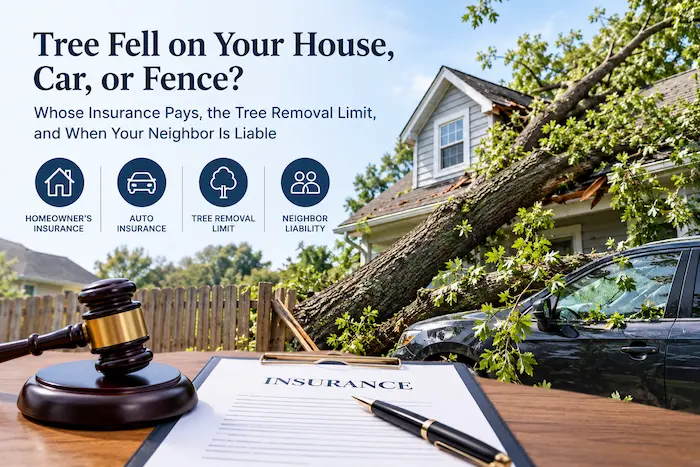
Safety first: Tree touching a power line? Stay away and call the utility or 911 first.
- On your houseYour homeowners policy usually pays, whoever owned the tree.
- On your carYour comprehensive auto coverage, minus your deductible.
- On your fence or garageYour homeowners policy, under other structures coverage.
- In your yard onlyUsually your cost. Removal coverage normally needs a hit.
- Neighbor’s dead treeYour policy first. The neighbor pays only if negligent.
This guide includes a Fallen Tree Claim Estimator. See what insurance may pay and what you’ll owe. And the one invoice change that can move thousands from “your cost” to “covered” is explained below.
Fallen Tree Claim Estimator
Enter what you know and get an estimate of what insurance may pay and what you may owe, with and without the lift-off argument.
Close to your deductible? See Insurance Claim or Pay Out of Pocket? for the break-even math.
Who Pays When a Tree Falls?
Usually your own insurance pays first, because a tree that a storm knocks down is nobody's fault.
Insurers treat wind, lightning, and hail as accidents of nature, sometimes called an "act of God." When a healthy tree goes over, no one is at fault, so no one else owes you money.
Your own policy is the thing you bought for exactly that situation.
The exceptions are a tree someone should have dealt with earlier, and a tree on a car, which goes to a different policy altogether.
| Scenario | Policy that usually responds | Key question |
|---|---|---|
| Healthy tree (any owner) on your house | Your homeowners policy | Is wind, lightning, or hail the cause? What is your deductible? |
| Neighbor's known-dead tree on your house | Your homeowners first, then possible subrogation | Can negligence be shown? |
| Your tree on your neighbor's house | Their homeowners; yours if you were negligent | Was the tree's condition known? |
| Tree on detached garage or fence | Your homeowners, other structures coverage | What is the other structures limit? |
| Tree in your yard only | Usually you | Does your policy cover any removal without damage? |
| Tree blocking driveway or ramp | Possibly your homeowners | Does your policy say so? Check it. |
| Tree on your car | Your comprehensive auto coverage | Do you carry comprehensive? What is the deductible? |
| Tree on a rented home | Landlord (building) plus your renters policy (belongings, extra living costs) | What does your renters policy include? |
Three tiers to keep in mind
USUALLY COVERED
- Damage to your house, other insured structures, and contents when a tree hits them
- Damage to your car, if you carry comprehensive coverage
LIMITED
- Cutting up and hauling the tree (removal caps)
- Stump grinding
- The tree itself, for listed perils only, with a cap
- Everything above your deductible, including percentage wind or hurricane deductibles
USUALLY NOT COVERED
- Yard-only cleanup where the tree hit nothing
- Replacing a tree that wind knocked down
- Removing a tree before it falls
- Damage tied to poor tree maintenance
Your Tree, Their Tree: Why It's Usually Your Claim
When a tree hits your home or another insured structure, a standard homeowners policy covers the damage to the structure and your contents, no matter who owned the tree.
The Insurance Information Institute (III) notes that this includes trees brought down by wind, lightning, or hail. Insurers generally don't investigate where the tree came from, so you don't have to prove it was the neighbor's.
Subrogation: how you might get your deductible back
If the tree came from a neighbor's property, your insurer may try to collect from the neighbor's insurer. This is called subrogation.
If your insurer succeeds, you may get your deductible back. That is not guaranteed, and it can take a while, so don't count on it when you decide how to cover repairs.
When Your Neighbor Is Liable
A neighbor is generally liable only when they were negligent, which in plain terms means they knew, or should have known, the tree was dangerous and did nothing.
A healthy tree that a storm knocks over doesn't meet that bar. A dead or rotting tree that the neighbor had been told about often does.
What "knew or should have known" looks like
- A dead tree, or one with bare limbs, fungus, or a hollow trunk that anyone could see
- A tree that was leaning or split after an earlier storm
- A request from you, in writing, to remove or inspect it
- An arborist recommendation to remove it
- A city notice about a dead, diseased, or dangerous tree
Evidence that proves it
- Dated photos of the tree before the fall
- Texts, emails, or letters warning the neighbor
- An arborist report or a city notice
- Names and numbers of witnesses
A certified letter is good evidence, but it isn't a legal requirement. Any dated, written warning helps. Give everything to your adjuster and ask about subrogation.
| Question | Healthy tree, storm | Dead or diseased tree, owner knew |
|---|---|---|
| Whose insurance pays first? | Yours | Yours, then possible subrogation |
| Is the neighbor liable? | Generally no | Possibly, if negligence is shown |
| Can you get your deductible back? | Generally no | Possibly, through subrogation or a claim against the neighbor |
| What evidence helps? | Photos of the damage | Dated photos of the tree, warnings, arborist or city notice, witnesses |
Can you sue your neighbor? If they won't pay your deductible
If the neighbor was negligent and your insurer isn't pursuing it, small claims court may be an option for a deductible-sized amount. Whether it is worth the effort depends on your state's rules and the evidence you have. See How to Sue in Small Claims Court, and How to Collect a Small Claims Judgment if you win and they still don't pay.
When Your Tree Hits Their House
Your neighbor's homeowners policy usually pays for their house first, and your policy comes in only if you were negligent.
The same test applies in reverse. If your tree was healthy and a storm took it down, you're generally not liable. If it was dead or leaning and you knew it, your liability coverage may be asked to respond.
If a neighbor or their insurer contacts you about a fallen tree, tell your own insurer promptly.
For a bigger exposure, such as someone being injured, an umbrella policy is the extra layer: see Umbrella Insurance.
Another neighbor dispute that follows the same "who pays" logic: Bitten by a Neighbor's Dog?
Does Insurance Cover Tree Removal?
Yes, when the tree hits an insured structure, but the payment is usually capped at a small amount, generally about $500 to $1,000 depending on the insurer and policy.
The III gives that range. A commonly cited form of this coverage is $500 per tree and $1,000 per loss, but your own policy decides, so check the declarations and endorsements.
Per tree vs per loss
A per-tree limit caps what you collect for each tree. A per-loss limit caps the total for the whole storm. You get whichever is lower.
With a $500 per tree and $1,000 per loss limit, three downed trees that cost more than that to remove pay $1,000, not $1,500.
If the tree hit nothing
If the tree didn't hit an insured structure, there is generally no debris-removal coverage. A tree that falls in your yard and hits nothing is usually your cost.
Some insurers pay when the tree blocks a driveway or a ramp for people with disabilities, and some forms cover removal even when nothing is hit, with higher limits on premium tiers. Limits vary, so read your policy.
A fence or a shed usually counts as an insured structure, but confirm that in your policy.
For a short overview of debris removal and reasonable repairs among other easy-to-miss coverages, see Homeowners Insurance: Hidden Coverages.
Lift-Off vs Haul-Away: The Invoice That Changes Your Payout
Lifting a tree off your roof can be argued to be part of the repair, while cutting it up and hauling it away falls under the removal limit, and one split invoice can show the difference.
Repair cost
Lifting and dropping the tree off the structure. This is part of fixing the damage and may fall under the "reasonable repairs" additional coverage.
Removal limit
Cutting up, hauling away, and stump grinding. This is the part the removal sublimit is aimed at.
A real-world example
IA Magazine (Big "I" Virtual University, Jan. 10, 2020) described a tree-on-roof removal that cost $4,500, which the carrier limited to $1,000.
The faculty responses made this distinction. Removing the tree from the roof is part of the covered repair, or the "reasonable repairs" additional coverage. Cutting up, hauling, and stump grinding fall under the removal sublimit.
Their practical advice: ask the contractor to split the bill into "lift and drop" and "cut up and haul away."
How to raise it
- Ask your tree service for an invoice that separates lift and drop, cut up and haul away, stump grinding, and any emergency or after-hours charges.
- Ask your adjuster, in writing, for the exact policy language on debris removal and on reasonable repairs.
- Ask which of those two provisions the roof lift-off falls under, and why.
Treat this as an argument to make, not a guaranteed result. Your insurer may read it differently, and your policy wording and state law control.
One faculty member said the question has been litigated, but no case was named, so don't count on a particular ruling.
Another noted that one tree may carry a $500 limit rather than $1,000 under the wording of some forms.
| Task | Usually treated as | Why |
|---|---|---|
| Lift and drop the tree off the structure | Part of the repair, though an insurer may dispute it | IA Magazine faculty: part of the covered repair, or "reasonable repairs" additional coverage |
| Cut up and haul away | Removal limit | This is debris removal |
| Stump grinding | Part of the removal limit, or not covered | IA Magazine faculty grouped it with cut-and-haul under the removal sublimit |
| Replacing the tree | Listed perils only; not wind | Tree and plant coverage excludes wind |
Will Insurance Replace the Tree Itself?
Usually not after a windstorm, because coverage for trees and plants applies only to a short list of perils, and wind isn't on it.
According to the III, the covered perils are fire, lightning, explosion, theft, aircraft, vehicles not owned by the resident, and vandalism and malicious mischief. A tree struck by lightning may therefore qualify.
Coverage is generally limited to about 5% of the dwelling amount, with a per-tree cap. Poor maintenance isn't covered.
| Coverage | What it pays | Typical limit (verify) | Wind? |
|---|---|---|---|
| House damage (dwelling) | Repair of the structure, minus the deductible | Your dwelling coverage amount | Yes, a wind-felled tree that hits the house is a covered cause |
| Other structures (garage, shed, fence) | Repair of detached structures | Commonly cited as about 10% of dwelling coverage | Yes |
| Contents | Belongings damaged when the tree hits | Your personal property limit | Yes |
| Tree removal | Cutting up and hauling when an insured structure is hit | About $500 to $1,000; commonly $500 per tree, $1,000 per loss | Applies when the tree hits a structure |
| Trees and plants themselves | Replacement, for listed perils only | Generally about 5% of dwelling coverage, with a per-tree cap | No |
Fences, Garages, and Sheds
A tree on a detached garage, shed, or fence is usually a claim on your own homeowners policy under the other structures coverage.
That coverage has its own limit, which is commonly a percentage of your dwelling coverage (about 10% on many forms). A long fence run or a big garage can use it up fast, so check the number.
A shared fence on the property line is trickier, because it may belong to you, to your neighbor, or to both of you. Start by working out whose fence it is. The negligence rules in this guide apply the same way: a healthy tree in a storm is your claim, a known-dead tree may shift responsibility.
If the tree also needs to be cut and hauled, the removal limits above apply when it hit an insured structure.
Tree on Your Car
A tree, branch, or limb falling on your car is usually a comprehensive auto claim, paid minus your deductible; if you carry liability only, there is no coverage for your own car.
A parked car is treated the same way: comprehensive coverage and your auto deductible decide what you collect.
Progressive (updated Aug. 15, 2023) lays out the details that matter:
- Your tree on your car is your responsibility.
- A neighbor's tree is generally your claim too, unless you can prove negligence: a dead or rotting tree, a prior request to remove it, or an arborist recommendation.
- If a third party caused the fall, such as a tree service, that party should pay.
- A tree that falls on you while you are driving is a comprehensive claim. Hitting a tree that is already in the road is usually a collision claim.
- A tree that lands on both your house and your car is two claims. Some bundled insurers may waive one deductible.
Not sure what comprehensive covers? See Full Coverage vs Liability. If the car is crushed, Totaled Car explains how the payout works, and Diminished Value Claim covers the loss in value after a repair.
Renters: Who Covers What
If a tree hits the house you rent, the landlord's insurance generally covers the building, while your renters policy covers your belongings and, if your policy includes it, extra living costs.
Take photos of the damage and of your belongings, tell your landlord right away, and call your renters insurer. Your car is separate: a tree on it is a comprehensive auto claim.
For how the two policies divide up a similar problem, see Ceiling Leaking? Who Pays and What Does Renters Insurance Cover?
Deductibles and Whether to File
Each policy applies its own deductible once per claim, and if the covered amount is close to it, filing may not be worth it.
A tree that hits both your house and your car involves two policies, so two deductibles.
Most homeowners deductibles are a flat dollar amount. Many coastal states use a percentage of dwelling coverage for hurricane, named-storm, or wind damage instead. Check the wording of your policy. See Hurricane Insurance: Florida and Coastal Guide for more.
Hypothetical arithmetic: a 2% wind deductible on $300,000 of dwelling coverage is $6,000. A $5,000 roof repair would pay nothing.
A claim above the deductible isn't automatically worth filing either. Claims can affect your premium and renewal; read Home Insurance Non-Renewal and run the break-even math in Insurance Claim or Pay Out of Pocket?
City or Utility Trees
If a city or utility tree fell on your property, your own policy usually still responds first, and you should report the tree to the owner right away.
A claim against a city may have a short notice deadline, and it varies by place, so check local deadlines now rather than later. Keep the same evidence you would for a neighbor: photos, dates, and any earlier complaints about the tree.
If the tree is on or near a power line, stay clear and call the utility or 911. Who pays to clear it depends on where it fell, who owned it, and the utility's rules, so ask when you call.
Can You Cut Your Neighbor's Branches?
Generally yes, every state recognizes a common-law right to cut branches and roots that cross onto your property, but with limits.
That summary comes from the Texas State Law Library (updated Mar. 8, 2024), quoting Nolo's Neighbor Law. You can't:
- Trim past the boundary line
- Injure or kill the tree
- Enter the neighbor's land without permission, unless there is an imminent threat
You can be liable for poor trimming. Local ordinances and HOA rules may also require a permit, and a city may order the removal of dead, diseased, or dangerous trees.
Talking to your neighbor first is the easiest route, and a written note creates a dated record if the tree later falls.
What to Do in the First 24 Hours
Stay safe, photograph everything before anything moves, stop further damage, and call your insurer.
The Texas Department of Insurance (Jan. 24, 2026) gives the same core advice: photograph before moving the tree, make temporary repairs, and save receipts.
First hour
- [ ] Stay clear of power lines.
- [ ] Keep people and pets away from the damaged area, and don't climb onto the roof or cut a tree that is resting on the structure. A shifting trunk can be dangerous.
- [ ] Take photos and video from every angle before moving anything.
- [ ] Tarp or board up openings to prevent more damage.
- [ ] Keep every receipt.
- [ ] Call your insurer or agent promptly. Policies set their own reporting deadlines.
- [ ] Read any tree-service contract before signing, especially one that asks you to assign your claim to the company. Rules on assignment vary by state.
Ask your tree service for a split invoice
- [ ] Lift and drop off the structure
- [ ] Cut up and haul away
- [ ] Stump grinding
- [ ] Emergency or after-hours charges
If you think the neighbor is liable
- [ ] Dated photos of the tree before the fall
- [ ] Texts, emails, or letters warning them
- [ ] Arborist report or city notice
- [ ] Witness names
- [ ] Give all of it to your adjuster and ask about subrogation and your deductible
If your own tree looks risky
- [ ] Arborist inspection
- [ ] Written quote
- [ ] Remove or trim before storm season. Preventive removal is on you.
Worked Examples
These hypothetical examples show how the numbers play out; your costs, limits, and deductible will differ.
| Case | Costs | Estimated payment | You pay |
|---|---|---|---|
| One oak on the roof | Repair $12,000; lift-off $2,500; cut-and-haul $1,500; limits $500 per tree and $1,000 per loss; deductible $1,000 | Scenario A: 12,000 + 2,500 + 500 - 1,000 = $14,000. Scenario B: 12,000 + 500 - 1,000 = $11,500. Gap: $2,500. | Scenario A: $2,000. Scenario B: $4,500. |
| Three trees in a storm, on a garage and fence | Repair $6,000; removal $900 each ($2,700); limits $500 per tree and $1,000 per loss; deductible $2,000 | 6,000 + 1,000 - 2,000 = $5,000 | $3,700: $1,700 of removal plus the $2,000 deductible |
| Tree on a car | Damage $3,000; comprehensive with a $500 deductible | $2,500 (liability only: $0) | $500 (liability only: $3,000) |
| Yard only, hits nothing | Removal $1,200 | Usually $0 unless your policy says otherwise | $1,200 |
FAQ
Who pays if a tree falls on my house?
Usually your own homeowners insurance, minus your deductible, whoever owned the tree.
If my neighbor's tree falls on my house, who pays?
Start with your own policy. It covers the damage to your home even though the tree was your neighbor's. Your insurer may later try to recover from the neighbor's insurer.
Is my neighbor responsible for a fallen tree?
Generally only if they were negligent. A healthy tree that a storm knocked over is usually no one's fault.
What if my neighbor's dead tree fell on my house?
Your policy still pays first. If your neighbor knew or should have known the tree was dangerous, they may be liable, and your insurer may pursue subrogation.
How do I prove my neighbor knew the tree was dangerous?
Dated photos of the tree before the fall, written warnings you sent, an arborist report or city notice, and witness names. Give them to your adjuster.
Will I get my deductible back?
Possibly. If your insurer recovers money from the neighbor's insurer, you may get your deductible back. It isn't guaranteed.
If my tree falls on my neighbor's house, who pays?
Their homeowners insurance usually pays first. Your liability coverage may come in if you were negligent, for example if you knew the tree was dead.
Does homeowners insurance cover tree removal?
Generally yes when the tree hits an insured structure, subject to a limit. If it hit nothing, there is generally no removal coverage.
How much will insurance pay to remove a tree?
Generally about $500 to $1,000, depending on the insurer and policy. A commonly cited form is $500 per tree and $1,000 per loss.
Does insurance pay to lift a tree off my roof?
It can be argued that lifting the tree off the roof is part of the covered repair, not the removal limit. Ask for a split invoice and the exact policy language. Your insurer may disagree.
Is stump grinding covered?
Often treated as part of the removal limit, or not covered. Check your policy.
Will insurance pay if a tree falls in my yard and hits nothing?
Usually not, unless your policy specifically covers removal with no damage.
What if a fallen tree blocks my driveway?
Some insurers pay when a tree blocks a driveway or a ramp for people with disabilities. Many don't. Read your policy and ask.
Will insurance replace a tree that blew down?
Usually not. Tree and plant coverage applies only to listed perils such as fire, lightning, and vandalism, and wind isn't one of them.
Does homeowners insurance cover a fence damaged by a tree?
Usually, under other structures coverage, up to that coverage's limit.
Who pays if a tree falls on my car?
Your comprehensive auto coverage, minus the deductible. A neighbor's tree is generally still your claim unless you can prove negligence.
Does homeowners insurance cover a tree on my car?
Generally not. A tree on a car is typically a comprehensive auto claim rather than a homeowners claim. Check both policies, and file the house damage and the car damage separately.
What if a tree hits my car while I'm driving?
A tree that falls on you while you drive is generally a comprehensive claim. Driving into a tree already in the road is usually a collision claim.
I rent. Who pays when a tree hits the house?
Your landlord's insurance generally covers the building. Your renters policy covers your belongings and, if included, extra living costs.
Should I file a claim if the damage is close to my deductible?
Maybe not. Compare the payment to your deductible and weigh your claim history and renewal. See Insurance Claim or Pay Out of Pocket?
What if a city tree falls on my property?
Report it right away. Your own policy usually responds first, and a claim against the city may have a short notice deadline, so check local deadlines.
Can I cut my neighbor's overhanging branches?
Generally yes, up to the property line, without harming the tree. Local ordinances and HOA rules may require a permit, and you can be liable for poor trimming.
Sources
- Insurance Information Institute: "If a tree falls on your house, are you covered?"
- IA Magazine / Big "I" Virtual University: "How Much Should the Carrier Pay for Removing a Fallen Tree?" (Jan. 10, 2020)
- Progressive: "Am I covered if a tree falls on my car?" (updated Aug. 15, 2023)
- Texas Department of Insurance: "Does insurance cover fallen tree branches?" (Jan. 24, 2026)
- Texas State Law Library: neighbor tree branches and roots FAQ (updated Mar. 8, 2024)
- ISO HO 00 03 homeowners form, as referenced in state insurance department filings (for commonly cited tree-removal and other-structures limits)
Last updated:
This article is general information, not insurance or legal advice. Coverage depends on your policy, your insurer, and your state, and a neighbor's liability depends on the facts and local law. Examples are hypothetical. Sources checked on October 9, 2026.

Daniel Hayes is the founder and sole researcher at AdvoraHQ. He covers U.S. personal finance, insurance, and consumer law — working directly from IRS publications, federal and state statutes, court opinions, and SEC filings rather than secondary summaries. His focus is the gap between what readers think they know and what the source documents actually say. Daniel is not a licensed attorney, CPA, or financial advisor; his articles are educational and not personalized advice. Reach him at Daniel.Hayes@advorahq.com.
