
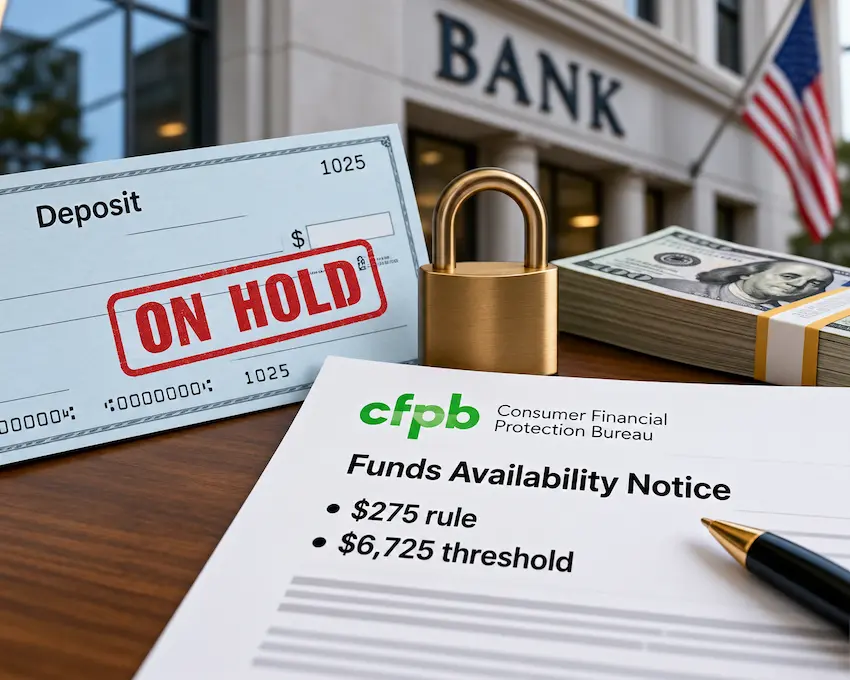
Federal rules cap how long a bank can hold most check deposits. At least $275 of a qualifying check deposit must be available the next business day, and most of the rest within a day or two after that. A bank can hold longer only under six specific exceptions — and for four of them it owes you a written notice saying why and exactly when your money arrives.
Both figures have been current since July 1, 2025, under the Federal Reserve and CFPB’s inflation adjustment to Regulation CC — they are not a 2026 change. Jump to the availability date estimator →
And yes — there’s a rule that can get you a refunded overdraft fee when the bank held your check and never told you at the counter. It’s in the section on overdraft fee refunds below.
Funds Availability Date Estimator
Answer what you know about your deposit. This estimates the dates federal rules require, based on 12 CFR Part 229 (Regulation CC) — your bank may release funds sooner.
The Ordinary Availability Schedule
Most deposits follow a simple pattern: some money is available the next business day, and the rest is available a day or two after that.
Tap a row below for the short version of each deposit type.
| Deposit type | In person, before cut-off | ATM or mobile | Earliest required availability |
|---|---|---|---|
| Cash | Next business day | Bank’s own ATM/night drop: 2nd business day. Another bank’s ATM: up to 5th business day. | §229.10(a); §229.12(f) |
| Direct deposit / electronic payment | Next business day after the bank receives it — method doesn’t apply | §229.10(b) | |
| U.S. Treasury check | Next business day | Not deposited in person: 2nd business day | §229.10(c)(1)(i), (c)(2) |
| Cashier’s, certified, or teller’s check | Next business day (may require a special deposit slip) | Not deposited in person: 2nd business day | §229.10(c)(1)(v), (c)(2) |
| State or local government check | Next business day, if deposited in a bank in the issuing state (may require a special deposit slip) | Not deposited in person, or different state: 2nd business day | §229.10(c)(1)(iv), (c)(2) |
| Check drawn on the same bank | Next business day (both branches in the same state or check-processing region) | Same rule applies regardless of method | §229.10(c)(1)(vi) |
| Ordinary personal or business check | First $275 next business day; the rest by the 2nd business day (rarely, up to the 5th) | Same tiers; the ATM or cut-off rule can push the start date later | §229.10(c)(1)(vii); §229.12(b)-(c) |
Cash
In person: next business day. Your bank’s own ATM or a night drop: 2nd business day. Another bank’s ATM: up to the 5th business day.
Direct deposit / electronic payment
Next business day after your bank actually receives the payment.
U.S. Treasury check
In person: next business day. Not in person: 2nd business day.
Cashier’s, certified, or teller’s check
In person (sometimes with a special deposit slip): next business day. Not in person: 2nd business day.
State or local government check
In person, deposited in the issuing state: next business day. Otherwise: 2nd business day.
Check drawn on the same bank
Next business day, in person or not, as long as both branches share a state or check-processing region.
Ordinary personal or business check
First $275: next business day. The rest: 2nd business day in almost all cases; a small number of “nonlocal” checks can take up to the 5th.
“Business day” excludes Saturdays, Sundays, and the ten federal holidays fixed in the regulation itself. “Banking day” is the part of a business day your specific bank is open for its usual banking business — see timing and cut-offs below.
The Six Exceptions
A bank can hold money longer than the ordinary schedule only if one of six exceptions applies. Four of the six come with a hard requirement: a written notice telling you why and when.
| Exception | What triggers it | What can be delayed | Extra time allowed | Written notice required? |
|---|---|---|---|---|
| New accounts | Account open fewer than 30 calendar days (unless every holder already had another account at the bank for 30+ days) | Next-day treatment applies only to the first $6,725 of certain official checks; ordinary and same-bank checks aren’t covered by the federal next-day or 2nd/5th-day timelines at all | Amount over $6,725: by the 9th business day | No — covered by the account’s funds-availability disclosure instead |
| Large deposits | Check deposits totaling more than $6,725 to one or more accounts on one banking day | Only the amount above $6,725 | A “reasonable period” (see below) | Yes |
| Redeposited checks | A check bounced and was redeposited | That check | A “reasonable period” | Yes — unless returned only for a missing endorsement (now obtained) or for being postdated (and no longer is) |
| Repeated overdrafts | Negative balance 6+ banking days, or 2+ days by $6,725 or more, in the preceding 6 months | All check deposits into any of that customer’s accounts at the bank | A “reasonable period,” for 6 months after the last qualifying overdraft | Yes — a single “period” notice can cover it |
| Reasonable cause | Specific facts giving a well-grounded belief the check won’t be paid — never the type of check or who deposited it | That check | A “reasonable period” | Yes — and the fee-refund rule applies if it isn’t given at deposit |
| Emergency conditions | Equipment or communications failure, another bank suspending payments, war, or a similar emergency, with due diligence | Checks deposited during the emergency | A “reasonable period” after the emergency ends | In a reasonable form and time — skipped if funds become available first |
New accounts
Large deposits
Redeposited checks
Repeated overdrafts
Reasonable cause
Emergency conditions
How Much Longer Can They Hold It?
Regulation CC defines “reasonable period” by the type of check being delayed, not by which of the four noticed exceptions is invoked:
- Checks drawn on the same bank: up to 1 extra business day.
- Most other checks — local checks, government checks, cashier’s/certified/teller’s checks, and ordinary checks that qualify as “local”: up to 5 extra business days.
- Nonlocal checks and deposits made at another bank’s ATM: up to 6 extra business days.
A bank can hold longer than these windows, but only if it can show the longer period is genuinely reasonable under the circumstances — the burden of proving that falls on the bank, not on you.
The Notice Your Bank May Owe You
When a bank invokes the large-deposit, redeposited-check, repeated-overdraft, or reasonable-cause exception, it must give you a written notice.
| Required item | Why it matters |
|---|---|
| An account number or code (4 digits is enough) | Ties the notice to your specific account without requiring your full number on the slip. |
| The date of the deposit | Pins down which deposit the hold applies to. |
| The amount being delayed | Confirms whether the whole deposit is held, or just part of it. |
| The reason for the exception | Tells you which of the four exceptions the bank is using — the first thing to check against Table 2. |
| When the funds will be available | Gives you a specific date to hold the bank to. |
| Timing | At deposit, unless it wasn’t made in person or the facts emerged later — then as soon as practical, no later than the first business day after the facts are known or the deposit is made, whichever is later. |
What the notice must say
- An account number or code (no more than 4 digits needed)
- The date of the deposit
- The amount being delayed
- The reason the exception was used
- The exact date the funds will be available
When you should get it
At the time of deposit — unless you didn’t deposit it in person, or the bank didn’t learn the relevant facts until later. In that case: as soon as practical, and no later than the first business day after the deposit or after the facts become known, whichever is later.
Two shortcuts exist for banks, and they matter if your notice looks generic: a one-time notice can cover large-deposit and redeposited-check exceptions for business accounts, and a period notice can cover repeated overdrafts for a whole six-month stretch. New accounts and emergencies are handled outside this notice paragraph entirely — new accounts fall under your account’s standard funds-availability disclosure, and emergencies get a separate “reasonable form and time” standard. Banks are also required to keep a record of each reasonable-cause notice, along with the facts behind it.
When a Hold Can Get Your Overdraft Fee Refunded
This is the rule most consumer guides miss entirely. It applies specifically to the reasonable cause exception.
If your bank delays a deposit for reasonable cause and does not give you written notice at the time of deposit, it generally can’t charge you overdraft or returned-item fees that happened only because of that delay — as long as the check was eventually paid by the bank it was drawn on.
There’s one way around that for the bank: if it includes a separate notice about overdraft and returned-check fees along with the exception notice — stating that you may be entitled to a refund if the check is paid, and how to ask for one — it can charge the fee, but then has to refund it on request.
Friday, Weekends, Holidays, and Cut-Off Times
Your bank can set a cut-off hour for deposits — but not earlier than 2:00 p.m. for check deposits, or noon for deposits at an ATM or other off-premise location. A deposit made on a non-business day, or after that cut-off, counts as made on the next banking day.
Worked example. You deposit a $900 ordinary check in person on Friday, October 9, 2026, before cut-off. The weekend (Oct. 10–11) doesn’t count, and neither does Columbus Day on Monday, October 12 — it’s one of the ten fixed federal holidays. The clock effectively starts Tuesday, October 13: $275 is available that day, and the rest is available Wednesday, October 14.
Worked example — after cut-off. You deposit the same check on Tuesday, October 13, 2026, but after your bank’s 2 p.m. cut-off. It’s treated as deposited Wednesday, October 14: $275 is available Thursday, October 15, and the rest Friday, October 16.
Mobile and ATM Deposits
Regulation CC sets floors, not a single nationwide mobile-deposit rule. A deposit at another bank’s (“nonproprietary”) ATM gets a floor of the 5th business day. Checks and other items not deposited in person to a bank employee generally shift from next-day to 2nd-business-day treatment. Mobile remote deposit isn’t named separately in the rule — banks commonly treat it as “not in person,” so the same-day, in-branch perks (next-day cashier’s-check treatment, for instance) may not apply the way they would at the counter.
Your bank’s app may show a faster “provisional” date than the federal floor — that’s the bank being more generous, not the law requiring it. The estimator above shows the statutory floor for mobile deposits and deliberately won’t promise you an exact date, since bank policy varies here more than almost anywhere else in this topic.
“Cleared” vs. “Available”
A check “clearing” means the paying bank has processed and paid it. “Available” means your bank has decided you can use the money. These aren’t the same event, and they don’t have to happen on the same day.
Your app can show a check as “cleared” days before the funds are actually available for withdrawal — your bank already knows the check is good but is still running out whatever hold period applies. The reverse is also possible and more painful: a bank can release held funds for your use under Regulation CC’s deadlines, and the check can still come back unpaid later, at which point the bank is allowed to reverse the credit and charge your account back.
New Accounts
An account counts as “new” for its first 30 calendar days — unless every person on it already held another account at the same bank for at least 30 days before this one was opened.
For a new account, next-day treatment on certain official check types (Treasury checks, USPS money orders, Federal Reserve/Home Loan Bank checks, state or local government checks, and cashier’s/certified/teller’s checks) applies only to the first $6,725 deposited in one banking day; anything over that must be available by the ninth business day. Ordinary personal checks and checks drawn on the same bank aren’t covered by the federal next-day or 2nd/5th-day schedule at all for a new account — your bank’s own funds-availability policy sets the timeline for those, and it’s worth reading before you open an account you’ll need to use quickly. Cash and electronic payments still follow the ordinary next-day rules regardless of how new the account is.
Cash and Electronic Payments
None of the six check-hold exceptions apply to cash deposited in person or to electronic payments like direct deposit and wire transfers — those follow the straightforward next-day rule on their own. That doesn’t mean money in your account can never be unavailable for other reasons: a fraud review, a legal order, or a scam-related reversal can all affect funds outside of Regulation CC entirely. If a transfer went to the wrong person or you’re disputing a Zelle payment, that’s a different set of rules — see our guide to Zelle scams and bank rules.
Hold vs. Freeze vs. Closure
These get confused constantly, and they call for different responses.
| What it is | What’s affected | Typical cause | Your first move |
|---|---|---|---|
| Check hold | Only the amount of that one check — a bank legally cannot hold more than the check’s own amount, or hold it longer than Regulation CC allows | One of the six exceptions above | Ask which exception and read the notice |
| Account freeze | The whole account, or a large portion of it, unrelated to any single check’s amount | Fraud investigation, legal order, suspected identity issue | Call the bank directly; this isn’t governed by the check-hold rules |
| Account closure | Access to the account going forward | Bank discretion, repeated overdrafts, compliance decision | Ask for the closure letter and where the remaining balance is being sent |
Check hold
Affects only that check’s amount. A bank can’t hold more than the check is worth, or longer than federal rules allow, without one of the six named exceptions. First move: ask which exception applies.
Account freeze
Affects the whole account, for reasons unrelated to a single check’s dollar amount — usually fraud review or a legal order. This sits outside the check-hold rules; call your bank.
Account closure
Ends your access going forward. Ask for the closure letter and how your remaining balance will be returned to you.
One more federal protection worth knowing: a bank that takes a check for deposit cannot hold more of your account than the check’s own amount, and cannot hold it longer than Regulation CC’s deadlines allow — on that deposit or on your other funds. If more than the check amount is frozen, or the whole account is locked because of one deposit, you’re looking at something past a plain check hold. See our separate guide on what to do when a bank freezes your account.
What to Do Today
Four scripts and a short checklist — copy whatever you need.
Ask at the branch or on the phone:
- “Is this an exception hold, and which exception?”
- “What exact business day will the full amount be available?”
- “Will you send me the written notice required for that exception?”
- “Can you release part of the deposit today?”
If you got no notice and the hold is about doubt over the check:
- Ask for the notice in writing.
- Ask whether any overdraft or returned-item fees were caused by the hold.
- If the check was ultimately paid, ask for a refund of those fees.
Document everything:
- Your deposit receipt
- A screenshot of the posted hold and the dates shown
- The notice itself, with the envelope if mailed
- Names, dates, and times of any calls
Where to Complain
Escalate in order: the branch manager, then the bank’s complaint line, then the bank’s federal regulator — national banks, federal savings associations, federal credit unions, and state-chartered banks each answer to a different one, so confirm which applies to your institution — and finally the CFPB’s complaint portal, which accepts complaints about any bank regardless of its specific regulator.
A few habits prevent the next hold: ask the teller about a large or unusual deposit before you hand it over, split very large legitimate deposits across separate banking days where that makes sense for you, lean on electronic payments when money is time-critical, and keep the account out of repeated-overdraft territory in the first place.
Frequently Asked Questions
How long can a bank legally hold a check?
Under ordinary rules, the first $275 by the next business day and the rest within a day or two more. With one of six exceptions and proper notice, a bank can add a defined “reasonable period” on top — generally 1, 5, or 6 extra business days depending on the check type.
Does the $275 rule apply to every deposit?
No — it applies to the portion of a qualifying check deposit not already covered by a faster next-day category like cash or certain government and official checks.
Can a bank hold the whole amount of a big check?
Only up to $6,725 of it follows the ordinary schedule unconditionally; anything above that can be delayed under the large-deposit exception, with notice.
How long can a hold last on a new account?
The account is “new” for 30 calendar days. Certain official checks get next-day treatment only on the first $6,725, with the excess available by the ninth business day; ordinary checks aren’t covered by a federal floor at all during that window.
Is a hold on a cashier’s check allowed?
Yes, but a cashier’s, certified, or teller’s check deposited in person usually qualifies for next-business-day availability — a longer hold on one needs an exception, like reasonable cause, with notice.
Can a bank hold cash or a direct deposit?
Not under these exceptions — cash deposited in person and electronic payments follow the straightforward next-day rule and aren’t subject to the six check-hold exceptions.
Does the bank have to tell me why?
For four of the six exceptions — large deposits, redeposited checks, repeated overdrafts, and reasonable cause — yes, in writing. New accounts and emergencies are handled differently.
What must the hold notice say?
An account number or code, the deposit date, the amount delayed, the reason, and the date funds will be available. See Table 3 above.
When must I get the notice?
At the time of deposit if it’s made in person and the facts are already known; otherwise as soon as practical, no later than the first business day after the deposit or after the facts become known, whichever is later.
My bank gave no notice — what now?
Ask for it in writing, and if the hold was for reasonable cause, ask whether you’re owed a refund of any overdraft or returned-item fees the delay caused.
Can I get an overdraft fee refunded because of a hold?
Possibly — if the hold was for reasonable cause, you weren’t notified at deposit, the overdraft wouldn’t have happened without the delay, and the check was ultimately paid. See the fee-refund section above.
Is Saturday a business day?
No. Regulation CC’s “business day” excludes Saturdays, Sundays, and ten fixed federal holidays.
I deposited Friday evening — when is it available?
It typically counts as deposited that Friday if before cut-off, and the countdown skips the weekend and any federal holiday that falls in between. See the worked example above.
Why does my app say the check cleared but the money isn’t available?
“Cleared” and “available” are different events — the check being paid by the other bank doesn’t automatically end your bank’s hold period.
Do mobile deposits take longer?
Often, yes, relative to an in-person deposit of the same check — many banks treat a mobile deposit as “not in person,” which can shift some categories from next-day to 2nd-business-day treatment. Your bank’s app may still show a faster date as a courtesy.
Why is my account flagged for repeated overdrafts?
A bank can apply this exception if your balance went negative on 6 or more banking days, or on 2 or more days by $6,725 or more, in the preceding six months — and it can keep applying for six months after the most recent qualifying overdraft.
Can the bank release the hold early?
Yes — nothing stops a bank from making funds available sooner than the federal deadline; the rules set a ceiling on the hold, not a floor.
Is a hold the same as a frozen account?
No. A check hold is capped at that check’s amount and at Regulation CC’s deadlines. A frozen account affects more than one check and usually involves fraud review or a legal order — a different situation entirely.
Can a released check still bounce later?
Yes. Funds being made available under these deadlines doesn’t guarantee the check is good — if it’s later returned unpaid, the bank can reverse the credit and charge your account.
Who regulates my bank?
It depends on the charter — national banks, federal savings associations, federal credit unions, and state-chartered banks each have a different primary regulator. The CFPB’s complaint portal is a reliable starting point regardless of which one applies to you.
This article is general information, not legal or financial advice. It’s based on 12 CFR Part 229 (Regulation CC) and the dollar-threshold adjustment effective July 1, 2025, verified against the current eCFR text as of the date below. Your bank’s own policy may make funds available sooner than the law requires, but never later. — thresholds and the federal holiday list should be re-verified yearly.

Daniel Hayes is the founder and sole researcher at AdvoraHQ. He covers U.S. personal finance, insurance, and consumer law — working directly from IRS publications, federal and state statutes, court opinions, and SEC filings rather than secondary summaries. His focus is the gap between what readers think they know and what the source documents actually say. Daniel is not a licensed attorney, CPA, or financial advisor; his articles are educational and not personalized advice. Reach him at Daniel.Hayes@advorahq.com.
