
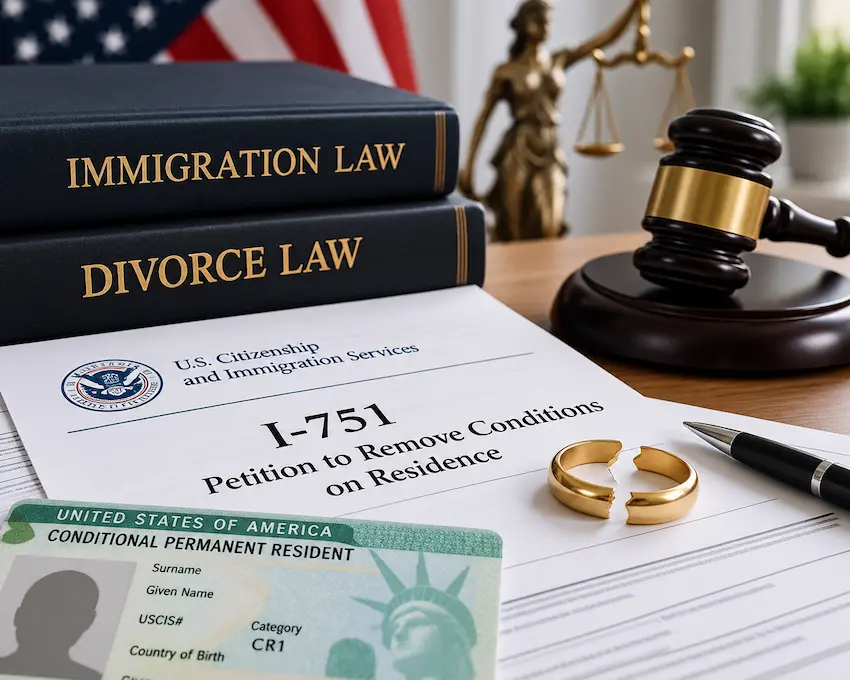
Divorce does not cancel your conditional green card, and it does not mean you must leave. You can file Form I-751 on your own, without your spouse’s signature, by requesting a waiver of the joint filing requirement — if your marriage was entered in good faith. What changes is which path you file under and when, and that depends on whether your divorce is final.
- My divorce is final
See the clear path and what to send. - My divorce is pending
See the riskier path and what USCIS may ask for. - We’re separated, not divorced
See why separation alone isn’t enough.
A properly filed I-751 gets you a receipt notice that extends your green card validity 48 months past the expiration date, so you can keep working and traveling while USCIS decides.
Not sure which situation applies to you? Use the path guide below ↓
This is general information. If your divorce isn’t final, you’ve experienced abuse, or your case was denied before, talk to an immigration attorney — free and low-cost options are listed near the end of this guide.
Which I-751 Filing Path May Apply to You?
Answer a few questions. This tool gives general information only — it does not predict approval, estimate processing time, or replace legal advice.
Does Divorce Cancel a Conditional Green Card?
No. Divorce by itself does not cancel your status and does not force you to leave the country. What ends your status is failing to file the right paperwork on time, not the divorce itself.
When you got a green card through a marriage that was less than two years old at the time it was approved, USCIS issued it as conditional, valid for two years. Form I-751, Petition to Remove Conditions on Residence, is how you ask USCIS to remove those conditions and issue a regular 10-year green card. Your marriage ending changes how you file that form, not whether you're allowed to file it.
Joint Petition vs. Waiver: Two Different Filings
There are two ways to file Form I-751. A joint petition is filed together with your spouse. A waiver lets you file alone, without your spouse's signature, when you can't file jointly — including when the marriage ended in divorce or annulment but was entered in good faith.
| Question | Joint filing | Waiver filing |
|---|---|---|
| Spouse's signature needed? | Yes, both spouses sign | No |
| When to file | Within the 90 days before the card expires | Not tied to that 90-day window — but don't wait without reason |
| Divorce decree needed? | No | Yes, for the divorce/annulment ground — generally a final decree |
| Interview likelihood | Possible, not automatic | Commonly referred for one, not automatic |
| What must be proven | The marriage is genuine and ongoing | The marriage was entered in good faith — it does not have to have lasted |
When to File
A joint petition is filed in the 90 days immediately before your conditional card expires — not earlier. A waiver works differently: it is not tied to that 90-day window, so you can generally request one before or after that window, and even after the card has expired. That flexibility is not an invitation to wait. Filing late can create gaps in your proof of status and invites extra scrutiny, so file as soon as you're eligible.
| Your situation | When to file | What to include | Main risk |
|---|---|---|---|
| Divorce final | As soon as you can after the waiver ground applies | Final decree, good-faith evidence | Delay weakens your proof of status |
| Divorce pending | Get legal advice before filing on this ground | Proof proceedings began; expect an RFE for the final decree | Denial if the decree isn't produced by the RFE deadline |
| Separated, not divorced | Depends on your path — see the separation section | Varies by which ground applies | Separation alone is not a divorce-waiver basis |
| Spouse won't sign | Depends on whether another ground applies | Varies — talk to an attorney | Limited options while still married |
| Spouse died | As soon as you can | Death certificate, good-faith evidence | Generally lower risk if evidence is solid |
| Card already expired | As soon as possible | Whatever your applicable ground requires | Harder to document continuous status |
If Your Divorce Is Final
With a final decree in hand, you can request the waiver on the divorce or annulment ground. Send a copy of the decree with your petition, along with evidence that the marriage was entered in good faith when it began — see the evidence section below. You do not need your ex-spouse's involvement or signature for this filing.
If Your Divorce Is Still Pending
A waiver based on divorce generally requires that the marriage be legally terminated. If you file while your divorce is still in progress, USCIS may issue a Request for Evidence asking for the final decree. If you can't provide it by the deadline stated on that notice, USCIS may deny the petition. There is no fixed "day count" that applies to every case — the deadline is whatever the RFE notice says, and it's worth reading carefully the moment it arrives.
This is not a loophole to leverage, and it is not a path to take lightly. If your divorce isn't final and your card is approaching its expiration date, talk to an immigration attorney about your timing and options before you file anything.
If You're Separated but Not Divorced
Legally, you're still married until a court finalizes a divorce or annulment. Separation by itself is not a basis for the divorce-waiver ground. Depending on your situation, your options may include: filing jointly if your spouse is still willing despite the separation, moving forward with a divorce so the waiver ground becomes available, or looking at whether another ground — such as abuse — applies to you. An attorney can help you sort out which applies before your deadline arrives.
If Your Spouse Refuses to Sign
If you're still married and your spouse won't cooperate on a joint petition, your realistic routes typically depend on what else is true about your situation: whether divorce is an option, whether you've experienced abuse, or whether your spouse's death applies. There is no version of this where waiting for your deadline to pass is a safe strategy. If none of the standard waiver grounds clearly fit yet, get legal advice early so you have time to act before your card expires.
Proving a Good-Faith Marriage
Good faith means something specific here: that you entered the marriage intending to build a life together when it began. It does not mean the marriage had to succeed or last. This is required on every waiver ground — divorce, abuse, and the death of a spouse all still require proof of a good-faith marriage.
| Document | What it shows | How to strengthen it | If you don't have it |
|---|---|---|---|
| Joint bank records | Shared finances | Include statements spanning the relationship, not one month | Explain why in a written statement; use another financial record instead |
| Joint tax filings | Shared financial life, reported to the government | Include multiple years if available | Explain the filing choice; substitute other financial evidence |
| Lease or mortgage | Shared residence | Both names on the document, consistent address history | Utility bills or mail addressed to both of you at the same address |
| Utilities and insurance | Shared household, shared risk and benefit | Beneficiary designations naming each other | Correspondence or account records showing the same address |
| Children's records | A shared family life, where applicable | Birth certificates, school or medical records naming both parents | Not applicable if there are no children together |
| Photos and travel | A relationship over time, not a single event | Dated photos across different periods and occasions, travel records tied to dates | Rely more heavily on affidavits and other documentary categories |
| Correspondence | Ongoing communication and involvement in each other's lives | Dated messages or letters covering different time periods | Affidavits from people who witnessed the relationship directly |
| Affidavits | First-hand knowledge from people who knew you as a couple | Specific, dated events the writer witnessed personally | Gather from more than one person who can speak to different periods |
What If You Don't Have Joint Accounts or Taxes?
Missing documents are common, especially in shorter marriages or marriages that ended badly. A missing document is not fatal on its own. Explain why it doesn't exist in a written statement, then substitute records that show the same underlying fact — correspondence, a timeline of the relationship, or affidavits from people with direct, first-hand knowledge. A specific affidavit describing events someone actually witnessed carries real weight. A generic letter that could describe any couple does not add much. Never create or backdate a document to fill a gap — misrepresentation to USCIS carries serious consequences, on top of being wrong.
Your Status While You Wait
Once you file a properly completed I-751, USCIS issues a receipt notice, Form I-797C. That notice currently extends your green card's validity 48 months beyond the date printed on the card, which means you remain authorized to work and travel during that period. Carry the receipt notice together with your expired card as your proof of continued status. If an earlier notice you received showed a shorter extension, USCIS has been reissuing updated notices reflecting the current 48-month period. If you need to take a long trip abroad while your case is pending, ask an attorney whether a reentry permit makes sense for your situation.
USCIS processing times for I-751 petitions can run well beyond a year, and recent reports describe waits of two years or more. Check the current estimate for your service center using the USCIS processing-times tool before you plan around a specific date, since this changes often.
RFEs
A Request for Evidence means USCIS wants something specific from you before it can decide your case — often the final divorce decree in a pending-divorce situation, or stronger good-faith evidence. The notice itself states your deadline to respond; there is no universal number of days that applies to every RFE, so read your notice carefully the day it arrives. Answer every item it asks for, send your response by that deadline, and keep proof of delivery.
The Interview
USCIS may schedule an interview on an I-751 case. Waiver cases are commonly referred for one, but an interview is not guaranteed and not automatic. Prepare as though it might happen: bring original documents, know your own timeline of the relationship, and be ready to explain how and why things changed. Inconsistencies between your paperwork and your answers tend to cause more trouble than honest gaps or hard details about the breakup.
If USCIS Denies the Petition
A denied I-751 can lead to termination of your conditional resident status and a Notice to Appear, which refers your case to immigration court. That is not necessarily the end of the road — the petition can generally be renewed and considered independently before an immigration judge in those proceedings. This is a serious stage with real consequences. Get an immigration attorney involved immediately if you're denied.
Other Waiver Grounds
Divorce isn't the only basis for a waiver of the joint filing requirement.
Battery or extreme cruelty. If you experienced abuse from your spouse, a waiver on this ground may be available, and good faith is still required — the same standard as the divorce ground. If this applies to you, confidential help is available any time, free of charge, from the National Domestic Violence Hotline at 1-800-799-7233, or by texting START to 88788.
Death of a spouse. If your spouse died, you can generally request the waiver on that basis, showing the marriage was entered in good faith, along with a copy of the death certificate.
A few other, narrower grounds exist as well. ★Editor: confirm the current, complete list of waiver grounds and exact checkbox wording directly from the current edition of Form I-751 and its instructions before publishing, since this can change between editions.
Getting Help Safely
Several of the situations in this guide — a pending or no divorce, abuse, a prior denial, removal proceedings, any criminal history, or a prior allegation of marriage fraud — are reasons to talk to a licensed immigration attorney rather than go it alone. If cost is a barrier, look for DOJ-recognized organizations and accredited representatives, who are authorized to provide immigration help at low or no cost, or a nonprofit immigration legal services provider in your area.
Be careful about who you pay for help. In many countries a "notario" is a licensed legal professional, but in the United States a notary public is not the same as a lawyer and generally cannot give you legal advice on an immigration case. Verify anyone's credentials before you pay them for legal help.
Checklists
1. Evidence to gather, by category
- Joint financial records
- Joint lease or mortgage
- Joint tax filings
- Insurance and beneficiary designations
- Children's records
- Shared bills and correspondence
- Travel and photos tied to dates
- Affidavits from people who knew you as a couple
2. If a document doesn't exist
- Explain why in a written statement
- Substitute records that show the same fact
- Provide a timeline of the relationship
- Never create a document after the fact
3. Writing a useful affidavit
- Who the writer is
- How they know you both
- Specific events they witnessed, with dates
- Signed and dated
Generic letters add little.
4. Before you mail
- Current form edition
- Correct fee from uscis.gov
- The waiver box checked
- Divorce decree, or proof proceedings began
- Copies of both sides of the card
- Keep a complete copy of everything
- Use trackable mail
5. If an RFE arrives
- Read the deadline on the notice
- Answer every item
- Send by the deadline
- Keep proof of delivery
6. Preparing for an interview
- Bring originals
- Know your own timeline
- Explain changes honestly
- Inconsistencies hurt more than gaps
| Stage | What it means | What to do |
|---|---|---|
| Receipt notice (48-month extension) | USCIS has your petition and extended your status | Keep it with your expired card as proof of status |
| Biometrics | USCIS may schedule fingerprinting/photo capture | Attend as scheduled, or follow the notice's rescheduling instructions |
| RFE | USCIS needs more evidence before deciding | Respond fully by the deadline on the notice |
| Interview | USCIS wants to ask you questions directly | Bring originals; be consistent and honest |
| Decision | Approval (10-year card) or denial | If denied, get an attorney immediately |
FAQ
Does divorce cancel my conditional green card?
No. It changes how you file Form I-751, not whether you're allowed to.
Can I file I-751 without my spouse's signature?
Yes, through a waiver of the joint filing requirement, if you qualify for one of the available grounds.
Can I file before my divorce is final?
Generally the divorce-based waiver needs a final decree. Filing before that point is riskier and worth discussing with an attorney first.
What if my card expires before the divorce is final?
This is a situation where legal advice matters, since your options and timing depend on your specific facts.
Is separation enough for a divorce waiver?
No. You're still legally married during separation, so that ground alone doesn't apply yet.
What if my spouse refuses to sign?
Your options depend on whether another ground — divorce, abuse, or your spouse's death — applies to your situation.
Can I file after my card already expired?
A waiver isn't tied to the 90-day window, so filing is often still possible, but you should act quickly and get advice if you've already passed your expiration date.
How long does the receipt notice extend my status?
Currently 48 months beyond the date printed on your expired card, for a properly filed petition.
Can I work and travel while it's pending?
Yes, by presenting your receipt notice together with your expired card, for the length of that extension.
What proves a good-faith marriage?
Joint financial, housing, and household records, plus photos, correspondence, and specific affidavits — see the evidence matrix above.
What if we never had joint accounts?
Explain why in a written statement and substitute other evidence that shows the same relationship over time.
Do photos and affidavits help?
Yes, especially specific, dated ones. Vague or generic ones add little on their own.
Will I have an interview?
Maybe. It's common on waiver cases but not automatic or guaranteed.
What questions does USCIS ask after a divorce?
Expect questions about your relationship timeline, how you lived together, and what changed — answered honestly and consistently with your paperwork.
What do I do about an RFE?
Read the deadline on the notice itself, answer every item asked, and send your response with proof of delivery.
What happens if it's denied?
Your status can be terminated and your case referred to immigration court, where the petition can generally be renewed before a judge. Get a lawyer right away.
Can I apply for citizenship while I-751 is pending?
This depends on your specific timeline and eligibility. Talk to an attorney about how a pending I-751 interacts with a naturalization application.
What if my spouse abused me?
A waiver based on battery or extreme cruelty may be available, with good faith still required. Confidential help is available from the National Domestic Violence Hotline, 1-800-799-7233.
What if my spouse died?
You can generally request a waiver on that basis, with a death certificate and good-faith evidence.
Do I need a lawyer?
Not always, but strongly consider one if your divorce isn't final, your card has expired, you're in removal proceedings, you've experienced abuse, you had a prior denial, you have any criminal history, or there's been a prior marriage-fraud allegation.
This article is general information, not legal advice. Immigration rules, forms, and fees change often. The facts in this guide were checked against USCIS sources as of the Last Updated date below. Consult a licensed immigration attorney or a DOJ-accredited representative about your own case.
Last Updated: . ★Editor: re-verify the form edition, fee, and extension policy every 3 months, and immediately before each republish.

Daniel Hayes is the founder and sole researcher at AdvoraHQ. He covers U.S. personal finance, insurance, and consumer law — working directly from IRS publications, federal and state statutes, court opinions, and SEC filings rather than secondary summaries. His focus is the gap between what readers think they know and what the source documents actually say. Daniel is not a licensed attorney, CPA, or financial advisor; his articles are educational and not personalized advice. Reach him at Daniel.Hayes@advorahq.com.
