
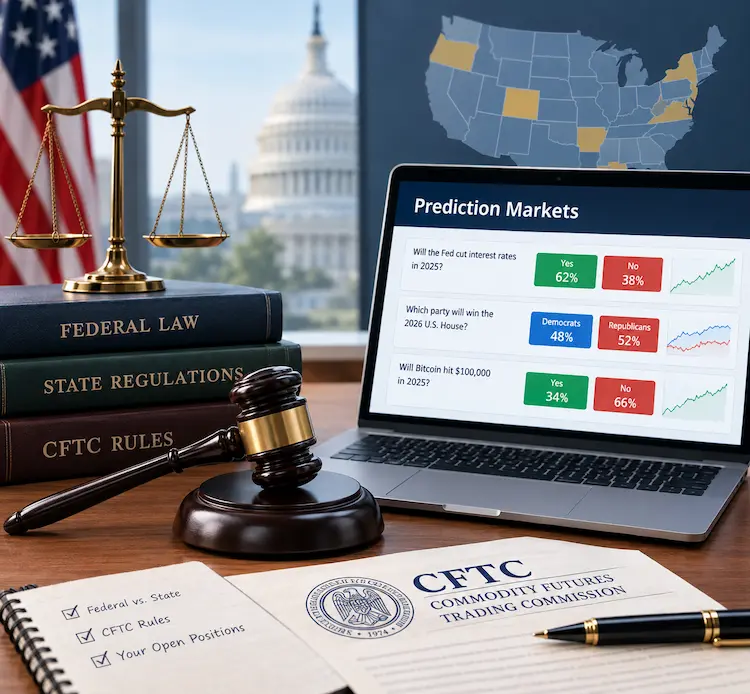
Quick answer: These platforms are federally registered exchanges, but three federal appeals courts have now split on a single question: whether sports-related event contracts are swaps — federal derivatives — or wagers your state can regulate. Two courts have said they are not swaps. One said they are. The CFTC is writing rules to try to settle it. Until it’s settled, access in your state can change by court order.
The honest line: That means the real risk isn’t just the trade. It’s what happens to your account if a court rules while you’re holding a position.
See the known status for your state → Jump to the state checker
Verified October 14, 2026. This area is changing weekly — check the sources before relying on anything here.
State Status Snapshot
Pick your state and the type of contract you’re asking about. This tool reports known court and regulator actions — it does not tell you whether trading is “legal” or “illegal” in your situation.
What an Event Contract Actually Is
An event contract pays a fixed amount if a specific, defined outcome happens — a game result, an economic report, an election, a weather threshold — and pays nothing if it doesn’t. You buy and sell contracts on an exchange registered with the Commodity Futures Trading Commission (CFTC), called a Designated Contract Market (DCM), rather than placing a bet with a bookmaker.
That’s the structural difference from a sportsbook wager: a sportsbook sets odds and takes the other side of your bet directly, and it’s licensed by a state (or tribal) gaming regulator. An event contract trades on an exchange, where your counterparty is another trader, and the exchange itself is licensed federally. It also differs from a stock: a stock represents ownership in a company and trades on a securities exchange regulated by the SEC; an event contract’s payout is tied to a yes/no outcome, not a company’s earnings, and it trades on a derivatives exchange regulated by the CFTC.
| Event contract | Sportsbook bet | Stock trade | |
|---|---|---|---|
| Who regulates it | CFTC (federal) — contested for sports contracts specifically | State gaming regulator, or tribal gaming authority on tribal land | SEC / FINRA (federal) |
| Where it trades | A CFTC-registered Designated Contract Market (exchange) | A state- or tribally-licensed sportsbook | A registered national securities exchange, via a broker-dealer |
| What protections apply | Customer funds must be segregated under CFTC rules; not SIPC- or FDIC-insured | State bonding or trust-fund rules, which vary by state; not SIPC-insured | SIPC-protected up to $500,000 (including up to $250,000 in cash) if the brokerage fails |
| How it’s taxed | Disputed — see the tax section below | Gambling winnings; a W-2G may be issued above certain thresholds; losses are deductible only if you itemize | Capital gains and losses |
The Question Everything Turns On: Swap or Wager?
The Commodity Exchange Act (CEA) defines a “swap” broadly to include an agreement whose value depends on the occurrence of an event with a financial, economic, or commercial consequence. If a sports-related event contract fits that definition, the CFTC argues it has exclusive jurisdiction over it — meaning states cannot apply their own gambling laws, under a legal doctrine called federal preemption.
If it doesn’t fit the definition — if it’s functionally a sports bet wearing an exchange’s clothing — then states argue their gambling laws apply as they always have, regardless of what federal regulator licenses the platform.
Courts have now answered this question three different ways. That’s the circuit split below.
Three Courts, Three Answers
Third Circuit — April 6, 2026 — Sports contracts ARE swaps
Case: KalshiEX LLC v. New Jersey Division of Gaming Enforcement.
Held: In a 2–1 decision, Kalshi’s sports-related event contracts fit the statutory definition of a swap, and the Commodity Exchange Act preempts New Jersey’s gambling laws as applied to a CFTC-licensed exchange.
Did not decide: The full merits of the underlying case — this affirmed a preliminary injunction only. Judge Roth dissented, warning the majority’s reasoning “elevates form over substance.”
Stage: Preliminary injunction affirmed. New Jersey has since petitioned the U.S. Supreme Court for review (filed September 2, 2026).
Ninth Circuit — August 28, 2026 — Sports contracts are NOT swaps
Case: KalshiEX, LLC v. Assad (No. 25-7516), involving Nevada.
Held: A unanimous three-judge panel ruled Kalshi had not shown its sports-event contracts meet the swap definition, clearing the way for Nevada to enforce its gaming law. The panel explicitly rejected the Third Circuit’s reasoning as overly literal.
Did not decide: The panel addressed only sports event contracts; it remanded the election-contract question to the district court.
Stage: Preliminary injunction dissolved. Companion unpublished rulings the same day went against Crypto.com and Robinhood on similar Nevada claims.
Sixth Circuit — September 25, 2026 — Not swaps, and no preemption either way
Case: Kalshi’s consolidated appeals involving Ohio and Tennessee.
Held: A unanimous panel held the sports contracts are not swaps, and separately held that even if they were, the CEA would not preempt Ohio’s or Tennessee’s gambling laws, because those laws only incidentally affect a federally licensed exchange.
Did not decide: A final merits judgment in either case.
Stage: Ohio’s denial of an injunction was affirmed. Tennessee’s injunction was vacated and the case sent back to the district court.
| Court / Date | Holding | What it did NOT decide | Stage |
|---|---|---|---|
| Third Circuit April 6, 2026 | Sports-related event contracts fit the swap definition; CEA preempts New Jersey’s gambling law (2–1, Judge Roth dissenting) | The full merits; this was a preliminary-injunction appeal | Injunction affirmed; NJ has petitioned the Supreme Court |
| Ninth Circuit August 28, 2026 | Sports-related contracts are not swaps; Nevada may enforce its gaming law (3–0) | Election-contract classification, remanded to the district court | Injunction dissolved |
| Sixth Circuit September 25, 2026 | Not swaps; and even if they were, no preemption of Ohio’s or Tennessee’s gambling laws (unanimous) | A final merits judgment | Ohio: injunction denial affirmed. Tennessee: injunction vacated, remanded. |
A similar appeal involving Maryland is still pending before the Fourth Circuit, which heard oral argument in May 2026. Litigation is also ongoing in district courts covering Connecticut, Minnesota, New York, and Washington State, among others.
What the CFTC Did on October 9, 2026
On the same day, the CFTC issued two distinct actions.
The Interim Final Rule codifies that casino-style gambling products — including sportsbook wagers and casino games — are excluded from the legal definition of a swap. Chairman Michael Selig said: “Casino-style gambling products are not derivatives… the Commission today provides clarity regarding the limits of its regulatory remit.” This rule takes effect immediately upon publication in the Federal Register, with a 30-day comment window after that. It does not, on its own, say anything about whether sports event contracts are swaps — it only addresses traditional sportsbook-style gambling.
The Notice of Proposed Rulemaking (NPRM), titled “Further Definition of ‘Swap’ – Inclusions” (RIN 3038-AF82), proposes adding event contracts — including those based on sports, politics, cultural events, and weather — to the swap definition. Selig said these products are “commodity derivatives squarely within the CFTC’s regulatory remit under the Commodity Exchange Act and… within the agency’s exclusive jurisdiction.” This is a proposal only; it is not yet in effect. Written comments are due within 30 days of its Federal Register publication, submitted through Regulations.gov and referencing RIN 3038-AF82.
The NPRM states that at least seven CFTC-registered designated contract markets offered sports-related event contracts as of September 1, 2026.
These two actions followed an earlier Advance Notice of Proposed Rulemaking (ANPRM), published March 16, 2026, in which the CFTC sought public comment on how its existing rules should apply to prediction markets generally — including market-integrity safeguards, insider-trading concerns, and which event contracts might be prohibited as contrary to the public interest. That comment period closed April 30, 2026.
| Document | What it does | Effective | Comment period |
|---|---|---|---|
| Interim Final Rule (RIN 3038-AF81) | Excludes casino-style gambling products (sportsbook wagers, casino games) from the “swap” definition | Immediately upon Federal Register publication | 30 days after publication |
| NPRM, “Further Definition of ‘Swap’ – Inclusions” (RIN 3038-AF82) | Proposes adding event contracts — sports, politics, cultural, and weather-related — to the “swap” definition | Not in effect; proposal only | 30 days after publication |
Sports vs. Everything Else
Almost every lawsuit and enforcement action described on this page is about sports-related event contracts. States have generally not gone after weather, economic, or political contracts with the same intensity — those categories don’t overlap with an existing, heavily regulated state industry the way sports betting does.
That could change. The CFTC’s pending NPRM would define “swap” to include event contracts based on politics, cultural events, and weather, not only sports. If finalized, it would strengthen the CFTC’s claim to exclusive jurisdiction over those categories too — but it’s a proposal, not a rule, as of the verification date, so treat sports contracts as the clearly contested category and everything else as comparatively, not definitively, settled.
Your State Right Now
This is a dated snapshot, not a legal determination. Use the tool above for a one-line version, or the table below (desktop) for more detail.
| State | Known action | Date | Source | Contract type affected |
|---|---|---|---|---|
| New Jersey | Third Circuit affirmed injunction allowing Kalshi to continue operating; state has petitioned the Supreme Court | Apr. 6, 2026 / Sept. 2, 2026 | Third Circuit; NJ Attorney General | Sports |
| Nevada | Ninth Circuit cleared the way for the Gaming Control Board to enforce state law against sports contracts | Aug. 28, 2026 | Ninth Circuit | Sports |
| Ohio | Sixth Circuit affirmed denial of Kalshi’s injunction; Casino Control Commission enforcement may proceed | Sept. 25, 2026 | Sixth Circuit | Sports |
| Tennessee | Sixth Circuit vacated Kalshi’s injunction and remanded; Sports Wagering Council enforcement unresolved | Sept. 25, 2026 | Sixth Circuit | Sports |
| Maryland | Gaming Commission enforcement challenged; appeal pending before the Fourth Circuit | Argued May 7, 2026 | Fourth Circuit docket | Sports |
| Massachusetts | State court enjoined Kalshi’s sports contracts; a state appeals court stayed that injunction pending appeal | Injunction Jan. 2026; stay Feb. 2026 | Massachusetts courts | Sports |
| Michigan | AG filed a civil enforcement action; later court orders have restricted or required geofencing of sports contracts | Mar. 4, 2026 and later orders | Michigan Attorney General; state courts | Sports |
| Illinois | Gaming Board cease-and-desist letters; a new state law requiring licensing and a transaction tax on sports-related contracts took effect, now challenged in federal court by the CFTC and Kalshi | Law effective Jul. 1, 2026 | Illinois Gaming Board; CFTC litigation | Sports |
| Connecticut | Department of Consumer Protection issued cease-and-desist orders; CFTC sued the state seeking to block enforcement | Dec. 3, 2025 / Apr. 2, 2026 | CT DCP; CFTC litigation | Sports |
| Arizona | CFTC sued to block state criminal enforcement; a federal judge halted the state’s case | Apr. 2–10, 2026 | CFTC litigation | Sports |
| Minnesota | CFTC sued the state; a federal court preliminarily enjoined a broader prediction-market ban on preemption grounds | Jul. 27, 2026 | D. Minn. litigation | Sports and broader |
| New York | Litigation ongoing; state sued Polymarket US over unlicensed gambling | Sept. 24, 2026 | NY state litigation | Sports |
| Washington | State lawsuit against Kalshi proceeding in federal court; venue-transfer request denied | Ongoing since early 2026 | W.D. Wash. litigation | Sports |
| California | Tribal coalition’s request for a preliminary injunction was denied; case continues | Denied Nov. 2025 | N.D. Cal. litigation | Sports, on tribal land |
| Wisconsin | Ho-Chunk Nation allowed to proceed with a tribal-sovereignty suit under IGRA | Filed 2025; proceeding 2026 | W.D. Wis. litigation | Sports, on tribal land |
| New Mexico | Four tribes/pueblos sued alleging IGRA violations and underage access; case pending | Filed May 12, 2026 | D.N.M. litigation | Sports, on tribal land |
| Kentucky | State enacted a tax on prediction-market trading exchanges rather than seeking to block them | 2026 | State legislation | Sports and broader |
What a Court Order Can Do to Your Open Position
This is the question that matters most if you already have money on one of these platforms, and it’s the one none of the law-firm alerts or sportsbook roundups spend much time on.
When a state wins an injunction or passes a licensing law, the order is typically aimed at the platform — barring it from offering new contracts to residents of that state, or requiring it to geofence them out. What happens to a contract you already hold at that moment is a separate question, governed by the platform’s own terms of service, not by the court order itself. Massachusetts and Michigan have both produced orders restricting access going forward; reporting on both situations describes platforms continuing to operate for a period under stays or partial compliance rather than an instant, total shutdown, but the pattern is not uniform and has not been fully litigated state by state.
Because the legal question is unsettled, so is the practical one: whether an open contract would be voided and your premium refunded, settled early at the current market price, frozen until you can withdraw, or left to settle normally at its original expiration, likely depends on the specific order, the specific platform’s terms, and facts that haven’t yet been tested in court for most states on this list.
That’s why the honest answer is a set of questions to ask before you fund an account, not a reassurance. See the checklist below.
Taxes: Genuinely Unsettled
Event contracts could, in principle, be treated as financial contracts — similar to other instruments traded on a regulated exchange — or as wagering transactions, similar to a sports bet, depending on how the underlying legal question (swap or wager) ultimately resolves and how the IRS chooses to treat them. The two characterizations carry different rules for how gains, losses, and reporting work.
This article is not going to tell you that one of those treatments is correct, because no settled authority says so. Anyone presenting a confident, specific tax answer right now is getting ahead of the actual state of the law. Talk to a CPA familiar with derivatives and gambling tax treatment before you rely on any particular position, and check for IRS guidance that may have been issued after this page’s verification date.
What Protections Apply — and Which Don’t
Not SIPC. The Securities Investor Protection Corporation protects customers of failed securities brokerages, up to $500,000 including up to $250,000 in cash. Event contracts are derivatives, not securities, and these platforms are not broker-dealers, so SIPC does not apply.
CFTC segregation rules instead. A Designated Contract Market is required to hold customer funds in accounts segregated from its own operating capital, which is meant to protect customer funds from the firm’s creditors if the company fails. That is a different and narrower protection than deposit or brokerage insurance: there is no dollar cap and no dedicated insurance fund standing behind it the way SIPC or FDIC coverage works, and how an actual insolvency would play out in practice has not been tested.
Age. Federal commodity-market rules generally allow participation at 18. Several state-licensed sportsbooks, and most tribal gaming compacts, set the minimum age at 21. That gap has become a specific point of contention: court filings in Massachusetts and the tribal lawsuits in New Mexico both allege that these platforms allowed 18-, 19-, and 20-year-olds to trade sports contracts in jurisdictions where a licensed sportsbook could not legally have served them.
How This Likely Ends
A few things are in motion at once, each on its own timeline.
The Supreme Court. New Jersey filed a 332-page petition for a writ of certiorari on September 2, 2026, asking the Court to resolve whether federal law preempts state gambling laws as applied to CFTC-registered exchanges. The Court is not required to take the case; Kalshi’s response deadline was extended to November 9, 2026, after which the Court will decide whether to grant review. If it does, a definitive nationwide answer could still be a year or more away.
The CFTC’s rulemaking. Both the Interim Final Rule and the NPRM are open for public comment. The NPRM, in particular, could take months to finalize, and any final rule would itself likely be challenged in court by the states that have lost ground to it.
More circuits. The Fourth Circuit (Maryland) has not yet ruled, and district-court litigation is ongoing in several more states. Additional, possibly conflicting, appellate rulings are plausible before the Supreme Court, if it takes the case, resolves anything.
Until one of these resolves — and it’s reasonable to expect that could take through 2027 or beyond — the state-by-state patchwork described above is the operating reality.
Questions to Ask Before You Fund an Account
Copy this list before you deposit anything.
- On cancellation: what do the terms say happens to open contracts if a court or regulator restricts the platform in my state? Are contracts voided and premiums returned, or settled?
- On withdrawals: if access is blocked, how do I get my balance out, and how long does it take?
- On custody: how are customer funds held? Is there any insurance, and what does it cover? It is not SIPC coverage.
- On tax forms: which form will I receive, and when? Does the platform state a tax position? A form is not tax advice, and the treatment is disputed.
- On records: export your transaction history regularly and keep it.
- On yourself: am I hedging a real exposure, speculating with money I can lose, or chasing losses? If it’s the third, stop and call the National Problem Gambling Helpline at 1-800-522-4700.
FAQ
Are prediction markets legal in the US?
The platforms themselves are federally registered exchanges, which is legal. Whether a specific sports-related event contract is beyond state gambling law is the contested question this entire page is about — courts currently disagree.
Are they legal in my state?
Use the state checker above for the known status in your state as of the verification date. No state has a final, settled answer for sports contracts; several have active litigation or court orders.
Are event contracts gambling?
That’s the legal question in dispute. The CFTC and some courts say sports-related event contracts are swaps — financial derivatives. Other courts have said they function like wagers and remain subject to state gambling law. Both views currently have appellate support.
What is a swap, and why does it matter?
A swap is a category of financial derivative defined broadly under the Commodity Exchange Act. If an event contract is a swap, the CFTC claims exclusive federal jurisdiction over it, which would generally bar state gambling regulators from reaching it. If it isn’t, state law can apply as usual.
What did the Third Circuit decide?
On April 6, 2026, in a 2–1 decision, it held that Kalshi’s sports-related event contracts fit the swap definition and that federal law preempts New Jersey’s gambling law as applied to them. It affirmed a preliminary injunction, not a final merits ruling.
What did the Ninth Circuit decide?
On August 28, 2026, a unanimous panel held the opposite in a Nevada case: sports-related event contracts are not swaps, so Nevada can enforce its gaming law against them.
What did the Sixth Circuit decide?
On September 25, 2026, a unanimous panel held the contracts are not swaps and, separately, that even if they were, federal law would not preempt Ohio’s or Tennessee’s gambling laws.
What did the CFTC do on October 9, 2026?
It issued two separate documents: an Interim Final Rule excluding casino-style gambling products from the swap definition, and a proposed rule (NPRM) that would add event contracts — including sports, political, cultural, and weather contracts — to that same definition.
Does the new rule make them legal everywhere?
No. The NPRM is a proposal, not a final rule, and it would still face legal challenges from states even if finalized. Neither October 9 document resolves the circuit split on its own.
Can I comment on the proposed rule?
Yes. Comments on the NPRM can be submitted through Regulations.gov within 30 days of its Federal Register publication, referencing “Further Definition of ‘Swap’ – Inclusions” and RIN 3038-AF82.
Why are sports contracts treated differently?
Sports contracts compete directly with an existing, heavily regulated state industry — licensed sports betting — which is why states have enforced against them far more than weather, economic, or political contracts.
What happens to my open positions if my state blocks access?
It depends on the specific order and the platform’s own terms, and it has not been uniformly tested in court. See the “open positions” section above, and ask your platform the cancellation question in the checklist before you fund an account.
Can my contracts be cancelled and refunded?
Possibly, depending on the platform’s terms and the specific court order involved. This is unsettled and varies; it is one of the first questions to ask before funding an account.
Can I withdraw my money if access is blocked?
Platforms generally describe withdrawal processes in their terms, but timing and process in a block scenario specifically are not something this article can promise. Ask before you deposit.
Are my funds SIPC-protected?
No. These are not securities brokerage accounts. Customer funds are instead required to be held in accounts segregated from the platform’s own operating capital under CFTC rules, which is a different, narrower protection with no dedicated insurance fund behind it.
How are winnings taxed?
Genuinely unsettled; see the taxes section above. Do not rely on a confident answer from anyone, including this article. Talk to a CPA.
Will I get a tax form?
Platforms generally state what form, if any, they intend to issue, but that is a platform’s own position, not a settled tax determination, since the underlying characterization is disputed.
Will the Supreme Court decide this?
Possibly. New Jersey has petitioned for review as of September 2, 2026, but the Court isn’t required to take the case, and if it does, a decision is likely a year or more away.
This is general information, not legal, tax, or investment advice. The law in this area is actively contested, and the facts in this article were verified on October 14, 2026. Availability and legal status can change without notice.
Last updated:
Related reading
- PDT Rule Replaced by Intraday Margin — another CFTC/FINRA-adjacent market-structure change.
- Tax-Loss Harvesting Calculator — a reminder that these contracts don’t follow ordinary securities tax rules.

Daniel Hayes is the founder and sole researcher at AdvoraHQ. He covers U.S. personal finance, insurance, and consumer law — working directly from IRS publications, federal and state statutes, court opinions, and SEC filings rather than secondary summaries. His focus is the gap between what readers think they know and what the source documents actually say. Daniel is not a licensed attorney, CPA, or financial advisor; his articles are educational and not personalized advice. Reach him at Daniel.Hayes@advorahq.com.
