
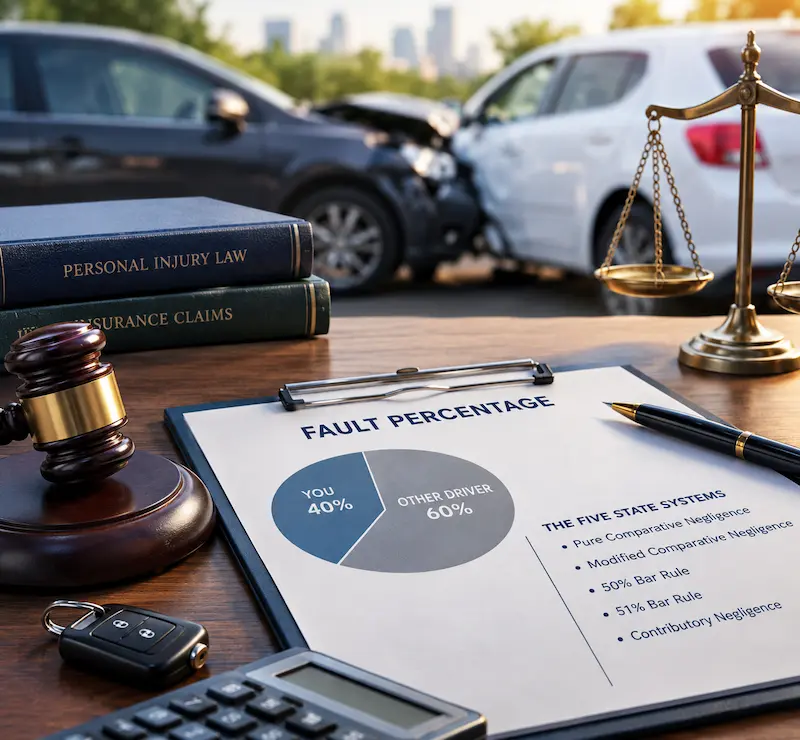
An adjuster just told you you’re 30% at fault. What that means for your recovery depends on the state’s fault rule, the type and timing of your claim, and whether a statutory exception applies. In five jurisdictions, contributory negligence can generally bar recovery even when your share of fault is small.
Fault Reduction Calculator
Enter the percentage an insurer has assigned you and see what your state’s rule actually does with it.
A fault percentage from an insurance company is not a court ruling. It is that company’s position, written by an employee, before anyone has been cross-examined.
This is a practical overview of the general comparative-fault frameworks, checked against the cited legal authorities as of October 14, 2026. Claim-specific statutes, exceptions, government-claim rules, and newer amendments can change the result; the table is a starting point, not a substitute for checking the law that governs your case.
What a Fault Percentage Actually Is — and Who Assigns It
A fault percentage is one party’s estimate of how much each driver or property owner contributed to an accident. Early on, that estimate comes from an insurance adjuster. It is not a legal finding.
An adjuster reviews the police report, photos, damage patterns, and any statements, then assigns a percentage that becomes the insurer’s negotiating position. Nothing requires that number to be final, and nothing requires you to accept it.
A percentage only becomes a legal finding if a judge or jury apportions fault at trial, or if both sides agree to it in a settlement. Until then, it’s a position — not a verdict.
The Five Broad Systems States Use
Most negligence claims can be grouped into five broad comparative-fault frameworks. These are useful starting points, not universal answers for every claim: statutes may create exceptions by claim type, defendant, date, or claimant category.
REDUCED — Pure comparative negligence
What it means: you recover damages reduced by your percentage of fault, no matter how high that percentage is.
At your percentage: even at 80% or 90% fault, you still recover the remaining share.
What to check: there’s no bar to watch for — the math is the same at every percentage.
— Modified comparative, 50% bar
What it means: you recover a reduced amount up to 49% fault; at 50% fault or more, you recover nothing.
At your percentage: 49% still pays; 50% pays zero.
What to check: whether your percentage is at or above 50 — that’s the entire question.
— Modified comparative, 51% bar
What it means: you recover a reduced amount up to exactly 50% fault; above 50%, you recover nothing.
At your percentage: 50% still pays half; 51% pays zero.
What to check: whether your percentage is above 50, not at or above it — this is the opposite cutoff from the 50% bar.
— Pure contributory negligence
What it means: any fault on your part, even 1%, bars recovery entirely.
At your percentage: 5% pays zero; so does 50%.
What to check: whether any narrow exception (last clear chance, gross negligence, a statutory carve-out) applies — see the contributory states section below.
Slight comparative negligence — South Dakota only
What it means: under S.D.C.L. § 20-9-2, a plaintiff’s negligence does not bar recovery if it is “slight” in comparison with the defendant’s negligence; damages are reduced in proportion to the plaintiff’s negligence. The statute does not impose a separate “gross negligence” requirement.
At your percentage: there is no statutory percentage cutoff. Courts assess the facts and relative negligence; past case outcomes are fact-specific and should not be turned into a universal 10%, 20%, or 30% rule.
What to check: whether the facts support calling your share “slight” — the number alone doesn’t decide it.
| System | What happens to your recovery | Where the bar sits | What to check |
|---|---|---|---|
| REDUCED Pure comparative | Reduced by your % of fault, at any percentage | No bar | Nothing — the math is the same throughout |
50% bar | Reduced up to 49% fault; zero at 50%+ | 50% or more | Whether you’re at or above 50 |
51% bar | Reduced up to exactly 50% fault; zero above 50% | More than 50% | Whether you’re above 50, not at it |
Pure contributory | Zero if you bear any fault at all | Any fault (1%) | Whether a narrow exception applies |
| Slight comparative (South Dakota only) | Recovery may be reduced if the plaintiff’s negligence is “slight” compared with the defendant’s negligence | No fixed percentage | How the relative negligence is evaluated under S.D.C.L. § 20-9-2 |
South Dakota is the only state generally described as using a slight-comparative-negligence system. The statute’s test is comparative and fact-specific; it should not be summarized as requiring the defendant’s negligence to be “gross.”
50% vs. 51%: The Line That Decides Everything
The 50% bar and the 51% bar sound almost identical. At exactly 50% fault, they give opposite answers.
In a 50% bar state, a plaintiff who is 50% at fault recovers nothing — the bar is “50% or more.” In a 51% bar state, that same plaintiff still recovers half of their damages — the bar there is “more than 50%,” so 50% exactly still clears it.
For ordinary negligence claims, state surveys commonly group ten states under a 50% bar and twenty-five under a 51% bar, including Florida for most claims since 2023. Those broad counts do not capture every claim-specific exception or hybrid rule—for example, New York has a special provision for certain Article 51 motor-vehicle personal-injury actions commenced on or after May 26, 2026. The two standard bars are not interchangeable, and a reader at exactly 50% fault needs to identify the rule that actually governs the claim.
The Five Jurisdictions Where 1% Ends It
Alabama, Maryland, North Carolina, Virginia, and the District of Columbia generally apply contributory negligence in many negligence claims: a plaintiff’s own negligence can bar recovery. Exceptions and claim-specific rules matter, including D.C.’s statutory vulnerable-user provision described below.
That’s four states plus D.C. — five jurisdictions, not five states. D.C. has a statutory exception under D.C. Code § 50-2204.52. In the collision categories specified by that law, an eligible pedestrian or other “vulnerable user” of a public highway or sidewalk may recover unless their negligence is greater than the combined negligence of the defendant or defendants. The statute’s definition of vulnerable user can include certain motorized and non-motorized devices; it is not limited to cyclists or non-motorized users struck by a motor vehicle. Whether the exception applies depends on the people and collision involved. Outside the statutory categories, D.C.’s ordinary contributory-negligence rule generally applies.
North Carolina recognizes the last clear chance doctrine as a softener: if the other party had a clear, final opportunity to avoid the crash and failed to take it, your own contributory fault may not bar your claim. North Carolina courts have also recognized exceptions for gross or willful conduct, a sudden-emergency reaction, and claims by a child under seven.
Alabama’s situation is more tangled than most summaries suggest. Alabama’s product-liability doctrine (the AEMLD) has, in some decisions, limited the contributory-negligence defense to misuse of the product or assumption of the risk — not ordinary negligence that merely helped cause the accident. But Alabama courts have also applied contributory negligence as a complete bar in other AEMLD cases. If your claim involves a defective product, this is a question for an Alabama product-liability attorney, not a flat rule either way.
Florida Changed in 2023 — and Many Pages Still Say Otherwise
Florida is no longer a pure comparative negligence state. Many ranking pages still say it is.
Governor Ron DeSantis signed HB 837 into law on March 24, 2023. It amended Fla. Stat. § 768.81, and subsection (6) now reads, in substance, that a party found greater than 50% at fault for their own harm may not recover any damages — a 51% bar. Before that date, Florida allowed recovery at any percentage of fault, reduced proportionally.
Two things the law carves out matter for a given reader:
Medical negligence is exempt. Personal injury and wrongful death claims arising out of medical negligence are not subject to the new 51% bar; they remain under the prior pure comparative standard.
The general trigger is when the case was filed, not when the crash happened. HB 837 states that, except where the act says otherwise, it “shall apply to causes of action filed after the effective date of this act.” That’s a filing-date test, not an accident-date test — a crash that happened before March 24, 2023 can still fall under the new 51% bar if the lawsuit was filed after that date. (A separate, narrower piece of the law — the shortened negligence statute of limitations — does turn on when the claim accrued, which is a different question from which comparative-fault rule applies.) A small number of non-binding trial-court rulings have treated the comparative-fault change as procedural and applied it more broadly still. If your filing date or accident date sits close to March 24, 2023, that distinction is worth confirming with a Florida attorney rather than assuming either answer.
Your State, Right Now
The table identifies the general rule and a principal authority for each jurisdiction. It is not an exhaustive survey of every exception, local rule, government-claim statute, or claim-specific amendment; confirm the controlling law for the facts and filing date of your case.
| State | System | Bar threshold | Statute or doctrine | Verified |
|---|
Rules change. Treat every row as a starting point for your own confirmation, not a final answer.
Why an Adjuster Has a Reason to Reach for 51%
In a bar-rule state, a percentage just above the threshold costs the insurer nothing. A percentage just below it can cost tens of thousands of dollars.
This isn’t an accusation — it’s a structural fact about how the rule works. An adjuster who assigns you 51% fault in a 51%-bar state has closed the claim for the insurer’s full exposure. An adjuster who assigns you 49% has to pay out a reduced amount. That difference sits on one side of the negotiating table, which is a reason to look closely at how any number near the threshold was reached, not a reason to assume bad faith.
A recorded statement is one of the most common ways a percentage gets built, because casual language (“I didn’t see them,” “I might have been going a little fast”) can be read back later as support for a higher share of fault. If you’ve already given one, see Gave a Recorded Statement? Here’s What to Do Now for what to do next.
How a Fault Percentage Is Challenged
A percentage is challenged with evidence and written reasoning — not by arguing, and never by changing your story.
Before You Accept a Fault Percentage
- Ask for it in writing. Request the adjuster’s written basis for the percentage — which facts, which documents, which statements it relies on.
- Get the police or incident report and read the diagram and narrative closely. A report’s opinion on fault is evidence, not a binding determination.
- Collect what expires fastest: nearby business and doorbell camera footage, which is often overwritten within days, and witness contact details.
- Preserve your own evidence: photos of final vehicle positions, skid marks, signage, sightlines, weather, and lighting.
- Check what the percentage rests on: a recorded statement you gave, an admission at the scene, or a citation. A citation is evidence of a violation, not a verdict on fault.
- Know your threshold. In a bar-rule state, confirm whether your state bars at 50% or 51% before discussing any number with an adjuster.
- If you’re in a 1%-bar jurisdiction, treat any admission as decisive and speak to an injury attorney before anything else.
- Never revise a statement to fit a theory, omit a known fact, or delay a report you’re required to make.
| Evidence | Weight | Why |
|---|---|---|
| Independent camera footage (traffic, doorbell, business) | High | Captures positions and timing without relying on anyone’s memory |
| Independent witness account | High | A third party with no stake in the outcome, if the account is consistent and detailed |
| Your own scene photos | Moderate–High | Documents conditions at the time, but taken from one side’s perspective |
| Police report’s opinion on fault | Moderate | An officer’s conclusion based on a brief on-scene review — informative, not binding |
| A traffic citation | Moderate | Evidence a law was broken, not a formal ruling on who caused the crash |
| Your own recorded statement | Variable | Can support or undercut a percentage depending on exact wording and context |
| An apology or “sorry” at the scene | Low, but sometimes cited | A reflexive courtesy, not an admission of legal fault — though adjusters may still point to it |
Where This Fits in Your Claim
Fault reduction happens first, before anyone talks about fees or liens. The order is: total damages, then the fault-based reduction described on this page, and only after that, the deductions covered elsewhere.
This page covers your gross recovery after a fault reduction. A different question — what you personally keep after attorney fees and medical liens are paid from that amount — is covered in How Much of My Settlement Will I Get? The two don’t compete; they’re two steps in the same math, in order.
When This Needs a Lawyer
Some situations are worth a consultation before you say anything further to an adjuster:
- You’re in a bar-rule state and your assigned percentage is within 10 points of the threshold.
- You’re in Alabama, Maryland, North Carolina, Virginia, or D.C., and any fault has been suggested.
- Your injuries are serious, ongoing, or will affect future work or care.
- Fault is being apportioned among three or more vehicles or parties.
For how a lawyer’s fee works and what representation changes, see Car Accident Lawyer: Fees, Claims & Settlements.
The Same Crash Under Four State Rules
One accident, $100,000 in damages, and three fault percentages produce different outcomes under these four illustrative general rules. Claim-specific exceptions can change the result.
| State | System | Fault 30% | Fault 49% | Fault 51% |
|---|---|---|---|---|
| California | Pure comparative | $70,000 | $51,000 | $49,000 |
| Georgia | 50% bar | $70,000 | $51,000 | $0 (barred) |
| Florida | 51% bar | $70,000 | $51,000 | $0 (barred) |
| Maryland | Pure contributory | $0 (barred) | $0 (barred) | $0 (barred) |
FAQ
Can I still get a settlement if I was partially at fault?
In most states, yes — your recovery is reduced by your percentage of fault rather than eliminated. In five jurisdictions (Alabama, Maryland, North Carolina, Virginia, and D.C.), contributory negligence can generally bar recovery, subject to exceptions and claim-specific rules.
What happens if I’m exactly 50% at fault?
It depends entirely on which rule your state uses. In a 50%-bar state, you recover nothing. In a 51%-bar state, you still recover half your damages. In a pure comparative state, you recover half regardless.
What’s the difference between the 50% and 51% bar rules?
A 50% bar blocks recovery at 50% fault or more. A 51% bar only blocks recovery above 50% — so someone exactly 50% at fault still recovers under a 51%-bar rule but not under a 50%-bar rule.
Which states bar recovery if I’m even 1% at fault?
Alabama, Maryland, North Carolina, Virginia, and the District of Columbia generally apply contributory negligence, subject to jurisdiction-specific exceptions. D.C.’s statutory exception covers certain qualifying pedestrians and vulnerable users in the collision categories set out in D.C. Code § 50-2204.52.
Is Florida still a pure comparative negligence state?
No. Since HB 837 took effect on March 24, 2023, Florida uses a 51% bar for most negligence claims. Medical negligence claims are the exception and remain pure comparative.
When did Florida’s rule change, and which crashes does it affect?
The law changed March 24, 2023. The new 51% bar generally applies to cases filed after that date, regardless of when the crash itself happened — confirm the filing date on your specific case with a Florida attorney.
Does the Florida rule apply to medical malpractice claims?
No. Fla. Stat. § 768.81(6) expressly exempts actions arising from medical negligence, which stay under the prior pure comparative standard.
Who decides my fault percentage?
Early on, an insurance adjuster assigns it as the company’s negotiating position. It becomes a binding legal determination only if a court or jury rules, or if you agree to it in a settlement.
Is an adjuster’s percentage final?
No. It’s a starting position that can be challenged with evidence and written argument before any settlement is reached.
Can I dispute a fault percentage, and how?
Yes. Ask for the adjuster’s written basis, gather independent evidence (camera footage, witnesses, your own photos), and present it in writing. See the dispute checklist above.
Does the police report decide fault?
No. An officer’s opinion on fault is one piece of evidence among several, not a binding ruling.
Does a traffic ticket mean I was at fault?
A citation shows a law was broken, which can support a fault finding, but it isn’t itself a legal determination of fault for the crash.
What if both drivers are 50/50?
The outcome depends on your state’s system: a 50%-bar state pays neither driver anything at that split; a 51%-bar state still pays each driver half their damages; a pure comparative state does the same.
How is fault split between three or more vehicles?
Each party is assigned their own percentage, and most bar-rule states compare your share against the combined share of everyone else, not against any single other driver. The specific wording varies by state statute.
Does being partly at fault raise my premium?
It can factor into how an insurer prices your future coverage, but the details vary by insurer, state, and policy. Ask your agent or insurer directly rather than assuming a specific effect.
What is the last clear chance doctrine?
An exception recognized in some contributory-negligence states (notably North Carolina): if the other party had a final, clear opportunity to avoid the accident and failed to take it, your own contributory fault may not bar your claim.
Do these rules apply to slip and fall cases too?
Generally yes — the same state fault system usually applies across negligence claim types, including premises liability, though exceptions and nuances can differ by claim type. See Slip and Fall Lawsuits for the specifics of that claim type.
Do I need a lawyer if I’m only slightly at fault?
Not always, but it’s worth a consultation if you’re near a bar-rule threshold, in a contributory-negligence jurisdiction, or facing a serious injury. See “When This Needs a Lawyer” above.
This article is general information, not legal advice. Fault rules vary by state and by claim type, filing date, defendant, and applicable statutory exceptions. The state classifications and selected legal authorities were reviewed for this article as of October 14, 2026, but this is not a certification that every possible claim-specific rule has been exhaustively verified. Consult a licensed attorney in the relevant state about your situation.

Daniel Hayes is the founder and sole researcher at AdvoraHQ. He covers U.S. personal finance, insurance, and consumer law — working directly from IRS publications, federal and state statutes, court opinions, and SEC filings rather than secondary summaries. His focus is the gap between what readers think they know and what the source documents actually say. Daniel is not a licensed attorney, CPA, or financial advisor; his articles are educational and not personalized advice. Reach him at Daniel.Hayes@advorahq.com.
