
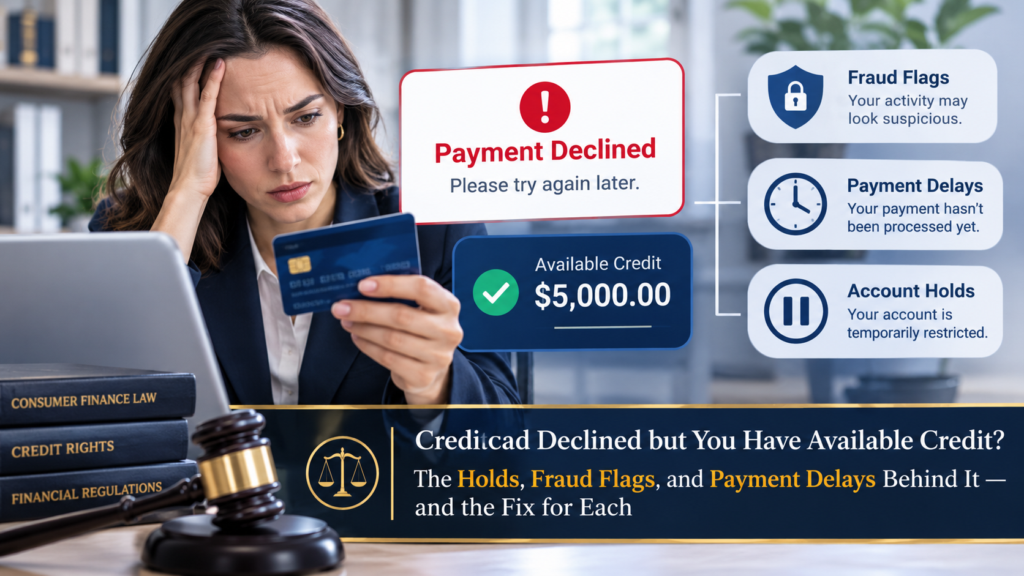
- WAIT OR ASK THE MERCHANT
At a gas pump: pay inside for a set amount. At a hotel or rental counter, ask what will be held and when the merchant will release unused authorization.
- CALL THE ISSUER
Right after a payment: the credit may not be released yet. Ask the issuer when it will be.
- FIX IT NOW
Online or traveling: a fraud flag or a ZIP/CVV mismatch. Confirm in the official app, then retry.
Find the likely cause of your decline in 30 seconds →
Security: Only call the number on the back of your card or in the official app. Never use a number or link from a text or email about a “declined” transaction.
Why Was My Card Declined? Find the Likely Cause
Answer what you know. Skip anything you’re unsure of. This tool never asks for card numbers, CVV, ZIP code, or amounts.
Matching articles: Credit Limit Lowered Without Warning · Credit Card Closed Without Notice · Unauthorized Credit Card Charges · Pay in Dollars or Local Currency
What “Available Credit” Really Means
As a rule of thumb, available credit is your credit limit minus the balance and pending authorizations that the issuer is counting against the account. It can also be affected by a changed credit limit, account restrictions, or issuer-specific processing.
Your posted balance reflects transactions that have been posted to the account. Pending items are authorizations or transactions that have not finished posting. Available credit is the amount the issuer currently makes available for new purchases.
The app may not refresh every part of the account at the same time. A pending authorization may already affect the issuer’s approval decision even if the display is delayed or the transaction details are not yet obvious.
A pending authorization is not necessarily a completed charge, but it can still reduce available credit. The amount may be adjusted when the final transaction is processed or when the authorization is reversed or expires under the applicable rules.
Holds: Gas Pumps, Hotels, and Rental Cars
A hold is a temporary authorization that can reduce the credit available for new purchases before the merchant knows or submits the final amount. The station, hotel, rental company, or another merchant initiates the authorization, while the issuer applies it to the account.
At a gas pump, the merchant may request an authorization before dispensing fuel. The authorized amount can be much higher than the final fill-up, but there is no single dollar amount that applies to every network and authorization method.
Gas-pump amounts, as of October 17, 2026: Visa’s U.S. rules distinguish a $175 status-check authorization ($1,000 for a Visa Fleet Card) from initial authorizations that can be as high as $500 ($1,000 for a Visa Fleet Card). Mastercard’s U.S. rules say issuers should place a temporary hold of up to $175 for consumer Mastercard transactions and up to $500 for certain corporate, fleet, and purchasing cards. NACS reported in 2022 that Discover raised its pump pre-authorization limit to $175; treat that as a reported network figure, not a promise that every station uses that amount. NACS also reported no fixed American Express network cap, while Amex’s merchant rules require a good-faith estimate for automated fuel pumps.
The station’s processor and the type of authorization determine what is requested in a particular transaction, so a customer will not necessarily see the maximum. A hold may also be lower than the eventual purchase amount if the pump stops at the authorized amount.
Timing matters, too: Visa’s rules set two-hour processing deadlines for certain automated-fuel authorizations; which event starts the clock depends on the authorization method. Mastercard’s U.S. rules require the acquirer to send the final fuel amount within 60 minutes of the original preauthorization, and the issuer must release any excess hold within 60 minutes after receiving the final-amount advice. These are network processing requirements, not a guarantee that every app will display the restored credit instantly.
| Hold type | Who sets the amount | What the network rules tell you | What it means for your available credit | Practical step |
|---|---|---|---|---|
| Gas pump | The station or processor chooses the authorization method and amount within applicable network rules. | Visa U.S.: $175 for a status-check authorization, but initial authorizations may reach $500 for consumer cards ($1,000 for Visa Fleet). Mastercard U.S.: up to $175 for consumer cards and $500 for certain commercial card types. NACS reported $175 for Discover in 2022. | Visa and Mastercard have time-bound processing and release steps, but the exact authorization path matters. A network processing deadline is not the same as an app-refresh guarantee. | Pay inside for a set amount, or ask the station what amount it will authorize before using the pump. |
| Hotel | The hotel, usually an estimate for the stay plus incidentals. | Visa’s current rules allow 30 calendar days to process certain estimated lodging authorizations. Mastercard has 30-day preauthorization processing rules. These periods are not universal consumer hold-duration promises. | The hold may be reduced or reversed after checkout, but the amount shown in your account can take longer to update. | Ask the hold amount at check-in and ask the hotel to send the appropriate release or reversal at checkout. |
| Car rental | The rental company, usually an estimate or deposit plus expected incidentals. | Visa’s current rules allow 30 calendar days to process certain estimated vehicle-rental authorizations; Mastercard also has 30-day preauthorization processing rules. | The merchant’s processing deadline is not a reliable estimate of when your issuer will show the credit as available. | Ask the amount at the counter and ask when the company will send the release after return. |
| Cruise | The cruise line, often an estimate for onboard spending. | Visa’s current rules allow 30 calendar days to process certain estimated cruise authorizations; Mastercard preauthorization rules also use a 30-day timeframe. | Multiple or incremental authorizations may affect available credit during the trip. | Ask which amounts are being authorized and when unused authorizations will be reversed. |
| Other merchants | The merchant, based on the transaction type and its payment setup. | General authorization-processing windows differ by network and by whether the authorization is final or a preauthorization. | Do not treat a network processing window as a guaranteed consumer hold duration. | Ask the merchant whether it has completed the sale or sent a reversal; then ask the issuer about any remaining hold. |
Gas pump
Who sets it: The station or processor chooses the authorization method and amount within the applicable network rules.
Authorization amounts: Visa U.S. rules distinguish $175 status-check authorizations from initial authorizations up to $500 for consumer cards ($1,000 for Visa Fleet). Mastercard U.S. rules allow a temporary hold up to $175 for consumer cards and $500 for certain corporate, fleet, and purchasing cards. NACS reported a $175 Discover limit in 2022.
When credit returns: Visa has two-hour processing steps for certain fuel authorizations. Mastercard requires the issuer to release the amount above the final fuel charge within 60 minutes after receiving the final-amount advice. Neither rule guarantees an instant app refresh.
Practical step: Pay inside for a set amount or ask the station what it will authorize.
Hotel
Who sets it: The hotel, usually an estimate for the stay plus incidentals.
Processing rules: Visa and Mastercard have 30-day processing timeframes for certain lodging or preauthorization transactions. These are not universal promises that the customer-facing hold will last exactly 30 days.
Practical step: Ask for the hold amount at check-in and ask the hotel to send the appropriate release or reversal at checkout.
Car rental
Who sets it: The rental company, usually an estimate or deposit plus expected incidentals.
Processing rules: Visa and Mastercard have 30-day processing timeframes for certain estimated or preauthorized rental transactions. The timeframe is not a guaranteed app-release date.
Practical step: Ask the amount at the counter and when the company will send the release after return.
Cruise
Who sets it: The cruise line, often an estimate for onboard spending.
Processing rules: Visa allows a 30-day processing timeframe for certain estimated cruise authorizations. Mastercard preauthorization rules also use a 30-day timeframe.
Practical step: Ask which amounts are being authorized and when unused authorizations will be reversed.
Other merchants
Who sets it: The merchant, based on the transaction type and payment setup.
Timing: Network processing windows vary and are not always the same as the time a hold remains visible to you.
Practical step: Ask whether the merchant has completed the sale or sent a reversal; then ask the issuer about any remaining hold.
Table 1 (as cards). Network processing deadlines are not a guaranteed consumer-facing hold duration. Sources: current Visa and Mastercard rules, NACS (2022), and American Express merchant regulations (2026). Checked October 17, 2026.
How to avoid or release a hold
WAIT OR ASK THE MERCHANT
Pay inside at the pump. Ask the cashier to authorize a set amount for the pump you’ll use. That avoids the large pre-authorization.
Ask the merchant to send the right update. Depending on whether the transaction was canceled, completed for a lower amount, or fully settled, the merchant or its processor may need to send a reversal or final-amount message. If the hold remains, call your issuer and ask whether it has received that message and what release timing applies. The app may not refresh at the same moment the network message is processed.
Check your app for pending items. If a hold from an earlier stop is the cause, you’ll usually see it listed as pending.
A bank check deposit hold on a debit account is a related but separate issue. This article covers credit cards.
You Paid — So Why Can’t You Spend?
For a payment made in accordance with the issuer’s payment instructions, Regulation Z generally requires the payment to be credited as of the date received; it does not set a fixed number of days for restoring spendable credit.
A payment can be credited before your available credit comes back. Those are two separate steps, and only the first has a federal deadline.
Regulation Z (12 CFR 1026.10) says a creditor generally must credit a conforming payment as of the date of receipt. The official interpretation clarifies that this does not necessarily require the creditor to display or post the payment on a particular calendar date; special rules can apply to payments that do not conform to the issuer’s stated requirements.
The rule doesn’t say when available credit must be replenished after a payment is credited. Its official commentary says the rule sets no number of days, and it allows an issuer to delay replenishing where appropriate, for example when it suspects fraud. Regulation Z doesn’t cause the delay. It just doesn’t limit it.
Some issuers keep part of the credit unavailable for a time after a payment. That is an issuer practice, not a federal requirement. Check your cardholder agreement for your own issuer’s terms.
No over-limit fee if the issuer was the one slow to release your credit. Under 12 CFR 1026.56(j)(2), an issuer may not charge an over-the-limit fee solely because it failed to promptly replenish your available credit after crediting your payment. That holds even if you opted in to over-limit transactions.
CALL THE ISSUER
Ask this: “My payment of [amount] on [date] — has it been credited, and when will that amount be available to spend?”
If you’re also wondering why interest appeared after you paid, see Charged Interest After Paying the Statement Balance.
Fraud Flags and Card Locks
An issuer may decline a transaction that looks unusual. A card lock can block many new purchases, although the effect on recurring payments, digital wallets, and other transaction types varies by issuer.
Fraud systems look at the amount, the location, and the merchant. A large purchase, a first-time merchant, or a charge far from home can all trigger one.
FIX IT NOW Open your issuer’s official app. Check for an alert asking you to confirm the purchase, and check whether a card lock or freeze switch is on. Confirm or unlock, then retry once.
CALL THE ISSUER If there’s no alert and no lock, call the number on the back of your card and ask whether there’s a flag on the account.
Don’t try to get around a flag by splitting the purchase into smaller ones, using someone else’s card, or changing your billing address. Those can make the situation worse.
If a charge you don’t recognize shows up, see Unauthorized Credit Card Charges.
Typos and Mismatches: ZIP, CVV, Expiration
A wrong digit in the ZIP, CVV, or expiration date is the quickest decline to fix, and it often looks identical to a credit problem.
Pumps often ask for a ZIP code. It needs to match the billing address your issuer has on file for the card, which may not be where you live now.
Online stores often check the billing address and CVV against your issuer’s records. A saved card in an app or browser can hold old details after a replacement.
FIX IT NOW Re-enter the details slowly. Use the billing address exactly as it appears on your statement. If it still fails online but works in a store, check your saved payment details for old information. If your address changed, update it with your issuer.
Account-Level Causes
Declines can also come from the account itself: a past-due balance, a lowered limit, a closure, or a replacement card that was never activated.
CALL THE ISSUER Past due. An account that’s behind on a payment can be blocked from new purchases. Ask what amount and date will bring it current.
CALL THE ISSUER Lowered limit. If your limit was cut, the available credit you remember may no longer exist. See Credit Limit Lowered Without Warning for what to check and ask.
CALL THE ISSUER Closed account. A closed card declines everywhere, even if it shows a balance. See Credit Card Closed Without Notice.
FIX IT NOW Unactivated replacement card. A new card has to be activated. Do it in the official app, or by calling the number on the back of the card. Then update any saved wallets and subscriptions, because the number, expiration date, or CVV may have changed.
Don’t confuse this with a rejected application. See the comparison table in the rights section, and Credit Card Application Denied.
Merchant and Travel Restrictions
Some purchase types and some locations are more likely to be declined, because issuers treat them as higher risk or restrict them.
Issuer policies differ. Commonly restricted or limited categories include gambling, cryptocurrency, money transfers, and gift cards. Check your cardholder agreement, or ask your issuer about a specific merchant.
Purchases made abroad, or with a foreign merchant, can also trigger a cross-border flag. Confirm the purchase in the official app, or tell your issuer your travel plans if it offers that option. For the currency choice at checkout, see Pay in Dollars or Local Currency.
All the causes at a glance
| Cause | Signal you’ll see | Tier | Fix | Who to call |
|---|---|---|---|---|
| Pump pre-authorization hold | Declined or shut off at the pump; pending charges in your app | WAIT OR ASK THE MERCHANT | Pay inside for a set amount; wait for the release | The station first; the issuer if it persists |
| Hotel or rental estimate hold | Declines after check-in or pickup; a pending charge bigger than expected | WAIT OR ASK THE MERCHANT | Ask the merchant to release the earlier authorization | The merchant; then the issuer if your app still shows it |
| Payment not yet released | You paid recently; the payment shows but available credit hasn’t moved | CALL THE ISSUER | Ask when the amount will be available to spend | The issuer, at the number on your card |
| Fraud flag | A text or app alert; an unusual amount, place, or merchant | CALL THE ISSUER | Confirm the purchase in the official app or by phone, then retry | The issuer |
| Card lock or freeze | Declined everywhere; the lock switch shows on in your app | FIX IT NOW | Turn the lock off in the official app | Nobody, unless it won’t unlock |
| Wrong ZIP, CVV, or expiration | Declined online or at the pump but works elsewhere | FIX IT NOW | Re-enter carefully using the billing address on file | The issuer, only if your address changed |
| New or unactivated replacement card | A recently received card; saved wallets stopped working | FIX IT NOW | Activate it, then update saved payment details | The issuer, if activation fails |
| Restricted merchant category | Gambling, crypto, money transfer, or gift card purchase | CALL THE ISSUER | Ask whether that category is restricted on your card | The issuer |
| Cross-border flag | Foreign merchant or location | CALL THE ISSUER | Confirm in the app; ask about travel settings | The issuer |
| Past-due account | A missed payment or a past-due notice | CALL THE ISSUER | Ask what will bring the account current | The issuer |
| Lowered limit or closed account | A notice, letter, or app message | CALL THE ISSUER | Ask the effective date and the reason | The issuer |
| Network or processor outage | Brief declines at several merchants with no alert | WAIT OR ASK THE MERCHANT | Retry later, or at a different terminal | The issuer, if it keeps happening |
Your Rights When You’re Declined
Federal rules limit certain over-the-limit fees and govern when payments must be credited. An ordinary point-of-sale decline generally does not trigger an adverse-action notice, but the rule has an exception when the refusal denies a properly submitted request for more credit.
A decline doesn’t come with a written reason — you have to ask. Regulation B treats a refusal to authorize a point-of-sale transaction as something other than adverse action, so no adverse action notice is triggered.
| Rule | What it says | What it means for you |
|---|---|---|
| Regulation Z, 12 CFR 1026.10 | A creditor must credit a payment as of the date of receipt. The rule sets no number of days for replenishing available credit. An issuer may not charge an over-limit fee caused solely by its failure to promptly replenish (see 1026.56(j)(2)). | Your payment counts as of the day it’s received, but there’s no federal deadline for freeing up credit. No over-limit fee if the delay was the issuer’s. |
| Regulation Z, 12 CFR 1026.56 | An issuer is never required to authorize an over-the-limit transaction, even if you opted in. If you didn’t opt in, it may still approve one but may not charge a fee for it. | A decline at the limit is always allowed. An approval without your opt-in can’t cost you an over-limit fee. |
| Regulation B, official interpretation, comment 2(c) | A refusal to authorize an account transaction at the point of sale is not adverse action, unless it denies a properly submitted request for more credit. | A single decline doesn’t trigger an adverse action notice. Ask the issuer for the reason. |
| Item | Transaction decline | Application denial |
|---|---|---|
| Notice required? | An ordinary point-of-sale decline generally does not trigger an adverse-action notice; an exception applies if it denies a properly submitted application for more credit. | A denial of a properly submitted credit application is generally adverse action and usually requires a notice. |
| Credit score effect | The decline itself isn’t reported; the cause can matter | An application usually involves a credit check, which can show as an inquiry |
| Next step | Find the cause using the diagnostic above | See Credit Card Application Denied |
No over-limit fee if the issuer was the one slow to release your credit. See Table 3 and the payment section above.
Does a decline hurt your credit score?
A declined transaction isn’t itself reported to the credit bureaus. What can matter is the underlying cause, such as high utilization or a missed payment. See Credit Utilization Ratio.
Where to complain
Start with your card issuer. If you don’t get a clear answer, you can submit a complaint to the CFPB.
What to Say When You Call
Ask four factual questions, in this order, and you’ll usually get an answer in one call.
Call the number on the back of your card or use the official app’s chat.
- 1. “Can you tell me the reason code or category for the declined transaction at [merchant] on [date]?”
- 2. “What’s my available credit right now, and are there any authorization holds counting against it? From which merchants, for how much?”
- 3. “My payment of [amount] on [date] — has it been credited, and when will that amount be available to spend?”
- 4. “Is there a fraud flag, a lock, or a restriction on the account? What do I need to do to clear it?”
Then: ask whether you can retry now, note the representative’s name and the date, and confirm any fix in the official app.
FAQ
Why was my card declined when I have available credit?
The approval system counts things your app may not show, such as holds, a recent payment that hasn’t been released, or a fraud flag. Typos, locks, and account changes are other common causes. Use the diagnostic above to narrow it down.
Why does the gas station show a hold larger than my fill-up?
The station may authorize an estimated amount before fuel is dispensed, then submit the final amount afterward. The authorization amount depends on the network and the method used. Current Visa U.S. rules distinguish a $175 status-check authorization from initial authorizations that can reach $500 for consumer cards; Mastercard U.S. rules provide for temporary holds up to $175 on consumer cards. A maximum is not the amount every station will use. Ask the station or issuer about the authorization on your transaction.
How long does a gas-station hold last?
Network rules set processing steps rather than one simple customer-facing timer. Visa’s current rules have two-hour requirements for certain automated-fuel authorization messages, depending on the authorization method. Mastercard’s U.S. rules require the acquirer to send the final amount within 60 minutes of the original preauthorization and the issuer to release any excess hold within 60 minutes of receiving that advice. If your available credit still has not returned, ask the issuer whether it received the merchant’s final-amount message and what release time applies.
How long can a hotel hold stay on my card?
There is no single customer-facing hold timer that applies to every network and issuer. Visa’s current rules provide a 30-calendar-day processing timeframe for certain estimated lodging transactions, and Mastercard has 30-day preauthorization processing rules. Those are network processing rules, not a guarantee the hold will stay for exactly that long or disappear on a particular day. Ask the hotel to send the appropriate release at checkout and ask your issuer for an account-specific estimate.
Can the merchant release a hold early?
The merchant or its processor may be able to send a reversal or a final-amount message, depending on whether the transaction was canceled or completed for less than the authorized amount. If the hold remains after that, contact your issuer to ask whether it received the message and when it will restore the available credit.
I paid my card — why didn’t my available credit go up?
Regulation Z requires your payment to be credited as of the date it’s received, but it sets no number of days for replenishing available credit. Ask your issuer when the amount will be available.
Is it legal to hold my available credit after a payment?
Federal rules don’t set a deadline for replenishing credit, and the official commentary allows delay where appropriate, for example if fraud is suspected. They do limit over-limit fees caused by the delay. Check your cardholder agreement. This isn’t legal advice.
Can they charge an over-limit fee if the decline was their delay?
No. An issuer may not charge an over-the-limit fee solely because it failed to promptly replenish your available credit after crediting your payment (12 CFR 1026.56(j)(2)). That’s true even if you opted in.
Do they have to tell me why my card was declined?
An ordinary refusal to authorize a point-of-sale transaction generally is not treated as adverse action under Regulation B, so it ordinarily does not trigger an adverse-action notice. A denial of a properly submitted application for an increase in credit is different. You can still ask the issuer for the decline reason or category.
Does a declined transaction hurt my credit score?
A decline isn’t itself reported to the credit bureaus. The underlying cause, such as high utilization or a late payment, can matter.
Why was I declined online but not in the store?
Online purchases often check the billing address, CVV, and expiration date, and they can look riskier to fraud systems. A typo or an old billing address is a common cause.
Why was I declined at the pump after entering my ZIP code?
The ZIP usually has to match the billing address your issuer has on file, which may not be your current one. Re-enter it carefully, or pay inside for a set amount.
What if I got a text saying my card was declined?
Treat it as unverified. Check the official app instead, and follow the security warning at the top of this page.
Why was my new replacement card declined?
It may not be activated yet. Saved wallets and subscriptions may also still hold the old card details.
Can a card be declined for gambling or crypto purchases?
Yes. Many issuers limit or restrict categories such as gambling, crypto, money transfers, and gift cards. Policies differ, so ask your issuer.
Why was my card declined abroad?
Foreign locations and merchants can trigger a cross-border or fraud flag. Confirm the purchase in the official app. For currency choices at checkout, see Pay in Dollars or Local Currency.
My card was declined but I still see a pending charge — was I charged?
A pending item isn’t a completed charge. It may be an earlier authorization or a hold that hasn’t dropped off yet. If you don’t recognize it, see Unauthorized Credit Card Charges.
Who do I complain to if the issuer won’t explain?
Your issuer first. Then you can file a complaint with the CFPB.
Sources
12 CFR 1026.10 and its official interpretation · 12 CFR 1026.56 and its official interpretation · Regulation B, official interpretation of 1002.2(c) · Visa Core Rules and Visa Product and Service Rules (April 18, 2026 edition) · Mastercard Transaction Processing Rules (June 10, 2025) · NACS, Visa, Mastercard Increase Pump Limits (June 22, 2022) · American Express Merchant Regulations (April 2026) · CFPB complaint portal
Last updated:
This article is general information, not financial or legal advice. Network rules and issuer policies vary and change. Information verified October 17, 2026. Only your card issuer can confirm why a transaction was declined.

Daniel Hayes is the founder and sole researcher at AdvoraHQ. He covers U.S. personal finance, insurance, and consumer law — working directly from IRS publications, federal and state statutes, court opinions, and SEC filings rather than secondary summaries. His focus is the gap between what readers think they know and what the source documents actually say. Daniel is not a licensed attorney, CPA, or financial advisor; his articles are educational and not personalized advice. Reach him at Daniel.Hayes@advorahq.com.