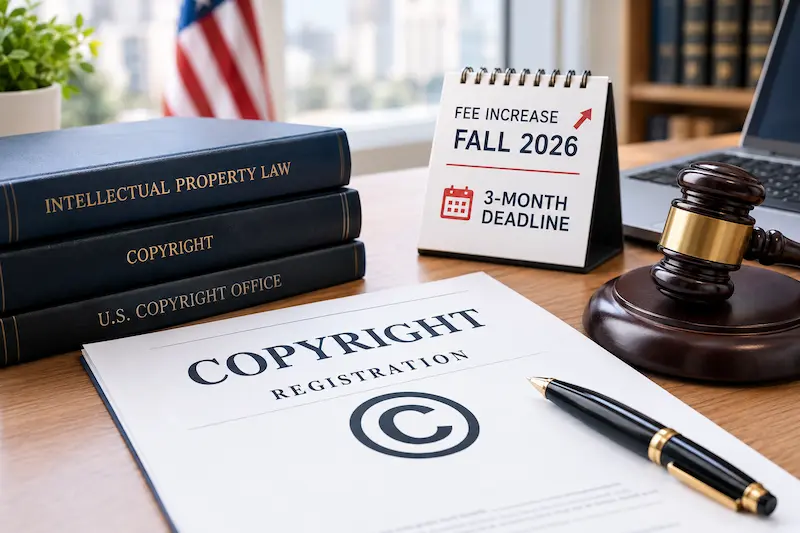
Quick answer: You own the copyright the moment your work is fixed — written, recorded, saved. Registration is optional, but it’s what lets you sue, and registering before an infringement (or within three months of publishing) is what makes statutory damages and attorney’s fees possible. Online registration currently costs $45 or $65 for most single works.
Those fees are scheduled to rise this fall — to $55 and $85 — and some group options double. The new fees can take effect on or after November 11, 2026. A complete filing submitted before the change is charged today’s fee.
Fees and processing times verified October 27, 2026 from copyright.gov. This is general information, not legal advice.
Which Application — and What Will It Cost?
You Already Own It: What “Automatic” Copyright Means
Copyright exists the moment your original work is fixed in a form you can see, hear, or reproduce.
AUTOMATIC: You own it already — registration is about enforcing it.
Copyright does not cover ideas, names, titles, or short phrases. Names and logos as brands are trademark territory — see How to Trademark a Business Name and Trademark vs Copyright vs Patent. The USPTO does not register copyrights; see the USPTO fee schedule for what it does charge for.
What Registration Adds — and Why the Timing Matters
Registration lets you sue, gives you evidence, and — if done in time — unlocks statutory damages and attorney’s fees.
- Right to sue: for a U.S. work, the Office must have registered or refused your claim before you file in federal court (17 U.S.C. §411(a); Fourth Estate v. Wall-Street.com, 2019).
- Evidence: a certificate made before or within five years of publication is prima facie evidence of validity (§410(c)).
- Money: §412 generally requires registration before the infringement began, or within three months of first publication, for statutory damages and attorney’s fees.
| What you get | Automatic | Registered | Registered in time |
|---|---|---|---|
| Ownership | Yes | Yes | Yes |
| Right to sue (U.S. works) | No | Yes | Yes |
| Prima facie evidence | No | If within 5 years of publication | Same |
| Statutory damages | No | Generally no | May be available |
| Attorney’s fees | No | Generally no | May be available |
| CCB statutory cap | Can’t file until an application is submitted | $7,500 per work / $15,000 total | Up to $15,000 per work |
In federal court, statutory damages run $750–$30,000 per work, up to $150,000 for willful infringement, and as low as $200 for innocent infringement (§504(c)). Nothing is guaranteed in any case.
The 3-Month Rule, Explained With Dates
If you register within three months of first publication — or before any infringement starts — statutory damages and attorney’s fees generally stay available.
REGISTERED IN TIME: The 3-month clock starts at first publication, not at creation. Your effective date of registration is the day the Office receives your complete application, deposit, and fee (§410(d)).
- Published book: published March 1 → grace window ends June 1.
- Unpublished song: no grace window. Register before anyone infringes.
- Photos posted online: posting publicly may count as publication; the clock may be running. Ask counsel if unsure.
3-Month Rule Checker
Which Application Fits Your Work
Use the Single Application only if you’re the sole author and owner of one work not made for hire; otherwise use Standard or a group option.
The Single Application has strict eligibility — one author, one work, not for hire. The Office says it has a high error rate and won’t carry into its new registration system for now. If unsure, use Standard.
| Work | Likely option | Key condition |
|---|---|---|
| Book, article, code, web content | Single or Standard | Single: sole author/owner, not for hire |
| Song and recording | Standard | Composition and recording are different works; one claim can cover both only if the owner is the same |
| Album songs / recordings | Album group options | Songs up to 20; recordings on an album |
| Photographs | Group of photographs | Up to 750; published and unpublished can’t mix yet |
| 2-D art | Group of 2-D artwork | Up to 20 published works |
| Blog posts | Group of short online works | Up to 50 |
| Several unpublished works | Group of unpublished works | Up to 10 |
If you made a book…
Register the final text. If you’re the only author and owner, Single may fit; otherwise Standard.
If you made a song or album…
Compositions and recordings are separate. Album recordings go from $65 to $130 under the new schedule.
If you made photos or art…
Group options can cost cents per image. Register before posting widely, or within three months of publishing.
If you wrote code or blog posts…
Code uses Standard (or Single if eligible). Blog posts can be grouped, up to 50. Disclose AI-generated material — see Can You Copyright AI-Generated Work.
What It Costs: 2026 Fees, Old and New
Online fees rise 22% for the Single Application and 31% for Standard, while several group options double.
| Option | What it covers | Current | New | Per work at max |
|---|---|---|---|---|
| Single Application | One author, one work, not for hire | $45 | $55 | $55 |
| Standard (electronic) | One work | $65 | $85 | $85 |
| Paper | One work | $125 | $185 | $185 |
| Photographs (group) | Up to 750 | $55 | $85 | About $0.11 |
| Album musical works | Up to 20 | $65 | $85 | $4.25 |
| Album recordings | One album | $65 | $130 | Varies by tracks |
| Short online works | Up to 50 | $65 | $130 | $2.60 |
| Unpublished works | Up to 10 | $85 | $130 | $13 |
| 2-D artwork | Up to 20 published | $85 | $130 | $6.50 |
| Periodical contributions | Group | $85 | $130 | Varies |
| Supplementary (electronic) | Correct a registration | $100 | $85 (decrease) | n/a |
| Special handling surcharge | Expedited | $800 | $1,100 | n/a |
An additional certificate goes from $55 to $80. The fee in force on the day your complete filing is received applies — confirm how the Office handles the switch. Filing services charge their own fees on top of the government fee; you can file yourself on the official portal.
How to File Online, Step by Step
Create an account on the Office’s portal, choose your application, pay, and upload your deposit.
- 1. Create an account at copyright.gov.
- 2. Pick the application and describe the work.
- 3. List authors and ownership; exclude licensed or AI-generated material.
- 4. Pay the fee.
- 5. Upload the deposit copy and save your case number.
Common refusals: ineligible Single Application, wrong work type, unclear authorship or excluded material.
How Long Registration Takes
Electronic claims averaged roughly three months for October 2025–March 2026, affected by the October 1–November 12, 2025 funding lapse; the Office expects under two months.
Your effective date is your submission date, not your certificate date. Special handling is worth considering only when a court deadline is near.
Five Copyright Myths
- Poor man’s copyright (mailing it to yourself): the Office says the law has no provision for it, and it isn’t a substitute for registration.
- The © symbol protects you: it’s a notice, not protection.
- “Change 30% and it’s yours”: no such rule.
- Registration protects ideas: it covers expression only.
- The USPTO registers copyrights: it doesn’t.
If Someone Copies Your Work: Court vs. the CCB
The Copyright Claims Board is a lower-cost route with caps; federal court has higher ceilings and costs.
| Feature | Federal court | CCB |
|---|---|---|
| Filing fee | Court fees apply | $100 total ($40 + $60) |
| Lawyer needed | Usually | No |
| Damages cap | Per statute | $30,000 per proceeding |
| Statutory damages | $750–$30,000 per work if timely | $15,000 per work timely; $7,500/$15,000 not timely |
| Opt-out | n/a | Respondent may opt out |
| Registration needed to file | Registered or refused | A submitted application is enough, but damages wait for the certificate |
State small claims is not the CCB — see small claims court. For the other side, see Copyright Letter Over a Photo. Consider an IP lawyer for works made for hire, joint works, disputes, and active infringement.
Pre-Filing Checklist
1. Final version of the work, saved in an accepted file format.
2. Publication facts: published or not; date and country of first publication.
3. Authorship: every author's name; whether any part was made for hire.
4. Ownership: who owns it now; any transfers in writing.
5. Material to exclude: prior versions, licensed samples, stock elements, AI-generated material.
6. Which application (see the tool above) and its eligibility conditions.
7. Pay the government fee on the official portal only.
8. Save the case number and the date you submitted — that's your likely effective date.
FAQ
Is copyright automatic in the US?
Yes, once your work is fixed. Registration is separate.
Do I need to register?
Not to own it, but you generally need to before suing over a U.S. work.
How much does it cost?
Currently $45 (Single) or $65 (Standard) online; see the table for group options.
Are fees going up?
Yes, on or after November 11, 2026 unless Congress disapproves. Confirm on copyright.gov.
Can I sue without registering?
For U.S. works, generally no.
What is the effective date of registration?
The day the Office receives your complete application, deposit, and fee.
What is the 3-month rule?
Register within three months of first publication, or before infringement begins, to keep statutory damages and attorney’s fees available.
Is poor man’s copyright legal?
The Office says the law has no provision for it and it is not a substitute for registration.
What is the Copyright Claims Board?
A small-claims tribunal for copyright disputes, capped at $30,000 per proceeding.
Can I copyright something I made with AI?
Disclose AI-generated material on the application. See You Don’t Own the AI Content You Created.
This is general information, not legal advice. Fees and processing times were verified October 27, 2026 from the U.S. Copyright Office; eligibility and enforcement depend on specific facts.
Last updated:

Daniel Hayes is the founder and sole researcher at AdvoraHQ. He covers U.S. personal finance, insurance, and consumer law — working directly from IRS publications, federal and state statutes, court opinions, and SEC filings rather than secondary summaries. His focus is the gap between what readers think they know and what the source documents actually say. Daniel is not a licensed attorney, CPA, or financial advisor; his articles are educational and not personalized advice. Reach him at Daniel.Hayes@advorahq.com.