
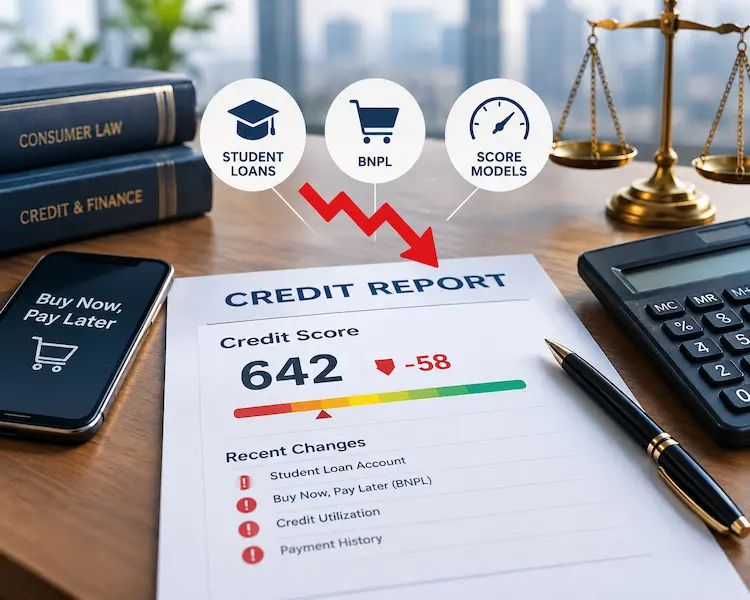
Your score almost never drops “for no reason.” Either something new reached your credit report, or you’re comparing two different scores. Small drops are usually timing — a balance that reported before your payment landed. Large drops usually mean a reported late payment or collection, and in 2025–2026, often a student loan delinquency.
Tell us how many points you lost — get the likely causes in order → Jump to the diagnoser
Under 20 points
Usually timing — a balance reported before payment, a hard inquiry, or a closed/paid-off account. See the size table.
20–59 points
Could be timing or something reported — an issuer-side change, a first late payment, or an early student loan delinquency. See the size table.
60+ points
Usually a serious reported event — a collection, a student loan default, or a longer missed-payment pattern. See the size table.
Different app, different number
Not necessarily a drop at all. Check whether you’re comparing the same score.
Data verified . Sources: FICO, the New York Fed, FHFA, and the CFPB.
Score Drop Diagnoser
Answer a few questions about what you saw and what happened in the last 60 days. This gives you a starting checklist, not a prediction.
First: Are You Even Looking at the Same Score?
There isn’t one “credit score.” There are dozens of scoring models, run on three different bureaus, and they disagree with each other routinely. A gap between two apps isn’t a drop — it’s two different rulers.
The most common split is FICO 8 (the model lenders have used for years) against VantageScore 3.0 or 4.0 (the model most free apps show). They weigh things like utilization, recent inquiries, and thin files differently, so the same credit report can produce two different numbers on the same day.
It also matters which bureau the score came from. A late payment or a new account doesn’t always land on Equifax, Experian, and TransUnion at the same time, so a score pulled from one bureau can lag or lead the others.
Mortgage scoring is shifting too. As of , Fannie Mae and Freddie Mac expanded approval of VantageScore 4.0 to all approved lenders, after a limited rollout that began . Classic FICO is still accepted, and FICO 10T has been approved for future use with no start date set yet. In practice: the score in your free app may not be the score a mortgage lender pulls.
“Two apps, two numbers — that’s usually two models, not a problem.”
Which Score Are You Looking At?
| Where you see it | Model usually shown | Bureau(s) | Who uses it |
|---|---|---|---|
| Free apps | Often VantageScore 3.0 | Usually TransUnion and/or Equifax | Rarely the exact model a lender pulls |
| Card issuer apps | Varies by issuer — often FICO 8 or VantageScore | Varies by issuer; check your card’s disclosure | Good for tracking trends, not guaranteed to match a lender’s pull |
| myFICO | FICO (various versions) | Your choice of bureau | Closer to what many lenders use, but not identical to every lender’s pull |
| Mortgage lenders | Classic FICO, or VantageScore 4.0 (expanded Sept. 9, 2026); FICO 10T approved for future use, no date yet | Typically a tri-merge of all three bureaus | Fannie Mae / Freddie Mac loan decisions |
| Auto lenders | FICO Auto Score (industry-specific) | Varies by lender | Auto financing decisions |
Read the Size of the Drop
The number of points you lost is a clue. Small drops tend to be timing. Large drops tend to be something that actually landed on your report.
Statement-date utilization
- Tier
- Timing
- Typical impact
- Varies — no reliable published average.
- How long it lasts
- Resolves next cycle once the lower balance reports.
- What to do
- Pay before the statement closing date, not just the due date.
- Deep dive
- Statement-date trap
Closed card (you closed it)
- Tier
- Reported change
- Typical impact
- Varies — no reliable published average.
- How long it lasts
- Often eases over a few months as utilization and average account age adjust.
- What to do
- Avoid closing more cards while recovering. Card Closed guide
Paid-off loan
- Tier
- Timing
- Typical impact
- Varies — no reliable published average.
- How long it lasts
- Usually temporary; often eases within a few cycles.
- What to do
- Don’t open new credit to “fix” it. Why paying off a loan can lower your score
Hard inquiry
- Tier
- Timing
- Typical impact
- Varies — no reliable published average.
- How long it lasts
- FICO stops counting it after 12 months; it stays on the report 2 years.
- What to do
- Nothing needed. Soft vs. hard pulls
Lowered limit (issuer action)
- Tier
- Reported change
- Typical impact
- Varies — no reliable published average.
- How long it lasts
- Until utilization recalculates or the limit is restored.
- What to do
- Call the issuer. Credit Limit Lowered guide
Removed as authorized user
- Tier
- Reported change
- Typical impact
- Varies — no reliable published average.
- How long it lasts
- Reflects once the account drops off your report.
- What to do
- Authorized User guide
30-day late payment
- Tier
- Serious negative
- Typical impact
- Varies — no reliable published average.
- How long it lasts
- Stays up to 7 years; impact fades over time.
- What to do
- Get current now; consider a goodwill letter if it’s a first slip. Goodwill letter
90-day late
- Tier
- Serious negative
- Typical impact
- Varies — no reliable published average.
- How long it lasts
- Stays up to 7 years.
- What to do
- Contact the creditor about repayment options. Fixes itself vs. needs you
Collection account
- Tier
- Serious negative
- Typical impact
- Varies — no reliable published average.
- How long it lasts
- Up to 7 years from the original delinquency date.
- What to do
- Verify it’s accurate and yours before paying. When it’s a mistake
Student loan delinquency
- Tier
- Serious negative
- Typical impact
- FICO (Aug. 25, 2026 update): borrowers with a recent delinquency saw an average 38-point year-over-year decline. FICO (Mar. 24, 2026 report): newly delinquent borrowers averaged a 62-point drop since January 2025. These are two separate measurements — don’t combine them.
- How long it lasts
- Reported once 90+ days past due; eases as you rebuild on-time payment history.
- What to do
- Contact your servicer. Student Loans
Student loan default
- Tier
- Serious negative
- Typical impact
- NY Fed (May 12, 2026): borrowers who defaulted in Q4 2025–Q1 2026 saw an average drop of about 91 points — on the Equifax Risk Score 3.0 scale, not FICO.
- How long it lasts
- Default notation can be removed only through rehabilitation (9 on-time payments in 10 consecutive months); late payments reported before default remain.
- What to do
- Look into rehabilitation or consolidation. Student Loans
Identity theft or report error
- Tier
- Serious negative — act now
- Typical impact
- Varies — no reliable published average.
- How long it lasts
- Until disputed and corrected; investigations generally run about 30 days.
- What to do
- Freeze your credit, file at IdentityTheft.gov, and dispute with the bureau and creditor. Dispute it · Someone opened a card in my name
| Cause | Tier | Typical impact (source) | How long it lasts | What to do | Deep dive |
|---|---|---|---|---|---|
| Statement-date utilization | Timing | Varies — no reliable published average | Next cycle, once the lower balance reports | Pay before the statement closing date | Statement-date trap |
| Closed card (you closed it) | Reported change | Varies — no reliable published average | Often eases over a few months | Avoid closing more cards while recovering | Card Closed guide |
| Paid-off loan | Timing | Varies — no reliable published average | Usually temporary, a few cycles | Don’t open new credit to “fix” it | Paid off a loan |
| Hard inquiry | Timing | Varies — no reliable published average | Counted 12 months; stays on report 2 years | Nothing needed | Soft vs. hard pulls |
| Lowered limit (issuer action) | Reported change | Varies — no reliable published average | Until utilization recalculates or limit restored | Call the issuer | Credit Limit Lowered |
| Removed as authorized user | Reported change | Varies — no reliable published average | Reflects once account drops off report | See guide | Authorized User |
| 30-day late payment | Serious negative | Varies — no reliable published average | Up to 7 years; impact fades | Get current; consider a goodwill letter | Goodwill letter |
| 90-day late | Serious negative | Varies — no reliable published average | Up to 7 years | Contact creditor about options | Fixes itself vs. needs you |
| Collection account | Serious negative | Varies — no reliable published average | Up to 7 years from delinquency date | Verify before paying | When it’s a mistake |
| Student loan delinquency | Serious negative | FICO Aug. 25, 2026: avg. 38-pt YoY decline (recent delinquency). FICO Mar. 24, 2026: avg. 62-pt drop since Jan. 2025 (newly delinquent). Separate measures. | Reported at 90+ days past due; eases with new on-time history | Contact your servicer | Student Loans |
| Student loan default | Serious negative | NY Fed May 12, 2026: avg. ~91-pt drop, Equifax Risk Score 3.0 scale (not FICO) | Default notation removable only via rehabilitation | Look into rehabilitation or consolidation | Student Loans |
| Identity theft or error | Serious negative — act now | Varies — no reliable published average | Until disputed/corrected (~30-day investigation) | Freeze credit, file at IdentityTheft.gov, dispute | Dispute it |
Paid in Full and It Still Dropped: The Statement-Date Trap
Your score usually reflects the balance your card issuer reported on your statement closing date — not the balance after you paid it off days later.
Worked example: a card with a $5,000 limit carries a $2,400 balance on the statement date. That’s 48% utilization, reported to the bureaus that day. Five days later, you pay the full $2,400. The payment doesn’t undo what was already reported — the bureaus see the next lower balance only after your next statement closes.
This is the single most common “I paid it off and it still dropped” story. See Statement Balance Interest and Credit Utilization for the mechanics.
“Paid in full and still dropped? Check your statement date, not your due date.”
Why Paying Off a Loan Can Lower Your Score
Closing out an installment loan — a car loan, a personal loan, a student loan — can shift two things scoring models look at: your credit mix (a blend of installment and revolving accounts) and your average account age once that account stops being counted as active.
This is usually temporary. The common instinct is to open a new account to “replace” what was closed — resist that. A new account adds a hard inquiry and a young account, which typically makes a recent drop worse, not better.
The 2026 Triggers Hitting People Who Changed Nothing
Four things shifted in 2025–2026 that can move your score even if you didn’t do anything differently.
| Trigger | What changed | Date | Who’s affected | Our guide |
|---|---|---|---|---|
| Student loan delinquency reporting resumed | Federal servicers resumed reporting delinquencies after the pandemic-era pause | Reflected in FICO reports dated Mar. 24, 2026 and Aug. 25, 2026 | Borrowers 90+ days behind on federal loans | Student Loan Wage Garnishment, RAP Plan |
| Student loan default reporting began | Federal loans default after 270 days unpaid; first defaults from the resumed collection period hit reports in Q4 2025 | NY Fed data covers Q4 2025–Q1 2026, published May 12, 2026 | Borrowers who reached 270+ days past due | Student Loan Wage Garnishment, RAP Plan |
| Medical debt rule vacated | A federal court vacated the CFPB rule banning medical debt from credit reports (Cornerstone Credit Union League v. CFPB) | July 11, 2025 | Anyone with medical collections — though the bureaus’ 2023 voluntary policies still apply | Medical Debt and Credit |
| Mortgage scoring models expanded | Fannie Mae / Freddie Mac allowed VantageScore 4.0 (limited rollout, then expanded to all approved lenders); Classic FICO still accepted; FICO 10T approved for future use | Apr. 22, 2026 → Sept. 9, 2026 | Mortgage applicants | Which score your lender pulls |
| BNPL reporting growth | FICO introduced BNPL-inclusive score versions; some BNPL providers now report to some bureaus — most lenders still use older models | 2025–2026 | BNPL users | BNPL Credit Reporting 2026 |
Student Loans
This is the biggest driver of 2026 score drops for people who feel like they changed nothing. FICO’s Spring 2026 Credit Insights report (dated March 24, 2026) found the average U.S. FICO Score fell to 714, driven mainly by resumed student loan delinquency reporting and a modest rise in mortgage delinquencies. About 7.1 million borrowers had a new student loan delinquency, averaging a 62-point drop since January 2025.
FICO’s August 25, 2026 update held the national average at 714. About 3.2 million consumers with a recent student loan delinquency saw an average 38-point year-over-year decline — while consistent payers gained 6 points, and borrowers without a recent delinquency gained 16.
Separately, the Federal Reserve Bank of New York (Liberty Street Economics, May 12, 2026) reported that federal loans default after 270 days of missed payments, so Q4 2025 was the first quarter new defaults appeared on credit reports. Roughly 3.6 million borrowers defaulted across Q4 2025–Q1 2026, with an average drop of about 91 points — but that figure is on the Equifax Risk Score 3.0 scale, a different measurement than FICO’s. Don’t merge these three numbers into one range; they measure different things.
Delinquency vs. default: federal servicers report delinquency once a payment is 90+ days past due. Default follows 270 days past due. Rehabilitation applies only to loans already in default — 9 on-time payments within 10 consecutive months removes the default notation, but late payments reported before the default remain on your report. If you’re delinquent but not yet in default, rehabilitation isn’t the tool; getting current, changing your repayment plan, or using deferment or forbearance are the options to ask your servicer about.
For next steps: Student Loan Wage Garnishment and RAP Plan.
BNPL
FICO introduced score versions that factor in buy now, pay later activity, and some BNPL providers have started reporting to some bureaus. But most lenders are still pulling older score versions that don’t include BNPL at all, so the practical effect today is inconsistent and provider-dependent. See BNPL Credit Reporting 2026 for the specifics.
Medical Debt
The CFPB rule that would have banned medical debt from credit reports was vacated by a federal court in Texas on July 11, 2025 (Cornerstone Credit Union League v. CFPB). That doesn’t mean every medical bill can now show up freely: the credit bureaus’ own voluntary 2023 policies still stand — paid medical collections and medical collections under $500 aren’t reported. Some states have additional protections of their own. See Medical Debt and Credit.
Your Lender’s New Score Model
If you’re applying for a mortgage, the model matters as much as your payment history. VantageScore 4.0 is now allowed across all Fannie Mae and Freddie Mac approved lenders as of September 9, 2026, after a limited rollout that began April 22, 2026. Classic FICO is still accepted, and FICO 10T is approved for future use with no start date announced yet. Ask your loan officer which model and bureau combination they’re pulling — it may not match the score in your free app.
Changes the Card Company Made, Not You
Some drops come entirely from your card issuer’s side, with no action from you.
A lowered credit limit raises your utilization on that card instantly, even if your balance didn’t change. See Credit Limit Lowered.
A card closed by the issuer — for inactivity or other reasons — removes that available credit and can shorten your average account age. See Card Closed Without Notice.
Being removed as an authorized user drops that account’s history from your report. See Authorized User.
Hard Inquiries: Smaller Than You Think
A hard inquiry stays on your report for 2 years, but FICO only counts it in your score for 12 months. Rate-shopping inquiries for a mortgage, auto loan, or student loan within a short window are typically grouped as one event by most scoring models — the exact window length varies by FICO version, so check the specifics for the model you’re being scored on. See Credit Limit Increase: Soft vs. Hard Pulls.
When It Is a Mistake — or Identity Theft
If something on your report isn’t yours or isn’t accurate, disputing is free and you have the right to do it directly with the bureau and the creditor. Under the FCRA, a dispute is generally investigated within 30 days.
If you don’t recognize an account at all, freeze your credit with all three bureaus and file a report at IdentityTheft.gov. If it’s a known error — a payment marked late that you made on time, a balance that’s wrong — dispute it directly; don’t let it sit.
One important line: never dispute information that’s actually accurate just because it hurts. Disputing accurate information doesn’t remove it, and it wastes the 30-day window you’d rather use on something real. For the identity-theft path specifically, see Someone Opened a Card in My Name.
Fixes Itself vs. Needs You
| Situation | Tier | Your move |
|---|---|---|
| Balance reported before payment posted | Timing | Nothing; pay before the next statement date |
| Paid-off installment loan | Timing | Nothing; don’t open new credit to offset it |
| Hard inquiry from rate shopping | Timing | Nothing; it fades from scoring within 12 months |
| Issuer lowered your limit or closed your account | Reported change | Call the issuer; see the Credit Limit Lowered / Card Closed guides |
| Removed as an authorized user | Reported change | See the Authorized User guide |
| Late payment (first time, now current) | Reported change / serious negative | Consider a goodwill letter; keep paying on time |
| Student loan delinquency | Serious negative | Contact your servicer about rehabilitation, consolidation, deferment, or forbearance |
| Collection, error, or identity theft | Serious negative | Dispute with the bureau and creditor; freeze credit if theft is suspected |
Getting a Late Payment Removed — Realistically
A goodwill letter asks a lender to stop reporting a single late payment, usually on an account that’s otherwise in good standing. It works best when there’s one slip, you’re current now, and you have a reasonable, honest explanation.
Important: this is a request, not a right. The lender has no legal obligation to grant it, and accurate information can lawfully stay on your report. Don’t use a goodwill letter for an error — dispute errors instead (see When It Is a Mistake).
Goodwill Letter Template
[Your name]
[Your address]
[Date]
[Lender name]
[Lender address]
Re: Account ending in [last 4 digits only]
Dear [Lender name],
I’m writing about a late payment reported on my account ending in [last 4 digits] for [month/year]. [One honest sentence on what happened — e.g., “I was between jobs that month and missed the due date before catching up.”]
Since then, I’ve brought the account current and have continued making on-time payments. I’m asking whether you’d consider a goodwill adjustment to remove the late-payment notation for that month from my credit report.
I understand this is entirely at your discretion, and I appreciate you taking the time to review my request.
Thank you,
[Your name]
How Long Until It Comes Back
Recovery time depends entirely on the cause — there’s no universal timeline, and individual results vary by scoring model and credit profile.
Timing causes (a reported balance, a recent inquiry, a paid-off loan) typically ease by the next reporting cycle or two, once the updated information reports.
Reported changes made by an issuer (a lowered limit, a closed account) often improve gradually over a few months as your utilization and account mix settle.
Serious negatives — late payments, collections, student loan delinquency or default — take longer. FICO’s August 2026 data shows the direction, not a timeline: consistent payers gained 6 points year-over-year, and borrowers without a recent delinquency gained 16. There’s no published average for “how many months until a late payment’s effect fades” — it depends on everything else on your report.
Your Next 30 Days
- 1. Pull all three reports free at AnnualCreditReport.com.
- 2. Compare the same model from the same bureau before and after.
- 3. Find the change: new late payment · higher reported balance · new inquiry · closed account · collection · unknown account.
- 4. Wrong? Dispute it with the bureau and the creditor; keep copies.
- 5. Unknown account? Freeze your credit and file at IdentityTheft.gov.
- 6. Timing? Pay before the statement date next cycle.
- 7. Student loans? Check your status on studentaid.gov this week.
- 8. Applying soon? Ask the lender which score model they use.
FAQ
Why did my credit score drop when nothing changed?
Something on your report changed even if you didn’t apply for anything — a reported balance, a late payment, an inquiry, or an issuer-side change like a lowered limit. Or you’re comparing two different scoring models.
Can your credit score drop for no reason?
No. Scores are calculated from your credit report at a point in time. If nothing on the report — and nothing about the scoring model — changed, the score doesn’t move.
Why did my credit score drop 50 points?
A drop this size usually points to something reported: a missed payment, a new collection, or a student loan delinquency, rather than a timing quirk. Check the size table above.
Why did my credit score drop 100 points?
This is a large drop, often tied to a serious report event — a first-time late payment on an otherwise clean file, a collection, or a student loan default. Pull your reports to confirm which.
Why did my score drop after I paid off my credit card?
Paying it off shouldn’t lower your score by itself. Check whether your reported balance was high on the statement date, before the payment posted — see the statement-date trap.
Why did my score drop after paying off my car loan?
Closing out an installment loan can shift your credit mix and average account age. This is usually temporary — don’t open new credit to offset it.
Why is my Credit Karma score different from my FICO score?
They’re usually different scoring models — often VantageScore vs. FICO — pulled from different bureaus. A gap between them isn’t a problem by itself; see which score are you looking at.
Which credit score do mortgage lenders use in 2026?
Classic FICO is still accepted, and VantageScore 4.0 is now allowed by Fannie Mae and Freddie Mac as of September 9, 2026. Ask your lender which model and bureau combination they’ll pull.
How much does a missed student loan payment hurt my score?
It depends on your file, but FICO’s 2026 data shows borrowers with a recent student loan delinquency losing meaningfully more on average than the typical borrower — see the labeled figures in Student Loans.
What’s the difference between student loan delinquency and default on my credit?
Delinquency is reported once a federal loan is 90+ days past due. Default follows 270 days past due. Rehabilitation removes only the default notation — late payments reported before the default remain.
Does buy now, pay later affect my credit score?
It can, depending on the provider and whether it reports to a bureau — but most lenders still use older scoring models that don’t yet include BNPL activity. See BNPL Credit Reporting 2026.
Is medical debt on credit reports in 2026?
The federal rule banning it from reports was vacated in 2025, so it isn’t automatically blocked. The bureaus’ own 2023 policies still keep paid medical collections, and ones under $500, off reports — and some states add further protections.
How many points does a hard inquiry take off?
There’s no reliable published average; the effect is usually small and short-lived. FICO stops counting inquiries after 12 months, even though they stay on your report for 2 years.
Does checking my own score lower it?
No. Checking your own score is a soft inquiry and doesn’t affect your score.
How long does a late payment stay on my report?
Up to 7 years, though its effect on your score typically fades well before it drops off.
Do goodwill letters actually work?
Sometimes, for a single late payment on an otherwise clean account — but it’s a request, not a right. The lender can say no, and it isn’t a substitute for disputing something that’s actually wrong.
How long does it take for my score to go back up?
It depends on the cause. Timing issues usually ease next cycle, while late payments, collections, and student loan events take longer and improve gradually as you build new payment history.
Should I open a new card to raise my score after a drop?
No — opening new credit adds a hard inquiry and a new, young account, which can lower your score further right after a drop.
This article is general information, not financial or legal advice. Score impacts vary by scoring model and individual credit profile. Figures are from the cited sources as of the dates noted above. Only your own credit reports show exactly what changed.
Last updated: .

Daniel Hayes is the founder and sole researcher at AdvoraHQ. He covers U.S. personal finance, insurance, and consumer law — working directly from IRS publications, federal and state statutes, court opinions, and SEC filings rather than secondary summaries. His focus is the gap between what readers think they know and what the source documents actually say. Daniel is not a licensed attorney, CPA, or financial advisor; his articles are educational and not personalized advice. Reach him at Daniel.Hayes@advorahq.com.
