
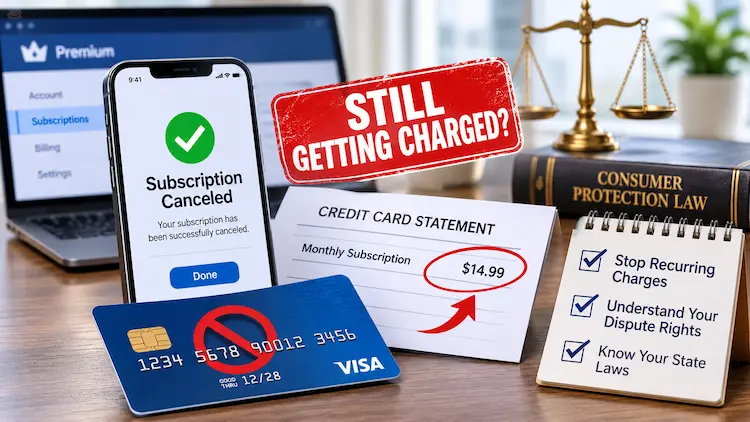
Quick answer: Don’t start by getting a new card. Visa, Mastercard, and Amex run updater services that can pass your new number to the merchant. Instead: (1) find who is actually billing you — the company, Apple, Google, or PayPal; (2) cancel there and save proof; (3) ask your card issuer to block the merchant, and dispute any charge after your cancellation date in writing within 60 days of the statement it first appears on.
Build your exact steps — and your deadline →
1. Find it
Read the billing line on your statement. The charge may come from the company, Apple, Google, or PayPal, and each is canceled in a different place.
2. Stop it
STOP IT. Cancel where you are billed, send a written notice, then block the merchant (credit card) or file a stop payment (debit or bank debit).
3. Get it back
GET IT BACK. For charges after your cancellation date, send a written billing-error notice within 60 days of the first statement showing the charge.
- Who’s billing you
- New card trap
- Every way to stop it
- Credit vs. debit
- Get your money back
- State laws
- Letters
Rules verified . The FTC’s 2024 click-to-cancel rule was vacated in July 2025; state laws now do most of the work.
This guide uses three tiers. STOP IT covers future charges. GET IT BACK covers charges already posted. PROVE IT covers the records that win disputes. If the charge is from a company you never signed up with at all, start with Unauthorized Credit Card Charges instead.
The “Stop This Charge” Planner
Answer a few questions to get an ordered list of steps and your deadline. Nothing you pick is stored or sent anywhere. Don’t type card numbers, names, or amounts.
First, Find Who Is Actually Billing You
The company you signed up with may not be the one that bills you, and each biller is canceled in a different place.
Look at the billing line on the statement, not the brand name. It can show a parent company, a payment processor, or an abbreviation. Then check three places that often hide a subscription:
- Directly from the merchant
- Cancel in the company’s own account settings or by its stated cancellation method.
- Apple or Google Play
- Charges billed through an app store are canceled in that account, not on the company’s website. Deleting the app does not cancel the subscription (Apple and Google both say so on their help pages).
- PayPal
- If the statement shows PayPal, the recurring payment is an automatic payment in your PayPal account. Cancel it there and cancel with the company too. Menu labels change, so use PayPal’s Help Center for current steps.
Free trials deserve a second look. A trial that converted to a paid plan was part of the terms you accepted at sign-up. Whether a charge is disputable depends on when you canceled relative to the trial end date and what the offer disclosed.
Why a New Card Number Often Doesn’t Stop It
A replacement card often doesn’t stop a recurring charge, because Visa, Mastercard, and American Express run services that can pass your new number or expiration date to merchants enrolled in them.
The services are called Visa Account Updater, Mastercard Automatic Billing Updater, and American Express Cardrefresher. They exist so subscriptions don’t fail when a card is renewed or replaced. The catch: they work for the merchant, not for your cancellation.
STOP IT. The updater changes which number gets charged. It doesn’t change whether you canceled. Say so in writing: your cancellation notice should include “do not charge any updated card number” (the notice is in the Cancel the Right Way section).
What to ask your card issuer
Call the number on the back of your card, and ask these four things:
- 1
- Is this card enrolled in the network’s account updater?
- 2
- Can I opt out? (Some issuers let cardholders opt out; not all do. Ask your issuer.)
- 3
- Can you block this merchant from charging the card?
- 4
- What is the billing-error address for written disputes?
An opt-out may apply to every merchant on the card, not just the one you’re escaping. Utilities and other billers may then need your new number entered by hand. Opting out also doesn’t cancel anything.
When closing the card makes sense, and the downside
Closing a card is a blunt last resort, not a first move. It doesn’t cancel the subscription or settle what you owe, it can affect your credit, and any refund sent later to a closed card gets harder to receive. See How to Cancel a Credit Card and Refund Sent to a Closed Card. If you moved to a different issuer, recurring billing may move with the account; see Credit Card Changing Issuers.
Every Way to Stop a Recurring Charge, Compared
Different methods stop different things: some stop the next charge, some recover past charges, and none does both on its own.
Cancel with the company (STOP IT)
- Stops future charges?
- Yes, once the company processes it.
- Recovers past charges?
- No.
- The catch
- Needs proof of the date. Contract notice periods or written-notice rules may still apply, and an unprocessed cancellation keeps the billing going.
Cancel in Apple, Google, or PayPal (STOP IT)
- Stops future charges?
- Yes, for charges billed through that account.
- Recovers past charges?
- No. Refunds are a separate request.
- The catch
- It only reaches charges billed through that platform. Deleting the app does not cancel the subscription.
Issuer merchant block (STOP IT)
- Stops future charges?
- Often.
- Recovers past charges?
- No.
- The catch
- Issuer policy, not a legal entitlement, so it may be declined. A merchant that bills under another name may get past it.
Reg E stop payment, debit card or ACH (STOP IT)
- Stops future charges?
- Yes, if requested at least 3 business days before the scheduled debit.
- Recovers past charges?
- No.
- The catch
- Oral is valid, but the bank may require written confirmation within 14 days. It stops the debit; it doesn’t end any contract obligation.
New card number (STOP IT, unreliable)
- Stops future charges?
- Not reliably.
- Recovers past charges?
- No.
- The catch
- Account updater services can pass the new number to enrolled merchants, so the charge may follow you.
Account-updater opt-out (STOP IT)
- Stops future charges?
- Helps keep a new number from being passed along; not offered by every issuer.
- Recovers past charges?
- No.
- The catch
- Ask your issuer. An opt-out may apply to all merchants, not just one, and it doesn’t cancel anything.
Closing the card (STOP IT, blunt)
- Stops future charges?
- Not reliably.
- Recovers past charges?
- No.
- The catch
- Can affect your credit, complicates refunds sent to a closed card, and doesn’t end what you owe. A last resort.
Billing-error dispute, credit card (GET IT BACK)
- Stops future charges?
- No. Pair it with a stop method.
- Recovers past charges?
- Possibly.
- The catch
- Written notice must reach the billing-error address within 60 days of the first statement showing the charge. The outcome depends on the facts and your contract.
Virtual card number (STOP IT)
- Stops future charges?
- Yes, if you delete the number or set limits on it.
- Recovers past charges?
- No.
- The catch
- Only where your issuer offers virtual numbers, and best set up before the merchant starts billing.
| Method | Tier | Stops future charges? | Recovers past charges? | The catch |
|---|---|---|---|---|
| Cancel with the company | STOP IT | Yes, once the company processes it | No | Needs proof of the date. Contract notice periods or written-notice rules may still apply, and an unprocessed cancellation keeps the billing going. |
| Cancel in Apple, Google, or PayPal | STOP IT | Yes, for charges billed through that account | No; refunds are a separate request | It only reaches charges billed through that platform. Deleting the app does not cancel the subscription. |
| Issuer merchant block | STOP IT | Often | No | Issuer policy, not a legal entitlement, so it may be declined. A merchant that bills under another name may get past it. |
| Reg E stop payment (debit card, ACH) | STOP IT | Yes, if requested at least 3 business days before the scheduled debit | No | Oral is valid, but the bank may require written confirmation within 14 days. It stops the debit; it doesn’t end any contract obligation. |
| New card number | STOP IT (unreliable) | Not reliably | No | Account updater services can pass the new number to enrolled merchants, so the charge may follow you. |
| Account-updater opt-out | STOP IT | Helps keep a new number from being passed along; not offered by every issuer | No | Ask your issuer. An opt-out may apply to all merchants, not just one, and it doesn’t cancel anything. |
| Closing the card | STOP IT (blunt) | Not reliably | No | Can affect your credit, complicates refunds sent to a closed card, and doesn’t end what you owe. A last resort. |
| Billing-error dispute (credit card) | GET IT BACK | No; pair it with a stop method | Possibly | Written notice must reach the billing-error address within 60 days of the first statement showing the charge. The outcome depends on the facts and your contract. |
| Virtual card number | STOP IT | Yes, if you delete the number or set limits on it | No | Only where your issuer offers virtual numbers, and best set up before the merchant starts billing. |
Credit Card, Debit Card, or Bank Debit: Your Rights Aren’t the Same
Credit cards give you a written dispute process but no statutory stop-payment right, while debit cards and bank debits give you a stop-payment right under Regulation E.
Credit cards: Regulation Z
The Fair Credit Billing Act, implemented by Regulation Z (12 CFR §1026.13), covers billing errors, including charges for goods or services not accepted or not delivered as agreed. There is no matching federal stop-payment right for credit cards. Many issuers will block a merchant as a policy; that is a courtesy, not an entitlement.
Debit cards and bank debits: Regulation E
Under Regulation E (12 CFR §1005.10(c)), recurring debits, including recurring debit-card charges, are “preauthorized transfers.” You can stop one by notifying your bank orally or in writing at least three business days before the scheduled debit. The bank may require written confirmation within 14 days of an oral notice, and an oral stop order stops being binding after 14 days if the confirmation never arrives.
Once the bank knows your authorization has ended, it must block future payments to that payee. The official commentary (comments 10(c)-2 and 10(c)-3) lets the bank confirm that you told the merchant, for example by asking for a copy of your revocation within 14 days of an oral notice. It also lets a bank that can’t block a debit-card-network debit use a third party to block it, as long as your account isn’t debited. If the debit item is resubmitted, the bank has to keep honoring the order (comment 10(c)-1).
If a debit-card subscription pushes you into overdraft, see Overdraft Fees Refunded.
Credit card
- Law
- Fair Credit Billing Act; Regulation Z, 12 CFR §1026.13
- Stop-payment right
- None in the statute. A merchant block is issuer policy.
- Dispute deadline
- Written notice received within 60 days after the first statement showing the charge.
- Your money during the investigation
- The issuer must acknowledge within 30 days and resolve within two complete billing cycles, no later than 90 days. You generally don’t have to pay the disputed amount meanwhile ★verify §1026.13(d).
Debit card
- Law
- Electronic Fund Transfer Act; Regulation E, 12 CFR §1005.10(c) and §1005.11
- Stop-payment right
- Yes: at least 3 business days before the scheduled debit. Oral is valid; written confirmation within 14 days may be required.
- Dispute deadline
- Error notice no later than 60 days after the statement first showing the error.
- Your money during the investigation
- The bank generally must resolve within 10 business days, or take up to 45 days if it credits your account provisionally within 10 business days. No provisional credit is required if the bank asked for written confirmation of an oral notice and didn’t get it within 10 business days.
Bank debit (ACH)
- Law
- Regulation E, same sections as debit cards
- Stop-payment right
- Yes, same as debit cards.
- Dispute deadline
- Same 60-day error notice.
- Your money during the investigation
- Same investigation and provisional-credit rules as debit cards.
PayPal or app store
- Law
- PayPal’s user agreement; Apple’s and Google’s terms. Regulation Z or E may apply to the card or bank account behind the payment in some cases ★verify.
- Stop-payment right
- Cancel the automatic payment or subscription in that account.
- Dispute deadline
- ★verify; set by the platform’s current terms.
- Your money during the investigation
- ★verify; set by the platform.
| Payment type | Law | Stop-payment right | Dispute deadline | Your money during the investigation |
|---|---|---|---|---|
| Credit card | Fair Credit Billing Act; Regulation Z, 12 CFR §1026.13 | None in the statute. A merchant block is issuer policy. | Written notice received within 60 days after the first statement showing the charge | Issuer must acknowledge within 30 days and resolve within two complete billing cycles, no later than 90 days. You generally don’t have to pay the disputed amount meanwhile ★verify §1026.13(d). |
| Debit card | Electronic Fund Transfer Act; Regulation E, 12 CFR §1005.10(c) and §1005.11 | Yes: at least 3 business days before the scheduled debit. Oral is valid; written confirmation within 14 days may be required. | Error notice no later than 60 days after the statement first showing the error | Bank generally must resolve within 10 business days, or take up to 45 days if it credits your account provisionally within 10 business days. No provisional credit is required if the bank asked for written confirmation of an oral notice and didn’t get it within 10 business days. |
| Bank debit (ACH) | Regulation E, same sections as debit cards | Yes, same as debit cards | Same 60-day error notice | Same investigation and provisional-credit rules as debit cards |
| PayPal | PayPal’s user agreement. Regulation Z or E may apply to the card or bank account behind the payment in some cases ★verify. | Cancel the automatic payment in PayPal ★verify any bank-level stop-payment rights for PayPal-funded debits | ★verify the current window in PayPal’s user agreement | ★verify; set by PayPal’s policies |
| App store (Apple, Google Play) | Apple’s and Google’s terms | Cancel the subscription in your Apple Account or Google Play subscriptions list | ★verify; set by Apple or Google | ★verify; set by Apple or Google |
Why credit is often the safer way to pay for subscriptions
A credit card dispute is a fight over the issuer’s money, not yours. A debit or ACH dispute starts with cash already gone from your account, which can trigger overdrafts while the bank investigates. Credit also gives you the written billing-error process with a fixed timeline.
How to Get Back Charges You Didn’t Owe
For a credit card, send a written billing-error notice that reaches the issuer’s billing-error address within 60 days after the first statement showing the charge.
GET IT BACK. The notice must be in writing and received, not just sent. Electronic notice counts only if the issuer’s billing-rights statement says it accepts one, and tells you how to send it.
- You don’t have to contact the merchant first
- Regulation Z says a consumer isn’t required to notify the merchant before sending a billing-error notice (comment 13(a)(3)-3). Your proof of cancellation still matters.
- What the issuer must do
- Acknowledge your notice within 30 days, then resolve it within two complete billing cycles, and no later than 90 days.
- How to describe it
- Present the charge as a billing error and describe your cancellation. Whether a specific post-cancellation charge counts as unauthorized or “not delivered as agreed” depends on the facts, so don’t over-label it.
Worked example: a gym canceled on March 3
Say you canceled on March 3 and were charged on April 1 and May 1. Each charge has its own deadline, counted from the statement that first shows it. These statement dates are examples; use your own.
- April 1 charge
- First shows on the statement dated April 20. Notice must be received by June 19.
- May 1 charge
- First shows on the statement dated May 20. Notice must be received by July 19.
If your contract required 30 days’ written notice, the April 1 charge may have been owed and only the May 1 charge is worth disputing. That is why the contract check in the contracts section comes before any dispute. Mail early, because late arrival is the usual way to lose this right.
Billing-error letter for a charge after cancellation (copyable)
For credit cards. Send it so it is received within 60 days of the first statement showing the charge. For debit cards, use your bank’s Reg E error process instead.
For the full dispute walkthrough, see Dispute a Credit Card Charge. For what happens to your money during the investigation, see Provisional Credit.
Cancel the Right Way: Proof That Wins Disputes
A dated, written cancellation that the company can’t deny receiving is the single best piece of evidence you can have.
PROVE IT. Send the notice below by email or through the account’s message center, then screenshot the confirmation with the date and time visible.
Cancellation notice (copyable)
The records checklist
- Cancellation proof
- Confirmation email, screenshot, or reference number, with date and time.
- Account identity
- The email or member ID used on the account.
- Every charge
- Statement pages with each post-cancellation charge highlighted, and the date of the first statement showing it.
- The terms
- Sign-up screenshots, the cancellation policy, and any written contract.
- Every contact
- Date, time, method, and the name of anyone you spoke to or chatted with.
- Your letters
- Copies of the cancellation notice and the billing-error letter, plus proof of how you sent them.
Gyms, Annual Plans, and Contracts With Notice Periods
A charge after you “canceled” may still be owed if your contract required written notice, a notice period, or an early termination fee.
PROVE IT. Before disputing anything, read the notice and termination terms you agreed to. A charge allowed by those terms may not be a billing error, and you shouldn’t dispute a charge you actually owe.
- Fixed-term and annual plans
- Cancellation may stop renewal, not the current term. Check whether the term runs to its end date.
- Gyms and memberships
- Many require notice in a specific form or by a specific date. Some states also regulate gym memberships separately, and some automatic-renewal laws now cover them (Maine’s chapter title includes health club memberships). Your state attorney general’s consumer site is the place to check.
- Free trials that converted
- Look at the trial-end date and what the offer said. If you canceled before the trial ended and were still charged, say so with the dates.
If you followed the contract’s cancellation terms and the charges continued, that is when a written billing-error notice makes sense.
What Happened to Click-to-Cancel
The FTC’s 2024 click-to-cancel rule is not in effect: a federal appeals court vacated it in July 2025, and the FTC has restarted the process.
The Eighth Circuit vacated the rule on procedural grounds in Custom Communications, Inc. v. FTC, No. 24-3137, days before the July 14, 2025 compliance date. The FTC then issued an advance notice of proposed rulemaking (ANPRM), which asked for public comment on whether and how to write a new rule. An ANPRM is a request for comment, not a rule. As of October 31, 2026, we found no published proposed rule (NPRM); check the FTC’s site for any update.
What federal law still requires
- ROSCA (15 U.S.C. §8401 et seq.)
- For online sales with a negative option feature, the seller must clearly disclose the material terms before taking your billing information, get your express informed consent before charging you, and provide simple mechanisms to stop recurring charges (§8403).
- Section 5 of the FTC Act
- Prohibits unfair or deceptive acts or practices, and the FTC has used it against deceptive subscription practices.
- The 1973 Negative Option Rule
- Still on the books, but it covers only prenotification plans, where a seller notifies you of upcoming shipments and treats silence as acceptance.
| Date | What happened |
|---|---|
| October 2024 | FTC finalized amendments to the Negative Option Rule, known as “click-to-cancel.” |
| July 8, 2025 | Eighth Circuit vacated the rule on procedural grounds (Custom Communications, Inc. v. FTC, No. 24-3137). |
| January 30, 2026 | FTC sent a draft ANPRM to the Office of Management and Budget’s regulatory office for review. |
| March 11, 2026 | FTC announced the ANPRM; it was published in the Federal Register on March 13. |
| April 13, 2026 | Comment period closed. |
| Next | A proposed rule (NPRM) has not been located as of October 31, 2026. Re-check before relying on this. |
State Laws That Make Canceling Easier
With the federal rule gone, state automatic-renewal laws are now the main source of cancellation rules, and several recently tightened.
On a phone, pick your state in the planner to see its entry, with the effective date and citation. The full table is on larger screens.
| State | Online cancellation required? | Effective date | Citation |
|---|---|---|---|
| California | Yes, if you signed up online | Contracts entered into, amended, or extended on or after July 1, 2025 | Cal. Bus. & Prof. Code §§17601–17602 (AB 2863), including §17602(f) |
| Colorado | Yes: a one-step online cancellation link for online sign-ups | August 6, 2025 (cancellation provision); February 16, 2026 (expanded definition of “consumer”) | C.R.S. §6-1-732(2)(d) (SB25-145) |
| Connecticut | Yes, for online agreements: a clear online option or a dedicated email address | July 1, 2026 | Conn. Gen. Stat. §42-158ff, as amended by Public Act 25-44 (SB 3) |
| Maine | Yes, for online agreements | Agreements entered into or renewed on or after January 1, 2026 | 10 M.R.S. §1210-C (P.L. 2025, c. 376) |
| Maryland | Yes: same medium used to consent, with a direct link or button (or a termination email) for electronic cancellation | June 1, 2026 | Md. Code, Com. Law §14-1329 |
| Massachusetts | Yes: same medium as sign-up, at least as easy as signing up | September 2, 2025 | 940 CMR 38.05 (Attorney General regulation) |
| New York | Yes: online cancellation for consumers who accept the offer online | Amended requirements effective November 5, 2025 | N.Y. Gen. Bus. Law §527-a(3) |
How to complain
Start with your state attorney general’s consumer protection page. Attach your cancellation proof and the charges. You can also report to the FTC at ReportFraud.ftc.gov, and to the CFPB at consumerfinance.gov/complaint. Complaints don’t replace a written dispute with your issuer or bank.
Stop It From Happening Again
A few habits at sign-up and a quick review each quarter prevent most repeat charges.
- Calendar reminders
- Set one for every trial end date and one a week before annual renewals.
- Virtual card numbers
- If your issuer offers them, use one for subscriptions so you can delete it when you cancel.
- Credit instead of debit
- Put subscriptions on a credit card, not a debit card or direct bank debit.
- Screenshot the terms
- Save the cancellation policy and price at sign-up.
- A quarterly statement sweep
- Read one full statement every three months for recurring lines you don’t recognize.
FAQ
Why am I still being charged after I canceled?
Common reasons: the company never processed it, you canceled in the wrong place (the merchant instead of Apple, Google, or PayPal), a contract notice period applies, or a card-network updater passed your new number to a merchant that still has an active account. Check the billing line and your confirmation first.
Will getting a new card number stop recurring payments?
Often not. Account updater services can pass a new number or expiration date to enrolled merchants. Cancel with the merchant and ask your issuer about the updater.
What is Visa Account Updater, and can I opt out?
It’s a Visa service that can pass an updated card number or expiration date to enrolled merchants. Mastercard (Automatic Billing Updater) and American Express (Cardrefresher) have similar services. Some issuers let cardholders opt out and some don’t, so ask your issuer.
Can my credit card company block a merchant?
Many issuers can, as a policy, but it isn’t a legal entitlement and can be declined. Ask, and follow with a written billing-error notice for any charge after your cancellation date.
Can my bank stop a recurring debit card payment?
Yes. Under Regulation E, recurring debits, including recurring debit-card charges, are preauthorized transfers, and the bank must honor a stop-payment order given at least three business days before the scheduled debit.
How many days before the charge must I ask for a stop payment?
At least three business days before the scheduled debit. Oral notice is valid, though the bank may require written confirmation within 14 days.
How long do I have to dispute a charge after canceling?
For a credit card, written notice must reach the issuer’s billing-error address within 60 days after the first statement showing the charge. Debit and bank debits have a similar 60-day error notice. Each charge is counted from its own statement. If more than 60 days have passed, statutory rights may have lapsed, but the issuer or merchant may still help.
Does a phone dispute protect my rights?
It may not. The Regulation Z billing-error notice must be written, and an electronic notice counts only if the issuer’s billing-rights statement accepts it. Follow up in writing.
Do I have to contact the merchant before disputing?
Not under Regulation Z’s billing-error rules (comment 13(a)(3)-3). Contacting the merchant and keeping proof still helps your case.
Is it illegal to charge me after I cancel?
Not always. It is often disputable, but it depends on your contract terms, any notice period, and state law. Federal and state laws can make some practices unlawful, such as failing to give a simple way to stop recurring charges.
Why did Apple or Google still charge me?
The subscription may still be active in a different Apple Account or Google account, a trial may have renewed, or you canceled on the company’s site instead of the platform. Deleting the app doesn’t cancel it. Check each platform’s current help page.
How do I cancel a PayPal automatic payment?
Log in to PayPal on a computer and open the automatic payments settings (reached through Settings and Payments; labels change). Cancel the payment there, and cancel with the company too.
Does deleting the app cancel the subscription?
No. Apple and Google both say deleting or uninstalling an app doesn’t cancel its subscription. Cancel in the subscriptions list for your Apple Account or Google Play.
Can a gym keep charging me after I cancel?
It may if your contract required a notice period, written notice, or a termination fee. If you followed the contract’s cancellation terms and charges continued, send a written billing-error notice with your proof.
Is the FTC click-to-cancel rule in effect?
No. It was vacated on July 8, 2025. The FTC began a new rulemaking in March 2026, and as of October 31, 2026 we found no proposed rule. ROSCA and state laws still apply.
Does my state require online cancellation?
Several do, including California, Colorado, Connecticut, Maine, Maryland, Massachusetts, and New York (see the table above or the planner). A state not listed has not been verified here, not necessarily without a law.
Should I close my credit card to stop the charges?
Usually not as a first step. It may not stop the charge, can affect your credit, and complicates refunds. See How to Cancel a Credit Card.
Will disputing a subscription charge hurt my credit?
A billing-error notice is a right the law gives you. Your score can still change for other reasons, such as higher balances or a closed account. If your score dropped and you can’t tell why, see Credit Score Dropped for No Reason.
Last updated: . Re-check if the FTC issues a proposed rule.
This guide is general information, not legal advice. Whether a charge is owed depends on your contract and your state's law. Rules were verified on October 31, 2026, and federal and state requirements are changing, so confirm the current rule before relying on it.

Daniel Hayes is the founder and sole researcher at AdvoraHQ. He covers U.S. personal finance, insurance, and consumer law — working directly from IRS publications, federal and state statutes, court opinions, and SEC filings rather than secondary summaries. His focus is the gap between what readers think they know and what the source documents actually say. Daniel is not a licensed attorney, CPA, or financial advisor; his articles are educational and not personalized advice. Reach him at Daniel.Hayes@advorahq.com.
