
Student loans, status as of November 16, 2026: involuntary collections, including refund offsets, have been paused since January 16, 2026. No restart date has been announced. If your loans are in default, plan as if offsets could return.
Check before you file: Treasury Offset line 1-800-304-3107
Doesn’t show IRS tax debts. Check your IRS online account for those. Have your Social Security number ready. The IRS lists the line as open Monday to Friday, 7:30 a.m. to 5 p.m. Central time.
- Who can take it
- Student loans 2027
- Child support
- State & unemployment
- Can’t take it
- Married filers
- Hardship
- Already taken?
- FAQ
Rules verified November 16, 2026 against IRS Topic 203, the Form 8379 instructions, 26 U.S.C. §6402, and Fiscal Service guidance. Not tax or legal advice.
Will My Refund Be Taken? Risk Check
Tick the debts you may have and get a plain-text read on which ones can reach your refund, in the order they are applied.
Debts you may have
Your return
Who Can Take Your Refund, and in What Order
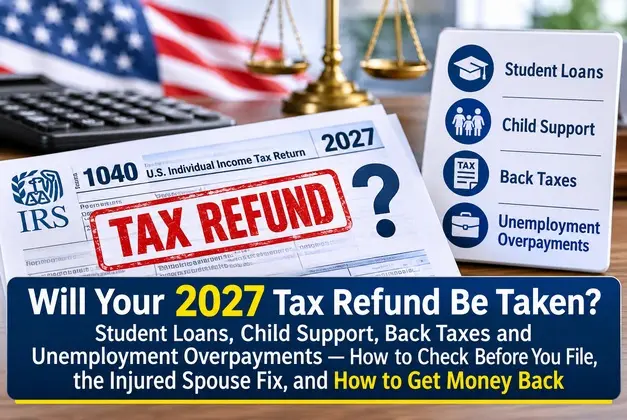
Five kinds of government debt can take your federal refund before it reaches you, and they are paid in a fixed order: the IRS first, then four categories through Treasury.
The IRS looks at your return first. Under IRC §6402(a), it may apply your refund to federal tax you owe from earlier years. The statute says the IRS “may” do this, which is why a hardship exception exists (see the hardship section below).
Whatever is left goes to Treasury’s Bureau of the Fiscal Service (BFS), which runs the Treasury Offset Program (TOP). BFS matches your Social Security number against debts that agencies have referred, then applies the refund in the order set by §6402(c) through (f).
- IRS: past-due federal tax
- Child support: past-due support referred by your state
- Federal debts: federal agency non-tax debts, including defaulted federal student loans
- State income tax: debts your state referred
- Unemployment: fraud, unreported earnings, or unpaid state contributions
- DebtAnswer
- Past-due federal income taxCAN TAKE IT
- Child support ($150 or $500 minimum)CAN TAKE IT
- Defaulted federal student loans (paused since January 16, 2026)CAN TAKE IT
- Other federal agency debtsCAN TAKE IT
- State income taxCAN TAKE IT
- Unemployment: fraud, unreported earnings, unpaid contributionsCAN TAKE IT
- Credit cardsCAN’T TAKE IT AFTER DEPOSIT with a judgment
- Medical bills (private providers)CAN’T TAKE IT AFTER DEPOSIT with a judgment
- Private student loansCAN’T TAKE IT AFTER DEPOSIT with a judgment
- Personal and payday loansCAN’T TAKE IT AFTER DEPOSIT with a judgment
| Debt | Answer | Who takes it | Order | Notes |
|---|---|---|---|---|
| Past-due federal income tax | CAN TAKE IT | IRS | 1st | Applied before TOP debts. Shows in your IRS online account, not on the TOP phone line. |
| Child support | CAN TAKE IT | TOP, for your state agency | 2nd | $150 or more owed to the state, $500 or more in other cases. |
| Defaulted federal student loans | CAN TAKE IT | TOP, for the Department of Education | 3rd | Collections paused since January 16, 2026. No restart date announced as of November 16, 2026. |
| Other federal agency debts | CAN TAKE IT | TOP, for the agency | 3rd | Examples: SBA, HUD, VA. |
| State income tax | CAN TAKE IT | TOP, for your state | 4th | Applies when your federal return shows an address in the state that referred the debt. |
| Unemployment: fraud, unreported earnings, or unpaid contributions | CAN TAKE IT | TOP, for your state | 5th | Agency-error overpayments generally aren’t federal-offset debts. |
| Credit cards | CAN’T TAKE IT AFTER DEPOSIT | No one through TOP | None | A court judgment can lead to a bank-account levy after the refund lands. |
| Medical bills (private providers) | CAN’T TAKE IT AFTER DEPOSIT | No one through TOP | None | Public or state-affiliated creditors may reach a state refund in some states. |
| Private student loans | CAN’T TAKE IT AFTER DEPOSIT | No one through TOP | None | Only federal loans can be referred to TOP. |
| Personal and payday loans | CAN’T TAKE IT AFTER DEPOSIT | No one through TOP | None | Same rule: judgment first, then a levy on the account. |
Your next step: run the Offset Risk Check above, call 1-800-304-3107, and log in to your IRS online account. You need both checks, and the next section explains why.
How to Check Before You File
Check two places, because no single source shows every debt: the Treasury Offset phone line for referred non-tax debts, and your IRS online account for past-due federal tax.
The TOP line, 1-800-304-3107, tells you whether a debt has been referred and which agency to contact. The IRS lists a TTY number of 1-800-877-8339 and hours of Monday to Friday, 7:30 a.m. to 5 p.m. Central time.
Your IRS online account shows federal tax balances and payment history. If you can’t get into it, the Taxpayer Advocate Service says you can call the IRS at 800-829-1040 and ask about any balance from earlier years.
| Where to check | What it shows | What it doesn’t | When to use it |
|---|---|---|---|
| TOP phone line, 1-800-304-3107 | Debts referred to Treasury, and the agency to contact | Past-due federal tax owed to the IRS | Before you file, and again if your refund looks short |
| IRS online account | Federal tax balances and payment history | Debts owed to other agencies | Before you file, to catch prior-year tax debt |
Why a clean result still isn’t a guarantee
Agencies can refer a debt to Treasury later, including after you call. Notices about a debt may also have gone to an old address. Treat the checks as a snapshot, not a promise.
Notices you may have
After an offset, BFS mails a notice showing your original refund, the amount taken, and the agency that was paid, with that agency’s contact information. If the IRS adjusted your refund for a tax debt, the IRS sends its own notice.
Your next step: write down any agency the phone line names and its contact details before you file. You will need them if you have to dispute an amount.
Student Loans and Your 2027 Refund
Defaulted federal student loans can take your whole refund through TOP, but the Department of Education has paused refund offsets since January 16, 2026, and as of November 16, 2026 no restart date has been announced.
Dated status, November 16, 2026: On January 16, 2026, the Department of Education paused involuntary collections on defaulted federal student loans it holds, including Treasury offsets and wage garnishment. We found no announced restart date. Press reports in October 2026, citing unnamed sources, said Treasury was preparing to hire private collectors and that broader collections could return in 2027. None of that has been confirmed. We re-check this box through the filing season.
The pause doesn’t cure default. A loan that stays in default remains eligible when collections restart, and an offset can take the entire refund, EITC and Child Tax Credit included.
How many borrowers are affected
Federal Student Aid data reported this fall counted 9.3 million borrowers in default, owing about $234 billion, as of June 30, 2026. A year earlier the count was about 5.3 million.
The Treasury takeover
A March 19, 2026 interagency agreement moves servicing of defaulted federal loans from Education to Treasury. The Congressional Research Service put the affected portfolio at about 7.8 million borrowers and $179 billion as of December 31, 2025, and described a gradual, phased transfer. Treasury already runs TOP, so a restart would use the same offset system.
What “default” means
Default generally follows about 270 days of missed payments. A few late payments don’t trigger an offset. Private student loans can’t be referred to TOP at all.
Older FFEL loans
Whether the pause covers older FFEL loans held by guaranty agencies is unverified. Ask your loan holder directly before you assume you’re covered.
Getting out of default
Rehabilitation and consolidation both take a loan out of default, and the notice of intent to offset carries review rights. Rehabilitation can generally be used once per loan. Our full guide covers the steps and deadlines: Student Loan Wage Garnishment 2026: Is It Back or Paused? For repayment plans afterward, see SAVE Plan Ended: IBR or RAP? and RAP Plan Student Loans.
Your next step: check your loan status at StudentAid.gov now. If a loan is in default, start rehabilitation or consolidation before the season, not after a notice arrives.
Child Support Offsets
Past-due child support can take your whole federal refund once the balance reaches $150 for support owed to the state or $500 in other cases.
The $150 figure applies to cases where support is owed to the state, such as assigned or TANF cases. The $500 figure applies to other cases. Your state child support agency submits the case, so it can tell you how yours is classified.
The offset pays past-due support, not current support. EITC and Child Tax Credit amounts can be taken like any other part of the refund.
Joint returns can be held
When the offset comes from a joint return, many state agencies hold the money for up to six months. That gives the other spouse time to file an injured spouse claim. Your state’s rules set the exact hold, so ask the agency.
If you overpaid
If the offset took more than you owed, ask the state child support agency for a refund of the overpayment. That request goes to the state, not to the IRS. For how amounts are set, see How Child Support Is Calculated.
Your next step: ask your state agency for your arrears total and payment history before you file. If you disagree with a figure, raise it now, not after the refund is gone.
State Taxes and Unemployment Overpayments
Referred state income tax and certain unemployment debts can take your federal refund, but only the unemployment debts tied to fraud, unreported earnings, or unpaid employer contributions.
For state income tax, your state revenue department refers the debt to TOP. Under §6402(e), this applies when the address on your federal return is in the state seeking the offset.
For unemployment, §6402(f) covers an erroneous payment “due to fraud or the person’s failure to report earnings” once the debt is final under state law. It also covers contributions owed to a state’s unemployment fund. Overpayments caused by agency error generally aren’t federal-offset debts. Confirm with your state unemployment agency.
State refunds run on a separate system
Many states run their own setoff programs against your state refund. They can include state agencies, local governments, and courts. Minnesota’s revenue recapture covers the University of Minnesota, counties and cities, and governmentally owned hospitals. Arizona’s liability setoff covers state agencies, political subdivisions, and courts. Your state’s rules differ.
Your next step: if you owe state tax or an unemployment overpayment, call the agency, ask whether the debt was referred, and ask what it would take to set up a payment arrangement.
What Can’t Take Your Refund, and the Bank-Account Trap
Credit card companies, private medical providers, payday lenders, and private student lenders can’t take your federal refund before it reaches you, but a creditor with a court judgment may reach your bank account afterward.
CAN’T TAKE IT Private creditors have no access to TOP. A debt collector calling about a credit card, a medical bill, or a personal loan can’t intercept your refund.
AFTER DEPOSIT If a creditor sues and wins a judgment, it may be able to levy or garnish your bank account once the refund is deposited. A judgment is the key step. Without one, a private creditor generally can’t take money from your account. A bank may be able to use your account agreement to collect a debt you owe that same bank.
State protections vary
Federal law doesn’t shield a tax refund from a judgment creditor once it’s in your account. Some states protect earned income credit money. Nebraska’s statute exempts earned income tax credit refunds from attachment and garnishment in collecting a money judgment, and Arizona’s exemption statute also lists refundable EITC and child tax credit amounts. Many states offer no such protection. Check your state’s current law or ask legal aid.
If a levy or garnishment notice arrives
Respond in writing within the deadline on the notice and claim any exemption that applies. Keep copies of everything. Our guides explain the details: How Much of Your Paycheck Can Be Garnished? and Bank Froze My Account.
Your next step: if any creditor has sued you, find out whether a judgment was entered. If one was, talk to legal aid before the refund lands.
Married Filing Jointly: Protect Your Share With Form 8379
If you file jointly and your spouse alone owes a past-due debt, you can file Form 8379, Injured Spouse Allocation, to get back your share of the refund.
This is a legal claim the IRS built for this situation. It doesn’t help you avoid a debt you owe yourself, and it doesn’t reduce what your spouse owes.
Who qualifies
You may be an injured spouse if you filed a joint return and all or part of your share of the refund was, or is expected to be, applied to your spouse’s past-due federal tax, state income tax, state unemployment debt, child support, or federal non-tax debt such as a student loan.
When and how to file
File as soon as you learn your share was or may be offset. You can attach Form 8379 to the joint return, e-file it with the return, or send it alone after the return is processed. If you send it alone, attach copies of both spouses’ W-2s and any 1099s showing withholding. Don’t attach the joint return. File once for each year you want your share back.
The deadline is the later of 3 years from the return’s due date (including extensions) or 2 years from the date the offset tax was paid.
Injured Spouse Share Estimator
Enter figures from your return to get a rough idea of the share of the joint refund that may belong to you.
How long Form 8379 takes
The instructions give these approximate processing times. Errors can add to them.
E-filed with the return
About 11 weeks
Paper, filed with the return
About 14 weeks
Filed by itself after the return was processed
About 8 weeks
| How you file | About how long |
|---|---|
| E-filed with the return | About 11 weeks |
| Paper, filed with the return | About 14 weeks |
| By itself after the joint return was processed | About 8 weeks |
Community property states
Arizona, California, Idaho, Louisiana, Nevada, New Mexico, Texas, Washington, and Wisconsin have special rules. The instructions say that, generally, 50% of a joint overpayment other than the earned income credit can be applied to non-federal debts such as child support or student loans. The earned income credit is divided by each spouse’s earned income. The IRS divides the refund under state law, so the estimator above may not apply.
Injured spouse is not innocent spouse
Injured spouse relief (Form 8379) recovers your share of a joint refund taken for your spouse’s other debt. Innocent spouse relief (Form 8857) asks to be freed from responsibility for a joint tax debt. Don’t file Form 8379 if you’re claiming innocent spouse relief.
| Form | Problem it solves | Who files | Time limit |
|---|---|---|---|
| Form 8379, Injured Spouse Allocation | Your share of a joint refund was applied to your spouse’s past-due debt | The spouse who doesn’t owe the debt | Later of 3 years from the return’s due date or 2 years from payment of the offset tax |
| Form 8857, Request for Innocent Spouse Relief | Relief from a joint tax debt caused by your spouse’s errors | A spouse asking to be released from a joint tax liability | Generally 2 years from the IRS’s first collection activity for two of the three relief types. Equitable relief follows the collection and refund limitation periods. |
Filing separately as an alternative
Filing separately keeps your return, and your refund, apart from your spouse’s debt. The cost is often higher tax, and some credits are limited or unavailable to separate filers. It also doesn’t help with a debt you owe yourself. A free VITA clinic or a tax preparer can run both versions for you.
Your next step: if your spouse owes a debt, prepare Form 8379 before you file and attach it to the joint return, or compare the separate-filing numbers first.
Hardship: The Offset Bypass Refund
An Offset Bypass Refund can release a refund that would otherwise go to your prior federal tax debt, but only for IRS tax debts and only if you ask before the offset happens.
The IRS has discretion over whether to apply your refund to its own tax claim. When you can show economic hardship, such as facing an eviction or a utility shutoff, it can issue part of the refund first. The Taxpayer Advocate Service says a request can be made before or alongside filing, usually with Form 911. Once the refund has been applied to the tax debt, the bypass is no longer available.
If you also owe a TOP debt, that part of the refund can’t be bypassed. The IRS must send it to the agency.
For broader hardship options on IRS debt, see IRS Hardship Program Guide.
Your next step: if you owe the IRS and a bill is about to cause a crisis, contact the Taxpayer Advocate Service before you file.
Already Taken? How to Get Money Back
Read the BFS offset notice, then dispute the debt with the agency named on it, because the IRS and BFS can’t settle that dispute for you.
The notice shows your original refund, the amount taken, and the agency paid, with its contact information. Contact the IRS only if the original refund on the notice differs from the refund on your return.
If the debt was wrong, already paid, or the wrong amount, write to that agency, attach proof, and keep copies. If the agency agrees, it returns the money, not the IRS.
If you filed jointly and the debt wasn’t yours, file Form 8379 by itself. The instructions give about 8 weeks for that route. See the injured spouse section above for the deadline.
| Debt | Contact | What to ask for |
|---|---|---|
| Child support | Your state child support agency | A payment history check, correction of any wrong amount, and a refund of any overpayment |
| Federal student loan | The Department of Education or the holder named on the notice | A review of the debt, proof of payment, and whether a hardship refund or review is available (see our student loan guide) |
| Other federal agency debt | The agency named on the notice | A written explanation of the debt, and correction or refund if it was wrong |
| State income tax | Your state revenue department | An account statement, and correction if the balance was wrong or already paid |
| Unemployment overpayment | Your state unemployment agency | The basis for the debt and the finding behind it, and an appeal if one is open to you |
| IRS tax debt | The IRS, using the number on its notice | An account transcript, and a Taxpayer Advocate referral if there is hardship |
Your next step: send your dispute letter this week. Free help is available from the Taxpayer Advocate Service, a VITA/TCE clinic, or legal aid.
Checklists
Use the first list before you file and the second if your refund was already taken, and copy either one to your phone or notes.
Before You File
- Call 1-800-304-3107 and note any agency named.
- Check your IRS online account for balances due.
- Student loans: check your status at StudentAid.gov. If you are in default, start rehabilitation or consolidation now (see our student loan guide).
- Child support: contact your state agency about arrears and payment records.
- Married to someone with a debt? Prepare Form 8379 and attach it to your joint return, or compare filing separately with a tax preparer.
- Facing eviction or a utility shutoff and you owe IRS tax? Ask the Taxpayer Advocate about an Offset Bypass Refund before you file.
- Expect EITC and ACTC refunds no earlier than mid-February under the PATH Act.
For refund timing, see 2026 Tax Refund Schedule. If your income is low and you’re unsure you must file, see Do You Have to File Taxes? Skipping a return doesn’t avoid an offset. You lose the right to claim a refund after 3 years, and penalties can apply if you owe tax.
If Your Refund Was Already Taken
- Read the BFS offset notice: amount, agency, and contact details.
- Wrong debt or wrong amount? Dispute it with that agency, in writing, and keep copies.
- Joint return and not your debt? File Form 8379 by itself (about 8 weeks).
- Student loans: ask about a hardship refund or review rights (see our student loan guide).
- Overpaid child support? Request a refund from the state child support agency.
- Free help: Taxpayer Advocate Service, VITA/TCE, legal aid.
Frequently Asked Questions
Short answers to the questions people ask most, current as of November 16, 2026.
Will student loans take my 2027 tax refund?
Only if the loan is in default and collections have resumed. The Department of Education has paused refund offsets since January 16, 2026, and as of November 16, 2026 had announced no restart date. A defaulted loan stays eligible when collections restart, so plan as if offsets could return.
Is the student loan offset pause still in effect?
Yes, as of November 16, 2026. The Department of Education paused involuntary collections, including Treasury offsets and wage garnishment, on January 16, 2026, and no restart date has been announced. The pause doesn’t cure default. Check StudentAid.gov before you file, because this status can change quickly.
How do I check if my tax refund will be offset?
Check two places. Call the Treasury Offset line at 1-800-304-3107 for referred child support, federal agency, state tax, and unemployment debts. Then log in to your IRS online account for past-due federal tax. Neither check guarantees an outcome, because agencies can refer debts later.
What’s the Treasury Offset Program phone number?
The number is 1-800-304-3107, listed by the IRS for Monday through Friday, 7:30 a.m. to 5 p.m. Central time. The TTY number is 1-800-877-8339. Have your Social Security number ready. The line shows referred debts and the agency to contact, but not IRS tax debts.
The offset line says I owe nothing. Why was my refund reduced?
The TOP line doesn’t show past-due federal tax owed to the IRS, and the IRS may apply your refund to that debt first. Check your IRS online account, or call the IRS at 800-829-1040. A debt referred after your call can also reduce a refund.
Can child support take my whole refund?
Yes, up to the amount owed. If past-due support meets the referral threshold, the offset can take the entire refund, including EITC and Child Tax Credit amounts. You get any remainder. On a joint return, the state may hold the money for months while a spouse’s claim is pending.
How much child support do I have to owe for a refund offset?
For federal refund offset, past-due support generally must reach $150 when owed to the state, such as assigned or TANF cases, or $500 in other cases. Your state child support agency can tell you how your case is classified and what it has referred.
Can the government take my EITC or Child Tax Credit?
Yes. Refundable credits aren’t protected from offset. Past-due federal tax, child support, federal agency debt, state tax, or a qualifying unemployment debt can take the entire refund, including the credit portions. Plan around the refund you’ve confirmed, not the figure on your return.
Can credit card companies take my tax refund?
No. Credit card companies have no access to the Treasury Offset Program, so they can’t intercept your refund before it reaches you. If a creditor wins a court judgment, it may later try to levy your bank account after the refund is deposited, subject to your state’s exemptions.
Can medical bills take my tax refund?
Generally no. Private hospitals and medical providers can’t use the Treasury Offset Program. Some states let public or state-affiliated creditors, such as governmentally owned hospitals, collect from your state refund, not your federal one. A judgment could also reach your bank account after deposit.
Can a creditor take my refund after it’s in my bank account?
Possibly, but only with a court judgment. A creditor who has one may be able to levy or garnish your bank account, and your state’s exemptions decide what is protected. Some states protect EITC funds. If your account is frozen, act quickly and read the linked guides.
Can an unemployment overpayment take my federal refund?
Sometimes. Federal offset covers state unemployment debts from fraud or failure to report earnings, plus unpaid employer contributions, once final under state law. Overpayments caused by agency error generally aren’t federal-offset debts. Confirm the basis for your debt with your state unemployment agency.
My spouse owes the debt. Can I protect my part?
If you filed jointly and your spouse’s past-due debt takes the refund, you may file Form 8379, Injured Spouse Allocation, to recover your share. Attach it to the joint return or file it alone later. It doesn’t help with debts you owe together.
How long does Form 8379 take?
The Form 8379 instructions give about 11 weeks if e-filed with the return, 14 weeks on paper, and 8 weeks if filed by itself after the joint return was processed. Errors can add time. Expect your whole refund to arrive later than usual.
Can I file Form 8379 after my refund was taken?
Yes. File it once you learn your share was or will be offset, alone if needed, attaching copies of both spouses’ W-2s and any 1099s showing withholding. The deadline is the later of 3 years from the return’s due date or 2 years from payment of the offset tax.
What’s the difference between injured spouse and innocent spouse?
Injured spouse relief (Form 8379) recovers your share of a joint refund taken for your spouse’s other debt. Innocent spouse relief (Form 8857) asks to be freed from responsibility for a joint tax debt caused by your spouse’s errors. They solve different problems. Don’t file both for the same issue.
What is an Offset Bypass Refund?
It is a narrow IRS hardship procedure that can release a refund that would otherwise pay a prior federal tax debt. You must request it before the offset, usually through the Taxpayer Advocate Service with Form 911. It can’t stop child support, student loan, state, or unemployment offsets.
How do I get an offset refunded if the debt was wrong?
Contact the agency named on your BFS notice, not the IRS or BFS, and dispute in writing with proof like payment records. If the agency agrees the debt was wrong, it issues the refund. Keep copies and ask the Taxpayer Advocate, a VITA clinic, or legal aid for free help.
Sources
- IRS Topic 203, Reduced Refund
- IRS Instructions for Form 8379, Injured Spouse Allocation
- 26 U.S.C. §6402, authority to make credits or refunds
- Bureau of the Fiscal Service, Treasury Offset Program and state programs
- Congressional Research Service R48962, Transition of Servicing Defaulted Federal Student Loans to the Department of the Treasury (May 29, 2026)
- The College Investor, reporting Federal Student Aid default data as of June 30, 2026
- Receivables Info, October 20, 2026, on reported Treasury plans for private collectors (unconfirmed)
- Taxpayer Advocate Service, how to prevent a refund offset in economic hardship
- Oklahoma Child Support Services, federal tax refund offset (example of state agency guidance)
- Minnesota House Research, revenue recapture
- Arizona Revised Statutes 42-1122, setoff for debts to state agencies
Last updated:
This article is general information, not tax or legal advice. Offset rules and the student-loan collection status were verified on November 16, 2026 and may change. Contact the agency named in your notice, or get free help from the Taxpayer Advocate Service or a VITA clinic.

Daniel Hayes is the founder and sole researcher at AdvoraHQ. He covers U.S. personal finance, insurance, and consumer law — working directly from IRS publications, federal and state statutes, court opinions, and SEC filings rather than secondary summaries. His focus is the gap between what readers think they know and what the source documents actually say. Daniel is not a licensed attorney, CPA, or financial advisor; his articles are educational and not personalized advice. Reach him at Daniel.Hayes@advorahq.com.
