
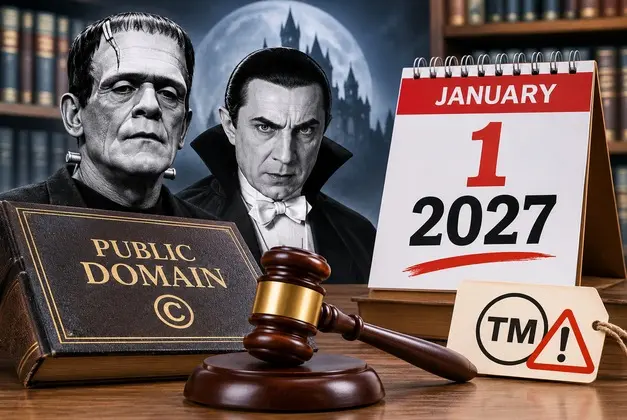
- FREE: the 1931 works as published
- STILL OWNED: trademarks, later versions, new restorations
- DEPENDS: actors’ likenesses, other countries
Rules verified . The 2027 list below was cross-checked against press and reference lists; Duke’s Center for the Study of the Public Domain had not yet published its 2027 list on that date and will be checked when it appears. U.S. law only. Not legal advice.
Is It Public Domain in the U.S.? Check Any Work
Enter a work’s details to get an estimate of its U.S. copyright status and how to verify it.
Result
This tool estimates U.S. copyright status only. It doesn’t check trademarks, publicity rights, or foreign law.
What Enters the Public Domain on January 1, 2027
On January 1, 2027, U.S. copyright ends for works published in 1931 and for sound recordings first published in 1926.
Under the 95-year rule, a U.S. work published in 1931 stays protected through December 31, 2026. It becomes free the next day. Works published before 1931 are already public domain.
That holds for works whose copyright was valid and renewed. Many works from 1929 to 1963 were never renewed, so they may already be free. The renewal shortcut section below shows how to check.
Why sound recordings run on a different clock
Recordings made before 1972 came under federal law through the Music Modernization Act (Title II, formerly the CLASSICS Act), which set its own schedule:
- Before 1923: public domain since January 1, 2022.
- 1923 through 1946: 100 years from publication, so a recording published in 1926 enters on January 1, 2027.
- 1947 through 1956: 110 years from publication.
- Other recordings fixed before February 15, 1972: protected until February 15, 2067.
The clock runs from the day a recording was first released, not from the studio session. A song recorded in 1926 but released in 1927 waits another year.
The verified 2027 highlights
Several popular 2027 lists contain errors, such as foreign art counted as a 1931 U.S. publication. Paintings are often unpublished, so this guide doesn’t list art as “published in 1931” without checking. Each title below was checked individually. Where a detail couldn’t be confirmed, the table says so.
| Work | Type | Creator or studio | What’s free | What may still be protected | Source |
|---|---|---|---|---|---|
| Frankenstein (1931) | Film | Universal Pictures; dir. James Whale; released Nov. 21, 1931 | The film as released: its scenes, dialogue, and the monster as designed and shown in it. | Sequels (1935 enters 2031; 1939 enters 2035), restorations, colorized versions, new scores, Universal’s trademarks, and actors’ likenesses. | AFI Catalog (release date; Universal registration dated Nov. 16, 1931). Renewal record still to confirm. |
| Dracula (1931) and Spanish-language Drácula (1931) | Film | Universal Pictures; dir. Tod Browning (English) and George Melford (Spanish, released Apr. 24, 1931) | Both films as released. | Dracula’s Daughter (1936 enters 2032), restorations, new scores, trademarks, actors’ likenesses. The stage-play lineage behind the films is disputed. | Press and reference lists (Wikipedia 2027 list; film databases). Renewal records still to confirm. |
| City Lights | Film | Charlie Chaplin | The film as released in 1931. | Restorations, later re-release edits, rights holders’ trademarks, and uses of Chaplin’s name or image. | Wikipedia 2027 list; AP and trade coverage. Renewal record still to confirm. |
| The Public Enemy | Film | Warner Bros.; dir. William Wellman | The film as released in 1931. | Restorations, studio trademarks, and the actors’ likenesses. | Wikipedia 2027 list. Renewal record still to confirm. |
| Monkey Business | Film | Paramount; the Marx Brothers | The film as released in 1931. | Restorations, studio trademarks, and the performers’ names and likenesses. | Wikipedia 2027 list. Renewal record still to confirm. |
| M (foreign title) | Film (German) | Fritz Lang | The film as released in 1931, if its U.S. copyright was restored under the URAA (generally 95 years from publication). | Restorations, subtitled or dubbed versions, and translations. Restoration eligibility must be confirmed for this title. | Wikipedia 2027 list; 17 U.S.C. § 104A. Verify each foreign title. |
| The Good Earth | Book | Pearl S. Buck | The text as first published in 1931. | The 1937 film (enters 2033), later editions with new introductions, and translations. | Wikipedia 2027 list. Check the Stanford renewal database. |
| Sanctuary | Book | William Faulkner | The text as first published in 1931. | Later corrected or scholarly editions, introductions, and adaptations on their own schedules. | Wikipedia 2027 list. Check the Stanford renewal database. |
| Nancy Drew: The Secret at Shadow Ranch and The Secret of Red Gate Farm | Book | Published under the pen name Carolyn Keene | The original 1931 texts. | Revised-text editions issued from the late 1950s on, later books and adaptations, and the series’ trademarks. | Wikipedia 2027 list; AP coverage of the 2026 class. Check the Stanford renewal database. |
| “As Time Goes By” (the composition) | Song (composition) | Herman Hupfeld; published by Harms, Inc., 1931 | The music and lyrics as published in 1931. | The Casablanca (1942) recording and film (the film enters 2038), other recordings, and later arrangements. | IMSLP publication record (Harms, 1931); Wikipedia 2027 list. Renewal record still to confirm. |
| First Dick Tracy strips (Oct. 4, 1931) | Comic strip | Chester Gould; Chicago Tribune–New York News Syndicate | Status disputed. Some lists include the strips for 2027; others say early strips lapsed for lack of renewal. Check strip by strip. | Later strips, characters introduced later, and syndicate trademarks. | Launch date from the Library of Congress and reference sources; status needs a Catalog of Copyright Entries check. |
| 1931 Mickey Mouse cartoons and Silly Symphonies | Cartoons | Walt Disney Productions | The shorts as released in 1931, such as The Moose Hunt (Pluto’s first named appearance) and the Silly Symphonies from Birds of a Feather to The Ugly Duckling. | Later Mickey and Pluto designs, later cartoons, and Disney’s trademarks. | D23 Silly Symphony list; Wikipedia 2027 list. Mickey shorts to be matched against Duke’s list. |
| 1926 sound recordings | Sound recordings | Various artists and labels | Recordings first published (released) in 1926, for example Louis Armstrong’s Hot Five and Bessie Smith sessions released that year. Confirm each release date. | Songs written later, remasters or compilations that add material, and recordings released in 1927 or after. | 17 U.S.C. § 1401; Cornell term chart. Duke’s list to confirm examples. |
Films
Frankenstein (1931)
Creator: Universal Pictures; dir. James Whale; released Nov. 21, 1931
What’s free: The film as released: its scenes, dialogue, and the monster as designed and shown in it.
What may still be protected: Sequels (1935 enters 2031; 1939 enters 2035), restorations, colorized versions, new scores, Universal’s trademarks, and actors’ likenesses.
Source: AFI Catalog (release date; Universal registration dated Nov. 16, 1931). Renewal record still to confirm.
Dracula (1931) and Spanish-language Drácula (1931)
Creator: Universal Pictures; dir. Tod Browning (English) and George Melford (Spanish, released Apr. 24, 1931)
What’s free: Both films as released.
What may still be protected: Dracula’s Daughter (1936 enters 2032), restorations, new scores, trademarks, actors’ likenesses. The stage-play lineage behind the films is disputed.
Source: Press and reference lists (Wikipedia 2027 list; film databases). Renewal records still to confirm.
City Lights
Creator: Charlie Chaplin
What’s free: The film as released in 1931.
What may still be protected: Restorations, later re-release edits, rights holders’ trademarks, and uses of Chaplin’s name or image.
Source: Wikipedia 2027 list; AP and trade coverage. Renewal record still to confirm.
The Public Enemy
Creator: Warner Bros.; dir. William Wellman
What’s free: The film as released in 1931.
What may still be protected: Restorations, studio trademarks, and the actors’ likenesses.
Source: Wikipedia 2027 list. Renewal record still to confirm.
Monkey Business
Creator: Paramount; the Marx Brothers
What’s free: The film as released in 1931.
What may still be protected: Restorations, studio trademarks, and the performers’ names and likenesses.
Source: Wikipedia 2027 list. Renewal record still to confirm.
M (foreign title)
Creator: Fritz Lang
What’s free: The film as released in 1931, if its U.S. copyright was restored under the URAA (generally 95 years from publication).
What may still be protected: Restorations, subtitled or dubbed versions, and translations. Restoration eligibility must be confirmed for this title.
Source: Wikipedia 2027 list; 17 U.S.C. § 104A. Verify each foreign title.
Books
The Good Earth
Creator: Pearl S. Buck
What’s free: The text as first published in 1931.
What may still be protected: The 1937 film (enters 2033), later editions with new introductions, and translations.
Source: Wikipedia 2027 list. Check the Stanford renewal database.
Sanctuary
Creator: William Faulkner
What’s free: The text as first published in 1931.
What may still be protected: Later corrected or scholarly editions, introductions, and adaptations on their own schedules.
Source: Wikipedia 2027 list. Check the Stanford renewal database.
Nancy Drew: The Secret at Shadow Ranch and The Secret of Red Gate Farm
Creator: Published under the pen name Carolyn Keene
What’s free: The original 1931 texts.
What may still be protected: Revised-text editions issued from the late 1950s on, later books and adaptations, and the series’ trademarks.
Source: Wikipedia 2027 list; AP coverage of the 2026 class. Check the Stanford renewal database.
Music
“As Time Goes By” (the composition)
Creator: Herman Hupfeld; published by Harms, Inc., 1931
What’s free: The music and lyrics as published in 1931.
What may still be protected: The Casablanca (1942) recording and film (the film enters 2038), other recordings, and later arrangements.
Source: IMSLP publication record (Harms, 1931); Wikipedia 2027 list. Renewal record still to confirm.
Comics & cartoons
First Dick Tracy strips (Oct. 4, 1931)
Creator: Chester Gould; Chicago Tribune–New York News Syndicate
What’s free: Status disputed. Some lists include the strips for 2027; others say early strips lapsed for lack of renewal. Check strip by strip.
What may still be protected: Later strips, characters introduced later, and syndicate trademarks.
Source: Launch date from the Library of Congress and reference sources; status needs a Catalog of Copyright Entries check.
1931 Mickey Mouse cartoons and Silly Symphonies
Creator: Walt Disney Productions
What’s free: The shorts as released in 1931, such as The Moose Hunt (Pluto’s first named appearance) and the Silly Symphonies from Birds of a Feather to The Ugly Duckling.
What may still be protected: Later Mickey and Pluto designs, later cartoons, and Disney’s trademarks.
Source: D23 Silly Symphony list; Wikipedia 2027 list. Mickey shorts to be matched against Duke’s list.
Recordings
1926 sound recordings
Creator: Various artists and labels
What’s free: Recordings first published (released) in 1926, for example Louis Armstrong’s Hot Five and Bessie Smith sessions released that year. Confirm each release date.
What may still be protected: Songs written later, remasters or compilations that add material, and recordings released in 1927 or after.
Source: 17 U.S.C. § 1401; Cornell term chart. Duke’s list to confirm examples.
Table 1. 2027 highlights, checked November 16, 2026 against press and reference lists; Duke’s official list is pending. Status assumes a valid renewal where renewal was required. Confirm each title’s record before commercial use.
Duke’s Center for the Study of the Public Domain usually publishes its official list in mid-December. This table will be re-checked against it then, and again on January 1.
Frankenstein and Dracula: What’s Actually Free
On January 1, 2027, the 1931 Universal films themselves become free in the U.S.: their scenes, their dialogue, and the monster design shown in them. Universal’s sequels, trademarks, and the actors’ faces do not.
Frankenstein: novel, play, and film
Mary Shelley’s 1818 novel has long been public domain, so anyone can retell the story. What Universal added in 1931 wasn’t in the book: the film’s look, scenes, and dialogue. The film opened on November 21, 1931.
The film credits a stage play by Peggy Webling, adapted by John L. Balderston. Commentators disagree about whether any play-only material is still protected. Working from the film plus Shelley’s novel is the cleanest path.
Dracula: novel, play, and two films
Bram Stoker’s 1897 novel is long public domain. Universal’s English-language Dracula (February 1931) enters on January 1, 2027. So does the Spanish-language Drácula, shot on the same sets with a different cast and released April 24, 1931.
The stage play behind the films is messier. The 1927 Deane–Balderston version is often described as public domain since 2023. Writers dispute that because of the play’s acting editions and Hamilton Deane’s earlier 1924 script. If you rely on play dialogue, check its record or ask an attorney.
What the 1931 films add, and what stays owned
The parts that become free are the film’s own creative elements: the monster as designed and shown in Frankenstein, both films’ scenes, and their dialogue. Here is what doesn’t:
- STILL OWNED, sequels: Bride of Frankenstein (1935) enters in 2031, Dracula’s Daughter (1936) in 2032, and Son of Frankenstein (1939) in 2035.
- STILL OWNED, new layers: restorations, new scores, colorized versions, and later artwork may carry their own protection.
- STILL OWNED, trademarks: Universal claims trademark rights tied to its classic monsters (next section).
- DEPENDS, actors: Lugosi and Karloff are separate cases (next section).
Son of Frankenstein (1939) introduces Ygor. The 1931 assistant is Fritz, so a character named Ygor is a 1939 element, not a 1931 one.
| Work | Year | U.S. public domain |
|---|---|---|
| Frankenstein line | ||
| Frankenstein; or, The Modern Prometheus (Mary Shelley, novel) | 1818 | Long public domain |
| Frankenstein (Universal film) | 1931 | January 1, 2027 |
| Bride of Frankenstein | 1935 | January 1, 2031 |
| Son of Frankenstein (introduces Ygor; the 1931 assistant is Fritz) | 1939 | January 1, 2035 |
| Dracula line | ||
| Dracula (Bram Stoker, novel) | 1897 | Long public domain |
| Dracula (Deane–Balderston stage play) | 1927 | Often described as public domain since 2023; disputed, so verify |
| Dracula (Universal film) and Spanish-language Drácula | 1931 | January 1, 2027 |
| Dracula’s Daughter | 1936 | January 1, 2032 |
- Frankenstein line
- Frankenstein; or, The Modern Prometheus (Mary Shelley, novel)Year: 1818U.S. public domain: Long public domain
- Frankenstein (Universal film)Year: 1931U.S. public domain: January 1, 2027
- Bride of FrankensteinYear: 1935U.S. public domain: January 1, 2031
- Son of Frankenstein (introduces Ygor; the 1931 assistant is Fritz)Year: 1939U.S. public domain: January 1, 2035
- Dracula line
- Dracula (Bram Stoker, novel)Year: 1897U.S. public domain: Long public domain
- Dracula (Deane–Balderston stage play)Year: 1927U.S. public domain: Often described as public domain since 2023; disputed, so verify
- Dracula (Universal film) and Spanish-language DráculaYear: 1931U.S. public domain: January 1, 2027
- Dracula’s DaughterYear: 1936U.S. public domain: January 1, 2032
Table 5. Novel to play to 1931 film to sequels. Public domain dates are U.S. dates, checked November 16, 2026. The 1927 play’s status is disputed; verify before relying on it.
Three Rights, Three Clocks: Copyright, Trademark, Publicity
Copyright, trademark, and right of publicity protect different things, last different lengths of time, and can each stop a product after copyright ends.
Most “is it public domain?” answers address only the first. A seller needs all three. For a plain-language comparison of the full set of IP types, see Trademark vs Copyright vs Patent.
| Right | What it protects | How long | Who enforces it | What it means for the 1931 monsters |
|---|---|---|---|---|
| Copyright | Original creative expression: a film’s scenes, design and dialogue, a book’s text, a song’s music and words. | A fixed term. For 1931 U.S. works, 95 years from publication, ending Dec. 31, 2026. | The copyright owner, through takedown notices and federal court. | The 1931 films’ own material is free on Jan. 1, 2027. Sequels and new restorations are separate. |
| Trademark | Names, logos and looks that tell buyers who made or approved a product. | No fixed end. It can last as long as the owner keeps using and maintaining it. | The trademark owner, through platform reports and lawsuits over likely confusion. Registrations are recorded at the USPTO. | Universal claims trademark rights tied to its classic monsters. Don’t suggest Universal made or approved your product. |
| Right of publicity | A person’s name, face, voice or likeness in commercial use. | Set by state law. Some states give a term after death (California: 70 years), others differ or have none. | The person, or the estate or successors, in court. | Lugosi and Karloff are separate cases (see below). Treat actors’ faces as off-limits without advice. |
- CopyrightWhat it protects: Original creative expression: a film’s scenes, design and dialogue, a book’s text, a song’s music and words.How long: A fixed term. For 1931 U.S. works, 95 years from publication, ending Dec. 31, 2026.Who enforces it: The copyright owner, through takedown notices and federal court.What it means for the 1931 monsters: The 1931 films’ own material is free on Jan. 1, 2027. Sequels and new restorations are separate.
- TrademarkWhat it protects: Names, logos and looks that tell buyers who made or approved a product.How long: No fixed end. It can last as long as the owner keeps using and maintaining it.Who enforces it: The trademark owner, through platform reports and lawsuits over likely confusion. Registrations are recorded at the USPTO.What it means for the 1931 monsters: Universal claims trademark rights tied to its classic monsters. Don’t suggest Universal made or approved your product.
- Right of publicityWhat it protects: A person’s name, face, voice or likeness in commercial use.How long: Set by state law. Some states give a term after death (California: 70 years), others differ or have none.Who enforces it: The person, or the estate or successors, in court.What it means for the 1931 monsters: Lugosi and Karloff are separate cases (see below). Treat actors’ faces as off-limits without advice.
Table 3. Three rights, three clocks. General U.S. summary, checked November 16, 2026; state publicity laws vary.
Mickey Mouse and Betty Boop show how it plays out
When the Steamboat Willie version of Mickey Mouse became free on January 1, 2024, Disney pointed out that its trademarks continue. Betty Boop’s debut cartoon, Dizzy Dishes (1930), became free on January 1, 2026. The rights holder, Fleischer Studios, says that character is only a precursor and that its Betty Boop trademarks remain in force.
Others disagree about how much of Betty Boop that frees. Copyright expired either way; the trademark fight is a separate one.
The source-confusion test
Trademark law asks whether buyers could think a product comes from, or is approved by, the trademark owner. A shirt that says “Universal Monsters” or looks like official merchandise fails that test even if every image on it is free.
Check the USPTO records yourself. For example, third-party mirrors of USPTO data list a live registration for the word DRACULA held by Universal City Studios that covers clothing among other classes (Reg. No. 4042239). Confirm on the USPTO site, and search FRANKENSTEIN and UNIVERSAL MONSTERS too, in your product’s class. This guide doesn’t assume which visual elements a registration covers; read the registration.
Bela Lugosi: the California clock, and why it isn’t the whole answer
In Lugosi v. Universal Pictures (Cal. 1979), the California Supreme Court held that Lugosi’s publicity rights did not pass to his heirs. California then passed a post-mortem statute, now Civil Code § 3344.1. It lasts 70 years after death and reaches people who died within the 70 years before 1985.
Lugosi died on August 16, 1956, so a California post-mortem term would have ended in August 2026. That isn’t a verdict that his face is free. Other states set longer terms (reported examples include Washington at 75 years and Indiana and Oklahoma at 100). Which state’s law applies can change the answer, and contracts and Universal’s trademarks still matter.
Boris Karloff: a different case
Karloff died on February 2, 1969, in England, with a different death year, a different place of death, and a different licensing history. His family has long licensed his image, according to published interviews; confirm who holds those rights today.
Whether any post-mortem publicity right applies depends on his domicile and the state whose law a court would use. This guide treats it as unsettled. Never read the Lugosi answer as covering Karloff.
For AI recreations of actors, note that California amended § 3344.1 in a bill signed in September 2024 (AB 1836) to address digital replicas of deceased personalities’ voices and likenesses in audiovisual works and sound recordings. See the AI section below.
The Later-Version Trap
Only the 1931 version is free in 2027; anything added in a sequel, a color treatment, a restoration, or a new score has its own clock.
The trap is easy to fall into because the famous version of a character is often a blend. A fan image of the monster in color mixes the 1931 design with later artwork and color treatments. Using the blend can copy protected material.
- Sequels: the 1935, 1936, and 1939 films add characters and looks that stay protected until 2031, 2032, and 2035.
- Color and restorations: a colorized print or a cleaned-up restoration can carry new protection for what was added.
- New scores: music added to a modern release of a silent-era or early-sound film is separate from the film.
- Later editions of books: the 1931 Nancy Drew texts are free, but revised-text editions issued from the late 1950s on are separate works.
To stay on the right side, work from a dated 1931 source, such as a 1931 print, a dated scan, or the book as first published. Keep that copy and its date.
The Music Trap: Sheet Music vs. Recordings
A song and a recording of it are two different works with two different clocks, so a free song can still be tied to a protected recording.
“As Time Goes By” is the standard example. Herman Hupfeld’s composition, published as sheet music by Harms, Inc. in 1931, is expected to enter the public domain on January 1, 2027. You can arrange it, perform it, and record your own version.
The version most people know is Dooley Wilson’s in Casablanca (1942). That film and its soundtrack stay protected until January 1, 2038. A 1931 recording of the song, such as Rudy Vallée’s, follows the recording schedule and enters in 2032.
The 1926 recordings entering in 2027 work the other way around. The recording is free, but the song inside may have been written later and may still be protected. Check both.
If you post your own performance on YouTube, Content ID can still flag it against someone else’s recording. For the full picture on music in videos, see Can You Use Copyrighted Music?.
Can You Sell It, Film It, or Post It?
Usually yes for new stories and films built on the 1931 material, but merch, logos, and anything that looks official need extra care.
Find your use below, then run the checker. For the fair-use side of merch, see Can You Sell Fan Art?; this guide doesn’t repeat that.
| Use | Answer | Why |
|---|---|---|
| Write a new story, book, or play | GENERALLY YES | Shelley’s and Stoker’s novels are long free, and the 1931 films’ own material is free from Jan. 1, 2027. Don’t borrow from sequels. |
| Make a film from the 1931 material | GENERALLY YES | Fine for the films’ original material. Be careful with restored footage, modern scores, and sequel looks. |
| Post original 1931 footage on YouTube | CAREFUL | The film is free, but your copy may be a restoration with a new score, and Content ID can still flag it. |
| Sell shirts with the 1931 design | CAREFUL | Copyright is no longer the main risk. Trademark, actors’ likenesses, and platform review are. |
| Use a studio name or “official” | USUALLY NO | Studio names are trademarks, and “official” suggests approval you don’t have. |
| Use a sequel’s look | USUALLY NO | Bride stays protected until 2031, Dracula’s Daughter until 2032, Son until 2035. |
| Use an actor’s face | USUALLY NO | Publicity rights depend on the state and the person. Lugosi and Karloff are different cases. Get advice first. |
| Use the character as your logo | USUALLY NO | A logo is brand use, so trademark and source-confusion risk is highest, and you can’t own the character. |
| Perform the 1931 song | GENERALLY YES | The composition is free from Jan. 1, 2027 if it was renewed. Use your own performance. |
| Use the Casablanca recording | USUALLY NO | The 1942 film and its soundtrack stay protected until 2038. |
- Write a new story, book, or playGENERALLY YESShelley’s and Stoker’s novels are long free, and the 1931 films’ own material is free from Jan. 1, 2027. Don’t borrow from sequels.
- Make a film from the 1931 materialGENERALLY YESFine for the films’ original material. Be careful with restored footage, modern scores, and sequel looks.
- Post original 1931 footage on YouTubeCAREFULThe film is free, but your copy may be a restoration with a new score, and Content ID can still flag it.
- Sell shirts with the 1931 designCAREFULCopyright is no longer the main risk. Trademark, actors’ likenesses, and platform review are.
- Use a studio name or “official”USUALLY NOStudio names are trademarks, and “official” suggests approval you don’t have.
- Use a sequel’s lookUSUALLY NOBride stays protected until 2031, Dracula’s Daughter until 2032, Son until 2035.
- Use an actor’s faceUSUALLY NOPublicity rights depend on the state and the person. Lugosi and Karloff are different cases. Get advice first.
- Use the character as your logoUSUALLY NOA logo is brand use, so trademark and source-confusion risk is highest, and you can’t own the character.
- Perform the 1931 songGENERALLY YESThe composition is free from Jan. 1, 2027 if it was renewed. Use your own performance.
- Use the Casablanca recordingUSUALLY NOThe 1942 film and its soundtrack stay protected until 2038.
Table 2. Can I do this? Risk notes only, checked November 16, 2026. GENERALLY YES, CAREFUL, and USUALLY NO are risk levels, not guarantees.
Can I Use It This Way? Check Your Plan
Pick a work and a use to see the copyright, trademark, publicity, and platform risks that apply.
Result
If a notice arrives, see How to File a DMCA Takedown and Got a Trademark Cease and Desist Letter?. For background on fan merch, see Can You Sell Fan Art?.
Selling on Etsy, Redbubble, and Amazon, and Posting on YouTube
Platforms act on reports before any court rules, so a listing or video built on a free work can still be pulled.
Etsy, Redbubble, and Amazon
Etsy’s policy says it removes material cited in a compliant report and doesn’t decide whether a listing infringes. Sellers are responsible for having the rights. Etsy tells the seller about a removal and, for U.S. copyright reports, explains the counter-notice process.
Etsy may end selling privileges after repeated or multiple notices. A trademark complaint can hit a listing that is built entirely on a free work. Redbubble and Amazon Merch run their own review and takedown systems and publish their own content policies. Read the current version before you upload.
Titles, tags, and descriptions count too. A free image under a title like “Universal Monsters tee” can still be flagged for the title alone.
YouTube and Content ID
Content ID is automated. It can match your upload to a reference file even when the underlying footage is public domain, for example when someone uploaded a restoration or a re-recorded score. Public domain footage has been claimed this way before.
You can dispute a claim, and the claimant then has 30 days to respond. YouTube warns you to dispute only if you are confident you have the rights, and repeated or malicious disputes can bring penalties. In YouTube’s transparency data for late 2023, fewer than 1% of claims were disputed and over 65% of those disputes succeeded.
If a notice or letter arrives
Read it first. Check whether it names a copyright, a trademark, or a person’s likeness, because the response differs. For takedowns and counter-notices, see How to File a DMCA Takedown. For trademark letters, see Got a Trademark Cease and Desist Letter?. For the broader merch question, see Can You Sell Fan Art?.
How to Check Whether Any Work Is Public Domain
Find the exact version’s first publication date, apply the term rule for its type, and, for U.S. works from 1929 to 1963, search the renewal records.
| Published | Rule | Public domain on |
|---|---|---|
| Before 1931 (U.S.) | Term has ended. | Already public domain |
| 1931 (U.S., with notice, renewed) | 95 years from publication. | January 1, 2027 |
| 1929–1977 (U.S.), no copyright notice | Generally lost protection. | Likely already public domain; verify |
| 1929–1963 (U.S.), not renewed | Protection ended after the first 28-year term. | Likely already public domain; verify the record |
| 1964–1977 (U.S., with notice) | Renewal was automatic; 95 years from publication. | January 1 of publication year + 96 |
| 1978 and later | Author’s life + 70 years; 95 years from publication or 120 from creation for works made for hire. | Decades away; varies by work |
| Foreign works, 1931–1977 (restored under the URAA) | 95 years from publication, regardless of renewal or notice. | January 1 of publication year + 96 |
| Sound recordings before 1923 | Term has ended. | Public domain since January 1, 2022 |
| Sound recordings 1923–1946 | 100 years from publication. | January 1 of publication year + 101 (1926 → Jan. 1, 2027) |
| Sound recordings 1947–1956 | 110 years from publication. | January 1 of publication year + 111 |
| Sound recordings 1957 to Feb. 14, 1972 | Protected on a fixed schedule. | February 15, 2067 |
- Before 1931 (U.S.)Rule: Term has ended.Public domain on: Already public domain
- 1931 (U.S., with notice, renewed)Rule: 95 years from publication.Public domain on: January 1, 2027
- 1929–1977 (U.S.), no copyright noticeRule: Generally lost protection.Public domain on: Likely already public domain; verify
- 1929–1963 (U.S.), not renewedRule: Protection ended after the first 28-year term.Public domain on: Likely already public domain; verify the record
- 1964–1977 (U.S., with notice)Rule: Renewal was automatic; 95 years from publication.Public domain on: January 1 of publication year + 96
- 1978 and laterRule: Author’s life + 70 years; 95 years from publication or 120 from creation for works made for hire.Public domain on: Decades away; varies by work
- Foreign works, 1931–1977 (restored under the URAA)Rule: 95 years from publication, regardless of renewal or notice.Public domain on: January 1 of publication year + 96
- Sound recordings before 1923Rule: Term has ended.Public domain on: Public domain since January 1, 2022
- Sound recordings 1923–1946Rule: 100 years from publication.Public domain on: January 1 of publication year + 101 (1926 → Jan. 1, 2027)
- Sound recordings 1947–1956Rule: 110 years from publication.Public domain on: January 1 of publication year + 111
- Sound recordings 1957 to Feb. 14, 1972Rule: Protected on a fixed schedule.Public domain on: February 15, 2067
Table 4. U.S. term rules at a glance, checked November 16, 2026 against 17 U.S.C. §§ 304, 104A, 1401 and the Cornell term chart. The tool at the top applies the same rules.
The renewal shortcut for 1929–1963
U.S. works published from 1929 to 1963 had to be renewed in their 28th year. Many weren’t, and those works are already public domain. A book published in 1955 and never renewed has been free for decades.
- 1. Pin down the version. Note the title, the year of first publication, and whether the copy shows a copyright notice.
- 2. Search renewals. For books, use the Stanford Copyright Renewal Database. It covers book renewals only. For films, music, and strips, search the Catalog of Copyright Entries scans.
- 3. Check the Copyright Office. Use its public records and follow Circular 22 for method.
- 4. Allow for gaps. A missing record isn’t conclusive. Typos and changed titles can hide a renewal, and the Copyright Office says its searches can’t be treated as conclusive.
For terms of protection, see Circular 15A (duration) and Circular 6A (renewal) on the Copyright Office circulars page. Cornell’s term chart pulls the rules into one table.
Foreign works
Many foreign works had U.S. copyright restored by the URAA (17 U.S.C. § 104A) if they were still protected at home on January 1, 1996. Restored works generally run 95 years from publication regardless of renewal. A 1931 foreign film such as Fritz Lang’s M is expected to enter on January 1, 2027. Verify each foreign title.
Other countries differ
The UK and EU count life plus 70 years, so works by authors who died in 1956 enter there in 2027. That means different works are free in different places. If you sell abroad, check each country.
Using a Public Domain Character for Your Brand or Logo
Copyright’s end lets you use the 1931 material, but it doesn’t clear the name or look for use as a brand, and it doesn’t give you exclusive rights.
A brand is a trademark use. The question is whether buyers could think your business is connected to the owner of an existing mark. Universal’s claims and registrations, and anyone else’s, can block you even though the character is free.
Your own trademark would cover only your original elements, such as your distinctive name and your own logo design. It won’t stop others from using the public domain character, and a registration doesn’t turn the 1931 design into something you own.
Search USPTO in your product class before you commit, and talk to an attorney. For the filing process, see How to Trademark a Business Name. To protect your own additions, see How to Copyright Your Work.
AI Images of Public Domain Characters
AI image tools may mix in later protected looks, and AI output can’t be assumed to be yours the way a human-made design can.
A prompt that names a character pulls from everything a model has seen: the 1931 design, later artwork, sequels, color treatments, and modern redesigns. The result can echo protected material without saying so.
Two other risks stay in play. Trademarks and actors’ likenesses apply to AI images the same way they apply to drawings, and California’s 2024 digital-replica amendment targets recreations of deceased performers. Whether AI output can be owned at all is covered in Can You Copyright AI-Generated Work?.
If you use AI, start from a dated 1931 reference, check the output against it, and add your own original work.
Before You List It: The Seller’s Checklist
Run these eight checks before you list a product built on a public domain work.
- 1. Confirm the year of the exact version you’re using, and keep the source (a 1931 print, a dated scan).
- 2. Avoid later versions: sequels, colorized frames, modern redesigns, new restorations.
- 3. No studio names, logos, or “official,” “licensed,” or “Universal Monsters” in titles, tags, or designs.
- 4. Search USPTO for trademarks on the character name in your product class.
- 5. Skip actors’ faces unless an attorney says your use is cleared.
- 6. Add your own original art or text. It’s also what you can protect (see How to Copyright Your Work).
- 7. Selling outside the U.S.? Check that country’s rules.
- 8. If you get a takedown: read it, don’t panic, and use the counter-notice process only if you’re confident (see How to File a DMCA Takedown).
FAQ: Public Domain 2027
These are the questions readers ask most about the 2027 class, the Universal monsters, and what you can sell.
What enters the public domain in 2027?
On January 1, 2027, U.S. copyright ends for works published in 1931, including Universal's Frankenstein and Dracula, City Lights, and The Good Earth, and for sound recordings first published in 1926. Titles that needed renewal need a valid record, and foreign works need a separate check.
Why 1931 works but 1926 recordings?
Published works get 95 years from publication, so 1931 works end in 2026. Sound recordings made before 1972 follow a separate Music Modernization Act schedule: recordings from 1923 through 1946 get 100 years from publication, so recordings released in 1926 enter in 2027.
Is Frankenstein public domain?
Mary Shelley's 1818 novel has long been public domain. Universal's 1931 film is expected to enter the U.S. public domain on January 1, 2027, freeing its scenes, dialogue, and monster design as shown. Sequels, trademarks, restorations, and actors' likenesses are separate questions.
Is Dracula public domain?
Bram Stoker's 1897 novel is long public domain. Universal's 1931 Dracula and the Spanish-language Drácula are expected to enter on January 1, 2027. The stage plays behind the films have a more tangled history, so check them if you rely on play dialogue.
Can I sell Frankenstein T-shirts on Etsy in 2027?
Copyright in the 1931 film's design ends, but trademark law, publicity rights, and Etsy's review can still apply. Skip studio names, “official,” actors' faces, and sequel looks, add your own art, and search USPTO first. A report can remove a listing before any court decides.
Does Universal still own trademarks on its monsters?
Universal claims trademark rights tied to its classic monsters, and trademarks don't expire when copyright does. Check current USPTO registrations for FRANKENSTEIN, DRACULA, and UNIVERSAL MONSTERS in your product class. The test is whether buyers could think Universal made or approved your product.
Is the Bride of Frankenstein public domain?
No. Bride of Frankenstein (1935) stays protected through December 31, 2030, and enters the U.S. public domain on January 1, 2031. The 1931 film's material is free in 2027, but the new material added in 1935 is not, so don't borrow from the sequel.
Is Bela Lugosi's likeness as Dracula free to use?
Don't assume so. California's 70-year post-mortem term for Lugosi, who died August 16, 1956, would have ended in August 2026. Other states' laws, contracts, and Universal's trademarks can still matter. This guide gives no verdict that his face is free.
Is Boris Karloff's face as the monster free to use?
Unsettled. Karloff died February 2, 1969, in England, so the Lugosi analysis doesn't carry over. Whether a post-mortem publicity right applies depends on domicile and the state whose law applies, and his family has long licensed his image. Never assume it is free.
Can I use 1931 Dracula footage on YouTube?
The film is expected to be free from January 1, 2027, but your copy matters. Restorations, new scores, and transfers can carry their own protection, and Content ID may still flag you. Use a dated 1931-era source, keep records, and dispute only if confident.
Why did my public domain video still get a Content ID claim?
Content ID is automated. It matches uploads against reference files rights holders submit, which can include restorations and re-recordings of public domain material. You can dispute, and the claimant has 30 days to respond. YouTube reported that over 65% of disputes in late 2023 succeeded.
Is “As Time Goes By” public domain?
The 1931 Herman Hupfeld composition is expected to enter on January 1, 2027, assuming a valid renewal. The recording in Casablanca does not: the 1942 film stays protected until 2038. A recording first published in 1931 follows the recording schedule and enters in 2032.
Can I use a public domain character as my logo?
Rarely a good idea. Copyright's end lets you use the 1931 material, but a logo is brand use, where trademark and source-confusion risk is highest. Others can use the same character, so you can't own it. Search USPTO in your class and talk to an attorney first.
Can I trademark my version of a public domain character?
You can seek a trademark for your own distinctive name or logo if it doesn't conflict with existing marks. Your rights cover only what you add, not the 1931 material, and a registration doesn't stop others from using the public domain character. Existing trademarks can block you.
How do I check if a 1950s book is public domain?
For a U.S. book published from 1950 through 1963, search the Stanford Copyright Renewal Database and Catalog of Copyright Entries scans for a renewal in its 28th year. No renewal usually means public domain, but typos can hide records. Also confirm the copyright notice and publication.
Is a 1931 foreign film public domain in the U.S.?
Not automatically. Many foreign films had U.S. copyright restored under the URAA (17 U.S.C. § 104A), generally lasting 95 years from publication regardless of renewal. A 1931 film like Fritz Lang's M is expected to enter on January 1, 2027, but verify each title's eligibility.
Is something public domain in the U.S. also free in the UK?
No. The UK and EU generally use the author's life plus 70 years, so a work can be free in the U.S. and protected there, or the reverse. In 2027, works by authors who died in 1956 enter there. This guide covers U.S. rights only.
What enters the public domain in 2028?
Under the same rules, works published in 1932 and sound recordings first published in 1927 are scheduled to enter the U.S. public domain on January 1, 2028. Duke's list usually appears in mid-December, and this guide will be rebuilt for 2028 next November.
Sources and Official References
These are the primary and reference sources behind the rules and dates above.
- Duke Center for the Study of the Public Domain: Public Domain Day (2027 list due in mid-December)
- U.S. Copyright Office, Circular 15A: Duration of Copyright
- U.S. Copyright Office, Circular 22: How to Investigate the Copyright Status of a Work
- U.S. Copyright Office circulars index (including Circular 6A, Renewal of Copyright)
- 17 U.S.C. § 304: duration of copyright for works created before 1978
- 17 U.S.C. § 104A: copyright in restored works (URAA)
- 17 U.S.C. § 1401: pre-1972 sound recordings (Music Modernization Act)
- Cornell University Library: Copyright Term and the Public Domain in the United States
- Catalog of Copyright Entries scans and renewal search (Online Books Page, Penn)
- Stanford Copyright Renewal Database (book renewals)
- USPTO trademark search
- AFI Catalog: Frankenstein (1931)
- D23: Silly Symphony list
- California Civil Code § 3344.1 (post-mortem right of publicity); Lugosi v. Universal Pictures, 25 Cal. 3d 813 (1979)
- Etsy Intellectual Property Policy
- YouTube Help: Dispute a Content ID claim
- YouTube Copyright Transparency Report
- Fleischer Studios: Fact Check 2026, Is Betty Boop in the Public Domain?
Last updated: . This guide will be updated when Duke publishes its list in mid-December and again on January 1, 2027.
This article is general information about U.S. law, not legal advice. Copyright status is only one question, and trademarks, publicity rights, and foreign law may still apply. Rules and lists were verified on November 16, 2026. Consult an intellectual-property attorney before commercial use.

Daniel Hayes is the founder and sole researcher at AdvoraHQ. He covers U.S. personal finance, insurance, and consumer law — working directly from IRS publications, federal and state statutes, court opinions, and SEC filings rather than secondary summaries. His focus is the gap between what readers think they know and what the source documents actually say. Daniel is not a licensed attorney, CPA, or financial advisor; his articles are educational and not personalized advice. Reach him at Daniel.Hayes@advorahq.com.
