
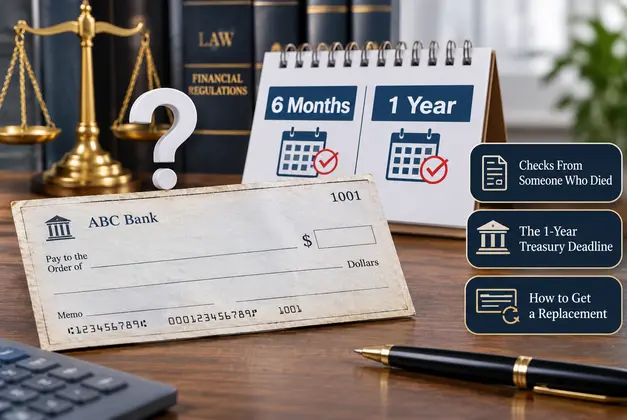
- PERSONAL, BUSINESS, OR PAYCHECK: STALE AFTER 6 MONTHS. Banks may refuse it after 6 months, but some still accept. If it’s your pay, the employer still owes you.
- U.S. TREASURY (tax refund, Social Security, VA): VOID AFTER 1 YEAR. The money isn’t lost; request it again from the agency.
- CASHIER’S OR CERTIFIED: NOT STALE AT 6 MONTHS. But after years it may be turned over to the state.
- THE WRITER DIED: TIME-SENSITIVE. A bank may pay for 10 days after the death, and a gift check that wasn’t paid before the death may not be owed by the estate.
- YOU WROTE IT: STOP BEFORE YOU REISSUE. Stop payment on the original first.
Three things not to do with an old check:
- Don’t mobile-deposit a stale check without asking your bank first.
- Don’t sign a check made out to someone who has died.
- Don’t write a replacement check before stopping the original.
Rules verified November 18, 2026. The federal paper-check phase-out is ongoing.
Old Check Checker
Answer a few questions about the check in your hand and get a status, the reason, and the next step. Nothing is saved or sent anywhere, and you never enter names, amounts, or account numbers.
How Long Is Each Type of Check Good For?
Most personal, business, and payroll checks go stale after six months, U.S. Treasury checks are void after one year, and bank-issued checks don’t go stale on that clock at all.
Stale doesn’t mean worthless. It means the bank is allowed to refuse the check, and the money is usually still owed to you. Find your check type below, then use the checker above for your exact dates.
| Check type | Usual window | What happens after | How to get paid |
|---|---|---|---|
| Personal check | 6 months from the date on it | STALE: the bank may refuse it or may pay it in good faith. The writer still owes you. | Ask the writer to stop payment and reissue. Ask a teller before depositing. |
| Business check | 6 months, unless a shorter limit is printed on it | STALE, same as a personal check. The business still owes you. | Ask the business for a replacement (Script 1). |
| Payroll check | 6 months | STALE. The paper expired; the wage debt didn’t. | Ask the employer to reissue (Script 2), then your state labor department, then unclaimed property. |
| U.S. Treasury check (tax refund, Social Security, VA, other federal) | 1 year from the issue date | VOID — REQUEST A NEW ONE. Treasury cancels it and returns the money to the issuing agency. | Ask the agency that issued it for a replacement (Script 3). |
| State or local government check | Often its own printed deadline, commonly 6 months to a year | Void under its printed terms. Read the check for the limit. | Contact the issuing agency. |
| Cashier’s check | No 6-month rule: the bank itself owes the money | GOOD, but after years it can be turned over to the state as unclaimed property. | Take it to the issuing bank. If it’s lost, ask about a declaration of loss (UCC 3-312). |
| Certified check | Carved out of the 6-month rule | GOOD, with the same unclaimed-property risk after years. | Take it to the issuing bank, or follow UCC 3-312 if lost. |
| Money order | No standard stale date; each issuer sets its own rules | Some issuers deduct service fees from old ones, and long-unclaimed money orders can go to the state. | Contact the issuer and keep your purchase receipt. |
| Insurance or settlement check | Look for a printed limit; with none, the 6-month rule applies | STALE or VOID depending on the printed terms. | Ask the insurer or claims administrator to reissue. |
What the 6-Month Rule Really Says
The six-month rule says a bank may refuse a check presented more than six months after its date. It doesn’t say the bank must refuse, and it doesn’t cancel what the writer owes you.
UCC § 4-404 covers a check “presented more than six months after its date.” The writer’s bank has no duty to pay it, but it may pay it in good faith and charge the writer’s account. Certified checks are carved out of the rule.
Banks may refuse after 6 months — they aren’t required to refuse.
May refuse, not must refuse
If the writer’s account has the money and the bank is comfortable with the check, it can pay a stale one. Some banks do. Many don’t, as a matter of policy. That is why asking a teller beats guessing.
Correcting the myth
Some quick-answer pages say banks are “legally obligated” to honor a check for six months. The rule works the other way: it marks when the writer’s bank may stop paying.
It isn’t a promise that any bank will cash your check at the counter during those six months. ID checks, holds, and the bank’s own policies still apply.
What “Void after 90 days” means
A printed “Void after 90 days” is the writer’s instruction, not a statute. The bank may follow it, and many mobile-deposit agreements list such checks as ineligible.
What the legend doesn’t do is cancel the debt. If you were owed the money, you still are. Ask the writer for a replacement (Script 1).
Why your bank might still take it
Some tellers will take a seven-month-old check without a second look; others won’t. The UCC is state law, and most states enacted the rule in nearly identical words, but check your own state’s version if the amount matters.
If the check was stolen or altered rather than just old, read Stolen Check Cashed.
Expired Treasury Checks: Tax Refunds, Social Security, and VA
A U.S. Treasury check is void one year after its issue date, but the payment you were owed doesn’t disappear: you ask the agency that issued it for a replacement.
Dated section. Reviewed November 18, 2026. The federal paper-check phase-out is still being put into effect, so re-check IRS.gov before you act.
The one-year rule
Treasury’s rules say it isn’t required to pay a check that wasn’t negotiated to a financial institution within 12 months of its issue date (31 C.F.R. § 240.5). Every Treasury check carries the legend “Void After One Year.”
After that, Treasury cancels the check and credits the money back to the agency that authorized it. The Treasury Financial Manual calls this a limited payability cancellation.
Fiscal Service tells banks not to accept a Treasury check older than one year, so a teller or an app will refuse it.
An expired Treasury check doesn’t erase the payment.
The money isn’t lost
The paper is dead; what it represented isn’t. The IRS tells people holding an expired refund check to call for a new one. Its CP32A notice for this situation says the same and asks you to destroy the old check if you still have it.
For Social Security, VA, or any other federal check, contact the agency that issued the payment, not your bank. Don’t sit on it: separate deadlines can apply to refund claims.
IRS refund checks: Form 3911 and who to call
Form 3911, the Taxpayer Statement Regarding Refund, carries a note: a check not cashed within one year of its issue date can no longer be cashed, and you should contact the IRS for instructions on how to return it.
The IRS’s lost-refund page says to start a refund trace. Use Where’s My Refund?, call 800-829-1954 for the automated line, or call 800-829-1040 to reach a representative. Those are the numbers listed on IRS.gov on a page reviewed October 21, 2026.
On a joint return the automated systems won’t start a trace, so call a representative or send Form 3911. For a check that was never cashed, the IRS says you’ll get a replacement once the original is canceled.
The About Form 3911 page lists the Refund Inquiry Unit number for each state.
One wrinkle: the CP32A page says to destroy the old check, while Form 3911 says to ask the IRS how to return it. Ask the agent which applies to you and follow that.
Paper checks are ending: what changed
Executive Order 14247 (March 25, 2025) directs Treasury to stop issuing paper checks for federal payments. The IRS announced in IR-2025-94 (September 23, 2025) that paper refund checks for individuals would be phased out beginning September 30, 2025, with limited exceptions.
The IRS’s January 2026 Q&A, FS-2026-02, says the IRS generally stopped issuing paper refund checks to individuals after that date. If it needs your bank details, it writes by mail first and then sends a notice giving you 30 days to respond. With no response and no other issues, the refund is released as a paper check after six weeks.
To see when refunds normally arrive, see our 2026 tax refund schedule.
What’s still unclear: replacements for old checks
The IRS’s published Q&A doesn’t address checks issued before the phase-out, checks older than a year, or how a replacement for an expired check will be delivered. The September 2025 announcement doesn’t say what happens to checks already issued.
The lost-refund page says a replacement follows once the original check is canceled, but it doesn’t say whether that replacement is paper or direct deposit. Form 3911 (revised October 2022) asks whether you originally requested a check or direct deposit and has bank fields, but it doesn’t say how a replacement will be sent.
So ask the agent how your replacement will be delivered, and don’t assume paper or direct deposit until you hear it. Script 3 below includes the question.
Social Security, VA, and other agencies
The one-year legend is the same across Treasury checks. For any federal payment other than an IRS refund, contact the agency that issued it and ask for a reissue. Have the check, the date, and the payment type in front of you.
The Writer Died: The 10-Day Rule and the Gift Problem
If the person who wrote your check has died, the bank may pay it for ten days after the date of death, but whether the estate owes you depends on whether the check was a gift or payment for something.
The 10-day rule
For ten days after a customer’s date of death, a bank can still pay checks that customer wrote on or before that date, even if the bank knows about the death. Anyone claiming an interest in the account, such as the executor, a relative, or a creditor, can tell the bank to stop. The rule is UCC § 4-405(b); read it at Cornell’s Legal Information Institute.
May, not must
The rule gives the bank permission, not a duty. A bank that knows of the death can say no, and many do. The rule protects the bank, not the person holding the check.
The executor can claw it back
The official comment says the section doesn’t stop an executor or administrator from recovering the payment from whoever holds the check. It also doesn’t change whether a gift was valid. A check that clears inside the window can still be contested.
Don’t try to deposit before the bank hears of the death. The law protects the bank for payments it makes without knowing, but it doesn’t decide who is entitled to the money, and the executor can still pursue a payment that was a gift.
Gift or debt? The question that decides it
Gift checks. A birthday or holiday check, or money handed over to help someone out, with nothing owed in return. In most states, if the giver dies before the check is paid, the recipient has no enforceable claim against the estate, because the gift isn’t complete until the bank honors the check. A New York Surrogate’s Court decision describes this as the prevailing rule.
Checks for value. Wages, a refund, payment for goods or services, repayment of a loan. If the check rested on something of value and the writer died before it was paid, the claim may be enforced against the estate, though not against the bank.
Statutory exceptions. Some states change the default by statute. Nebraska’s probate code, § 30-2723(d), makes a decedent’s estate liable to the payee of an unpaid request for payment made before death, and Nebraska courts have applied it to a check written as a gift.
There is no 50-state table here because there shouldn’t be one you can trust. Most states follow the incomplete-gift rule; some differ by statute; ask the executor.
A gift check that wasn’t paid before the giver died may not be owed.
What to do
Keep the check and don’t alter it. Contact the executor or personal representative, meaning the person named in the will or appointed by the court.
For a check given for value, ask when the deadline to present a claim runs out; probate claim deadlines can be short. If the amount matters or the estate disputes it, talk to a probate attorney.
| Situation | Can the bank pay? | Is the estate obligated? | What to do |
|---|---|---|---|
| Gift check, within 10 days of the death | It may, but doesn’t have to. Someone claiming an interest in the account can stop it. | Generally no in most states; some differ by statute. | Talk to the executor before depositing. A payment can be recovered. |
| Gift check, after 10 days | The 10-day permission has ended. Don’t expect payment once the bank knows of the death. | Generally no in most states; some differ by statute. | ASK THE ESTATE. Ask the executor whether the estate will honor it. |
| Check for value (wages, a refund, payment for goods or services) | It may pay inside the 10 days; after that, expect a refusal. | Often yes: a claim against the estate, not the bank. | Present a claim to the executor and ask about the probate claim deadline. |
| The bank already paid it | Already done. | The executor may be able to recover the payment from whoever holds it. | Keep records of what the check was for. If the executor contacts you, get legal advice. |
Gift check, within 10 days of the death
Can the bank pay? It may, but doesn’t have to. Someone claiming an interest in the account can stop it.
Is the estate obligated? Generally no in most states; some differ by statute.
What to do: Talk to the executor before depositing. A payment can be recovered.
Gift check, after 10 days
Can the bank pay? The 10-day permission has ended. Don’t expect payment once the bank knows of the death.
Is the estate obligated? Generally no in most states; some differ by statute.
What to do: ASK THE ESTATE. Ask the executor whether the estate will honor it.
Check for value (wages, a refund, payment for goods or services)
Can the bank pay? It may pay inside the 10 days; after that, expect a refusal.
Is the estate obligated? Often yes: a claim against the estate, not the bank.
What to do: Present a claim to the executor and ask about the probate claim deadline.
The bank already paid it
Can the bank pay? Already done.
Is the estate obligated? The executor may be able to recover the payment from whoever holds it.
What to do: Keep records of what the check was for. If the executor contacts you, get legal advice.
The Check Is Made Out to Someone Who Died
A check payable to someone who has died isn’t yours to sign; the executor or personal representative of the estate handles it.
Never endorse a check for someone who has died.
Signing the name of a person who has died, as if they were alive, can create legal trouble even when the reason is good.
The usual route is for the estate’s personal representative to endorse the check as representative and deposit it to an estate account. Ask the bank which papers it needs; the answer depends on your state and the amount.
For smaller estates, some states allow a small-estate affidavit instead of a full probate. See Small Estate Affidavit Limits by State.
The clock doesn’t stop while an estate is opened. If the check goes stale or void in the meantime, ask the writer or agency to reissue it payable to the estate. For tax refunds, the IRS says it will keep accepting or generating checks for decedent accounts under current practice and will announce changes.
Found more old paper in a parent’s files? How to Cash In Old Stock Certificates covers the next most common find.
Old Paychecks: The Paper Expired, the Debt Didn’t
An old paycheck can go stale after six months, but the wages are still owed, and an uncashed paycheck usually isn’t the employer’s to keep.
A stale check doesn’t cancel the wage debt. Ask payroll to void the old check and issue a new one, by direct deposit if possible. The employer may need to stop payment on the original first. Script 2 does the asking.
If the employer refuses or stops answering, your state labor department handles wage claims, and the rules differ by state. Our Final Paycheck Laws by State covers final-pay deadlines.
Uncashed wages can also be turned over to the state as unclaimed property after a waiting period the state sets. Employers are generally expected to report them, not keep them, so a paycheck from years ago may be sitting in a state database. Start with How to Find Unclaimed Money.
If the employer has closed, its bank account may be closed too, and a deposit could come back unpaid. Start with the labor department and an unclaimed-property search. Neither is a guarantee.
Cashier’s Checks, Certified Checks, and Money Orders
Cashier’s and certified checks don’t go stale at six months because the bank itself owes the money, but years later the funds can be turned over to the state.
The six-month rule in UCC § 4-404 is written for checks drawn on a customer’s account, and it names certified checks as an exception. A cashier’s check is drawn on the bank itself, so the bank is the one obligated to pay it.
That doesn’t make waiting safe. A cashier’s check that sits uncashed for years can be reported to the state as unclaimed property under state law, and the longer you wait the harder it is to sort out. If you think that has happened, see How to Find Unclaimed Money.
How to claim one
Take the check and your ID to the issuing bank, or ask a teller where to bring it. The bank can tell you whether it still holds the money.
If you lost it
UCC § 3-312 sets up a declaration-of-loss process for lost, destroyed, or stolen cashier’s, teller’s, and certified checks. The person claiming the money signs a statement under penalty of perjury that they lost possession and can’t reasonably get the check back.
The claim becomes enforceable on the later of the day it’s made or the 90th day after the check’s date. After that, the bank must pay the claimant unless the check was already paid to someone entitled to enforce it. Read the section at Cornell’s Legal Information Institute, then ask the bank for its form.
Money orders
Money orders don’t follow the six-month clock for ordinary checks, and each issuer sets its own rules. Some deduct service fees from old ones, and long-unclaimed money orders can end up with the state. Contact the issuer, keep your purchase receipt, and ask what your money order is worth today.
Depositing an Old Check: Mobile, Teller, or Check-Cashing Store
Ask a teller before you deposit any check over six months old, because the app may reject it and a check that comes back unpaid can cost you.
Why the app may say no
Many mobile-deposit agreements list checks dated more than six months before the deposit as ineligible, and some also exclude checks marked “void after 90 days.” An app that rejects the picture is the mild outcome. Read your bank’s agreement, or just ask.
Ask a teller first
A teller can tell you whether the branch will take the check, whether it will be held, and what happens if it comes back. Script 4 has the questions. A stale check can also draw a longer hold; see How Long Can a Bank Hold a Check.
The returned-item risk
If the writer’s bank refuses a stale check after your bank has credited it, your bank can reverse the credit and may charge a returned-item fee. Check-cashing stores set their own rules, may refuse an old check, and can hold you responsible if it’s returned.
A few habits that help
Keep the paper check until the deposit has fully cleared, and never deposit the same check twice, by app and at a branch. Never deposit a check from a stranger who asks you to send part of it back; that is a scam.
If You Wrote the Check: Wait, Stop, or Reissue?
If a check you wrote hasn’t been cashed, don’t just write a new one: stop payment on the original first, then reissue.
Stop payment first, then reissue.
Is the money yours again?
Not automatically. You still owe the payee, the check can still be paid inside six months, and after six months the bank may pay it in good faith. An uncashed check isn’t a refund to you.
How stop payment works
Under UCC § 4-403, you can order your bank to stop payment on a check drawn on your account, if the order reaches the bank in time for it to act. A written order is effective for six months and can be renewed in writing. An oral order lapses after 14 calendar days unless you confirm it in writing. Your bank’s own terms and your state’s version of the law govern.
Describe the check as precisely as you can: number, date, payee, and amount. Ask what the bank charges, and ask for written confirmation.
Then reissue
Once the bank confirms the stop, write the replacement and ask the payee to destroy the original (Script 5). If you reissue first and both checks clear, you could pay twice.
Cashier’s checks you bought
Stop payment works differently for a cashier’s check you bought: it isn’t drawn on your account, so you generally can’t stop it the way you stop one of your own checks. Use the lost-check process described in the cashier’s check section above.
If you wrote it for a business
Outstanding vendor and payroll checks can become unclaimed property that a business must report to the state after a waiting period that varies by state. Don’t void them and keep the money.
| Option | When it fits | Risk | What to keep |
|---|---|---|---|
| Wait | The check is under 6 months old and the payee is probably just slow. | It can be paid any day, so the money has to stay in your account. After 6 months the bank may still pay it. | The check number, the date, and a reminder to follow up. |
| Contact the payee | The payee hasn’t said it’s lost and you just want to know where it stands. | Little. A slow reply may leave you unsure whether it’s lost. | Your message and their reply. |
| Stop payment | The payee says it’s lost or destroyed, or you want the old check dead before replacing it. | A written order lasts 6 months unless renewed; an oral one lapses after 14 days unless confirmed in writing. The bank may charge for it, and a check can still slip through if the order is late or lapses. | The bank’s written confirmation, plus the check number, date, payee, and amount. |
| Reissue after the stop | The bank has confirmed the stop. | Reissuing first risks paying twice if both checks clear. | Both check numbers, the stop confirmation, and the payee’s agreement to destroy the original. |
Myths vs. the Actual Rules
Most of what people believe about old checks is half right, and the missing half is usually what costs them money.
| Myth | What’s actually true | Source |
|---|---|---|
| “Banks must honor checks for 6 months.” | The six months only marks when the writer’s bank may start refusing. It isn’t a guarantee that any bank will cash your check at the counter during that time. | UCC § 4-404 |
| “Void after 90 days means the money is gone.” | It’s the writer’s instruction, which the bank may follow. The debt behind the check survives, so ask for a replacement. | UCC Article 4; the legend is the writer’s own term |
| “An expired IRS check means a lost refund.” | The check can’t be cashed after a year, but you can ask the IRS for a replacement. | 31 C.F.R. § 240.5; IRS lost-refund page and CP32A notice |
| “Cashier’s checks never expire, so it’s fine to wait.” | They don’t go stale at 6 months, but after years the money can be reported to the state, and a lost one takes a formal claim. | UCC §§ 4-404, 3-312; state unclaimed-property laws |
| “Just write a new check; the old one will die.” | The old one can still be paid. Stop payment first, then reissue. | UCC §§ 4-403, 4-404 |
| “When the writer dies, their checks are worthless at once.” | A bank may pay for 10 days after the date of death. But a gift check that wasn’t paid before the death may not be owed by the estate, and an executor can recover a payment. | UCC § 4-405 and its official comment |
Copy-Ready Scripts
Five short scripts cover most old-check situations; fill in the blanks and send or read them as written.
Script 1: Replacement request (to a person or business)
Hi [name],

I have check #___ dated ___ for $___ that I wasn't able to deposit in time. Could you stop payment on it and issue a replacement? I'll destroy the original once the new one arrives.

Thank you,
[your name]
Script 2: Old paycheck (to the employer or payroll)
Hello [payroll contact],

I have paycheck #___ dated ___ for the pay period ending ___ that I wasn't able to deposit in time, and it is now more than six months old. Please void it and reissue the wages owed to me. Direct deposit works if you can set it up.

If the wages can't be reissued, please tell me in writing why, and whether they have been reported to the state as unclaimed property.

Thank you,
[your name]
If the employer refuses, contact your state labor department.
Script 3: Expired IRS or Treasury check (call checklist)
Have ready:
- the check (don't mail it yet)
- the tax year
- a copy of the return

Say:
"I have a federal refund check dated ___ that I didn't cash within a year. I'd like a replacement."

Ask:
1. How will the replacement be delivered: paper check or direct deposit?
2. What should I do with the original: destroy it or return it?
3. Do I need to send Form 3911?
4. How long will it take, and what reference number should I write down?
Numbers listed on IRS.gov (page reviewed October 21, 2026): 800-829-1954 for the automated line, 800-829-1040 for a representative. If you got a notice, use the number printed on it. For other federal checks, call the agency that issued the payment.
Script 4: Before you deposit a stale check (questions for the teller)
"Will you accept a check dated ___?
Will it be held?
Is there a fee if it's returned?"
Script 5: For writers (to the payee)
Hi [name],

Check #___ hasn't been deposited. I've placed a stop payment and will send a replacement on [date]. Please don't deposit the original.

Thank you,
[your name]
Old Check FAQ
Short answers to the questions people ask most about old checks.
How long is a check good for?
Most personal, business, and payroll checks go stale at six months. U.S. Treasury checks are void after one year. Cashier’s and certified checks don’t go stale at six months. A printed limit on the check can shorten the window.
Can you cash a check after 6 months?
Sometimes. The writer’s bank may refuse a stale check, but it may also pay it in good faith, and your own bank has its own policy. Ask a teller rather than trying an app.
Is a bank required to cash a check under 6 months old?
Not in the way the myth suggests. The six-month mark only matters to the writer’s bank. Any bank where you try to cash or deposit the check applies its own ID, hold, and eligibility rules.
Does “Void after 90 days” mean the money is gone?
No. It’s the writer’s instruction, and the bank may follow it. The debt behind the check survives, so ask the writer for a replacement.
How long is a Treasury check good for?
One year from the issue date. After that it is void, Treasury cancels it, and the money goes back to the agency that issued it. You request a replacement from that agency.
What if my IRS refund check is over a year old?
You can’t cash it, but you can ask the IRS for a replacement. Start a refund trace by phone or send Form 3911, and ask what to do with the old check. See the Treasury section for the numbers.
Will the IRS mail a paper replacement now?
It isn’t clear. The IRS says it generally stopped issuing paper refund checks to individuals after September 30, 2025, with limited exceptions, but its published Q&A doesn’t say how replacements for expired checks are delivered. Ask the agent and don’t assume either way.
How long is a paycheck good for?
As a check, about six months. As a debt, the wages stay owed. Ask the employer to void and reissue, and go to your state labor department if it won’t.
My old employer closed — can I still get paid?
Possibly. Start with your state labor department and an unclaimed-property search. The closed business’s account may be shut, so a deposit could be returned, and neither route is guaranteed.
Do cashier’s checks expire?
They don’t go stale under the six-month rule, because the bank itself owes the money. After years, though, the funds can be reported to the state as unclaimed property.
Do money orders expire?
There is no standard six-month clock, and each issuer sets its own rules. Some deduct service fees from old money orders. Contact the issuer and keep your receipt.
Can I cash a check from someone who just died?
A bank may pay it for ten days after the date of death, but it doesn’t have to, and an executor can recover a payment. Talk to the executor before you deposit it.
Is a gift check still valid after the giver dies?
In most states, if the check wasn’t paid before the death, the gift is incomplete and the estate generally doesn’t owe it. Some states differ by statute. Ask the executor.
Can the estate take the money back if I cashed it?
The executor may be able to recover a payment from the person who got it, particularly a gift. A check for something you were owed is different. Keep your records and get legal advice from a probate attorney.
What do I do with a check made out to someone who died?
Don’t sign it. The estate’s personal representative handles it, and for small estates some states allow an affidavit instead. See Small Estate Affidavit Limits by State.
Can I mobile-deposit an old check?
Many mobile-deposit agreements exclude checks dated more than six months before the deposit, so the app may reject it. Ask a teller first.
I wrote a check 8 months ago and it was never cashed — is the money mine?
Not automatically. You still owe the payee, and the bank may still pay the check in good faith. Contact the payee; if it’s lost, stop payment first, then reissue.
Should I stop payment before writing a new check?
Yes. Stop payment on the original, get the bank’s confirmation, then write the replacement. Reissuing first risks paying twice.
Last updated:
This article is general information, not legal or tax advice. Bank policies, state law, and federal payment procedures vary and change. For estates, disputed checks, or large amounts, talk to the executor or a probate attorney. Verified on November 18, 2026.

Daniel Hayes is the founder and sole researcher at AdvoraHQ. He covers U.S. personal finance, insurance, and consumer law — working directly from IRS publications, federal and state statutes, court opinions, and SEC filings rather than secondary summaries. His focus is the gap between what readers think they know and what the source documents actually say. Daniel is not a licensed attorney, CPA, or financial advisor; his articles are educational and not personalized advice. Reach him at Daniel.Hayes@advorahq.com.
