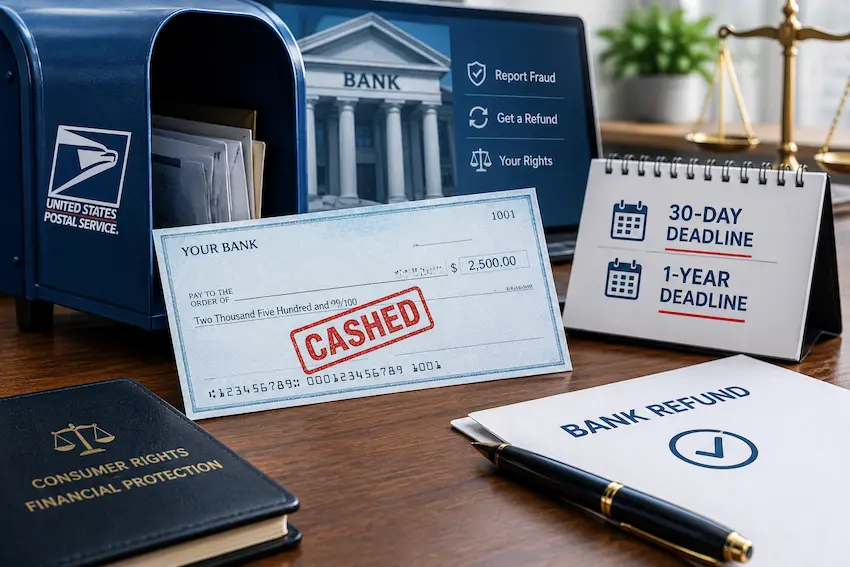
Quick answer: If someone stole a check you mailed and changed it, or forged the payee’s signature, your bank generally wasn’t authorized to pay it. Your claim is against your own bank, not the bank where the thief cashed it.
But your right to a refund depends on three things: what kind of fraud it was, how fast you report it, and the deadline in your account agreement, which can be much shorter than the law’s one-year limit.
Report it in writing today. Some account agreements give you as little as 30 days from the statement date, and courts have upheld periods as short as 14 days.
Find your deadline and who owes you (jump to the checker)
Copy the written notice to send your bank (jump to the letter)
Verified October 21, 2026. State versions of the UCC differ — check yours.
Who Pays and What Is Your Deadline? A Quick Checker
Answer six questions and you get the type of fraud, who you claim against, and your key dates.
After you see your result: copy the written notice. If it mentions Regulation E, read Provisional Credit Reversed?
The First 24 Hours
Call your bank’s fraud line, then put the claim in writing the same day.
- Call the bank’s fraud line. Use the number on your statement or card. Say “altered check” or “forged check,” ask them to open a claim, and write down the time, the person’s name, and any reference number.
- Get front and back images. Ask for images of the check as paid. Compare the payee, amount, handwriting, and the signature on the back with what you wrote.
- Send the written notice. A phone call alone leaves no proof. Copy the letter below and send it in a way you can prove.
- Stop payment on other outstanding checks. Stolen mail often holds more than one check. Ask about any fee, and which checks are still waiting to clear.
- File police and U.S. Postal Inspection Service reports. Call 877-876-2455 or use uspis.gov. Keep both report numbers; your bank will ask for them.
- Call the payee. Tell them the check was stolen. Ask whether they received it. You will likely need to pay them another way (see the unpaid bill).
- Ask about closing the account and getting a new account number. Every check shows your routing and account numbers, which is what thieves reuse.
- Consider a credit freeze. If the stolen check exposed your name, address, or account number, read Someone Opened a Credit Card in My Name.
My Check Was Washed. Who Pays?
Your own bank answers to you first, because it paid an item you didn’t authorize.
YOUR BANK’S PROBLEM
Your claim is against your own bank. Not the bank where the thief cashed the check, and not the payee.
A bank may charge your account only for items that are “properly payable” (UCC § 4-401). An item is properly payable if you authorized it. An altered or forged item generally isn’t.
A raised amount works differently. Under UCC § 4-401(d), your bank may be able to charge you the original amount you wrote. If you wrote $500 and it was paid as $5,000, your claim is generally for the $4,500 difference.
Behind the scenes, the banks sort out their own loss. Whoever presents a check for payment warrants to the paying bank that it has not been altered (UCC § 4-208). A paying bank that refunds you for an altered check can pursue the depositary bank, the bank that took the thief’s deposit.
That fight is between the banks. Don’t chase the cashing bank yourself: it has no account relationship with you, won’t discuss someone else’s account, and will send you back to your own bank.
None of this means a refund is automatic. Your bank can still raise timing, negligence, or account-agreement defenses, covered in deadlines and what to do if the bank says no.
Which Kind of Check Fraud Is It?
The type of fraud decides which rule and which deadline apply to you.
FinCEN reviewed 15,417 bank reports of mail-theft check fraud filed in the six months after its February 2023 alert. By FinCEN’s September 2024 analysis, about 44% involved altered checks, 26% counterfeits, and 20% fraudulent signatures.
The FBI and Postal Inspection Service warned in January 2025 that suspicious activity reports about check fraud had nearly doubled from 2021 to 2023. Nasdaq Verafin estimates U.S. check fraud losses reached $33.6 billion in 2025.
Altered checks come in two variants (payee or amount), so the table below has six rows for five types.
| What happened | What it’s called | Who you claim against | The deadline that matters | Your risk |
|---|---|---|---|---|
| The payee name on your check was changed (check washing) | Altered check | Your own bank. It can pursue the depositary bank (§ 4-208). | Statement review; 30-day same-wrongdoer rule for later checks; your account agreement; one-year bar | A missed deadline, or a negligence defense if blank space helped the change |
| The amount was raised | Altered check (raised amount) | Your own bank, usually for the difference between what you wrote and what was paid | Same as above | The bank may charge the original amount (§ 4-401(d)); same deadline risks |
| The payee’s name is right, but someone else signed the back and cashed it | Forged endorsement | Your own bank | No § 4-406 statement-review duty; a statute of limitations instead (three years in the model code, one year in some states) | Waiting too long: some states run a one-year clock from when you should have discovered it |
| A check you never wrote, with your account number, or one printed from a copied image | Counterfeit check; check cooking | Your own bank. Generally the paying bank’s risk. | Statement review; 30-day same-wrongdoer rule; your account agreement; one-year bar for an unauthorized drawer signature | More counterfeit checks can follow from the same image or account number |
| Your signature was forged on a check stolen from your checkbook | Forged drawer signature | Your own bank | Same as counterfeit | Missed deadlines. A signature you authorized someone to make is not a forgery. |
| You signed a blank check and someone filled in a payee and amount | Completed item (signed blank check) | You can ask your own bank, but this claim usually fails | Report now; timing is not the main issue | High: the bank may charge the item as completed (§ 4-401(d)) |
1. Altered check (payee changed or amount raised)
What happened: A genuine check you wrote was physically changed, usually by washing off the ink and rewriting the payee or the amount.
YOUR BANK’S PROBLEM
Claim against your own bank. It can pursue the depositary bank under § 4-208. For a raised amount, your bank may be able to charge you the original amount you wrote (§ 4-401(d)), so the claim is usually for the difference.
YOUR DEADLINE
Statement review, the 30-day same-wrongdoer rule for later checks, your account agreement, and the one-year bar.
YOUR RISK
A missed deadline, or a negligence defense if blank space on the check helped the change.
2. Forged endorsement
What happened: The payee’s name is right, but someone else signed the back and cashed it.
YOUR BANK’S PROBLEM
Claim against your own bank.
YOUR DEADLINE
No § 4-406 statement-review duty. A statute of limitations applies instead: three years in the model code, one year in some states.
YOUR RISK
Waiting. In some states a one-year clock runs from when you should have discovered it.
3. Counterfeit check or check cooking
What happened: A check you never wrote, printed with your account number, or one made from a copied image of your check.
YOUR BANK’S PROBLEM
Claim against your own bank. Generally the paying bank’s risk.
YOUR DEADLINE
Statement review, the 30-day same-wrongdoer rule, your account agreement, and the one-year bar for an unauthorized drawer signature.
YOUR RISK
More counterfeit checks can follow from the same image or account number.
4. Forged drawer signature
What happened: Someone forged your signature on a check stolen from your checkbook.
YOUR BANK’S PROBLEM
Claim against your own bank.
YOUR DEADLINE
Same as counterfeit: statement review, 30-day rule, account agreement, one-year bar.
YOUR RISK
Missed deadlines. A signature you authorized someone to make is not a forgery.
5. Signed blank check
What happened: You signed a blank check and someone filled in a payee and amount.
YOUR RISK
High. The CFPB says protections generally do not apply, and you usually can’t get the money back if someone fills in their own name. The bank may charge the item as completed (§ 4-401(d)).
YOUR DEADLINE
Report now. Timing is not the main issue for this type.
Sources: model UCC §§ 4-208, 4-401, 4-406, 4-111; CFPB. State versions vary. Verified October 21, 2026.
“Check cooking” is a fully digital forgery. Fraudsters photograph a stolen check, alter the image with software, and print counterfeits, per the FBI and Postal Inspection Service alert of January 27, 2025.
Your Deadlines: 30 Days, Your Account Agreement, and One Year
Several separate clocks can run on your claim, and which one matters depends on the type of fraud.
YOUR DEADLINE
Your account agreement may set a deadline much shorter than one year. Find the section on reporting unauthorized or altered items and read the number of days.
The 30-day same-wrongdoer rule. You must examine your statement with reasonable promptness (UCC § 4-406). If you don’t report within a reasonable time, not more than 30 days after the statement is made available, you may be barred from claims on later items by the same wrongdoer.
This rule does not cut the first check’s deadline to 30 days. It protects the bank against later checks paid before you gave notice.
Your account agreement. The UCC lets a bank and customer vary many of these terms by agreement, unless the standard is “manifestly unreasonable” (§ 4-103). Courts have upheld a 14-day period in Clemente Bros. Contracting Corp. v. Hafner-Milazzo (N.Y. 2014) and a 60-day period in National Title Insurance Corp. Agency v. First Union National Bank (Va.).
Both cases involved business accounts, and this is not universal. Say it this way: your account agreement may set a shorter deadline, and courts in several states have enforced them. Whether a bank can contractually shorten the forged-endorsement period is disputed.
The one-year bar. Regardless of either side’s care, a claim for an unauthorized drawer signature or an alteration that you don’t report within one year after the statement is made available is barred (§ 4-406(f)). If the bar applies, the paying bank also loses its § 4-208 claim against the other bank, so your bank will check this date.
YOUR DEADLINE
A forged endorsement follows different deadlines. Official Comment 5 to § 4-406 says the section imposes no duty on you to discover a forged endorsement.
Claims are subject to the statute of limitations instead: three years in the model code (§ 4-111), one year in some states. California Code of Civil Procedure § 340(c) sets one year, and the Ninth Circuit held in 2020 that it runs from when the customer reasonably should have discovered the forged endorsement. Some states, such as New York, which still uses the older Article 4 text, address forged endorsements inside their own § 4-406 with different periods, so check yours.
The CFPB says it plainly: you are generally not responsible for a fraudulent endorsement as long as you report it within the period set by state law.
| Clock | How long | Starts when | Applies to | Source |
|---|---|---|---|---|
| Same-wrongdoer rule | A reasonable time, not more than 30 days | Statement or items made available | Later checks by the same wrongdoer, paid before you gave notice | UCC § 4-406(d) |
| Account agreement | Often 30 to 60 days; courts have upheld 14 and 60 | As your agreement says (often the statement date or mailing date) | Whatever the agreement covers; whether it can shorten the forged-endorsement period is disputed | UCC § 4-103; Clemente Bros.; National Title |
| One-year bar | One year | Statement or items made available | Alterations and unauthorized drawer signatures (not forged endorsements in the model code) | UCC § 4-406(f) |
| Forged-endorsement statute of limitations | Three years in the model code; one year in some states | Varies; in California, when you reasonably should have discovered it | Forged endorsements | UCC § 4-111; Cal. Code Civ. Proc. § 340(c) |
| Regulation E, if converted to ACH | 60 days | Statement that shows the electronic transfer | Consumer accounts only | 12 C.F.R. § 1005.11 |
Is Check Fraud Covered by Regulation E?
Generally no for paper checks, unless the check was converted into an electronic (ACH) transfer.
The federal Electronic Fund Transfer Act excludes transactions originated by check. But when a merchant or biller uses your check only to capture your routing and account numbers and make a one-time electronic debit, Regulation E applies. These conversions are called ARC, BOC, and POP.
The CFPB makes the same point: if the check was processed as an electronic transfer, federal law gives you additional protections.
How to tell from your statement. Look for a line labeled ACH, eCheck, or electronic payment, or a debit with no check image. If you see it, report within 60 days of the statement that shows it. Regulation E covers consumer accounts only, never business accounts.
For the electronic case, read Provisional Credit Reversed? A Zelle payment follows different rules entirely: see Zelle Scam Refund Rules.
Altered or Counterfeit: Why the Banks’ Fight Matters to You
How the fraud is classified decides which bank absorbs the loss, and that can affect how your bank handles your claim.
An altered check is a genuine check that was physically changed. A counterfeit is fabricated, including a printed copy made from an image. The UCC’s alteration warranty reaches the first, not the second.
| What it is | Which bank usually bears the loss | What it means for you |
|---|---|---|
| Altered check: a genuine check physically changed (washing) | Often the depositary bank, through its presentment warranty that the check was not altered (§ 4-208) | Your bank may have a way to recover, so it may handle the claim as a warranty dispute with the other bank |
| Counterfeit check: fabricated, or printed from a copied image (check cooking) | Generally the paying bank, which is your bank | Your bank has less chance of passing the loss on, so it may scrutinize the claim more closely |
| Forged drawer signature on a genuine check from your checkbook | Generally the paying bank, which is your bank | Your bank is generally in the position of having paid an item it should not have |
Whether a check made from an image counts as altered or counterfeit can be argued. Ask your bank in writing how it classified your claim and why.
Banks also have their own time limits for claims against each other, which is one reason your bank may press you for dates and documents early.
How to File Your Claim
Send a written notice your bank can’t say it never received, then complete any affidavit it asks for.
Copy the letter below, fill in the brackets, and delete any line that doesn’t match what happened.
Subject: Written notice of altered / unauthorized check — request to recredit

[Edit or delete any line that does not match what happened. State only what is true.]

[Today's date]

To: [Bank name], [fraud or disputes department, address or secure message center]
From: [Your full name], account ending in [last four digits]

I am giving you written notice that a check drawn on my account was paid without my authorization, and I am asking you to recredit my account.

Check details
- Check number: [number]
- Date I wrote it: [date]
- Payee I wrote: [name]
- Amount I wrote: [$ amount]

What was paid instead
- Payee as shown on the check image: [name]
- Amount as shown: [$ amount]
- Date it was paid: [date]

My statement of the facts
- I did not authorize the change.
- I did not endorse this check to the person who cashed it, and I received no benefit from it.
- I mailed the check on [date] from [location].
- Other checks that look unauthorized: [list check numbers, or write "none known"].

My requests
1. Recredit my account because the item was not properly payable under [your state]'s Uniform Commercial Code.
2. Send me images of the front and back of the check as paid.
3. Send me a written decision on this claim and the name of the department handling it.

Reports I have filed
- Police report number: [number], [agency], [date]
- U.S. Postal Inspection Service report number: [number], [date]

If you need me to complete an affidavit of forgery, please send the form and I will complete it promptly.

[Your name]
[Phone] [Email]
Send it in a way you can prove — the bank’s secure message center plus a printed copy, or certified mail. Keep a copy.
The affidavit of forgery. Your bank may ask you to sign a sworn statement. Answer every question truthfully and completely, including how the check left your hands. Leaving out a fact or misstating one can sink a valid claim.
Documents to keep:
- Your copy of the letter and proof it was sent
- The front and back images of the check as paid
- The statement showing the payment
- Police and Postal Inspection Service report numbers
- A log of every call: date, name, what was said
- Your account agreement and any messages from the payee
The Bank Said No. Now What?
Get the reason in writing, work out which defense the bank is using, then escalate in steps.
- Get the reason in writing. Ask for a written decision that says exactly why the claim was denied.
- Identify the defense. The usual ones are timing (the statement-review duty, your account agreement, or the one-year bar), customer negligence under UCC § 3-406 (for example, blank space left on the check that made the change easy), or a claim that you signed a blank check. The bank may also say the item was your own.
- Escalate inside the bank. Ask for a supervisor or the disputes department, cite your dated written notice, and ask for the version of the account agreement in effect when the check was paid.
- File a regulator complaint. Which agency depends on your institution (Table 4). A complaint creates a paper trail and usually prompts a written response from the bank. It does not by itself force a refund.
- Consider small claims or an attorney. Small claims limits vary by state: see How to Sue in Small Claims Court. For a large amount, a business account, or repeated forgeries, talk to a consumer or banking attorney.
| Your institution | Regulator | How to file |
|---|---|---|
| National bank (the name includes "National" or "N.A.") | Office of the Comptroller of the Currency (OCC) | helpwithmybank.gov, online complaint form |
| Bank with more than $10 billion in assets | Consumer Financial Protection Bureau (CFPB) | consumerfinance.gov/complaint |
| State-chartered bank | Your state banking regulator; the FDIC (state banks outside the Federal Reserve System) or the Federal Reserve (state member banks) | fdic.gov/consumers or federalreserveconsumerhelp.gov; find your regulator with FDIC BankFind |
| Federal credit union | National Credit Union Administration (NCUA) | ncua.gov, consumer assistance |
| State credit union | Your state credit union regulator; the CFPB if the credit union has more than $10 billion in assets | Your state's financial regulator website |
National bank (name includes "National" or "N.A.")
Regulator: Office of the Comptroller of the Currency (OCC)
How to file: helpwithmybank.gov, online complaint form
Bank with more than $10 billion in assets
Regulator: Consumer Financial Protection Bureau (CFPB)
How to file: consumerfinance.gov/complaint
State-chartered bank
Regulator: your state banking regulator; the FDIC (state banks outside the Federal Reserve System) or the Federal Reserve (state member banks)
How to file: fdic.gov/consumers or federalreserveconsumerhelp.gov; find your regulator with FDIC BankFind
Federal credit union
Regulator: National Credit Union Administration (NCUA)
How to file: ncua.gov, consumer assistance
State credit union
Regulator: your state credit union regulator; the CFPB if the credit union has more than $10 billion in assets
How to file: your state's financial regulator website
Sources: Federal Reserve list of consumer complaint agencies; OCC. Verified October 21, 2026.
A deposit hold on a check you deposited is a separate problem from a fraud claim. This article covers a check you wrote that was stolen and cashed.
The Bill You Thought You Paid
You generally still owe the payee, because a stolen check that someone else cashed never paid them.
YOUR RISK
You may still owe the bill you tried to pay. Late fees and penalties can keep building while your bank reviews the claim.
Contact the payee right away. Tell them the check was stolen from the mail, give them your police and Postal Inspection Service report numbers, and offer a replacement payment you can trace.
Ask them to waive late fees and to note the fraud report on your account. Some will if you contact them quickly and show you reported it, but they are not required to.
Tax payments carry penalties and interest. If a property tax or IRS check was stolen, contact the taxing agency right away, give it your report numbers, and ask in writing how it handles a payment that never arrived.
Your Account Number Is Out There Now
Treat the old account as compromised, because your routing and account numbers are printed on every check.
Ask your bank about opening a new account with a new number. Before you close the old one, move automatic payments, wait for outstanding checks to clear, and ask whether closing it affects your claim.
Watch for new counterfeit checks. A thief with an image of one check can print many more. Review check images on every statement, not just the totals.
If your bank freezes the account during its review, see Bank Froze My Account. If a bank later denies you a new account, see Denied a Bank Account? ChexSystems.
Consider a credit freeze if your name and address were exposed. Our guide Someone Opened a Credit Card in My Name explains the steps.
How to Keep It From Happening Again
Take paper checks out of the mail wherever you can, and make the ones you do write harder to change.
- Hand checks to a postal clerk inside the post office, or use the letter slots inside it. The Postal Inspection Service advises using those slots or handing mail to a letter carrier.
- Use electronic bill pay or another electronic payment whenever the payee allows it.
- Write with black, pigmented gel ink. The OCC says black gel ink is highly resistant to check washing.
- Leave no blank space. Fill the payee and amount lines completely so nothing can be added.
- Sign up for Informed Delivery to preview your incoming mail, and pick up mail promptly.
- Have new checks delivered to the branch instead of your mailbox.
- Review check images monthly, and follow up with payees to confirm they received each check.
- Businesses: ask your bank about Positive Pay, which flags checks that don't match the ones you issued.
FAQ
What should I do if my check was stolen and cashed?
Call your bank's fraud line, send a written notice, ask for front and back images, file police and Postal Inspection Service reports, stop payment on other outstanding checks, and contact the payee. See the first 24 hours.
Will my bank refund a stolen or washed check?
Often, but not automatically. An altered or forged check generally isn't one your bank was authorized to pay, but your right to a refund depends on the type of fraud, how fast you report, and your account agreement. A signed blank check is the usual exception.
Who is liable for a washed check?
Your claim is against your own bank. Between banks, the bank that presented the check warrants it was not altered (UCC § 4-208), so a bank that refunds you can generally pursue the depositary bank.
How long do I have to report check fraud to my bank?
As fast as you can. Several clocks may apply: a reasonable time, not more than 30 days, for later checks by the same wrongdoer; your account agreement's deadline; and a one-year outside limit for alterations and forged drawer signatures. Forged endorsements follow a statute of limitations instead.
Can my bank shorten the one-year deadline?
Often, yes. The UCC lets banks and customers vary these terms unless the standard is "manifestly unreasonable," and courts have upheld 14-day and 60-day agreements. This is not universal, and those cases involved business accounts. Read your account agreement.
What if someone forged the payee's signature on the back?
The CFPB says you are generally not responsible for a forged endorsement as long as you report it within the period set by state law. The UCC's statement-review duty doesn't apply to forged endorsements, but a statute of limitations does. Report quickly.
What if the check was cashed for more than I wrote?
Your bank may be able to charge you the original amount you wrote (UCC § 4-401(d)). Your claim is generally for the difference. Ask for the check images and report in writing.
Is check fraud covered by Regulation E?
Generally not for paper checks. It can apply if the check was converted to an electronic (ACH) transfer, with a 60-day reporting window, and only for consumer accounts. Check your statement. See Provisional Credit Reversed?
What's the difference between an altered and a counterfeit check?
An altered check is a genuine check that was physically changed. A counterfeit is fabricated, including a printed copy made from an image. The classification generally decides which bank absorbs the loss.
What if I signed a blank check?
The CFPB says you usually can't get your money back if someone fills in their own name and cashes it. Report it to the police and the Postal Inspection Service, stop payment if it hasn't been cashed, and still ask your bank to review it.
Should I go to the bank that cashed it?
No. Your claim is against your own bank, and the cashing bank won't discuss someone else's account. Give your police report number to your bank and to investigators.
Do I still owe the bill I was paying?
Generally yes, because the payee never received the money. Contact them now and ask them to waive late fees. See the unpaid bill.
Should I close my bank account?
Ask for a new account number, since the old one is exposed. Before closing the old account, move automatic payments, let outstanding checks clear, and ask whether closing affects your claim. If the bank freezes the account, see Bank Froze My Account.
Can the thief use my account number again?
Yes. Your routing and account numbers are on every check, and a single check image can be used to print counterfeits. Watch your statements closely and consider a new account.
Where do I report mail theft?
Call the U.S. Postal Inspection Service at 877-876-2455 or file at uspis.gov, and report it to local police. For check cooking, you can also file with the FBI's Internet Crime Complaint Center at ic3.gov.
How do I complain if my bank refuses?
Get the denial in writing, escalate inside the bank, then file with your regulator (Table 4): the OCC for national banks, the CFPB for banks over $10 billion, the NCUA for federal credit unions, or your state regulator.
Can I sue my bank in small claims court?
Often, up to your state's small claims limit. See How to Sue in Small Claims Court. For large losses, business accounts, or repeated forgeries, talk to a consumer or banking attorney.
What's the safest way to mail a check?
Don't, if you can avoid it. If you must, hand it to a postal clerk inside the post office, write in black gel ink, leave no blank space, and confirm with the payee that it arrived.
Sources
- CFPB, I wrote a check to someone but it was stolen. The thief forged the indorsement (Ask CFPB)
- CFPB, My bank or credit union won't return my money. Am I responsible?
- Uniform Commercial Code §§ 3-406, 4-103, 4-111, 4-208, 4-401, 4-406 with Official Comments, in your state's codified version. Example of the revised text: Massachusetts § 4-406
- Clemente Bros. Contracting Corp. v. Hafner-Milazzo (N.Y. Court of Appeals, 2014), enforcing a 14-day reporting agreement
- National Title Insurance Corp. Agency v. First Union National Bank (Supreme Court of Virginia), enforcing a 60-day reporting agreement
- Navigators Specialty Insurance Co. v. California Bank & Trust (Ninth Circuit memorandum, 2020), on California Code of Civil Procedure § 340(c)
- FinCEN, Financial Trend Analysis on mail theft-related check fraud (September 9, 2024), at fincen.gov
- FBI and U.S. Postal Inspection Service, Alert I-012725-PSA, "Mail Theft-Related Check Fraud is on the Rise" (January 27, 2025), at ic3.gov
- U.S. Postal Inspection Service, report mail theft
- OCC, Check Fraud and OCC complaints
- Federal Reserve, where to file a complaint about a financial institution
- Nasdaq Verafin, Check Fraud's $33.6 Billion Epicenter (April 22, 2026), from the 2026 Global Financial Crime Report: an estimate for 2025
This article is general information, not legal advice. Check-fraud rules come from each state's version of the UCC and your account agreement, which may differ from the model rules described here. Verified on October 21, 2026. Consult a consumer or banking attorney about significant losses. Last updated .

Daniel Hayes is the founder and sole researcher at AdvoraHQ. He covers U.S. personal finance, insurance, and consumer law — working directly from IRS publications, federal and state statutes, court opinions, and SEC filings rather than secondary summaries. His focus is the gap between what readers think they know and what the source documents actually say. Daniel is not a licensed attorney, CPA, or financial advisor; his articles are educational and not personalized advice. Reach him at Daniel.Hayes@advorahq.com.