
Got an offer? Check it against your tier and see what each extra point costs →
Data: Experian Q2 2026 (VantageScore 4.0); NCUA (latest published quarter, rates as of Dec. 26, 2025). Verified November 18, 2026. We update this page when Experian’s Q3 report is released.
Rate Check & Markup Calculator
Enter your offer and see how it compares with the average for your tier, and what each extra point costs.
Your results
Car Loan Rates by Credit Score Right Now
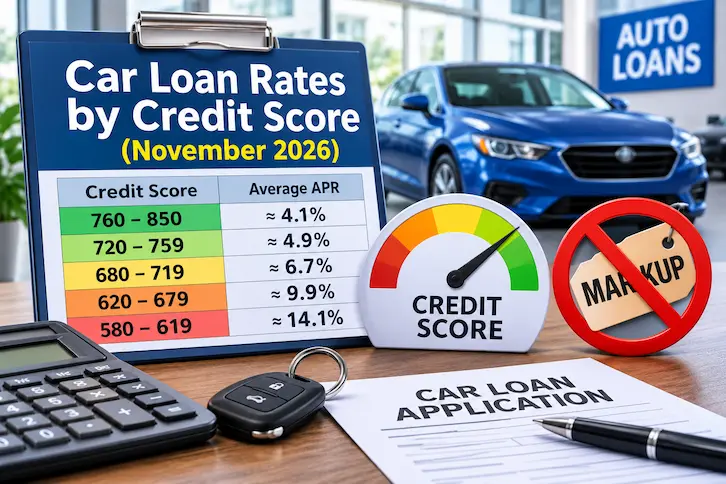
In Q2 2026, buyers in the top credit tier paid an average of 4.41% on a new car, while buyers in the lowest tier paid 16.11% (Experian, VantageScore 4.0 tiers).
YOUR CREDIT SETS IT
Your tier sets the starting point. Table 1 shows what buyers actually paid at each tier, new and used.
| Tier | New APR | New payment | Used APR | Used payment |
|---|---|---|---|---|
| Super prime (781+) | 4.41% | $741 | 6.29% | $534 |
| Prime (661–780) | 6.15% | $770 | 8.81% | $528 |
| Near prime (601–660) | 9.71% | $816 | 13.93% | $555 |
| Subprime (501–600) | 13.52% | $805 | 19.10% | $567 |
| Deep subprime (300–500) | 16.11% | $779 | 21.62% | $570 |
Payments reflect loan size and term as well as rate, so they don’t rise in a straight line from tier to tier.
New vs. used: the gap is big
Across all borrowers, the average rate was 6.35% on new cars and 11.19% on used cars in Q2 2026, a gap of 4.84 points (Experian). Used-car buyers financed less, so their average payment was lower.
New-car average, Q2 2026
Rate: 6.35%
Financed: $43,610
Term: 69.5 months
Payment: $765 a month
Average score: 751
Used-car average, Q2 2026
Rate: 11.19%
Financed: $27,852
Term: 67.9 months
Payment: $542 a month
Average score: 688
Source: Experian, Q2 2026. Average scores are VantageScore 4.0.
Quick lookups by score
These map common scores to Experian’s Q2 2026 tiers (VantageScore 4.0). The figures are tier averages, not quotes.
- 600: top of subprime (501–600). New 13.52%, used 19.10%.
- 650: near prime (601–660). New 9.71%, used 13.93%.
- 700: prime (661–780). New 6.15%, used 8.81%.
- 750: prime (661–780). New 6.15%, used 8.81%. Super prime starts at 781.
- 800: super prime (781+). New 4.41%, used 6.29%.
Lenders set their own cutoffs, so a score near a boundary can price between two tiers. A FICO or app score may not line up one-to-one with VantageScore 4.0; see why the dealer’s score differs.
More rates-by-score guides: Personal Loan Rates by Credit Score and Credit Card APR by Credit Score.
Is Your Rate Good? Compare It to Your Tier
A good rate is one at or below the average for your credit tier, not below the national average.
Every offer is built from three layers. Knowing which layer moved your rate tells you what you can change.
YOUR CREDIT SETS IT
The tier rate. For prime buyers, the Q2 2026 new-car average was 6.15% (Experian).
YOUR CHOICES CHANGE IT
Term, new vs. used, lender, and down payment. Used loans averaged 11.19% vs. 6.35% for new (Experian, Q2 2026).
THE DEAL CAN ADD TO IT
A dealer markup, add-ons rolled into the loan, or a longer term chosen to “fit the payment.”
How term and new vs. used shift your rate
Used-car loans cost more in rate terms. And in NCUA’s data, 60-month new-car loans averaged slightly more than 48-month ones: 5.44% vs. 5.32% at credit unions and 7.41% vs. 7.33% at banks (rates as of Dec. 26, 2025).
Tier averages blend all terms. Use them as a benchmark, then compare real offers at the same term.
Is 7% a good car loan rate?
It depends on your tier. On a new car, 7% is below the near prime average (9.71%) but above the prime average (6.15%). On a used car, 7% is below the prime average (8.81%) but above the super prime average (6.29%). All figures: Experian, Q2 2026.
Is 9% high for a car loan?
For a prime buyer on a new car, yes: it is 2.85 points above the 6.15% tier average. For a near prime buyer, it is below the 9.71% average. On a used car, 9% is close to the prime average of 8.81%.
Why the Dealer’s Score Isn’t the One in Your App
The score in a free app is often VantageScore 3.0, while a lender may pull a FICO Auto Score, a base FICO Score, or a VantageScore, so the numbers can differ.
| Score | Range | Where you see it | Who may use it | What it emphasizes |
|---|---|---|---|---|
| VantageScore 3.0 | 300–850 | Free apps such as Credit Karma, which shows TransUnion and Equifax versions | Lenders may use it | Factors similar to FICO Score 8, such as payment history and credit use |
| VantageScore 4.0 | 300–850 | Experian’s auto-market data, including Table 1 above | Lenders may use it | The same broad credit-risk factors; used here to group borrowers into tiers |
| Base FICO Score (versions 8, 9) | 300–850 | Some bank and card apps, paid FICO plans, and Experian’s free FICO Score 8 | Lenders across many loan types, including auto, may use it | General credit risk: payment history, amounts owed, length of history, new credit, credit mix |
| FICO Auto Score (versions 2, 4, 5, 8, 9, 10) | 250–900 | Often not the score shown in free apps; ask your lender which score it used | Auto lenders may use it | Tailored to auto-loan risk; weighs your past car-loan history more heavily |
Why auto history matters more on an auto score
A FICO Auto Score is built to predict whether you’ll pay a car loan on time. It puts more weight on how you handled past car loans, so a late car payment or a repossession can count for more than it does on a base score.
Why your numbers differ
Three things can move the number. The scoring model is different. The credit bureau may be different: a free app may show TransUnion and Equifax, and a lender may pull Experian. And your reports change over time, so a score pulled Tuesday can differ from one checked Friday.
So ask the lender which score and which bureau it used. Don’t assume. Mortgages work differently; see What Credit Score Do Mortgage Lenders Use.
The Dealer Markup: Buy Rate vs. Contract Rate
In dealer-arranged financing, the lender quotes the dealer a buy rate, and the dealer may set a higher contract rate and keep part of the difference.
THE DEAL CAN ADD TO IT
This is a common practice, often called a “dealer reserve” or discretionary markup (Congressional Research Service, March 2026). It is generally permitted, but it is subject to fair-lending law, state law, and each lender’s own rules. Whether your contract includes one depends on the lender and the deal. Here is how it works:
- The lender quotes a buy rate. That is the rate the lender will accept for your loan.
- The dealer sets the contract rate. That is the APR printed on your contract. It can be higher than the buy rate.
- The difference is the markup. The dealer may keep part of it as compensation.
What it can cost (illustration, not a real offer): $40,000 over 72 months. At a 6% buy rate the payment is $662.92. At an 8% contract rate it is $701.33. That is $38.41 a month, or $2,766 over the loan.
The documented caps
A cap is the most a lender lets a dealer add to its buy rate. Caps are set in each lender’s dealer agreement. Here is what is on the public record:
- Toyota Motor Credit allowed markups of up to 2.5 points before its 2016 order (CFPB).
- In settlements with the CFPB and DOJ, Honda (2015) and Toyota (2016) agreed to cap markups at 1.25 points on terms of 60 months or less and 1 point on longer terms (American Banker).
- Those orders had fixed terms, reported as up to five years for Honda and up to three for Toyota. Toyota’s order qualified for early termination in 2018, and the company reported plans to raise its caps (F&I Magazine, May 2018). Don’t treat them as today’s rules.
- We found no general federal cap on dealer markup, and state rules vary. Congress disapproved the CFPB’s 2013 guidance on dealer markup in 2018, and federal enforcement priorities have shifted since (Troutman Pepper Locke, Oct. 2026). State law and lenders’ own policies still apply.
What each point costs
| Loan | Term | Buy rate | Contract rate | Extra per month | Extra total |
|---|---|---|---|---|---|
| $40,000 | 72 months | 6% | 8% | $38.41 | $2,766 |
| $43,610 | 60 months | 6.15% | 7.40% | $25.64 | $1,538 |
| $43,610 | 72 months | 6.15% | 7.15% | $20.82 | $1,499 |
How to refuse a markup
You don’t need a confrontation. You need a competing number.
- Get a pre-approval from a bank or credit union before you shop.
- At the desk, ask: “Which lender is funding this, and does this rate include dealer compensation?”
- Compare the contract APR with your pre-approval and your tier average.
- If it is a point or more above both, ask whether they can match your pre-approval.
- If they can’t, finance with your own lender.
A rate above your pre-approval doesn’t prove a markup. Lender pricing and your full profile matter too. It is a reason to ask. The Rate Check calculator shows what the gap costs on your loan.
Credit Union vs. Bank vs. Dealer Financing
In the NCUA’s latest published figures, credit unions averaged about 2 points below banks on both new and used car loans.
| Loan type | Credit union avg | Bank avg | Gap |
|---|---|---|---|
| New car, 60 months | 5.44% | 7.41% | 1.97 points |
| New car, 48 months | 5.32% | 7.33% | 2.01 points |
| Used car, 48 months | 5.53% | 7.73% | 2.20 points |
| Used car, 36 months | 5.41% | 7.69% | 2.28 points |
Who finances the market (Experian, Q2 2026)
Banks: 27.15%
Captive lenders: 26.26%
Credit unions: 20.38%
A captive lender is a carmaker’s own finance arm. Shares are of total auto finance, per Experian.
NCUA’s figures are averages reported for set loan types on one day. They aren’t tier-specific, they are from December 2025, and they don’t measure what each buyer paid. Don’t compare them line by line with Experian’s tier table.
Credit unions have membership rules, and rates depend on your credit and the vehicle.
Dealer and captive financing
At a dealership, your application often goes to one or more lenders, and the dealer presents the result. That is convenient, and it is where a markup can enter (see the dealer markup).
Captive lenders also fund promotions such as 0% APR. Those usually come with set terms, models, and credit requirements. The simplest way to compare: get a pre-approval from your own bank or credit union first, then see whether the dealer can beat it.
0% APR vs. Cash Rebate: Run the Numbers
Take the rebate only if you can borrow below the break-even rate; if your outside rate is higher, the 0% offer costs less.
0% APR vs. Cash Rebate Calculator
The numbers shown are the worked example below. Replace them with yours.
Your results
The worked example
A $40,000 price, a $3,000 rebate, 60 months. The outside rate in the example is 5.44%, the NCUA credit union average for a new 60-month loan (rates as of Dec. 26, 2025).
| Option | Amount financed | APR | Monthly | Total |
|---|---|---|---|---|
| 0% APR, no rebate | $40,000 | 0% | $666.67 | $40,000 |
| Rebate + outside loan | $37,000 | 5.44% | $705.72 | $42,343 |
The break-even rule
In this example, the rebate wins only if the outside rate is below about 3.11%. At 5.44%, the 0% offer costs $2,343 less in total.
Change the outside rate and the answer flips. At 3%, the rebate path costs about $39,890 in total, roughly $110 less than 0%. Price, rebate size, and term all move the break-even, so run your own numbers.
What credit score gets 0%? There is no fixed score. Each promotion sets its own rules, and 0% offers usually go to top-tier credit on specific models and terms. If you are weighing a 0% card instead of a loan, see Can You Buy a Car With a Credit Card?
72- and 84-Month Loans: The Real Cost
A longer term lowers the monthly payment, but it raises total interest and the time you can owe more than the car is worth.
YOUR CHOICES CHANGE IT
Here is the same loan at three terms: $43,610 at 6.15% (Experian’s Q2 2026 average new-car amount and prime-tier rate).
- 60 months: $846.15 a month, about $7,159 in interest.
- 72 months: $725.84 a month, about $8,650 in interest.
- 84 months: $640.22 a month, about $10,168 in interest.
Going from 60 to 84 months cuts the payment by $205.93 but adds about $3,010 in interest. The example holds the rate fixed. Longer terms can carry higher rates, so real costs may be higher.
Long terms are now common. In Experian’s Q1 2026 data, 35.55% of new-vehicle loans ran longer than six years, up from 30.83% a year earlier.
THE DEAL CAN ADD TO IT
Watch for a term that was stretched to “fit the payment.” A longer loan builds equity more slowly, so you can owe more than the car is worth if you sell or trade early. See Trading In a Car With Negative Equity, and check your budget first with How Much Car Can You Afford.
How to Shop for Rates Without Hurting Your Score
Apply to several lenders within a short window and scoring models generally count the inquiries as one.
The window depends on the model (Experian):
- Newer FICO Scores: 45 days.
- Older FICO Scores: 14 days.
- VantageScore: 14 days.
You usually can’t tell which model a lender uses, so keeping all applications within 14 days is the safe choice. FICO also ignores auto-loan inquiries from the last 30 days.
Prequalification usually uses a soft pull, which doesn’t affect your score. A formal application usually triggers a hard inquiry. Ask which one you are getting before you submit.
Stuck With a High Rate? When Refinancing Makes Sense
You can refinance later if your credit improves or rates fall, but each lender sets its own rules and fees.
In Q2 2026, Experian reported an average refinance rate of 7.97% against an average original rate of 10.40%, saving borrowers an average of $83 a month.
What can change your rate later: a better credit profile, a lower balance relative to the car’s value, and the term you choose. Stretching the term can lower the payment while raising total interest.
Waiting periods and eligibility rules vary by lender, so ask. Also check whether your current contract has any prepayment charge.
The New Car Loan Interest Deduction
For tax years 2025 through 2028, you may be able to deduct up to $10,000 a year in interest on a qualifying new car loan.
The IRS says the vehicle must be new, assembled in the U.S., for personal use, and under 14,000 pounds gross vehicle weight rating, and the loan must be secured by the vehicle and originated after Dec. 31, 2024. The deduction starts to phase out above $100,000 of income ($200,000 for joint filers), and you can claim it whether or not you itemize. Used cars don’t qualify, and interest on a refinanced qualifying loan generally stays eligible. The IRS has issued more guidance since the law passed, so check the latest rules. See the IRS summary and our guide, Car Loan Interest Deduction. This isn’t tax advice.
Before You Sign
Eight checks in the finance office can save you from the most common surprises.
Before you sign in the finance office
- Bring a pre-approval from a bank or credit union.
- Ask which score and bureau the lender used.
- Ask: “Which lender is funding this, and does this rate include dealer compensation?”
- Compare the contract APR with your pre-approval and your tier average.
- Check the term. Did it stretch to 72 or 84 months to “fit the payment”?
- See add-ons itemized, such as GAP and service contracts. They are generally optional; ask whether the lender requires any, and get the answer in writing.
- Read the “total of payments” line on the contract.
- Don’t drive off on a “pending” approval without understanding what happens if financing falls through. See Can You Return a Car You Just Bought?
One more note: the FTC’s CARS Rule, aimed at hidden fees and bait-and-switch tactics, was vacated by the Fifth Circuit on Jan. 27, 2025, before it took effect, so it does not apply. Dealers remain subject to other existing FTC rules and to state law.
Car Loan Rates by Credit Score: FAQ
What is a good car loan rate in November 2026?
A rate at or below your tier’s average. In Q2 2026, Experian’s new-car tier averages ran from 4.41% to 16.11%. The all-borrower averages were 6.35% new and 11.19% used. Check yours with the Rate Check calculator.
What rate can I get with a 600 credit score?
A 600 sits at the top of subprime (501–600). Experian’s Q2 2026 averages for that tier were 13.52% new and 19.10% used. One point higher is near prime, which averaged 9.71% and 13.93%. Lenders set their own cutoffs.
What rate can I get with a 650 credit score?
A 650 is near prime (601–660). Experian’s Q2 2026 averages were 9.71% on new cars and 13.93% on used, with average payments of $816 and $555. Your own rate depends on the lender, term, vehicle, and down payment.
What rate can I get with a 700 credit score?
A 700 is prime (661–780). Experian’s Q2 2026 averages were 6.15% new and 8.81% used.
What rate can I get with a 750 or higher?
A 750 is still prime, at 6.15% new and 8.81% used. At 781 and above (super prime), the averages were 4.41% new and 6.29% used. All figures: Experian, Q2 2026.
What are used car loan rates by credit score?
In Q2 2026: 6.29% (781+), 8.81% (661–780), 13.93% (601–660), 19.10% (501–600), and 21.62% (300–500). The overall used average was 11.19% (Experian, VantageScore 4.0 tiers). See Table 1.
What credit score do car dealers use?
There isn’t one. Lenders may use a FICO Auto Score, a base FICO Score, or a VantageScore. Ask which score and which bureau the lender used. See Table 2.
Why is the dealer’s score lower than Credit Karma?
Credit Karma shows VantageScore 3.0 from TransUnion and Equifax. A lender may use a different model, a different bureau, or a report from a different day. Any of those can change the number.
What is a FICO Auto Score?
An industry-specific FICO score for auto lenders. It ranges from 250 to 900, versus 300 to 850 for base FICO Scores, and it is tailored to auto-loan risk.
Can a dealer mark up my interest rate?
In dealer-arranged financing, the lender quotes a buy rate, and the dealer may set a higher contract rate and keep part of the difference. Limits come from each lender’s dealer agreement. See the dealer markup section.
How much can a dealer mark up a car loan?
There is no single national figure. Caps are set lender by lender. Before its 2016 order, Toyota allowed up to 2.5 points. The Honda (2015) and Toyota (2016) settlements capped markup at 1.25 points for terms of 60 months or less and 1 point for longer terms, but those orders were fixed-term and aren’t today’s rules.
How can I tell if my rate was marked up?
You usually can’t see the buy rate. Compare your contract APR with a pre-approval and your tier average. If it is a point or more above both, ask whether the rate includes dealer compensation and which lender is funding the loan. A gap is a reason to ask, not proof.
Are credit union car loans cheaper than banks?
On average, yes. NCUA’s figures (rates as of Dec. 26, 2025) show credit unions about 2 points below banks on the loans it tracks. Averages aren’t offers, and credit unions have membership rules.
What credit score do I need for 0% APR?
There is no fixed score. Each promotion sets its own rules, and 0% offers usually go to top-tier credit on specific models and terms.
Is 0% APR or a cash rebate better?
It depends on the math. The rebate wins only if you can borrow below the break-even rate. In our example it was about 3.11%. Use the 0% vs. rebate calculator.
Does shopping for car loans hurt my credit?
Not much if you keep it short. Scoring models generally count auto-loan inquiries in a window of 14 to 45 days as one. Keeping every application within 14 days is the safe choice. See rate shopping.
Is an 84-month car loan a bad idea?
Not automatically, but it costs more in interest and raises the chance you owe more than the car is worth. At $43,610 and 6.15%, 84 months adds about $3,010 in interest over 60 months. See the long-loan math.
When can I refinance a car loan?
There is no single rule. Waiting periods and eligibility are set by each lender, so ask. In Q2 2026, Experian reported refinancing cut the average rate from 10.40% to 7.97%. See refinancing.
Last updated:
This article is general information, not financial advice. Averages are market data from Experian (VantageScore 4.0 tiers) and the NCUA and may not reflect the rate you’re offered. Your rate depends on the lender, your full credit profile, the vehicle, the term, and your down payment. Verified November 18, 2026.

Daniel Hayes is the founder and sole researcher at AdvoraHQ. He covers U.S. personal finance, insurance, and consumer law — working directly from IRS publications, federal and state statutes, court opinions, and SEC filings rather than secondary summaries. His focus is the gap between what readers think they know and what the source documents actually say. Daniel is not a licensed attorney, CPA, or financial advisor; his articles are educational and not personalized advice. Reach him at Daniel.Hayes@advorahq.com.
