
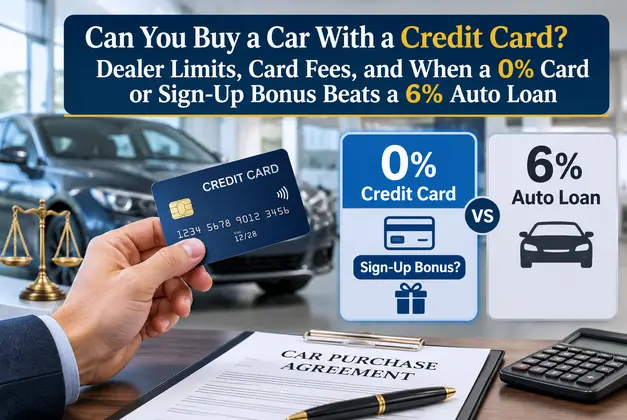
Compare your card vs. an auto loan →
Auto-loan rates from Experian (Q2 2026); tax rules from IRS final regulations (Sept. 2026); verified November 17, 2026. Not financial or tax advice.
Card vs. Auto Loan Calculator
Compare the same dollars on a card or an auto loan, over the same months.
Result
Will the Dealer Take Your Card — and How Much?
Usually for part of the price, rarely for all of it.
No federal law bars it. It’s up to the dealer, your card limit, and your issuer.
Caps and why dealers set them
Many dealers cap card payments. A commonly reported range is $5,000 to $10,000.
That figure dates from 2021, so treat it as a rough guide and ask your dealer.
The reason is cost. Processing a card costs the dealer roughly 2% to 3.5% of the sale.
On a $40,000 car, that is $800 to $1,400.
The average new car sold for a record $51,109 in October 2026 (Kelley Blue Book).
At that price, a 3% fee comes to about $1,533.
Fees and surcharges
Some dealers pass a credit-card surcharge on to you where state law and network rules allow it.
Whether yours can depends on your state. See Is a Credit Card Surcharge Legal?
Ask for any fee in dollars, and make sure it appears on the paperwork.
Debit versus credit
Card networks generally prohibit surcharging debit cards.
That is a network rule, not a federal law.
If a dealer quotes a debit fee, ask which rule it relies on before you pay.
Your bank may also limit how much a debit card can spend in a day.
Ask before you sign, not at the register
Once the price is settled, ask three things:
- How much can go on a card?
- What is the fee, in dollars?
- Does the cap cover the down payment, the full price, or both?
Not sure what fits your budget? See How Much Car Can You Afford.
When a Card Beats an Auto Loan: The Math
A card wins only with a 0% promo or a bonus, and only if you pay it off before the promo ends.
Each case compares two ways to cover the same dollars: the card, or the auto loan.
Both are repaid in equal payments over the same months.
For loan rates we use Experian’s Q2 2026 averages: 6.35% new, 11.19% used.
A weekly national average from Nov. 10, 2026 shows 6.005% new and 6.759% used.
It uses a different method, so we stick with one benchmark.
Verdicts: CARD WINS, ROUGHLY EVEN (within $100), or LOAN WINS.
Case A: bonus + 0%
$5,000 · 3% dealer fee · $750 sign-up bonus (minimum spend met) · 0% for 18 months · paid in 18 months · vs. 6.35% loan
Card net cost: -$600 ($150 fee minus $750 bonus). Loan interest: $255.
CARD WINS by $855.
Case B: paid late
$5,000 · 3% fee · 2% cash back · 0% for 15 months · paid in 24 months (24% APR after) · vs. 6.35% loan
Card net cost: $242. Loan interest: $337.
ROUGHLY EVEN: card ahead by $95.
Case C: used-car loan
$10,000 · no fee · 1.5% cash back · 0% for 21 months · paid in 21 months · vs. 11.19% used-car loan
Card net cost: -$150. Loan interest: $1,057.
CARD WINS by $1,207.
Case D: no promo
$5,000 · 3% fee · 2% cash back · no 0% period (24% APR) · paid in 12 months · vs. 6.35% loan
Card net cost: $724. Loan interest: $174.
LOAN WINS by $550.
Table 1. Four worked cases. Loan rates: Experian, Q2 2026. Computed November 17, 2026.
| Case | Setup | Card net cost | Loan interest | Verdict |
|---|---|---|---|---|
| A: bonus + 0% | $5,000 · 3% dealer fee · $750 sign-up bonus (minimum spend met) · 0% for 18 months · paid in 18 months · vs. 6.35% loan | -$600 | $255 | CARD WINS by $855 |
| B: paid late | $5,000 · 3% fee · 2% cash back · 0% for 15 months · paid in 24 months (24% APR after) · vs. 6.35% loan | $242 | $337 | ROUGHLY EVEN: card ahead by $95 |
| C: used-car loan | $10,000 · no fee · 1.5% cash back · 0% for 21 months · paid in 21 months · vs. 11.19% used-car loan | -$150 | $1,057 | CARD WINS by $1,207 |
| D: no promo | $5,000 · 3% fee · 2% cash back · no 0% period (24% APR) · paid in 12 months · vs. 6.35% loan | $724 | $174 | LOAN WINS by $550 |
Why Case D loses
With no 0% period and no bonus, the card charges 24% on money a loan would carry at 6.35%.
Over 12 months that is about $674 of card interest against $174 of loan interest.
Add the $150 fee, subtract $100 of cash back, and the card costs $550 more.
Card vs. loan vs. cash
| Item | Credit card | Auto loan |
|---|---|---|
| Typical rate | 0% during a promo, then the card’s regular APR (this article assumes 24%) | 6.35% new, 11.19% used (Experian averages) |
| Fees | Dealer may add about 3%; ask | Varies by lender; ask for the full terms |
| Rewards | Cash back or a sign-up bonus, if you qualify | None |
| Interest deduction | No | Up to $10,000 a year if the loan qualifies |
| Dispute rights | Yes, on the card charge | Not under card dispute rules; check your contract |
| Effect on credit | Raises reported utilization when the statement posts | New installment account; inquiry when you apply |
Two things this math doesn’t capture:
- A bigger down payment shrinks the loan, which can change whether you need GAP insurance.
- Rolling negative equity from a trade-in into the loan is a separate cost.
The 0% Clock: What Happens If You Don’t Pay It Off
On a standard 0% card, interest starts only on the balance left when the promo ends.
With deferred interest, it can reach back to the day you bought.
Can’t pay it off before the promo ends? A card is usually the most expensive way to finance a car.
Case B shows the milder version.
You charge $5,000 and pay it over 24 months, but 0% lasts only 15.
At about $208 a month, roughly $1,875 is left when the promo ends.
At 24%, the last nine months cost about $192 in interest.
It still lands near even, because 15 interest-free months did most of the work.
| Item | 0% intro APR | Deferred interest |
|---|---|---|
| How it’s worded | 0% intro APR for a set number of months | No interest if paid in full by a date |
| When the promo ends | Interest starts on the balance still unpaid | If any balance remains, interest can be charged back to the purchase date |
| Where you see it | Cards with an intro rate | Often store cards and promotional financing plans |
Put the promo end date in your calendar.
Set a payment that clears the balance a month early.
Rewards and Sign-Up Bonuses on a Car
A rewards rate helps only if it beats the dealer’s fee. A 3% fee beats 2% cash back.
On $5,000, a 3% fee costs $150 and 2% cash back returns $100.
You are $50 behind before any interest.
A sign-up bonus can flip that. In Case A, a $750 bonus beats the $150 fee by $600.
Minimum-spend timing
A bonus counts only if the charge posts before the deadline and meets the minimum spend.
The issuer’s terms decide, so read both before you swipe.
Bonus didn’t arrive? See Credit Card Sign-Up Bonus Not Received.
A new card also affects your credit. See your credit section.
Purchase or cash advance?
Dealer card payments usually post as purchases, not cash advances.
They post under the auto-dealer merchant category.
Payment apps or transfers to a private seller can code as cash advances or carry fees.
Details: Credit Card Cash Advance.
The Tax Angle: The New Car-Loan Interest Deduction
The deduction covers a qualifying auto loan. It does not cover credit-card interest.
The rules in brief, from the IRS final regulations (T.D. 10054, Sept. 4, 2026):
- Up to $10,000 of interest a year, tax years 2025 to 2028, with or without itemizing (Schedule 1-A).
- New car, personal use, original use begins with you, final assembly in the U.S.
- Loan originated after 2024 and secured by a first lien on the car.
- Phases out above $100,000 MAGI ($200,000 joint).
- Leases, used cars, and unsecured debt don’t qualify.
Check where a car was assembled with the NHTSA VIN decoder.
When it changes the math
The deduction lowers the loan’s cost, so it can narrow a card’s lead.
In Case B, a 22% marginal rate cuts the loan’s after-tax interest from $337 to about $263.
The card’s edge shrinks from $95 to about $21.
In Cases A and C, the card’s lead is too big for the deduction to change the verdict.
The calculator has a checkbox for this. Use it only if your car and income qualify.
Full rules and how to claim: Car Loan Interest Deduction guide.
Your Credit Score and Any Loan You’re About to Apply For
A big card charge can raise your reported utilization for a month or two.
It matters most if you’re about to apply for other credit.
Utilization is measured when your statement posts.
Charge $5,000 on a $10,000 limit and that card can report 50% utilization.
In most scoring models, utilization has no memory once you pay it down.
More: Credit Utilization Ratio.
A new card opened for a bonus adds a hard inquiry.
See Does Applying for a Credit Card Hurt Your Credit?
Dispute Rights on a Card-Paid Down Payment
A card-paid down payment carries dispute rights that cash and cashier’s checks don’t.
They cover the card charge only. The loan follows your loan contract.
Billing errors
The Fair Credit Billing Act (Regulation Z, section 1026.13) covers billing errors.
An example is goods not delivered as agreed.
Generally, you must raise it within 60 days of the statement showing the charge.
Send the notice in writing to your issuer’s billing-dispute address.
Claims and defenses
Section 1026.12(c) lets you raise problems with the purchase itself.
It generally applies to purchases over $50.
The purchase must be in your state or within 100 miles of your billing address.
You must first make a good-faith attempt to resolve it with the seller.
The claim is generally limited to the amount you still owe on the charge.
Network chargeback rules
Card networks have their own chargeback rules, separate from the law.
Time limits vary, so ask your issuer which apply.
A dispute is a request your issuer investigates, not a guaranteed refund.
Steps: How to Dispute a Credit Card Charge.
What to document
- The buyer’s order, with the out-the-door price in writing
- The receipt and your card statement
- Notes on what was promised, such as whether a deposit is refundable
- Dates, and the names of the people you dealt with
Used Cars, Private Sellers, and Leases
Dealers take cards up to their cap, private sellers rarely can, and leases follow the same rules.
| Seller | Usually | What to watch |
|---|---|---|
| Franchise dealer | Takes cards up to its own cap | Ask for the cap and any fee in dollars before you sign |
| Independent dealer | Policy varies; some limit card use | Ask whether cards are accepted and whether a fee applies |
| Private seller | Rarely has a card terminal | Apps and transfers can be coded as cash advances or carry fees |
| Lease drive-off | Often subject to the dealer’s card cap | Ask whether the cap covers the whole amount due at signing |
| Monthly loan payment | Most lenders don’t take cards directly | Third-party services often charge about 3% |
Used cars
Used-car loans cost more: 11.19% on average, against 6.35% for new.
That makes a 0% promo more valuable.
Case C shows it: $10,000 on a no-fee card with 21 interest-free months beats the loan by $1,207.
The catch is the no-fee part, so confirm it.
Used cars also don’t qualify for the car-loan interest deduction.
Private sellers
Most private sellers can’t take a card.
If you pay through an app or transfer, check how it will be coded and what it costs.
Get a bill of sale, and line up coverage the day you take the keys.
See New Car Insurance Grace Period.
Leases
A lease has no auto loan to compare against.
Leases also don’t qualify for the car-loan interest deduction.
If you charge the drive-off, the same fee, cap, and payoff questions apply.
It helps only if the fee is zero or covered by rewards, and you pay it off inside the promo.
Can You Pay Your Monthly Car Payment With a Credit Card?
Usually not directly, and a third-party service’s fee often wipes out the rewards.
Most auto lenders don’t accept credit cards for the monthly payment.
Third-party services fill the gap and often charge about 3%.
On a $500 payment, that is $15 a month.
A 2% cash-back card returns $10, so you are $5 behind every month.
That is $60 a year, before any interest if the balance carries over.
Before You Swipe
Eight checks, in order, before a large charge goes on your card.
- Get the out-the-door price in writing first, then ask about payment.
- Ask the dealer about the cap and any fee. Check your state’s surcharge rule.
- Call your issuer: confirm your credit, warn them of the charge, ask how it will post.
- Chasing a bonus? Confirm the minimum spend, the deadline, and that the charge counts.
- Put the promo end date in your calendar, and pay the balance off a month early.
- Applying for a mortgage or other loan soon? Don’t put the down payment on a card.
- Keep the buyer’s order, receipt, and card statement in case you need to dispute.
- Don’t sign a deferred-interest plan thinking it’s 0% APR.
Frequently Asked Questions
Short answers on caps, fees, rewards, taxes, credit, and disputes.
Can you buy a whole car with a credit card?
Only if the dealer accepts that much and your limit allows it.
Most dealers cap card payments, commonly reported at $5,000 to $10,000.
How much will a dealer let you put on a card?
It varies by dealer. A commonly reported range is $5,000 to $10,000.
That figure dates from 2021, so ask for the cap in dollars.
Also ask whether it covers the down payment, the full price, or both.
Do dealers charge a fee for credit cards?
Some do. Dealers pay roughly 2% to 3.5% to process a card.
Some pass a surcharge on to you where state law and network rules allow it.
Ask for any fee in dollars before you agree.
Can a dealer charge a fee for a debit card?
Card networks generally prohibit surcharging debit cards.
That is a network rule, not federal law.
If a dealer quotes a debit fee, ask which rule it relies on before you pay.
Can I put the down payment on a credit card if I’m financing the rest?
Often yes, within the dealer’s cap.
Skip it if a mortgage application is coming.
Mortgage underwriting looks at borrowed down-payment funds and new debt.
Auto lenders vary, so ask yours.
Is buying a car with a credit card a cash advance?
Dealer card payments usually post as purchases under the auto-dealer merchant category.
Apps or transfers to a private seller can code as cash advances or carry fees.
Is it smart to use a 0% APR card for a car?
Only if all three of these are true:
- The dealer fee is zero, or your rewards beat it.
- You have a 0% promo or a bonus.
- You’ll pay it off before the promo ends.
The calculator above runs your numbers.
What happens if I don’t pay it off before 0% ends?
On a standard 0% card, interest starts on the balance left at the end of the promo.
It is charged at the card’s regular APR.
With deferred interest, it can reach back to the purchase date.
Case B shows the first version.
Can I use a car purchase to earn a sign-up bonus?
It can, if the charge posts before the deadline and meets the minimum spend.
The card’s terms decide, and the bonus must beat the dealer’s fee.
Case A shows a situation where it does.
Is a 3% fee worth it for 2% cash back?
Not by itself. You lose 1%, which is $50 on $5,000, before any interest.
A bonus or a 0% promo has to close the gap.
Does paying with a card affect my auto loan approval?
A card payment reduces the amount you finance.
But a large charge can raise your reported utilization, and a new card adds an inquiry.
Lenders vary, so ask yours if timing is tight.
Will it hurt my credit score?
A big charge can raise reported utilization when your statement posts.
In most scoring models it fades once you pay the balance down.
A new card for a bonus adds a hard inquiry.
Does a card purchase qualify for the car-loan interest deduction?
No. Interest on the card portion isn’t deductible.
The rest of a qualifying auto loan still is, within the limits.
Can I dispute a car down payment on my credit card?
Yes. Billing-error disputes generally must be raised within 60 days of the statement.
Claims and defenses generally apply to purchases over $50.
The purchase must be in your state or within 100 miles of your billing address.
Cash and cashier’s checks carry no such rights.
Can I buy a used car from a private seller with a credit card?
Rarely. Most private sellers have no card terminal.
Apps and transfers can code as cash advances or carry fees.
Can I put a lease down payment on a credit card?
Often, within the dealer’s card cap.
Ask whether the cap covers the whole amount due at signing.
Can I pay my monthly car payment with a credit card?
Most auto lenders don’t accept cards directly.
Third-party services charge fees, often about 3%.
That usually wipes out the rewards.
Should I tell the dealer I’m paying by card before negotiating?
Settle the out-the-door price first, in writing.
Then, before you sign, ask about the card cap and any fee.
Last updated:
This article is general information, not financial, tax, or legal advice. Dealer policies, card terms, and tax eligibility vary. Rates and rules verified November 17, 2026.

Daniel Hayes is the founder and sole researcher at AdvoraHQ. He covers U.S. personal finance, insurance, and consumer law — working directly from IRS publications, federal and state statutes, court opinions, and SEC filings rather than secondary summaries. His focus is the gap between what readers think they know and what the source documents actually say. Daniel is not a licensed attorney, CPA, or financial advisor; his articles are educational and not personalized advice. Reach him at Daniel.Hayes@advorahq.com.
