
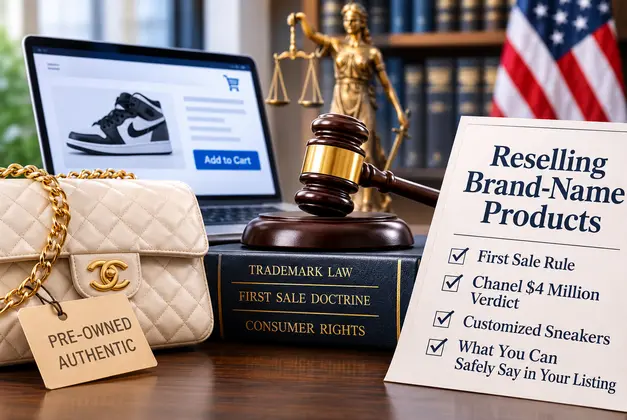
Quick answer: Yes. In the U.S. you can generally resell genuine brand-name items you lawfully bought, without the brand’s permission. That protection stops at four places: counterfeits, items you’ve altered or repackaged so they’re “materially different,” listings that make it look like the brand endorses you, and marketplace rules, which can remove a listing even when the sale is legal.
General information, not legal advice.
Where sellers actually get in trouble
- Fakes. Counterfeits are never covered, and “I didn’t know” does not stop a removal or civil liability. See counterfeits.
- Changed products. Altered, customized, de-coded, repackaged, or warranty-less goods can count as different products. See where it stops.
- Logos and “authorized” claims. Using a brand’s logo as your shop identity, or claiming approval you don’t have, suggests a link that isn’t there. See your listing.
- Platform complaints. A brand can report a listing and the marketplace can remove it, even when the sale itself was lawful. See platforms.
On November 3, 2026, a federal appeals court affirmed Chanel’s $4 million judgment against luxury reseller What Goes Around Comes Around, in a non-precedential summary order. The case was about which items the reseller sold and how it marketed them, not about reselling genuine goods as such.
USUALLY FINE
- The item is genuine and unaltered.
- You describe its condition honestly.
- The brand name is used only to identify what it is.
HIGH RISK (usually a problem)
- Fakes, or “inspired” items sold under the brand name.
- Customized or de-coded goods sold as the brand’s own.
- The brand’s logo as your shop identity.
- “Authorized dealer” claims you can’t back up.
Laws, cases, and platform policies verified November 19, 2026.
Resale Risk Checker
This checker turns your answers into an issue checklist, not a verdict on whether a sale is lawful. Nothing you choose is stored or sent anywhere, and it never asks for a brand name or a seller ID.
Your checklist
Why Reselling Is Legal: Two Laws, Not One
Reselling genuine goods is generally legal because of two separate rules: a copyright statute for books and media, and a court-made trademark rule for branded goods like clothing, shoes, and bags.
Say you buy a name-brand jacket at a thrift store and list it online. The brand's trademark is on the label, so your resale right comes from trademark law, not from the copyright statute that many guides cite.
Copyright and trademark give you resale rights in different ways.
Copyright first sale is a statute, 17 U.S.C. § 109(a). Trademark first sale (also called exhaustion) is a rule courts developed under the Lanham Act. They have different sources and different limits, so check which one applies to what you sell.
| Law | What it covers | Key authority | What breaks the protection | Typical items |
|---|---|---|---|---|
| Copyright first sale | The owner of a lawfully made copy may sell or dispose of that copy without the copyright owner's permission. | 17 U.S.C. § 109(a); Bobbs-Merrill Co. v. Straus, 210 U.S. 339 (1908); Kirtsaeng v. John Wiley & Sons, 568 U.S. 519 (2013) (copies lawfully made abroad) | Pirated copies, making new copies, and items you don't own as a copy (for example, licensed software or rentals). | Books, DVDs, games, artwork. |
| Trademark first sale (exhaustion) | A brand's right to control distribution of a genuine item generally ends after the first authorized sale. | Court-made rule under the Lanham Act; Sebastian Int'l, Inc. v. Longs Drug Stores Corp., 53 F.3d 1073 (9th Cir. 1995) | Counterfeits, materially different goods, quality-control problems, and listings that suggest the brand sponsors you. | Clothing, shoes, bags, electronics, cosmetics. |
Bobbs-Merrill Co. v. Straus, 210 U.S. 339 (1908)
What happened: A publisher printed a notice in its books setting a minimum retail price. A retailer sold below it.
What the court held: The Supreme Court held that the copyright owner's right to "vend" did not let it control later resale once it had sold the copy.
What it means for you: This is the root of the copyright first sale rule that Congress later wrote into § 109.
Kirtsaeng v. John Wiley & Sons, 568 U.S. 519 (2013)
What happened: A student resold textbooks that had been printed abroad.
What the court held: The Supreme Court held that the copyright first sale rule applies to copies lawfully made abroad.
What it means for you: Books and media bought overseas can still be resold, if they are lawfully made copies. Trademark goods follow a different rule, covered in the next section.
Sebastian Int'l, Inc. v. Longs Drug Stores Corp., 53 F.3d 1073 (9th Cir. 1995)
What happened: A hair-care brand that wanted its products sold through salons tried to stop a drugstore chain from reselling products the chain had bought on the open market.
What the court held: The Ninth Circuit rejected that attempt and reversed an injunction. A reseller that stocks and resells genuine products under the producer's trademark, and does nothing more, is not liable under the Lanham Act for that resale.
What it means for you: The words "and does nothing more" matter. Advertising, displays, and branding that go beyond identifying the product are where resellers run into trouble.
Which law applies to you depends on what you sell. A used paperback sits under copyright. A used handbag sits under trademark. For the difference between the two in general, see Trademark vs Copyright vs Patent.
Where the Protection Stops: "Materially Different" Goods
Trademark first sale protects genuine goods, and courts have held that goods stop being "genuine" when they differ materially from what the brand sells in the U.S.
Take a retail-arbitrage seller who buys a clearance blender at a big-box store and lists it new and unopened. That is usually fine. A seller who buys the same brand's model from a foreign distributor, with a different voltage and no U.S. warranty, is closer to the line.
Changing the product can change your rights.
The cases below are examples of what courts have held on their facts. They are not a universal rule, and results differ by circuit.
| Change | Why it matters | Example case | Tier |
|---|---|---|---|
| Removed or altered batch or serial codes | Codes can support a brand's quality control, recalls, and warranty service. Courts have treated their removal as a material difference. | Davidoff & CIE v. PLD Int'l, 263 F.3d 1297 (11th Cir. 2001); Beltronics USA v. Midwest Inventory Distribution, 562 F.3d 1067 (10th Cir. 2009) | HIGH RISK |
| Repackaging, bundling, or relabeling | The buyer may not get the product, packaging, or information the brand sells. Courts ask whether the buyer gets what the brand actually offers. | Fact-specific; no single case controls. | CHECK THIS |
| No manufacturer warranty or service | Differences in warranty or service terms can matter to buyers. One court held a lack of access to warranty service was material. | Beltronics USA v. Midwest Inventory Distribution, 562 F.3d 1067 (10th Cir. 2009) | CHECK THIS |
| Foreign version (gray market) | Goods made for another market can differ in formula, packaging, or quality control. | Société des Produits Nestlé v. Casa Helvetia, 982 F.2d 633 (1st Cir. 1992) | CHECK THIS |
| Customization sold under the brand's name | Brands have sued customizers over marks, trade dress, and "authentic" claims. The recent Nike and Goyard suits ended in settlements or were dropped, so they are not rulings on customizing. | Nike matters settled; Goyard dropped its suit. Settlements are not rulings. | HIGH RISK |
Société des Produits Nestlé v. Casa Helvetia, 982 F.2d 633 (1st Cir. 1992)
What happened: A distributor imported Venezuelan-made chocolates sold under the Perugina name into Puerto Rico, where the brand's owner sold Italian-made Perugina chocolates.
What the court held: The First Circuit held that where material differences exist between the foreign goods and the goods the owner sells in the U.S., importing and selling them under the same mark can infringe.
What it means for you: Goods that carry the same brand name but were made for another market may not count as the same genuine product.
Davidoff & CIE v. PLD Int'l Corp., 263 F.3d 1297 (11th Cir. 2001)
What happened: A company bought genuine fragrances meant for overseas or duty-free sale and resold them in the U.S. after the batch codes on the bottles had been etched off.
What the court held: The Eleventh Circuit affirmed a preliminary injunction, treating the removed batch codes as a material difference from the product the brand sold.
What it means for you: Do not remove or alter manufacturer codes on items you resell. If a code is already missing, say so and treat the item as a higher-risk listing.
Beltronics USA, Inc. v. Midwest Inventory Distribution, LLC, 562 F.3d 1067 (10th Cir. 2009)
What happened: Radar detectors were resold as new on eBay without their original serial-number labels.
What the court held: The Tenth Circuit held that the missing labels were a material difference because they affected buyers' access to the brand's warranty and services, so the first sale rule did not protect the resale.
What it means for you: Warranty and service access can be part of what a buyer is paying for. Don't promise a warranty you can't document.
For gray-market goods, the practical questions are simple. Is it the same product the brand sells in the U.S.? Is anything missing, changed, or different in the box? Can you say honestly where it came from?
Customized and Altered Items
Customizing a genuine item is not automatically unlawful, but selling customized goods under a brand's name is where brands actively sue, and those suits have ended in settlements rather than rulings.
Picture painted Air Force 1s. You buy genuine sneakers, repaint them, and sell them with the swoosh still visible and "authentic Nike" in the title. That combination, not the paint itself, is what brands have objected to.
Nike and Drip Creationz (agreed injunction, 2023)
What happened: Nike sued a sneaker customizer over Air Force 1 style shoes and customized pairs. In 2023 the parties filed an agreed permanent injunction.
What the court held: Nothing was decided on the merits. This was a settlement. As reported, the defendants stipulated that Nike's marks were valid and that they had bought authentic sneakers and made material alterations.
What it means for you: It shows how brands frame customization claims. It is not a ruling that customizing is unlawful.
Nike and The Shoe Surgeon (settled June 2025)
What happened: In July 2024 Nike sued a Los Angeles customizer in federal court in Manhattan, alleging trademark infringement, counterfeiting, and related claims, and said damages totaled over $60 million.
What the court held: No ruling. The parties settled in June 2025 on confidential terms.
What it means for you: Brands will sue over volume customization built on their marks. Settlements are not rulings, so they do not decide whether a one-off custom is lawful.
Goyard and The Shoe Surgeon (suit dropped January 2026)
What happened: Goyard sued over sneakers made with its canvas, saying it had not consented. Bloomberg Law reported on January 22, 2026 that Goyard dropped the suit.
What the court held: No ruling.
What it means for you: A dropped suit does not make a use safe. It means that case ended.
What brands have objected to, based on their complaints as reported, tends to fall into four groups:
- Building replicas "from scratch" and selling them as the brand's products.
- Putting the brand's logos, trade dress, or other brands' marks on customs in ways that suggest a collaboration.
- Calling a heavily altered item "100% authentic" or "official."
- Selling in volume, rather than as a one-off.
"Custom" is not a magic word.
Calling an item custom does not change what is on it. If the brand's marks are still prominent, buyers may assume the brand made it. A line saying you made the changes and the brand did not make or endorse the item lowers confusion, but it does not remove the risk of a brand claim.
If you are making original art with characters rather than reselling altered goods, that is a different question. See Can You Sell Fan Art?.
Counterfeits: The Line You Can't Cross
Counterfeits are never protected by first sale, and good faith does not stop a listing from being removed or a civil claim from going forward.
Imagine a $40 "designer" bag in a mixed lot, with no tags and a story about a closed store. If it turns out to be fake, your belief that it was real does not undo the listing's removal or the brand's claim.
- Civil damages. Statutory damages can run from $1,000 to $200,000 per counterfeit mark per type of goods, and up to $2,000,000 if the court finds willfulness (15 U.S.C. § 1117(c)).
- Criminal law. Intentionally trafficking in counterfeit goods can be prosecuted under 18 U.S.C. § 2320.
- Not knowing. Infringement does not require intent to deceive. Intent and knowledge mostly affect the remedies, such as whether damages are enhanced.
- Platforms. A marketplace can remove a listing or suspend an account on a counterfeit report without waiting for a court.
Red flags when sourcing
- The price is far below what the genuine item sells for.
- Tags, labels, or serial numbers are missing, uneven, or inconsistent.
- The seller will not say where the goods came from.
- Stitching, materials, or logos look off to you.
- A bulk lot mixes brands with no paperwork.
- The listing uses "replica," "inspired by," or "dupe" with a brand name.
A disclaimer doesn't fix a fake or a logo-branded storefront.
"Not affiliated" wording does not cure counterfeits, altered goods, or a shop built on a brand's logo. If you can't establish that an item is genuine, the safest choice is not to list it.
Your Listing: What You Can Say, Show, and Tag
You can use a brand's name to identify a genuine item, but not in a way that suggests the brand sponsors you, and logos, "authorized" claims, and borrowed photos add risk without helping you sell.
Courts apply this as nominative fair use. In Toyota Motor Sales, U.S.A., Inc. v. Tabari, 610 F.3d 1171 (9th Cir. 2010), the Ninth Circuit held that a car broker could use the Lexus name in its web addresses to refer to the cars it sold. The court also noted that using the brand's stylized mark and logo went further than needed. Other circuits analyze nominative fair use differently, so the same listing can be judged differently in different courts.
Toyota Motor Sales, U.S.A., Inc. v. Tabari, 610 F.3d 1171 (9th Cir. 2010)
What happened: Car brokers used "Lexus" in their website addresses and had used Lexus photos and logos. Toyota sued.
What the court held: The Ninth Circuit vacated a broad injunction. Using the name to refer to the genuine product could be fair use, but the brand's stylized mark and logo were more than needed and could suggest sponsorship.
What it means for you: Name the item, skip the logo, and say you are not affiliated.
Chanel, Inc. v. What Goes Around Comes Around, No. 1:18-cv-02253 (S.D.N.Y.)
What happened: Chanel sued a luxury resale company in 2018 over the items it sold and how it advertised them. On February 6, 2024 a jury found for Chanel on all four claims: two trademark infringement claims, unfair competition, and false advertising. It awarded $4 million in statutory damages. The damages were reported as $2 million for each of two counterfeit marks. Before trial, the court had already found the reseller liable on summary judgment for selling non-genuine point-of-sale display items and a small number of handbags with serial numbers Chanel said had been taken from an authorized manufacturer.
What the court held: On February 26, 2025, the court entered final judgment with the $4 million award and a permanent injunction. As reported by The Fashion Law, the injunction restricts the reseller's use of Chanel's trademarks, imagery, and branding without authorization, with examples including logos, hashtags, and altered products bearing voided serial numbers. On November 3, 2026, the Second Circuit affirmed the $4 million award by summary order, rejecting challenges to the jury instructions and to the size of the award. It sent a separate litigation-costs award back to the district court. Summary orders are non-precedential in the Second Circuit.
What it means for you: The case did not hold that reselling genuine goods is unlawful. It turned on which items were sold, whether they were genuine and authorized, and how the reseller marketed itself. The injunction binds that company, not every reseller.
The Chanel case is useful because it shows where a large reseller got into trouble: items the brand says it never authorized for sale, and marketing that suggested a closer link than existed.
| Element | Usually fine | Usually a problem |
|---|---|---|
| Title | The brand name plus what the item is, size, and condition, for a genuine item. | A brand name on an item the brand didn't make, or extra brand names added to attract searches. |
| Photos | Your own photos of the actual item. | The brand's official or website photos, or edited stock photos. |
| Shop name and profile picture | Your own name and your own image. | The brand's name or logo as your shop name, banner, or avatar. |
| Ad hashtags | Plain descriptive tags that name the item. | Brand-based hashtags in paid ads, including ones that merge your shop name with the brand's name. |
| "Authorized" and similar words | "Not affiliated with or endorsed by [Brand]." | "Authorized," "official," "certified," or "brand-approved" claims you can't back up. |
| Condition words | "Pre-owned," "open box," "customer return," "sold as-is." | "New" or "sealed" for opened or returned goods, or "full warranty" you can't document. |
Safe Listing Language Cards
Each card gives wording you can copy, and what to avoid saying. Replace the bracketed parts and keep the statements true. Only say "authentic" if you have a real basis for it.
Situation: Pre-owned genuine item
Safer wording:
Authentic [Brand] [item], pre-owned, purchased from [retailer]. Not affiliated with or endorsed by [Brand].
Avoid: "Official," and the brand's logo as your shop image.
Situation: New item bought at retail
Safer wording:
New, purchased at retail. Manufacturer warranty may not transfer or apply.
Avoid: "Authorized dealer" and "full warranty."
Situation: Customer return or liquidation item
Safer wording:
Customer return, open box, [tested working / untested]. Sold as-is.
Avoid: "Brand new" if the item has been opened.
Situation: Customized item
Safer wording:
Hand-customized by [Your Shop] on a genuine [Brand] [model]. Not made, sold, or endorsed by [Brand].
Avoid: Wording that suggests the brand made or approved the item.
CHECK THIS: This wording reduces confusion but does not remove the risk of a brand claim.
Situation: Your photos
Safer wording:
Photos are of the actual item.
Avoid: Copying the brand's website photos.
Liquidation Pallets, Returns, and Thrift Finds
Reselling pallets, returns, and thrift finds is often fine if the goods are genuine and you describe them honestly, but these sources carry the most surprises.
A mixed pallet of customer returns arrives. A few units are opened, one is missing parts, and one is a model that was recalled. Each unit needs its own look before it gets a listing.
- Condition honesty. Describe what is true: opened, returned, untested, missing parts, sold as-is. Do not list opened or returned items as new.
- Recalls. The Consumer Product Safety Commission says it is unlawful to sell recalled products, under Section 19 of the Consumer Product Safety Act (15 U.S.C. § 2068). That includes voluntary recalls announced with the Commission. Check CPSC.gov before you list.
- Expiration dates and lot codes. For beauty, personal care, supplements, and food, check expiration dates and sealed condition. Leave lot codes and labels as they are.
- Authenticity. Pallets and thrift finds are the most common places for a fake to slip in. Look at each item before you use the word "authentic."
- Warranty. Say the manufacturer warranty may not apply unless you can document it.
- Paperwork. Keep the liquidator's invoice and manifest, and your own photos from when the item arrived.
The checker above and the listing language cards cover most of these situations.
Legal to Sell Isn't the Same as Allowed to List
A marketplace can remove a listing or restrict an account under its own rules even when your sale is lawful, because platform policy is a separate system from the law.
A genuine, unaltered item can still be reported by a brand. The platform then decides, often quickly and without a court, whether to take it down.
Legal to sell doesn't mean a platform must let you sell it.
Platform policies change without notice. The table reflects what each platform's published rules and notices said when this article was verified on November 19, 2026. Check the current page before you rely on it.
On Amazon, a store receipt often isn't enough.
In the notices Amazon sends sellers, the usual fix is a retraction sent by the rights owner, or proof such as an invoice, license, or letter of authorization from the manufacturer or rights owner. Retail receipts are frequently not accepted. No document is guaranteed to work.
| Platform | Who can trigger removal | What proof it asks for | What it can't do |
|---|---|---|---|
| Amazon | Rights owners, through intellectual property complaints. Amazon also gates some brands and categories. | A retraction sent by the rights owner, or an invoice, license, or letter of authorization from the manufacturer or rights owner. Gated brands may require distributor invoices. Retail receipts are frequently not accepted. | Its decision is not a court ruling, and it cannot promise any particular document will work. |
| eBay | Rights owners, through the Verified Rights Owner (VeRO) program. eBay also enforces its own policies. | eBay's guidance points sellers to review the policy, file an appeal, or contact the rights owner with the listing numbers and product images. It also says sellers are responsible for making sure items are genuine and authorized for sale. | A removal is not a court finding that your sale was unlawful. |
| Poshmark, Mercari, Depop | Brands, other users, and each platform's own review. | Varies by platform. Photos of labels and tags and proof of purchase are the usual starting points. | A disclaimer does not rescue a counterfeit. Mercari's help center says counterfeits are prohibited even when the seller says so. |
Some platform rules go beyond the law. eBay's guidance says not to use a brand name for a product the brand did not make, or add extra brand names to improve search results. Mercari's help center gives similar advice. Following those rules also keeps you inside the nominative fair use limits.
If Your Listing Gets Taken Down
Read the notice first, don't relist the same item, and match your response to whether the complaint is about copyright, trademark, or counterfeits.
This list covers the first steps. It does not tell you how to avoid brand enforcement, and it cannot promise a listing will come back.
- Stop and read the notice. Note which rights owner filed it, which listing it covers, and whether it is a copyright, trademark, or counterfeit claim.
- Don't relist the same item. Repeat complaints can lead to account suspension. Opening a new account to get around a block can make things worse.
- If it's a copyright claim (photos or text): you may file a counter-notice if you believe the claim is a mistake. It is a legal statement made under penalty of perjury, and it can lead to the rights owner filing suit. See How to File a DMCA Takedown.
- If it's a trademark or counterfeit claim: the usual fix is a retraction from the rights owner, or proof the platform accepts, such as a license, letter of authorization, or supplier invoice. A store receipt often is not enough.
- Contact the rights owner politely, in writing, with your proof of purchase and photos of the item. Never send altered or invented invoices.
- Decide whether the item is worth it. Sometimes removing it and moving on protects the rest of your account.
- If you get a cease-and-desist letter or a lawsuit, see Trademark Cease-and-Desist Letter and talk to a trademark attorney.
Taxes and Reporting
Resale profit is taxable income whether or not you receive a Form 1099-K, and the INFORM Consumers Act is a separate rule that applies to new or unused goods on a single marketplace.
Selling a closet of used clothes for less than you paid is different from buying items to flip. The first produces no taxable gain, and the loss is not deductible (see IRS Publication 544). The second is generally business income.
- Flipping for profit. Regular resale for profit is generally reported on Schedule C, and net earnings of $400 or more are subject to self-employment tax. Hobby income is still taxable, but your ability to deduct expenses against it is limited.
- Form 1099-K. For 2026, a payment platform issues the form only above $20,000 and more than 200 transactions (One Big Beautiful Bill Act § 70432; IRS Fact Sheet 2025-08), applied retroactively to 2022. Some states set lower thresholds.
- INFORM Consumers Act. It took effect June 27, 2023 and the FTC enforces it. It covers new or unused consumer products and is counted per marketplace.
- Sales tax. Many states require marketplaces to collect sales tax on your behalf. Sales on your own website or in person may leave collection to you. Check your state.
| Rule | Threshold | What it means | What it doesn't mean |
|---|---|---|---|
| Form 1099-K (federal) | More than $20,000 and more than 200 transactions (2026). | A payment platform must send you and the IRS the form once you pass both. | That income below the threshold is tax-free. Your state may also have a lower threshold. |
| Reporting resale income | Any amount of taxable gain. | Income is taxable whether or not a form arrives. | That your gross sales are your profit. Costs and cost of goods can reduce it. |
| Personal items sold at a loss | Sold for less than you paid. | No taxable gain, and the loss is not deductible (IRS Pub. 544). | That items bought to resell get the same treatment. |
| INFORM Consumers Act | 200 or more separate sales of new or unused consumer products and $5,000 or more gross revenue in any continuous 12-month period within the past 24 months, on one marketplace. Seller identity is disclosed to buyers at $20,000 or more in annual gross revenue on that marketplace. | The marketplace has 10 days to collect your bank, contact, and tax ID details. | That it applies to used-goods closet sellers, or that it is a tax rule. |
| State sales tax | Varies by state. | Marketplaces often collect and remit on your behalf under marketplace facilitator laws. | That sales off a marketplace are exempt. |
For more detail, see 1099-K Threshold 2026 and Quarterly Estimated Taxes.
FAQ
These answers give the short version first, with links to the sections that hold the cases and detail.
Is it legal to resell brand-name products?
Generally yes. In the U.S., you can usually resell genuine brand-name goods you lawfully bought without the brand's permission. The protection comes from the copyright first sale statute for books and media and a court-made trademark rule for most other goods. It stops at counterfeits, materially different goods, and misleading listings. See why it's legal.
Is retail arbitrage legal?
Usually yes. Buying genuine, unaltered products at retail and reselling them is generally protected by the trademark first sale rule. Trouble comes from fakes, changed or de-coded goods, misleading brand claims in listings, and platform rules such as gated brands. Sales still carry tax obligations.
Is it legal to buy clearance items and resell them for profit?
Usually yes. A brand generally can't stop you from reselling genuine items you bought at clearance prices, because its control over distribution ends after the first authorized sale. Watch for recalled products, goods that differ from the U.S. version, and wording that suggests the brand sponsors you.
Can a brand stop me from reselling its products?
Not just because it dislikes resale. Brands can act when goods are counterfeit, materially different, altered, recalled, or advertised in a way that suggests affiliation. They can also report listings to marketplaces, which can remove them under platform rules even when the sale itself was lawful. See platforms.
Can Nike sue me for reselling shoes?
Anyone can be sued, but reselling genuine, unaltered shoes is generally protected. Nike's reported suits targeted customizers and alleged counterfeits. Altered or custom pairs sold as Nike's are the higher-risk category. Those matters ended in settlements, not rulings. See customized items.
Is it legal to customize Nike shoes and sell them?
It carries real risk. Nike and Goyard have sued customizers, but the Nike matters settled and Goyard dropped its suit, so those cases are not rulings on customizing. Risk rises with volume, brand logos, "authentic" claims, and wording that suggests the brand made the shoe.
Can I use the brand's name in my listing title?
Usually yes, if you use it to identify a genuine item and don't suggest the brand sponsors or endorses you. Courts apply this as nominative fair use, as in Toyota v. Tabari (9th Cir. 2010). Don't use a brand name for items it didn't make, or add brand names to attract searches.
Can I use the brand's official photos?
Usually not. Brand product photos are typically copyrighted, and marketplaces restrict copying images from other sites. Take your own photos of the actual item. Some platforms offer catalog images under their own terms, so check each platform's rules.
Can I use the brand's logo in my shop name or banner?
No, treat it as high risk. A brand's logo as your shop name, banner, or profile picture suggests a connection that doesn't exist, and a "not affiliated" disclaimer does not fix a logo-branded storefront. This is the kind of conduct at issue in Chanel v. What Goes Around Comes Around.
What is the first sale doctrine?
It is the rule that a rights holder's control over a particular copy or item ends after the first authorized sale. For copyrighted works it comes from 17 U.S.C. § 109(a). For trademarks it is a court-made rule under the Lanham Act. The two have different sources and different limits.
Does the first sale doctrine apply to items bought overseas?
Sometimes, with caution. Copyright first sale covers copies lawfully made abroad (Kirtsaeng, 2013). For trademarks, gray-market goods that are materially different from U.S. versions, such as different formulas, packaging, or warranty, may not be protected (for example, Nestlé v. Casa Helvetia, 1st Cir. 1992).
What makes a product "materially different"?
Courts generally ask whether the difference is one consumers would care about. Courts have held that removed batch or serial codes, missing warranty or service, and foreign versions can qualify (Davidoff, Beltronics, Nestlé). Results turn on the facts and differ by circuit. See where it stops.
Is it legal to resell liquidation pallets?
Often yes, if the goods are genuine and you describe them honestly. The risks are counterfeits mixed in, recalled items, returns sold as new, and missing warranties. Inspect each item, check recalls, and list the actual condition. Keep the liquidator's paperwork. See pallets, returns, and thrift finds.
Why did I get an Amazon IP complaint if my item is authentic?
A rights owner can file a complaint without any court deciding anything, and Amazon acts on it under its own policy. The usual fix is a retraction from the rights owner or proof Amazon accepts, such as a license, letter of authorization, or supplier invoice. See takedowns.
Does Amazon accept a store receipt as proof?
Often not. Amazon's notices typically ask for a retraction from the rights owner or an invoice, license, or letter of authorization from the manufacturer or rights owner. Retail receipts are frequently rejected, and no document is guaranteed to work. Check Seller Central for the current requirements.
What is eBay VeRO?
VeRO, the Verified Rights Owner program, lets rights owners report listings they believe infringe their intellectual property. If eBay finds a violation, it removes the listing and notifies you. eBay's guidance points sellers to contact the rights owner if they think a removal was a mistake.
Do I pay taxes on reselling if I don't get a 1099-K?
Yes. Resale profit is taxable income whether or not a form arrives. For 2026, a payment platform issues Form 1099-K only above $20,000 and more than 200 transactions. Selling personal items for less than you paid creates no taxable gain, but the loss isn't deductible. See taxes.
Does the INFORM Act apply to me?
Only if you sell new or unused consumer products on a marketplace, with 200 or more separate sales and $5,000 or more in gross revenue in any continuous 12-month period within the past 24 months, counted per marketplace. Used closet-cleanout sales generally fall outside it.
Related reading
Authorities and sources
- 17 U.S.C. § 109; Bobbs-Merrill Co. v. Straus, 210 U.S. 339 (1908); Kirtsaeng v. John Wiley & Sons, Inc., 568 U.S. 519 (2013).
- Sebastian Int'l, Inc. v. Longs Drug Stores Corp., 53 F.3d 1073 (9th Cir. 1995); Société des Produits Nestlé, S.A. v. Casa Helvetia, Inc., 982 F.2d 633 (1st Cir. 1992); Davidoff & CIE, S.A. v. PLD Int'l Corp., 263 F.3d 1297 (11th Cir. 2001); Beltronics USA, Inc. v. Midwest Inventory Distribution, LLC, 562 F.3d 1067 (10th Cir. 2009); Toyota Motor Sales, U.S.A., Inc. v. Tabari, 610 F.3d 1171 (9th Cir. 2010).
- Chanel, Inc. v. What Goes Around Comes Around, No. 1:18-cv-02253 (S.D.N.Y.), final judgment Feb. 26, 2025; appeal No. 25-722 (2d Cir. Nov. 3, 2026) (summary order, captioned Chanel, Inc. v. What Comes Around Goes Around LLC). Reporting: The Fashion Law on the appeal and case timeline.
- Customization matters: Nike and Drip Creationz; Nike and The Shoe Surgeon; Goyard and The Shoe Surgeon.
- 15 U.S.C. § 1117(c); 18 U.S.C. § 2320; 15 U.S.C. § 2068; CPSC guidance on selling recalled products.
- FTC INFORM Consumers Act business guidance; IRS Fact Sheet 2025-08 and Form 1099-K FAQs; IRS Publication 544; Schedule C instructions.
- Amazon Seller Central intellectual property policy; eBay VeRO program page; eBay intellectual property guidance; Mercari copyright and trademark tips. Platform policies verified November 19, 2026 and subject to change.
Last updated:
This article is general information about U.S. law and platform policies as verified on November 19, 2026. It is not legal or tax advice. Outcomes depend on the facts, the court, and each platform's current rules. Consult a trademark attorney or tax professional about your situation.

Daniel Hayes is the founder and sole researcher at AdvoraHQ. He covers U.S. personal finance, insurance, and consumer law — working directly from IRS publications, federal and state statutes, court opinions, and SEC filings rather than secondary summaries. His focus is the gap between what readers think they know and what the source documents actually say. Daniel is not a licensed attorney, CPA, or financial advisor; his articles are educational and not personalized advice. Reach him at Daniel.Hayes@advorahq.com.
