
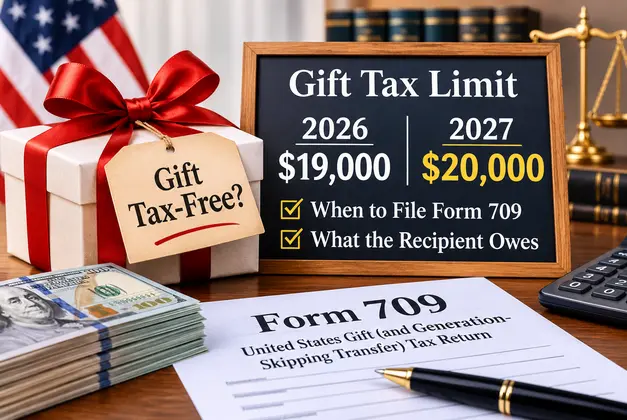
Quick answer: You can give up to $19,000 to as many people as you want in 2026, and $20,000 each in 2027, with no gift tax and no form. Give more than that to one person and you’ll usually file Form 709, but you almost certainly won’t owe tax: the excess just counts against a $15 million lifetime exemption ($15.48 million in 2027).
Getting a gift? You generally owe no federal income tax on it. The big exception is reporting: more than $100,000 in a year from family abroad means Form 3520.
Want it to count for 2026? A check must be deposited by December 31, not just written.
| Item | 2026 | 2027 |
|---|---|---|
| Annual exclusion (per giver, per recipient) | $19,000 | $20,000 |
| Couple, via gift splitting | $38,000 | $40,000 |
| 529 five-year election (per beneficiary, per giver) | $95,000 | $100,000 |
| Lifetime exemption (per person) | $15,000,000 | $15,480,000 |
| Gifts to a spouse who is not a U.S. citizen | $194,000 | $201,000 |
| Form 3520: from foreign individuals or estates | Over $100,000 | Over $100,000 |
| Form 3520: from foreign companies or partnerships | Over $20,573 | Over $21,240.31 |
| Top gift and estate tax rate | 40% | 40% |
Figures verified November 19, 2026 from IRS Rev. Proc. 2026-35. General information, not tax advice. Last updated .
Every result in this guide carries one of three tier words, so you can see at a glance where you stand:
Gift Checker: I’m Giving
Seven quick questions. Nothing is saved or sent anywhere. Please don’t enter names or Social Security numbers.
Gift Checker: I’m Receiving
Six quick questions. Nothing is saved or sent anywhere. Please don’t enter names or Social Security numbers.
The Limits: Annual Exclusion vs. Lifetime Exemption
You can give $19,000 to each person in 2026 ($20,000 in 2027) without any form, and anything above that is tracked against a $15 million lifetime exemption instead of being taxed.
You can give $19,000 to every person you know: it’s per recipient, not per year.
The annual exclusion applies per giver, per recipient, per year. A grandparent who gives $19,000 to each of five grandchildren in 2026 has given $95,000 and filed nothing.
The lifetime exemption works like a running balance. A 2025 law set it at $15,000,000 per person for 2026 and indexes it for inflation afterward; the IRS has set it at $15,480,000 for 2027 ($30,960,000 for a married couple). It is shared with the estate tax, so what you use while alive reduces what’s left at death.
Only the amount above the annual exclusion reduces it. That’s the point many guides get wrong.
Worked example, 2026: You give your daughter $50,000. The first $19,000 is covered by the annual exclusion. The other $31,000 goes on Form 709 and reduces your lifetime exemption from $15,000,000 to $14,969,000. You owe $0.
Why tax is so rare: you would have to give away more than $15 million in taxable gifts over your life, counting your estate too, before the 40% top rate applies. For the estate side, see our Estate Planning Guide.
When You Must File Form 709 (Even With No Tax)
You must file Form 709 when you give more than the annual exclusion to one person, elect gift splitting, or make a 529 five-year election, even though you will almost always owe nothing.
Filing Form 709 usually means paperwork, not a tax bill.
The form reports the gift and tracks your lifetime exemption. Tax comes into play only past the lifetime exemption.
- You gave one person (other than your spouse) more than the annual exclusion: $19,000 for 2026.
- You and your spouse want gift splitting. It always needs a return, whatever the amount.
- You made a 529 five-year election.
- You gave a future interest: money the person can’t use yet, such as certain trust gifts. Any amount.
- You gave your spouse a limited interest (a terminable interest), or a spouse who isn’t a U.S. citizen more than $194,000 (2026).
- You made no gifts to your spouse that need reporting. Outright gifts to a U.S.-citizen spouse generally don’t.
- You gave no one more than the annual exclusion.
- Every gift was a present interest: the person can use the money now.
- You are not electing gift splitting.
These lists paraphrase the “Who must file” section of the IRS Instructions for Form 709, checked November 19, 2026. Gifts only to qualifying charities also need no return when you transfer your entire interest.
| Situation | File? | Why |
|---|---|---|
| At or under the exclusion ($19,000 in 2026) to each person | NO FORM NEEDED | Fully covered by the annual exclusion. |
| Over the exclusion to one person | FILE FORM 709 — NO TAX (usually) | The excess is reported and reduces your lifetime exemption. |
| Gift splitting with a spouse | FILE FORM 709 — NO TAX | The election is made on the form, with your spouse’s signed consent. |
| 529 five-year election | FILE FORM 709 — NO TAX | The election is made on the form. |
| Tuition or medical bills paid directly | NO FORM NEEDED | Not treated as gifts (IRC § 2503(e)). |
| Outright gift to a U.S.-citizen spouse | NO FORM NEEDED (generally) | Unlimited marital deduction. Limited interests are the exception. |
| Future-interest gift | FILE FORM 709 — NO TAX | Doesn’t qualify for the annual exclusion at any amount. |
Due date and extensions
Form 709 for 2026 gifts is generally due April 15, 2027. An income tax extension (Form 4868) also extends it, and Form 8892 gives a separate six-month extension. Neither extends the time to pay any tax.
What happens if you skip it
The IRS late-filing penalty is a percentage of tax that’s due, so when no tax is due there is usually little for it to bite on. The bigger risks are quieter: the IRS clock for questioning a gift’s value generally doesn’t start until a return reporting it is filed, and willful failure to file carries separate penalties. If you missed a year, file late and talk to a CPA.
Married Couples: Gift Splitting Done Right
Spouses can each give $19,000 from their own money with no form, but giving $38,000 from one spouse’s money requires a gift-splitting election on Form 709.
Myth: “Married couples can give $38,000 without telling the IRS.”
Fact: That’s true only when each spouse gives $19,000 from their own money. If $38,000 comes from one spouse, you need Form 709 to split it.
Option 1: each spouse gives from their own money
You give $19,000 from your account. Your spouse gives $19,000 from theirs. The recipient gets $38,000 in 2026. No form, no election.
Option 2: gift splitting
Gift splitting lets you and your spouse treat a gift from one of you as made half by each. It’s a formal election on Form 709, and your spouse must consent in writing on the Notice of Consent. Each spouse files their own return; the IRS doesn’t accept a joint gift tax return.
Two rules catch people. The election covers all gifts to third parties that either of you made that year, not just one. And you must be married at the time of the gifts.
The single-return exception
Usually both spouses file. The exception: only one spouse made gifts, every gift was a present interest, and no recipient got more than $38,000 (2026). Then the donor files, and the other spouse signs the Notice of Consent on that return. For 2027 gifts the ceiling is $40,000. The IRS instructions also describe a narrower variation when the other spouse made small gifts of their own, so read them or ask a CPA.
Example, 2026: One spouse gives their son $60,000. Split in half, each spouse is treated as giving $30,000, which is $11,000 over each spouse’s $19,000. Both file. Each uses $11,000 of lifetime exemption. No tax. The single-return exception doesn’t apply because the gift is over $38,000.
Joint accounts and community property
A gift is generally treated as made by the spouse whose money it was. In a joint account, that can be one spouse or both, depending on who put the money in. Thinking of adding someone to an account? See Adding Someone to Your Bank Account.
In community-property states, money earned during marriage is often owned half by each spouse. A gift from those funds may count as half from each of you. That depends on your state and where the money came from, so check with a CPA before relying on it.
| Scenario | 2026 amount | Form needed? | Lifetime used |
|---|---|---|---|
| Grandparent to 5 grandkids | $95,000 ($19,000 each) | NO FORM NEEDED | $0 |
| $50,000 to one child | $50,000 | FILE FORM 709 — NO TAX | $31,000 |
| Couple gives $38,000 from one spouse’s account | $38,000 | FILE FORM 709 — NO TAX (splitting; single-return exception may apply) | $0 |
| Parents to a married child for a house | $76,000 (4 × $19,000) | NO FORM NEEDED if each parent gives from their own funds | $0 |
| 529 superfund for one grandchild | $95,000 | FILE FORM 709 — NO TAX (election) | $0 |
Worked examples, 2026 figures
Grandparent to 5 grandkids
2026 amount: $95,000 ($19,000 each)
Form needed? NO FORM NEEDED
Lifetime used: $0
$50,000 to one child
2026 amount: $50,000
Form needed? FILE FORM 709 — NO TAX
Lifetime used: $31,000
Couple gives $38,000 from one spouse’s account
2026 amount: $38,000
Form needed? FILE FORM 709 — NO TAX (splitting; the single-return exception may apply)
Lifetime used: $0
Parents to a married child for a house
2026 amount: $76,000 (4 × $19,000)
Form needed? NO FORM NEEDED if each parent gives from their own funds
Lifetime used: $0
529 superfund for one grandchild
2026 amount: $95,000
Form needed? FILE FORM 709 — NO TAX (election)
Lifetime used: $0
Source: IRS Rev. Proc. 2025-32; IRS Instructions for Form 709.
The December 31 Check Rule
A check you give to a person counts as a gift in the year the recipient deposits it, not the year you wrote it.
Deposit date decides the year.
A check written December 28, 2026 and deposited January 4, 2027 is a 2027 gift. It counts against the $20,000 limit for 2027, not the $19,000 limit for 2026.
This comes from IRS Rev. Rul. 96-56, which follows the Fourth Circuit’s decision in Metzger v. Commissioner, 38 F.3d 118 (1994). A check to a non-charity counts in the year it is deposited, if all of these hold:
- The bank pays the check while you are alive.
- You intended the gift and delivered the check with no conditions.
- The check was presented for payment in that year and within a reasonable time.
Wires and electronic transfers are usually treated as given when the money leaves your account and reaches the recipient. The ruling above is about checks, so for a large year-end transfer, send it well before the last business day and keep the confirmation. Charity gifts follow separate rules for the income tax deduction; see Year-End Tax Moves.
Year-End Gift Checklist
- List each person and what you’ve already given them this year.
- Keep each person at or under $19,000 for 2026 if you want no form.
- Married? Decide: each give from your own money, or split (and file 709).
- Paying tuition or medical bills? Pay the school or provider directly.
- Checks: hand them over early; they must be deposited by Dec 31.
- Gave more? Note it for Form 709 by April 15, 2027.
- Helping with a house? Ask the lender for its gift-letter form.
- Family abroad sending money? Track the total. Over $100,000 → Form 3520.
Receiving a Gift: What You Owe and Report
Money someone gives you is generally not taxable income to you, but what it earns later is, and some large gifts must be reported.
You don’t report an ordinary gift on your income tax return. The giver is the one who may file Form 709.
- Income the gift earns is yours. A $20,000 gift that earns $800 in interest means $800 of taxable interest to you.
- Gifted property keeps the giver’s cost basis. If you receive stock, the giver’s original cost carries over. See Gifting Stock to Family.
- Venmo, Zelle and PayPal. Personal gifts aren’t income. For 2026, Form 1099-K applies to goods and services above $20,000 and more than 200 transactions (some states set lower limits). If you get one in error for personal payments, follow the IRS Form 1099-K FAQs to report it and back it out. More in our 1099-K guide.
- The rare edge case. If a giver owes gift tax and doesn’t pay it, the IRS can collect from the person who received the gift (IRC § 6324(b)). That only happens when the giver’s gifts exceed the lifetime exemption.
- Reporting duties still exist. The best-known one is Form 3520 for large gifts from abroad, next.
“The recipient owes nothing” is not absolute. There’s no income tax on the gift itself, but there can be reporting duties, tax on later income, and carryover basis.
Gifts From Family Abroad: Form 3520
A U.S. person who receives more than $100,000 in a year from nonresident aliens or foreign estates must report it on Form 3520, even though the gift isn’t taxed.
Family abroad: the gift isn’t taxed, but not reporting it can cost up to 25%.
Form 3520 is an information return. It tells the IRS about the money. It does not create a tax bill.
Who has to file, and when
- From foreign individuals or estates: more than $100,000 in a year, for 2026 and 2027. Everything from the same person, and anyone related to them, is added together. Inheritances from a foreign estate count too.
- From foreign companies or partnerships: a much lower line, adjusted for inflation: $20,573 for 2026 (IRS Rev. Proc. 2025-32) and $21,240.31 for 2027 (IRS Rev. Proc. 2026-35). The IRS may also question whether such a “gift” is really income.
- Who “you” is: a U.S. citizen, green-card holder, or other U.S. tax resident.
- The test uses the year’s total, not each transfer.
- Due date: the same date as your income tax return, including extensions (April 15 for most people, October 15 at the latest). It’s filed separately, not attached to your Form 1040.
The penalty
If you miss a required Form 3520 for a foreign gift, the penalty is 5% of the gift for each month it stays unreported, up to 25% (IRC § 6039F). It applies even though no tax is owed, and it can be removed for reasonable cause. This is where families get hurt, so consider a CPA.
Example: Your parents in another country wire you $120,000 for a house. You owe no income tax. You must file Form 3520. If you skip it, the penalty can reach 25% of $120,000, which is $30,000.
Smaller example: An aunt abroad sends $15,000. That’s below $100,000, so no Form 3520. Keep the bank record and a short note from her saying it’s a gift.
Does the foreign giver owe U.S. gift tax?
Generally no, for cash and most other intangible property. A nonresident alien giver is usually subject to U.S. gift tax only on U.S. real estate and tangible property located in the U.S. That’s a general rule with exceptions, so ask a CPA about large gifts.
If your spouse isn’t a U.S. citizen
Gifts to a spouse who is not a U.S. citizen are capped at $194,000 for 2026 and $201,000 for 2027, and only present-interest gifts qualify. Above that, the gift is reported on Form 709 and uses lifetime exemption. For estate-side rules, read U.S. Estate Tax for Non-Citizens.
Gifts That Don’t Count: Spouse, Tuition, Medical, Charity
Gifts to a U.S.-citizen spouse, tuition or medical bills paid directly to the provider, qualifying charities, and political organizations don’t count as taxable gifts, whatever the amount.
| Transfer | Condition | Common mistake |
|---|---|---|
| Tuition | Paid directly to the school, for tuition only | Counting books, housing or meals. They don’t qualify. |
| Medical costs | Paid directly to the care provider | Reimbursing the person instead of paying the provider. |
| Spouse who is a U.S. citizen | Outright gift qualifies for the marital deduction | Assuming it works for a non-citizen spouse. That has a $194,000 (2026) cap. |
| Qualifying charity | The charity must qualify | Assuming every nonprofit-sounding group qualifies. |
| Political organization | Given to the organization for its use | Mixing it up with the income tax treatment, which is different. |
“Directly” is the whole rule
Grandma writes a $30,000 check to the university. Not a gift, no limit, no form.
Grandma gives her grandchild $30,000 to pay tuition. That’s a gift. It’s $11,000 over the 2026 exclusion and goes on Form 709.
Same for medical care: pay the hospital or doctor yourself. Amounts your relative’s insurance later reimburses don’t qualify. A contribution into a 529 plan is also a regular gift, not “tuition paid directly”; see the 529 section.
Helping With a House: Down Payments and Gift Letters
Parents can give any amount toward a down payment, but the lender will want a gift letter, and the giver may need Form 709 if the gift is above the annual exclusion.
A mortgage gift letter is for the lender, not the IRS.
It’s a lender document. You don’t file it with the IRS. Under Fannie Mae’s Selling Guide (B3-4.3-04, updated February 2026), the donor signs it, states the amount, confirms no repayment is expected, and gives their name, address, phone number and relationship to you. Your lender may add its own requirements.
If you do expect to be paid back, it isn’t a gift, and your lender needs to know. See the gift-or-loan section below.
Example: four gifts from two parents
A married child buys a home. Each parent gives $19,000 to the child and $19,000 to the child’s spouse in 2026, each from their own money. That’s 4 × $19,000 = $76,000, and no form. Each parent stays within the exclusion for each recipient.
Two things change the answer:
- One parent funds all of it. That parent has given $38,000 to each of two people, which is over $19,000 each. The parents can split on Form 709, and the single-return exception may apply since each recipient got no more than $38,000.
- The spouse must really be a recipient. The money should genuinely go to both, for example into an account in both names. Ask your lender how it wants the letter handled when only one spouse is on the loan.
Budgeting for the house? See How Much House Can I Afford. For assistance programs and their traps, see Down Payment Assistance.
529 Superfunding and Other Ways to Give to Kids
A 529 five-year election lets one giver put up to $95,000 (2026) or $100,000 (2027) into one beneficiary’s 529 plan at once without using lifetime exemption, but it requires Form 709.
- How it works. You elect to treat the contribution as five equal yearly gifts. $95,000 is 5 × $19,000. For 2027, $100,000 is 5 × $20,000.
- Per beneficiary, per giver. Two grandparents can each elect for the same grandchild.
- The form. You make the election on Form 709. Each year’s one-fifth is reported on that year’s form, and you don’t have to file again in later years unless you have other reportable gifts.
- Catch one. While the election runs, you’ve used up that child’s annual exclusion from you for those years. More gifts to the same child can count against your lifetime exemption.
- Catch two. If the giver dies within the five years, part of the contribution comes back into their estate.
For qualified expenses and plan rules, read our 529 plan guide.
Example, 2026: A grandmother puts $95,000 into a grandchild’s 529 and elects the five-year spread. She files Form 709, uses $0 of lifetime exemption, and treats it as $19,000 a year for five years.
Other ways to give to kids:
- UTMA/UGMA accounts are gifts too, and the child gets control at the age of majority. See UTMA/UGMA Custodial Accounts.
- Trump Accounts. A relative’s contribution is a gift. On June 29, 2026, the IRS issued Rev. Proc. 2026-25, a safe harbor that lets many donors treat qualifying cash contributions as annual-exclusion gifts and skip Form 709 if its conditions are met. Details in Trump Accounts.
Gift or Loan?
A family loan isn’t a gift if you document it and charge at least the IRS Applicable Federal Rate (AFR), and forgiving the loan later is a gift.
- Put it in writing. Amount, interest rate, repayment schedule. Then actually collect the payments.
- Use at least the AFR. The IRS publishes it monthly, with different rates for short, mid and long terms. A loan below the AFR can create imputed interest and a deemed gift under IRC § 7872.
- Small loans have a break. Gift loans between individuals of $10,000 or less are generally exempt from those rules, with exceptions, such as money used to buy income-producing assets.
- Forgiving a loan is a gift. Forgive $15,000 of principal in 2026 and it’s a $15,000 gift, inside the annual exclusion. Forgive more and you’re back to Form 709.
State Gift Taxes
Connecticut is the only state we found with a broad gift tax, and for gifts made in 2026 its exemption is $15 million, matching the federal figure.
- Connecticut. The exemption applies to all Connecticut taxable gifts made since 2005, added together. Report them on Form CT-706/709, due April 15 of the following year (April 15, 2027 for 2026 gifts), even if no tax is due. The Connecticut Department of Revenue Services page is the authority. Its exemption has tracked the federal one in recent years, so check it for 2027.
- Other states. Some have estate taxes and a few have inheritance taxes. Those are separate from the federal gift tax, and a few states add recent gifts back into the estate. Check yours.
For the bigger picture, see our Estate Planning Guide.
| Myth | Fact | Source |
|---|---|---|
| The recipient pays gift tax. | The giver files and pays, if tax is ever due. The recipient owes no income tax on the gift, with the rare unpaid-tax exception. | IRS Form 709 instructions; IRC § 6324(b) |
| Couples can give $38,000 with no paperwork. | Only if each spouse gives $19,000 of their own money. One spouse giving $38,000 needs a splitting election. | IRS Form 709 instructions |
| Over $19,000 means you owe tax. | Over $19,000 (2026) means you usually file, not pay. Tax starts past the $15,000,000 lifetime exemption. | IRS Rev. Proc. 2025-32 |
| A check written Dec 31 counts that year. | The deposit date decides the year. | IRS Rev. Rul. 96-56 |
| Gifts from abroad are taxed. | The gift isn’t taxed, but more than $100,000 from foreign individuals or estates must be reported. | IRS Form 3520 instructions |
FAQ
How much money can I gift tax-free in 2026?
You can give $19,000 to each person in 2026 with no gift tax and no form. The limit is per giver and per recipient, so you can give $19,000 to as many people as you like. Gifts above that need Form 709 but rarely produce tax, thanks to a $15,000,000 lifetime exemption.
What is the gift tax limit for 2027?
The annual exclusion is $20,000 per recipient in 2027, up from $19,000, according to IRS Rev. Proc. 2026-35 (announced November 5, 2026). The lifetime exemption rises to $15,480,000, or $30,960,000 for a married couple, and the five-year 529 election to $100,000.
Is the $19,000 limit per person or total?
It’s per recipient, per giver, per year. Giving $19,000 each to five grandchildren in 2026 is $95,000 with no form. There’s no cap on how many people you can give to. A married couple each giving from their own money gets two $19,000 limits per recipient.
Can a husband and wife each give $19,000 to the same person?
Yes. If each spouse gives $19,000 from their own money in 2026, that’s $38,000 to one person with no Form 709 and no election. The complication is whose money it is: joint accounts and community property can change the answer, so check with a CPA.
Do we need to file Form 709 to give $38,000 as a couple?
It depends on whose money it is. Each spouse giving $19,000 from separate funds needs no form. If $38,000 comes from one spouse, you need Form 709 to elect gift splitting, although under the single-return exception only the donor may need to file, with the other spouse signing consent.
What happens if I give someone $50,000?
In 2026 the first $19,000 is covered by the annual exclusion. The other $31,000 is reported on Form 709 and subtracted from your $15,000,000 lifetime exemption. You owe no tax unless your lifetime taxable gifts, plus your estate, pass the exemption.
Do I pay gift tax if I file Form 709?
Usually not. Filing reports the gift and tracks your lifetime exemption. Tax is due only after your lifetime taxable gifts pass $15,000,000 in 2026 ($15,480,000 in 2027). Rates then reach 40%. Most families never get near that, but the form is still required when the rules say so.
If someone gives me $20,000, do I report it?
Generally no. A gift isn’t taxable income to you, and you don’t report it on your income tax return. The exceptions are reporting rules for gifts from abroad: more than $100,000 in a year from foreign individuals or estates, or more than the IRS line from foreign companies, means Form 3520.
Is money gifted through Venmo or Zelle taxable?
Not if it’s a personal gift. For 2026, payment apps issue Form 1099-K only for goods and services above $20,000 and more than 200 transactions (some states set lower limits). If you get one for personal payments in error, the IRS Form 1099-K FAQs explain how to report it and back it out.
Do I pay tax on money my parents send from another country?
The gift itself isn’t taxed as income. But if you’re a U.S. person and receive more than $100,000 in a year from nonresident alien individuals or foreign estates, you must report it on Form 3520. Below that, no Form 3520 is needed for individuals; keep records.
What is Form 3520 and when is it due?
Form 3520 is an information return, not a tax return. Part IV reports large gifts and inheritances from foreign persons. It’s due on the same date as your income tax return, including extensions, and filed separately. The penalty for a missed foreign gift is 5% a month, up to 25%.
Can I write a check in December and have it count this year?
Only if the recipient deposits it by December 31. Under Rev. Rul. 96-56, a check to a non-charity counts in the year it is deposited, if the bank pays it while you’re alive and you delivered it unconditionally. A check deposited in January counts for the next year.
Is paying my grandchild’s tuition a gift?
Not if you pay the school directly. Tuition paid directly to the school isn’t treated as a gift, so there’s no limit and no form. Books, housing and meals don’t qualify. If you give the money to your grandchild to pay tuition, it’s a regular gift.
Can I pay someone’s medical bills without gift tax?
Yes, if you pay the doctor, hospital or other care provider directly. No limit, no form. Reimbursing the person doesn’t qualify, and amounts their insurance reimburses don’t either. Treat any payment to the person themselves as a regular gift.
How much can parents give for a down payment?
Parents can give any amount. Up to $19,000 per parent per recipient in 2026 needs no Form 709. A larger gift means filing Form 709, usually with no tax. The lender will also want a signed gift letter. A married child’s spouse can receive $19,000 from each parent too.
Does a mortgage gift letter get reported to the IRS?
No. The gift letter is a document for the lender, not an IRS filing. The giver may still need Form 709 if the gift is above the annual exclusion. The letter must be true: if repayment is expected, it’s a loan and the lender needs to know.
What is 529 superfunding?
It’s an election to spread one 529 contribution over five years: up to $95,000 in 2026 or $100,000 in 2027, per beneficiary, per giver. You make the election on Form 709. If the giver dies within the five years, part comes back into the estate.
Which states have a gift tax?
Connecticut is the only state we found with a broad gift tax. For 2026 gifts its exemption is $15 million. Other states may have estate or inheritance taxes, which are separate, so check your own state’s rules.
Sources
All checked November 19, 2026.
- IRS news release IR-2026-133, tax inflation adjustments for tax year 2027 (Nov. 5, 2026)
- IRS Rev. Proc. 2026-35 (2027 figures) and Rev. Proc. 2025-32 (2026 figures)
- IRS Instructions for Form 709
- IRS Instructions for Form 3520 (Part IV); IRC §§ 6039F, 6677
- IRS Rev. Proc. 2026-25 (Trump Account safe harbor, June 2026)
- IRS Rev. Rul. 96-56, 1996-2 C.B. 161; Metzger v. Commissioner, 38 F.3d 118 (4th Cir. 1994)
- IRC § 2503(b), (e); § 529(c)(2)(B); IRC § 7872
- IRS Form 1099-K FAQs
- Fannie Mae Selling Guide B3-4.3-04, Personal Gifts
- Connecticut Department of Revenue Services, Estate and Gift Tax Information
General information based on IRS rules and Rev. Proc. 2026-35, verified on November 19, 2026. This is not tax or legal advice. Gift splitting, trusts, non-citizen spouses and foreign gifts have rules not fully covered here, so consult a CPA or estate attorney.

Daniel Hayes is the founder and sole researcher at AdvoraHQ. He covers U.S. personal finance, insurance, and consumer law — working directly from IRS publications, federal and state statutes, court opinions, and SEC filings rather than secondary summaries. His focus is the gap between what readers think they know and what the source documents actually say. Daniel is not a licensed attorney, CPA, or financial advisor; his articles are educational and not personalized advice. Reach him at Daniel.Hayes@advorahq.com.
