
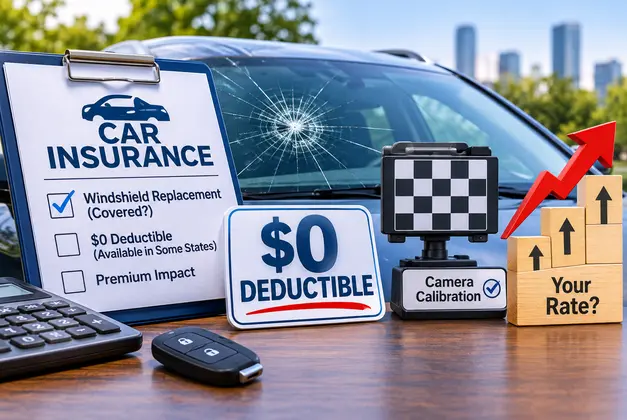
Yes, if you carry comprehensive coverage (or collision, if the glass broke in a crash). Liability-only never pays for your own glass.
Kentucky and South Carolina waive the deductible on all safety glass, and Florida on the windshield only. Everywhere else, you pay your deductible unless you bought full glass coverage.
A single glass claim usually isn’t treated as an at-fault accident, but it can cost you a claims-free discount, and several claims can matter.
The line most pages skip: on most newer cars, a new windshield means recalibrating the camera behind it. Ask whether your quote includes that before you decide anything.
Claim it or pay cash? Run your numbers in 30 seconds →
Do this first
- Photograph the damage and note where and when it happened.
- Find your comprehensive deductible and any glass deductible on your declarations page.
- Get a written quote that includes calibration.
- Which coverage pays
- $0-deductible states
- Florida’s 2023 change
- Calibration
- Repair or replace
- Will my rate go up?
- Choosing a shop
- FAQ
State rules checked November 20, 2026. Your policy and declarations page control. Last updated: .
Glass Claim or Pay Cash? Calculator
Answer what you know. Skip what you don’t. Don’t enter your name, VIN, or policy number. Nothing you enter is saved or sent anywhere.
Your result
Which Car Insurance Pays for a Windshield (and When None Does)
Comprehensive coverage pays for most glass damage that doesn’t come from a crash, and liability-only coverage never pays for your own glass.
Comprehensive covers non-collision events: a rock thrown up by a truck, hail, a falling branch, vandalism. Collision applies when the glass breaks in a crash. Some states, and some optional endorsements, remove the deductible for glass.
Not sure which coverage you carry? Our guide to full coverage vs. liability explains the difference.
| Coverage | Pays for your glass? | Typical deductible | When it applies |
|---|---|---|---|
| Liability only | No | Not applicable | Pays for damage you cause to others, never your own glass. |
| Comprehensive | Yes, for non-collision damage | Your comprehensive deductible, unless a state rule or glass endorsement waives it | Rocks, hail, falling branches, vandalism, and often animal strikes. Check your policy. |
| Collision | Yes, if the glass breaks in a crash | Your collision deductible, which usually applies to the whole claim | Glass is one part of a larger crash claim. |
| Full glass endorsement | Yes | $0 or low glass deductible | Optional add-on in some states. Check which glass it covers. |
The $0-Deductible States: What the Law Actually Says
Three states waive the glass deductible by law (Kentucky, South Carolina, and Florida), and the three laws cover different glass.
$0 BY LAW
States: Kentucky, South Carolina, Florida.
What glass: Kentucky: windshield, door and window glass, and glass in required lights. South Carolina: automobile safety glass. Florida: the windshield only.
What to check: that you carry comprehensive (Florida: comprehensive or combined additional coverage), and that the claim is glass-only in Kentucky. In Florida, side glass, rear glass, and sunroofs are outside the rule.
$0 IF YOU BOUGHT IT
States: optional full glass coverage is available in some states, including Arizona, Connecticut, Massachusetts, Minnesota, and New York.
What glass: depends on the endorsement.
What to check: whether you added it, what glass it covers, and whether the deductible is $0 or only reduced.
YOU PAY THE DEDUCTIBLE
States: all other states.
What glass: any glass your comprehensive coverage pays for.
What to check: whether your insurer waives the deductible for chip repair (an insurer practice, not a law) or sells glass coverage.
Kentucky
KRS 304.20-060 says a policy with comprehensive coverage must pay for damaged motor vehicle glass without regard to any deductible. The statute covers glass in the windshield, doors, and windows, plus the glass or plastic in required lights.
A 2024 amendment (Acts 2024, ch. 27, SB 29, signed April 2, 2024) went further. It counts the glass-related parts and recalibrating a driver-assistance system, when the glass replacement requires it, as part of the repair. It also bars requiring you to use a particular shop. It applies to policies issued or renewed on or after the Act took effect, and the $0 rule applies to glass-only claims.
South Carolina
S.C. Code § 38-77-280(B) says no automobile physical-damage deductible applies to automobile safety glass. Unlike Florida, that is not limited to the windshield.
Florida
Fla. Stat. § 627.7288 says the deductible in a policy with comprehensive or combined additional coverage does not apply to damage to the windshield. It says nothing about side windows, rear glass, or sunroofs.
Optional full glass coverage
Drivers in Arizona, Connecticut, Massachusetts, Minnesota, and New York can buy zero- or low-deductible glass coverage. Published lists disagree on which of these states make insurers offer it, so treat it as “available in some states” and ask your insurer what it sells and what it covers.
Florida’s 2023 Change: Is the Windshield Still Free?
Yes: Florida’s 2023 law left the $0 windshield rule alone and added rules about assignments, steering, incentives, and calibration notices.
You may have read that Florida let insurers offer an optional $250 windshield deductible. That language was in an earlier House bill (HB 541) and appeared in some news coverage. It is not in the enacted law. The current text of § 627.7288 has not been amended since 1997, and the 2023 act (ch. 2023-136, from CS/SB 1002) does not touch it.
What the 2023 law did change
- Assignment of benefits is void. Under § 627.7289, an agreement assigning post-loss glass benefits to a shop is void and unenforceable for policies issued or renewed on or after July 1, 2023. Staff analysis says this includes calibration.
- No steering. Under § 627.7291, an insurer, agent, or adjuster may not require you to use a particular company or location for windshield replacement, repair, or calibration under a personal auto policy. The insurer may still explain your comprehensive benefits.
- Repair arrangements need a discount. If an insurer offers a policy with a windshield repair arrangement and you accept it, the insurer must give you an actuarially sound discount.
- Shop incentives are restricted. Under § 559.920(17), a shop can’t offer a rebate, gift card, cash, coupon, or other thing of value in exchange for a glass or calibration claim.
- Calibration notice. Under § 559.920(18), a shop must give you electronic or written notice (12-point type or larger) saying whether calibration is required, and must ensure the service meets or exceeds the manufacturer’s specifications.
How to check your own policy
Look at your declarations page for comprehensive coverage. If your insurer says a deductible applies to a windshield claim, ask for the policy language in writing. If it can’t point to any, contact the Florida Department of Financial Services.
The Camera Behind Your Windshield: ADAS Calibration
Many windshields hold the camera that runs lane-keeping and emergency braking, so replacing the glass often means recalibrating that camera before you drive away.
Calibration realigns the camera to the manufacturer’s specification. A shop does it with targets in the bay (static), by driving the car with a scan tool (dynamic), or both. The automaker’s procedure decides which.
How common it is
Safelite, an auto glass company, reports that about 1 in 4 vehicles needed calibration after a windshield replacement in 2016, versus nearly 9 in 10 model-year 2023 vehicles. A 2023 industry report from AutoBolt shows the same trend.
What it can add to the bill
Enlyte’s 2026 trends report, citing 2025 estimating data (reported by Insurance Business), found calibration on 34.7% of repair estimates. When a calibration was present, it averaged $688 per estimate. That figure covers repair estimates in general, not windshield jobs, so don’t read it as a typical windshield bill. CCC, another industry source, puts the average calibration fee near $500 per repairable vehicle. Your own written quote is the number that matters.
Why do repairs cost more on these cars? IIHS and HLDI compared 2017–22 vehicles with and without driver-assistance bundles. On collision claims, equipped vehicles showed about 10% higher severity but about 10% lower frequency (IIHS, August 11, 2026).
Why missing paperwork can sink a claim
Some insurers ask for proof that required calibration was done, and a glass company notes that many policies expect it. Without a calibration report, an insurer could question the repair. Ask for the report and keep it. In Kentucky, shops must disclose before contracting whether calibration is needed and whether they can do it. In Florida, shops must give you the written notice described above.
This is also a safety issue. A camera that is out of alignment can mislead the systems that depend on it, whatever the money math says.
Questions to Ask the Shop Before You Approve
- Does this quote include calibration? Static, dynamic, or both, and where is it done?
- Will I get a written calibration report for my insurer and my records?
- Is the glass OEM, OEM-equivalent, or aftermarket, and does my policy pay for OEM?
- Is this a repair or a replacement, and why?
- Are you asking me to sign anything that assigns my insurance benefits to you? (In Florida, such agreements are void for policies issued or renewed on or after July 1, 2023.)
- Is any gift, cash, or discount being offered for filing a claim? If yes, walk away.
- If you’re out of network, will I owe any difference in price?
Repair or Replace?
A small chip can often be repaired instead of replaced, and many insurers waive the deductible for repair but not for replacement.
Chips vs. cracks
A chip is a small impact point. A crack runs. Shops generally repair chips and short cracks that are away from the edge and outside the driver’s view. Longer cracks, edge cracks, and damage in the driver’s view usually mean replacement. The shop’s call and your safety come first.
The 6-inch rule of thumb
You’ll hear that cracks under about 6 inches can be repaired. That is an industry rule of thumb, not a legal standard. Your shop and your insurer may draw the line elsewhere.
Why many insurers waive the deductible for repair
Repair costs less than replacement and stops a chip from spreading, so many insurers waive the deductible for it. That is insurer practice, not law. Ask yours before you assume it. In Kentucky, South Carolina, and Florida (windshield), the law already removes the deductible.
Cold weather and spreading cracks
Temperature swings and road vibration can make a chip spread. If you plan to repair, don’t wait for it to grow into a crack that needs replacement, and a replacement means a calibration bill on many cars.
OEM vs. Aftermarket Glass
Your policy decides what it will pay for, and many policies cover non-OEM glass unless you carry an OEM endorsement, so check your policy.
Sensors matter here. Rain sensors, heads-up display zones, and camera brackets all have to match the glass. Ask the shop how the glass you’re being quoted handles each, and get the calibration report afterward.
| Glass type | What it is | Will a policy usually pay? | What to check for sensors and calibration |
|---|---|---|---|
| OEM | Made by or for the automaker, to the original specification | Usually only with an OEM endorsement, or if the insurer agrees | Best match for camera bracket and sensors. Calibration is still usually needed. |
| OEM-equivalent | Sold as matching the original specification, from another maker | Often, depending on policy wording | Ask how it fits the camera bracket, rain sensor, and heads-up display. |
| Aftermarket | Made by a third-party glass maker | Many policies pay for non-OEM glass unless an OEM endorsement applies | Confirm it works with your camera and sensors, and get a calibration report. |
OEM glass
What it is: made by or for the automaker, to the original specification.
Will a policy usually pay? Usually only with an OEM endorsement, or if the insurer agrees.
Sensors and calibration: best match for the camera bracket and sensors. Calibration is still usually needed.
OEM-equivalent glass
What it is: sold as matching the original specification, from another maker.
Will a policy usually pay? Often, depending on policy wording.
Sensors and calibration: ask how it fits the camera bracket, rain sensor, and heads-up display.
Aftermarket glass
What it is: made by a third-party glass maker.
Will a policy usually pay? Many policies pay for non-OEM glass unless an OEM endorsement applies.
Sensors and calibration: confirm it works with your camera and sensors, and get a calibration report.
Will a Windshield Claim Raise Your Rate?
A single comprehensive glass claim usually isn’t treated like an at-fault accident, but it is still a claim, and claims can matter at renewal.
What usually doesn’t happen, and what can
Many insurers say one glass claim has little or no effect on your rate. Three things can still matter: you can lose a claims-free discount, a pattern of several claims can count against you, and every claim is recorded.
The industry’s claim-history database, LexisNexis C.L.U.E., holds up to seven years of personal auto claims. Texas’s insurance department says it lists the date of loss, the loss type, and the amount paid. How a glass claim is coded can vary by insurer, so ask yours how it will be reported.
Asking vs. filing
Washington’s insurance commissioner notes that LexisNexis advises insurers not to report claims information when you only ask about coverage or a deductible. Oklahoma goes further in 36 O.S. § 1241.2: an insurer can’t raise your rate, cancel, or refuse to renew solely because you inquired about a claim you then didn’t file.
What the Oklahoma and California rules actually say
Oklahoma. 36 O.S. § 941 bars rate increases, cancellation, and nonrenewal on liability or collision policies because you were in a collision that wasn’t your fault. It does not address glass claims as such.
California. Proposition 103 and its regulations make your driving safety record the first mandatory rating factor, and that record counts principally at-fault accidents (10 CCR §§ 2632.5 and 2632.13, where principally at fault means at least 51% at fault). We have not confirmed how the regulations treat a comprehensive or glass claim specifically, so ask your insurer in writing.
South Carolina. Lawmakers have filed bills to stop insurers from counting safety-glass claims when setting rates (H. 3408 in 2021–22 and H. 3260 in 2023–24). H. 3260 was still in committee on the State House site’s last update, May 2024. We did not confirm the current session, so don’t assume it’s law.
For how rates are built, see how car insurance rates are calculated. If you’ve had several claims, read about cancellation and nonrenewal deadlines.
Claim or Pay Cash: Worked Examples
Claiming usually wins when the quote is well above your deductible, and paying cash usually wins when the quote is at or below it.
| Scenario | Quote incl. calibration | Deductible | Out-of-pocket if you claim | Cash cost | Takeaway |
|---|---|---|---|---|---|
| Chip repair, state without a glass rule | $90 (no calibration) | $500 | $90, unless your insurer waives the deductible for repair | $90 | Filing pays nothing at this price. Ask about a repair waiver first. |
| Replacement in a state without a glass rule | $1,000 | $500 | $500 | $1,000 | Claiming saves $500 up front. Weigh that against a possible lost discount. |
| Replacement in Kentucky, glass-only comprehensive claim | $1,000 | $500, waived by law | $0 | $1,000 | The deductible does not apply. Check whether you’d lose a discount anyway. |
The general break-even math is in Insurance Claim or Pay Out of Pocket?. This table only compares what you pay now.
Choosing a Shop, Incentives, and Assignment of Benefits
In Florida and Kentucky the law bars insurers from requiring a particular shop for glass claims; elsewhere, check your policy and your state’s rules, because insurers can still run shop networks.
In Florida, § 627.7291 covers windshield replacement, repair, and calibration. In Kentucky, KRS 304.20-060 says you can’t be required to use a specific shop to receive benefits, though insurers may keep networks. If you go out of network, ask whether you’ll owe any price difference.
Assignment of benefits
An assignment of benefits hands your claim rights to the shop. In Florida it is void for policies issued or renewed on or after July 1, 2023. Kentucky’s 2024 Act bars assigning policy benefits too, though you can still direct payment to a shop for covered work. Read before you sign anything.
Why a “free gift for filing” is a red flag
Florida’s § 559.920(17) and a new Kentucky trade-practices section both bar glass shops from offering anything of value in exchange for a glass claim.
Misrepresenting a claim to an insurer, including the damage, when it happened, or how, is insurance fraud. Never file for damage that didn’t happen, and walk away from any offer that rewards you for filing.
Glass Broken in a Crash, by an Animal, a Tree, or Vandalism
The cause decides the coverage: crashes go to collision, and most other causes go to comprehensive.
- Crash with another vehicle: collision, usually with the collision deductible applied to the whole claim. See what happens if you slid on ice and hit a car.
- Hit an animal: usually comprehensive, though policies differ. See hit a deer for how the two coverages split.
- Tree or branch: usually comprehensive. See when a tree falls on your house, car, or fence.
- Vandalism or theft: comprehensive. Your insurer may ask for a police report.
- Hail, storm, or road debris: comprehensive.
Is It Legal to Drive With a Cracked Windshield?
It depends on your state, but a crack that blocks or distorts your view is a problem almost anywhere, and it’s a safety risk even where it’s legal.
Most states use a visibility test. California’s Vehicle Code § 26710, for example, makes it unlawful to drive when the windshield is so defective that it impairs the driver’s vision. Some states add inspection standards on size or location. Check your state’s vehicle code or DMV.
Safety comes before the money math. A crack in the driver’s view, or a skipped calibration, is not something to wait on while you compare quotes.
If Your Glass Claim Is Denied or Underpaid
Ask for the reason in writing, because most glass denials trace back to a short list of causes.
- No comprehensive coverage on the policy.
- Wear, pitting, or other pre-existing damage.
- A missing calibration record.
- A price difference between the shop’s quote and what the insurer will pay.
Ask the insurer to give you in writing: the specific policy language it relies on, the estimate it used, and what it needs to reconsider. Keep your photos, quote, and calibration report. If you still disagree, your state’s insurance department takes consumer complaints.
FAQ
Short answers to the questions people ask most. Your policy and state law control.
Does car insurance cover windshield replacement?
Yes, with comprehensive coverage, or collision if the glass broke in a crash. You usually pay your deductible unless a state rule or a glass endorsement removes it.
Does liability insurance cover a cracked windshield?
No. Liability pays for damage you cause to others, never your own glass.
Which states have free windshield replacement?
Kentucky and South Carolina (all safety glass) and Florida (windshield only) waive the deductible by law. It isn’t truly free, since you still pay for the coverage.
Is windshield replacement still free in Florida?
Yes, with comprehensive or combined additional coverage. The 2023 law changed assignments, steering, incentives, and calibration notices, not the deductible rule. Side glass, rear glass, and sunroofs are outside it.
Does Kentucky or South Carolina cover side and rear windows?
Kentucky’s statute covers glass in the windshield, doors, and windows. South Carolina’s says “automobile safety glass” without a list we could confirm, so ask your insurer about side and rear glass. Neither is clear about sunroofs.
What is full glass coverage, and is it worth it?
It’s an optional endorsement that lowers or removes your glass deductible, sold in some states. Compare its yearly price with your deductible and how often you’ve replaced glass.
Does insurance cover ADAS calibration?
Often, when calibration is required as part of a covered replacement, but it depends on your policy. Kentucky’s statute counts it as part of the repair. Get it in the written quote.
Is calibration required after a windshield replacement?
Many automakers specify it, and the share of vehicles that need it has grown a lot since 2016. Whether yours does depends on make, model, and year, so ask the shop for the manufacturer’s procedure.
Does a windshield claim raise my insurance rate?
Many insurers say one glass claim has little or no effect, but it can end a claims-free discount, and several claims can matter. It varies by insurer and state.
Does a glass claim count as an at-fault accident?
No. A comprehensive glass claim isn’t a collision. It is still a claim on your record.
Will a glass claim show on my CLUE report?
Paid claims are generally reported, with the date, loss type, and amount paid. Ask your insurer how it codes glass claims.
Why is chip repair free but replacement isn’t?
Many insurers waive the deductible for repair because it costs less and prevents bigger claims. That’s insurer practice, not law.
How long can a crack be before it needs replacement?
About 6 inches is an industry rule of thumb, not a legal standard. Location matters too, especially in the driver’s view or at the edge.
Will insurance pay for OEM glass?
Often only with an OEM endorsement. Many policies pay for non-OEM glass otherwise, so check your policy.
Can I choose my own glass shop?
In Florida and Kentucky the law bars insurers from requiring a particular shop. Elsewhere, check your policy, since networks exist and out-of-network shops may leave a price difference.
Is it legal for a shop to offer a gift for filing a claim?
Not in Florida or Kentucky. Wherever you live, don’t accept cash or gifts to file, and never file for damage that didn’t happen. That’s insurance fraud.
Does insurance cover a sunroof or rear window?
Comprehensive generally covers them, with your deductible applying unless a state rule or glass endorsement waives it. Check your policy.
Can I drive with a cracked windshield?
It depends on the crack and your state, but a crack in the driver’s view is both a legal and safety risk. Replace it promptly.
Sources and Statutes
Checked November 20, 2026. Statutes can change, so confirm against the current text.
- Florida: § 627.7288, § 627.7289, § 627.7291, § 559.920; CS/SB 1002 (2023), enrolled text and Rules Committee staff analysis
- Kentucky: KRS 304.20-060 and 2024 Acts ch. 27 (SB 29)
- South Carolina: Code § 38-77-280 and H. 3260 (2023–24)
- California: 10 CCR § 2632.5, Department of Insurance Bulletin 2002-06, Vehicle Code § 26710
- Oklahoma: 36 O.S. § 941, § 1241.2, Oklahoma Insurance Department FAQ
- Calibration data: Safelite, AutoBolt report coverage (2023), Insurance Business on Enlyte’s 2026 report, CCC, IIHS-HLDI (August 11, 2026)
- Claim history: LexisNexis C.L.U.E. Auto, Washington Office of the Insurance Commissioner, Texas Department of Insurance
This article is general information, not insurance or legal advice. Coverage depends on your policy, your declarations page, and state law. State rules were checked on November 20, 2026 and may change.

Daniel Hayes is the founder and sole researcher at AdvoraHQ. He covers U.S. personal finance, insurance, and consumer law — working directly from IRS publications, federal and state statutes, court opinions, and SEC filings rather than secondary summaries. His focus is the gap between what readers think they know and what the source documents actually say. Daniel is not a licensed attorney, CPA, or financial advisor; his articles are educational and not personalized advice. Reach him at Daniel.Hayes@advorahq.com.
