
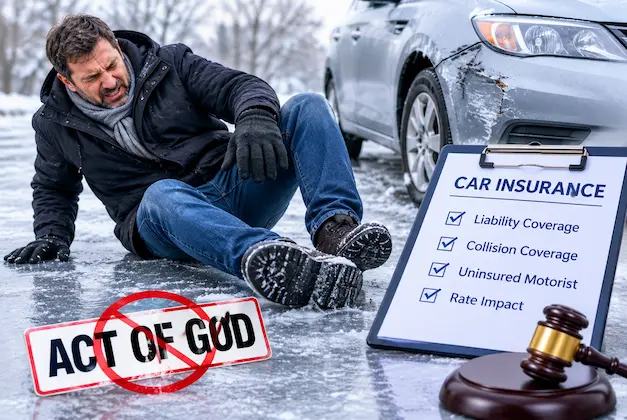
Quick answer
- USUALLY YOUR FAULT
Fault: usually yes. Drivers are expected to adjust to ice, so “the road was icy” rarely shifts the blame. - Your car: paid by collision coverage, minus your deductible. Liability-only won’t cover it.
- The other car or property: paid by your liability coverage.
- Rates: an at-fault claim can raise them. Small damage may be cheaper to pay yourself.
USUALLY NOT YOUR FAULT
The exception: if someone else slid into you, or ice flew off another vehicle, you’re usually not the one at fault. Their insurance should pay.
Anyone hurt, or stopped in a travel lane? Call 911 first.
Verified . Your policy and state law control.
Which Coverage Pays? Pick What Happened
Answer five quick questions and this tool shows the fault tier, what pays for your car and for others, and your rate risk.
Related guides for this result
Is Sliding on Ice Your Fault?
Usually, yes. Insurers and courts expect drivers to adjust speed and following distance to the conditions, so losing control on ice and hitting a vehicle or object is typically treated as at-fault, even though the ice wasn’t your choice.
Why the system sees it that way
The rule is simple: you must drive at a speed that fits the road you’re actually on. Many states write this into a basic speed law that bars driving faster than is reasonable for the conditions.
California’s is a clear example. Vehicle Code §22350 bars a speed greater than is reasonable or prudent, with due regard for weather, visibility, and the road surface. It also bars any speed that endangers people or property.
That is why driving under the posted limit doesn’t settle the question. On ice, a safe speed can be far below the sign.
The three tiers used in this guide
- USUALLY YOUR FAULT You slid into something.
- USUALLY NOT YOUR FAULT Someone slid into you, or ice flew off another vehicle.
- DEPENDS Pileups, road conditions, and claims against a government.
When it usually isn’t your fault
Fault can shift when another driver broke a traffic rule that caused the crash, such as running a stop sign or crossing into your lane.
It can also shift when a hazard appeared suddenly and you could not reasonably have seen or avoided it. Insurers weigh these case by case, so your evidence matters (see the checklist).
If fault is shared, your state’s fault system decides how it splits. See Partially at Fault for how that works.
| Question | Who decides | What it affects |
|---|---|---|
| Fault | Insurer adjusters; courts if it’s disputed | Whose liability pays, and often your rates |
| Coverage | Your policy wording and state law | Whether your own insurer pays you, and your deductible |
“Act of God”: Why It Rarely Works, and What It Actually Means
“Act of God” is a legal defense, not a type of coverage. It tries to excuse a driver by blaming nature as the sole cause, and it rarely succeeds when ice, snow, or a storm was forecast or foreseeable.
The person using it generally must show that nature was the only cause. They must also show the event couldn’t reasonably be anticipated or avoided.
A known storm or a forecast of black ice usually defeats it. A driver could have slowed down, left more room, or stayed off the road.
What it does not change
Act of God matters in liability disputes. It does not decide whether your insurer pays for your car.
Damage to your car from hail or a falling tree is a comprehensive claim regardless of fault. You never have to prove an act of God for that.
Examples, in general terms
DEPENDS May qualify (rare)
A sudden event with no warning that careful driving couldn’t have avoided, such as a healthy tree dropping onto the road in front of you at a reasonable speed.
USUALLY YOUR FAULT Usually doesn’t qualify
Sliding on ice during a forecast winter storm, hitting black ice on a bridge after a freeze warning, or following too closely on a snowy road.
Which Coverage Pays: Every Winter Scenario
Collision pays for your own car when it hits something or goes into a ditch, comprehensive pays for storm and falling-object damage, and liability pays for other people’s cars and injuries. Which one applies depends on what happened, not on who’s to blame.
- Collision: your car’s impact with a vehicle or object, or an upset. Your deductible applies.
- Comprehensive: other causes, such as a falling tree, hail, or flying objects. Your deductible applies.
- Liability: other people’s cars, property, and injuries. It never pays for your own car.
Not sure what you carry? Read Full Coverage vs. Liability. The same collision-versus-comprehensive split decides animal strikes too; see Hit a Deer.
Nine winter scenarios
Tap a card for the details. The table after the cards compares all nine.
1. I slid into another car
USUALLY YOUR FAULT
Your car: collision; your deductible applies. Liability-only won’t pay.
Others: your property damage liability pays for the other car. Bodily injury liability pays for injuries to the people in it.
Rate risk: likely. An at-fault collision claim can raise your premium.
If the car was parked and no one is around, don’t leave without trying to reach the owner or leaving your contact information.
2. I slid into a pole, guardrail, fence, mailbox, or building
USUALLY YOUR FAULT
Your car: collision; your deductible applies.
Others: your property damage liability pays the owner. Utilities and road agencies may bill you or your insurer.
Rate risk: likely.
3. I slid into a ditch or snowbank and my car is damaged
USUALLY YOUR FAULT
Your car: collision covers the upset of your car or its impact with an object, which includes most ditch and snowbank slides. Your deductible applies.
Others: none, unless you also damaged someone’s property.
Rate risk: possible. Some insurers count a single-car collision claim like any other at-fault claim.
4. I slid into a ditch, no damage, and need a tow out
USUALLY YOUR FAULT
Your car: roadside or towing coverage, if you have it. Collision and comprehensive respond to damage, not to a no-damage pull-out.
Others: none.
Rate risk: usually not. A tow with no damage usually isn’t an accident claim, though policies differ.
Fault rarely matters here because nothing was damaged and no one else was involved.
5. Someone slid into me
USUALLY NOT YOUR FAULT
Your car: usually the other driver’s property damage liability, with no deductible for you if their insurer accepts fault. If you carry collision, you can use it instead (deductible applies), and your insurer may seek reimbursement from them. That is called subrogation.
If the other driver is unidentified or uninsured, uninsured motorist property damage (UMPD) may apply where your state offers it. We cover that coverage in a separate guide on uninsured motorist coverage.
Rate risk: usually not, if you’re found not at fault. Practices vary.
See Rear-Ended? Who Pays for the rear-end version of this scenario.
6. Ice or snow flew off another vehicle and hit my car
USUALLY NOT YOUR FAULT
Your car: if the driver is identified, a claim against their liability. If not, often comprehensive (glass and flying or falling objects), with your deductible. UMPD may apply in some states, sometimes with conditions.
Rate risk: usually not.
Details are in the flying ice section.
7. A tree or limb fell on my car from snow or ice
USUALLY NOT YOUR FAULT
Your car: comprehensive; your deductible applies. Hail is handled the same way. Fault doesn’t matter.
Rate risk: usually not an at-fault surcharge, though some insurers still weigh claim history.
If the tree also hit your home, see Tree Fell on Your House.
8. I hit a pothole
DEPENDS
Your car: typically collision, with your deductible. Some policies and insurers treat potholes differently, so check yours.
Rate risk: possible. Ask before you file.
A claim against the road owner may be possible but is limited. See Blaming the city.
9. A chain-reaction pileup
DEPENDS
Your car: usually the liability coverage of the driver who hit you. If you carry collision, you can use it to speed repairs.
Others: your liability pays your share of the damage and injuries, under your state’s fault rules.
Rate risk: possible. It depends on whether you’re found at fault, in whole or in part.
| What happened | What pays for your car | Rate risk |
|---|---|---|
| 1. I slid into another car | Collision (deductible applies) | Likely |
| 2. Pole, guardrail, fence, mailbox, or building | Collision (deductible applies) | Likely |
| 3. Ditch or snowbank, car damaged | Collision (deductible applies) | Possible |
| 4. Ditch, no damage, tow needed | Roadside or towing coverage, if you have it | Usually not |
| 5. Someone slid into me | Their property damage liability; or your collision or UMPD | Usually not |
| 6. Ice or snow flew off another vehicle | Their liability if identified; otherwise often comprehensive | Usually not |
| 7. Tree or limb fell from snow or ice | Comprehensive (deductible applies) | Usually not |
| 8. Pothole | Typically collision (deductible applies) | Possible |
| 9. Chain-reaction pileup | Depends on fault share: others’ liability, or your collision | Possible |
If repairs would cost more than your car is worth, it may be declared a total loss. We cover that in a separate guide on totaled cars.
Slid Into a Ditch, No Other Car
If your car is damaged, collision coverage pays minus your deductible. If it’s undamaged and you only need a tow, roadside or towing coverage may pay. Without either, the pull-out is usually your own cost.
“No other car” doesn’t mean “no claim.” A ditch or snowbank slide is an impact or an upset, which collision covers if you carry it.
Check underneath before you decide there was no damage. Look at the wheels, bumpers, and alignment too.
Do you have to report it?
Two separate rules apply, and neither is the same as filing a claim.
Your policy: most policies require prompt notice of an accident or loss, including how, when, and where it happened. Read the notice section of yours.
Your state: many states require a police or DMV report above an injury or damage threshold. In California, for example, a collision must be reported to the DMV within 10 days if anyone is injured or killed, or if property damage tops $1,000 (California DMV). Other states set their own thresholds.
If nothing was damaged and no one was hurt, there’s no loss to claim. Ask your insurer how it records a notice-only report before you decide.
Ice or Snow Flew Off Another Vehicle
If you can identify the driver, you’d normally claim against their liability coverage. If you can’t, your own comprehensive coverage (which commonly covers glass and falling or flying objects) or UMPD may respond, depending on your policy and state.
If the driver is identified
Their property damage liability should pay for your car. You owe no deductible on that claim if their insurer accepts fault.
If you carry comprehensive or collision, you can also use it and let your insurer pursue them. That is called subrogation.
If the driver is not identified
A cracked windshield from a flying object is commonly a comprehensive claim. Your comprehensive deductible applies, and some policies carry a separate glass deductible.
Uninsured motorist property damage (UMPD) may also apply in some states. Some states attach conditions, such as contact, so ice from a vehicle that kept going may or may not qualify.
If the driver didn’t stop, read Hit and Run? Who Pays.
What to collect
- The plate and a description of the vehicle (type, color, company name).
- Dashcam footage, if you have it.
- A witness’s name and phone number.
- Photos of the ice on the road and the damage to your car.
Snow and ice removal laws
Some states require drivers to clear snow and ice before driving. These states include New Jersey, Pennsylvania, New Hampshire, Connecticut, and Rhode Island.
Lists online disagree about how many states have such laws, so this guide cites only statutes we read. Where no statute applies, a negligence claim may still be possible.
| State | What the law requires | Penalty |
|---|---|---|
| New Jersey N.J.S.A. 39:4-77.1 |
Make all reasonable efforts to remove accumulated snow and ice from exposed surfaces, including the roof, before driving. Exceptions: a storm that began and continued while you drove, and parked vehicles. | $25 to $75 per offense, whether or not anything falls. $200 to $1,000 for a non-commercial driver if dislodged snow or ice causes injury or property damage. |
| Pennsylvania 75 Pa.C.S. §3721 (Christine’s Law, 2022) |
Make reasonable efforts to remove accumulated ice or snow from the hood, trunk, and roof within 24 hours after the snow or ice stops falling. | $50 per offense, whether or not anything falls. $200 to $1,500 per offense if falling snow or ice causes death or serious bodily injury. |
| New Hampshire RSA 265:79-b (Jessica’s Law) |
The negligent driving statute. It doesn’t name snow or ice; it bars driving negligently or in a way that endangers, or is likely to endanger, people or property. Police have cited it against uncleared vehicles. | $250 to $500 for a first offense; $500 to $1,000 for a second or later offense. |
| Connecticut Conn. Gen. Stat. §14-252a |
Remove accumulated ice or snow, including from the hood, trunk, and roof, so it doesn’t threaten people or property. Exceptions: precipitation that began and continued while you drove, and parked vehicles. | $75 infraction. $200 to $1,000 for a non-commercial driver if dislodged snow or ice causes injury or property damage. |
| Rhode Island R.I. Gen. Laws §31-23-16(b) |
No driving with significant snow or ice on the vehicle. “Significant” means it could reasonably be expected to blow off and obscure another driver’s view. Natural buildup while driving in bad weather is excluded. | Fines under R.I. Gen. Laws §31-41.1-4. Check the current schedule. |
Will Your Rates Go Up?
An at-fault collision claim can raise your premium, and the size of the increase varies by insurer and state. Claims where you weren’t at fault usually shouldn’t, and small damage can be cheaper to pay yourself than to claim.
- Likely: you slid into a car or property and a collision or liability claim was paid.
- Possible: a ditch or pothole claim, or partial fault in a pileup. Practices differ by insurer.
- Usually not: someone else was at fault, a comprehensive claim such as a falling tree, or a roadside call.
Insurers weigh claims differently, and some states limit surcharges in certain cases. Your state insurance department can tell you the rules where you live.
Run the math before you file
Subtract your deductible from the repair estimate. That’s roughly what the insurer would pay.
If the result is small, you may be creating a claim record for a small payout. Our guide on filing a claim or paying out of pocket walks through it, and How Car Insurance Rates Are Calculated explains what insurers weigh.
Don’t misdescribe what happened to avoid a surcharge. Calling a slide a hit-and-run, for example, can get a claim denied and may be insurance fraud. Report the accident accurately.
Pileups on Ice: Who Pays Whom
DEPENDS In a chain-reaction pileup, fault is often split among several drivers under your state’s fault system. Following distance matters most: the driver who hit the car ahead is often found responsible for that impact.
If someone behind pushed you into the car ahead, you may not have caused that second impact. Photos that show the order and position of each vehicle are what prove it.
States use comparative fault, contributory fault, or no-fault systems, and each changes who pays first. Partially at Fault covers those systems, so we won’t repeat them here.
Expect several adjusters, each with a view of the order of impacts. Stick to facts and don’t accept blame at the scene.
If you were hit from behind, read Rear-Ended? Who Pays.
Can You Blame the City, the State, or a Road Crew?
DEPENDS Sometimes, but claims are limited and deadline-heavy. Rules vary widely by state, and they can include immunities, special treatment of snow and ice, and prior-notice requirements.
Many states give governments some immunity, carve out special rules for snow and ice, or require proof that the agency knew about a hazard and had time to fix it. That last rule is called prior notice.
The notice-of-claim deadline is what traps people. In California, for example, a claim for injury to a person or to personal property against a public entity generally must be presented within six months (Gov. Code §911.2). Other states set their own deadlines.
Potholes and unplowed roads
For a pothole, your own collision coverage is usually the practical route. A claim against the road owner may be possible, but it faces the same limits.
Photograph the pothole with something for scale, note the exact location, and report it to the road authority. Do that quickly.
A claim that a crew failed to plow or salt can be harder than a pothole claim, because many states treat snow-and-ice response differently.
For a serious injury or a clearly known hazard, talk to a local attorney about the deadline right away.
At the Scene: The 2-Minute Checklist
Make the scene safe, photograph everything before the ice melts, exchange information, and stick to facts when you talk to anyone. Don’t argue about fault at the scene.
For the full process after a crash, see What to Do After a Car Accident.
- Safety. Turn on your hazard lights. Call 911 if anyone is hurt or you’re blocking traffic. If getting out isn’t safe, stay buckled inside with your hazards on.
- Photos before the ice melts. The road surface, your tire tracks, both vehicles, the object you hit, road signs, and any unplowed or untreated stretch.
- Flying ice. Get the plate and a description of the vehicle it came from, any dashcam footage, and a witness’s name and number.
- Exchange information with the other driver: name, insurer, policy number, and plate. Don’t argue fault at the scene.
- Police report. Ask for one, or file one if your state requires it or the other driver disputes what happened.
- Note the time, weather, and temperature. Screenshot a weather alert if one was active.
- Call your insurer promptly, but stick to facts and don’t speculate on fault. Before a recorded statement, read Gave a Recorded Statement.
- Don’t call a slide a hit-and-run, and don’t alter or discard evidence.
How to Lower the Odds This Winter
Slow down before you need to, leave far more room than usual, and check your coverage before the storm arrives. Speed, space, tires, and coverage are the four things in your control.
Freezing precipitation is a real crash factor. The Federal Highway Administration, using federal crash data for 2019 to 2023, estimates about 220,000 crashes a year involve snow, sleet, hail, or freezing rain or drizzle, roughly 2% of all vehicle crashes (FHWA).
- Tires: check tread and pressure, since cold air lowers pressure. Consider winter tires if you drive in regular ice and snow.
- Following distance: stopping distances on ice can be many times longer than on dry pavement. Leave much more space.
- Bridges and overpasses: they freeze first, so slow down before you reach them.
- Smooth inputs: brake, steer, and accelerate gently.
- Clear your roof: it protects the drivers behind you, and in some states it’s the law (see Table 3).
- Check your coverage: confirm you carry collision, comprehensive, and roadside coverage, and know your deductibles.
FAQ
Is sliding on ice an at-fault accident?
Usually, yes. Insurers and courts expect drivers to adjust to conditions, so losing control on ice and hitting a car or object is typically treated as at-fault. Exceptions exist when another driver broke a traffic rule or a hazard couldn’t reasonably be seen or avoided.
Can I fight an at-fault ruling caused by black ice?
You can dispute it, but “it was black ice” rarely changes the outcome on its own. Send your insurer evidence that someone else contributed or that the hazard was unavoidable: photos, witnesses, dashcam footage. A black-ice warning in the forecast tends to hurt rather than help. Your state insurance department handles complaints about claims handling, and an attorney can advise on injuries or large losses.
Does “Act of God” apply to sliding on ice?
Rarely. It’s a liability defense that generally requires nature to be the sole cause of an event no one could reasonably anticipate or avoid. A known storm or black-ice forecast usually defeats it. Your own coverage doesn’t depend on it.
Does insurance cover sliding on ice?
It depends on what you hit and what you carry. Collision pays for your car, liability pays for other people’s cars and property, and comprehensive covers things like a falling tree or hail. A liability-only policy doesn’t pay to fix your own car.
Is black ice covered by collision or comprehensive?
The ice itself isn’t the trigger. If you slid and hit something or went into a ditch, that’s collision. Comprehensive covers other causes, such as a falling tree, hail, or an object that flies onto your car.
Will my insurance go up if I slid on ice and hit a pole?
It can. Sliding into a pole is typically an at-fault collision claim, and those can raise premiums by an amount that varies by insurer and state. Compare the repair estimate with your deductible first. See Claim or Pay Out of Pocket.
My car slid into a ditch with no damage. Do I need to report it?
Usually no police or DMV report is required when nothing is damaged and no one is hurt, but thresholds vary by state. Your policy also asks for prompt notice of an accident. Check for hidden damage first, then see the ditch section.
Does insurance pay to pull my car out of a ditch?
Only if you have roadside or towing coverage, or if the pull-out follows a covered collision. Roadside or towing is often an optional add-on. Check your policy and any separate roadside membership you carry.
Does liability insurance cover sliding into someone’s fence?
Yes. Your property damage liability pays for other people’s property, including a fence. It won’t pay for your own car; that takes collision coverage.
I slid into a parked car and no one saw. What should I do?
Don’t drive away. Try to find the owner. If you can’t, leave a note with your name and contact information, photograph the scene, and consider calling the police, since many states treat leaving the scene of a collision with an unattended vehicle as an offense. Then tell your insurer.
Who pays if ice flies off a truck and cracks my windshield?
If the driver or owner is identified, you’d generally claim against their liability coverage. If not, your comprehensive coverage (glass and flying or falling objects) may pay, subject to your deductible. See the flying ice section.
What if the truck that dropped the ice didn’t stop?
Check your comprehensive and UMPD terms, because some states attach conditions such as contact. Write down anything you remember: a plate, a company name, a trailer color. See Hit and Run? Who Pays.
Which states require you to clear snow off your roof?
These states include New Jersey, Pennsylvania, New Hampshire (through its negligent driving law), Connecticut, and Rhode Island. Other states may have rules. Table 3 lists the statutes and penalties we verified.
Who’s at fault in a pileup on ice?
It depends. Fault can be split among several drivers under your state’s fault system, and following distance matters. See Partially at Fault.
Someone slid into me. Does my rate go up?
Usually not if you’re found not at fault, though practices vary by insurer and state. Ask how your insurer treats not-at-fault claims. See Rear-Ended? Who Pays.
Can I sue the city for not plowing or salting?
Sometimes, but it’s limited. Immunities, snow-and-ice rules, prior-notice requirements, and short notice-of-claim deadlines vary by state. California, for example, generally requires a claim within six months. Talk to an attorney quickly.
Is pothole damage covered?
Typically by collision, with your deductible. Some policies and insurers treat it differently, so check yours. A claim against the road owner may be possible, subject to the limits above.
Should I file a claim or pay out of pocket?
Compare the repair estimate with your deductible, and ask about rate impact before you file. If the payout would barely exceed your deductible, paying yourself may be cheaper. If anyone was hurt or another party is involved, notify your insurer promptly. See Claim or Pay Out of Pocket.
Sources
- N.J.S.A. 39:4-77.1 (New Jersey)
- Act 90 of 2022, adding 75 Pa.C.S. §3721 (Pennsylvania)
- RSA 265:79-b (New Hampshire)
- Conn. Gen. Stat. §14-252a (Connecticut)
- R.I. Gen. Laws §31-23-16 (Rhode Island)
- Cal. Veh. Code §22350 (basic speed law example)
- Cal. Gov. Code §911.2 (notice-of-claim example)
- California DMV, collision reporting (reporting-threshold example)
- NAIC, auto insurance (collision and comprehensive)
- Personal auto policy, Part D analysis (PropertyCasualty360) (standard “other than collision” perils)
- FHWA Road Weather Management (weather-related crash estimates)
- Star Tribune report on Minnesota State Patrol guidance (staying buckled in the vehicle after a spinout)
Last updated:
This article is general information, not legal or insurance advice. Coverage depends on your policy wording and state law. The snow-removal laws cited were verified on November 16, 2026. Consult your insurer, your state insurance department, or an attorney about your situation. In an emergency, call 911.

Daniel Hayes is the founder and sole researcher at AdvoraHQ. He covers U.S. personal finance, insurance, and consumer law — working directly from IRS publications, federal and state statutes, court opinions, and SEC filings rather than secondary summaries. His focus is the gap between what readers think they know and what the source documents actually say. Daniel is not a licensed attorney, CPA, or financial advisor; his articles are educational and not personalized advice. Reach him at Daniel.Hayes@advorahq.com.
