
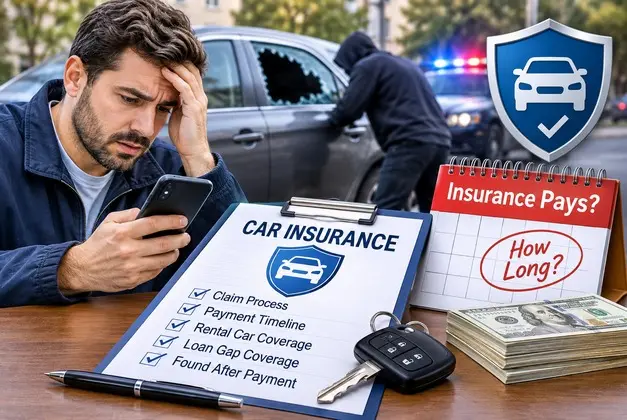
Car stolen? Do these in order
- Rule out a tow, then call police. Get the report number.
- Open a comprehensive claim. Ask when rental starts and the daily limit.
- Call your lender or leasing company. Keep making payments.
- Have a tracker or car app? Give the location to police. Don’t go yourself.
The honest timeline
- First 48 hours: many recovered cars turn up fast; rental coverage often hasn’t started.
- Days 3–30 (~30 DAYS): your insurer typically waits and investigates.
- After that: a settlement offer, then payment under your policy and state rules.
See your likely check, your lender’s share and your rental gap →
Policy form and state examples checked . Your policy and state control.
Stolen Car Payout & Gap Calculator
Nothing is saved or sent. Leave a field blank to skip it.
Your timeline
First Hour: What to Do, in Order
Confirm the car wasn’t towed or repossessed, report the theft to police, open a comprehensive claim with your insurer, notify your lender, and pass any tracker location to officers, writing down every report number, name and time as you go.
DAY 0. If a person is inside the car, or you see the theft happening, call 911.
- Towed or stolen? Check posted signs, the property manager, local tow lots and your lender.
- Police. The standard policy form requires prompt police notice of a theft. Get the report number.
- Insurer. Report promptly. Ask about the waiting period, rental start date, daily limit and maximum.
- Lender or lessor. Ask for the payoff amount and how to keep paying. Ask about GAP.
- Trackers. Send app or tracker locations to police.
- Loose ends. House keys or a garage opener inside? Secure your home. Report toll tags and stolen cards.
Safety first: if you spot your car, call police. Don’t approach it, follow it or confront anyone.
Does Your Insurance Cover a Stolen Car?
Your own stolen car is covered only if you bought comprehensive coverage, often called “other than collision”; a liability-only policy pays nothing toward it, and collision coverage doesn’t apply to theft, so always check your declarations page before assuming anything.
The ISO Personal Auto Policy (PP 00 01 09 18) lists theft as “other than collision.”
ISO is a standard industry form. Your insurer’s wording may differ, and yours is what counts.
| Policy | Stolen car | Rental after theft | Loan shortfall |
|---|---|---|---|
| Liability only | Not covered | Not covered | Not covered |
| Comprehensive | Covered, minus deductible | Standard form includes a limited amount; some policies differ | Not covered by itself |
| Comprehensive + rental reimbursement | Covered, minus deductible | Higher limits, as shown on your policy | Not covered by itself |
| Comprehensive + GAP | Covered, minus deductible | GAP adds no rental | May cover some or all, per GAP terms |
I left the keys in the car. Am I covered?
The ISO specimen we checked has no keys-in-car exclusion. Some insurer forms may differ, so read yours.
Expect questions about it. Tell the truth about where the keys were.
Someone I lent it to didn’t bring it back
This may not count as theft. Some forms exclude “conversion” or “embezzlement.”
The ISO specimen we checked shows no such exclusion for your own car. Check your form and tell police exactly what happened.
My car is leased
Report to both the insurer and the leasing company. The leasing company is typically paid first because it owns the car.
How Long Does Insurance Take to Pay for a Stolen Car, and Why?
Most claims for an unrecovered car take about 30 days or more, because insurers commonly wait for police to find it before settling; that waiting period is company practice, while separate state rules and your policy govern notices, offers and payment deadlines.
Some insurers use a shorter wait. Ask yours for its number of days, in writing.
- DAY 0: report to police and insurer.
- 48 HOURS: rental starts under the standard form.
- ~30 DAYS: typical recovery wait (practice, not law).
- SETTLEMENT: offer based on your car’s value.
- PAYMENT: check or lender payoff, subject to state deadlines.
Why insurers wait
In NICB’s 2022 data, 34% of recovered cars were found the same day, 45% within two days.
Those percentages describe cars that were recovered. They aren’t your odds of getting yours back.
Theft is also falling: NICB reported 268,415 thefts in the first half of 2026, down 21% year over year.
The delay few people explain: NICB reporting
Some states hold payment until theft reports are checked, often by the National Insurance Crime Bureau (NICB).
- California: for private passenger cars with wholesale value over $2,000, no total-theft payment until reported to NICB, and then either acknowledged or 10 working days pass with no unresolved concerns (10 CCR § 2191.2).
- Massachusetts: no comprehensive theft payment for a vehicle or major component parts until NICB has the report and acknowledges it (211 CMR 75.05).
- New York: payment on a total theft waits five calendar days after a designated central organization acknowledges the report (11 NYCRR § 216.8).
- New Jersey: payment waits five calendar days after NICB’s acknowledgment (N.J.A.C. 11:16-2.7).
Massachusetts, New York and New Jersey also let a claim move ahead if a VIN error can’t be resolved after 30 days.
State deadlines (examples)
| State | Rule | What it means for you | Source |
|---|---|---|---|
| California | NICB step; payment within 30 days of acceptance; taxes and fees | Pay is due within 30 calendar days after the claim is accepted and any needed release is received. Accept or deny is generally due within 40 days of proof of claim. | § 2191.2, § 2695.7, § 2695.8 |
| Massachusetts | NICB report and acknowledgment | No theft payment before this step. | 211 CMR 75.05 |
| New York | Central-organization theft verification | Short hold after acknowledgment before total-theft payment. | 11 NYCRR § 216.8 |
| New Jersey | 30-day maximum payment period for physical damage claims; NICB step | Counted from notice of loss, unless there is clear justification. Written delay reasons every 30 days. | 11:3-10.5, 11:16-2.7 |
| Maryland | Unrecovered theft offer timing; tax on total loss | Offer due within the later of 30 days after notice of claim or the period in your policy. | COMAR 31.15.12.03, MIA FAQ |
| Michigan | 30-day notice of needed information | The insurer must tell you what it needs to handle the claim. | State of Michigan |
| Colorado | Title fees, sales tax, transfer and registration fees | Look for these on a total-loss settlement. | C.R.S. § 10-4-639, B-5.51 |
| Kansas | Sales taxes and fees in total-loss settlements | Look for these on your offer. | Bulletin 2013-1 |
State examples checked November 26, 2026. Not a complete list.
California
Accept or deny: generally within 40 days of proof of claim.
Payment: within 30 calendar days of acceptance, plus any needed release. NICB step first. Taxes and fees included.
New York
Total-theft payment waits for verification, then five calendar days after acknowledgment.
Source: 11 NYCRR § 216.8
New Jersey
Physical damage claims: 30-day maximum from notice of loss unless clearly justified.
Written delay reasons every 30 days. NICB step applies.
Maryland
Unrecovered theft: offer due within the later of 30 days after notice or your policy’s period.
Total-loss offers include applicable tax.
Sources: COMAR 31.15.12.03, MIA FAQ
Michigan
Within 30 days of learning of the loss, the insurer must tell you what information it needs.
Source: State of Michigan
Colorado
Insurer pays title fees, sales tax and transfer or registration fees on a total loss.
Sources: C.R.S. § 10-4-639, B-5.51
Why is my claim taking so long?
- The waiting period hasn’t ended.
- NICB reporting or a VIN mismatch is unresolved.
- The insurer is missing a police report, title, keys or loan details.
- The claim was referred for further investigation.
Ask in writing: “What is still open, who needs to act, and by what date?”
How Much Will Insurance Pay for a Stolen Car?
Expect your car’s actual cash value, meaning what a comparable vehicle was worth just before the theft, minus your comprehensive deductible, with sales tax and title or registration fees added in many states; a loan or lease lender is usually paid first.
SETTLEMENT. The basic math:
Actual cash value + required tax and fees − deductible = settlement
Illustration only: $18,000 value + $1,260 tax (at 7%) − $500 deductible = $18,760, before any fees.
Actual cash value (ACV)
ACV reflects age, mileage, condition and options. It is not what you paid or what you still owe.
The ISO form limits payment to the lower of ACV or the cost to replace with like kind and quality.
To show value, gather purchase records, service records, dated photos and local listings for comparable cars.
Sales tax and fees
Many states require them. Examples:
- California: transfer taxes and one-time fees, plus prorated license and annual fees (10 CCR § 2695.8(b)).
- Colorado: title fees, sales tax and transfer or registration fees (C.R.S. § 10-4-639(1)).
- Kansas: sales taxes and fees in total-loss settlements (Bulletin 2013-1).
Many states require the insurer to include sales tax and fees — check yours.
Deductible and upgrades
Your comprehensive deductible comes off the payment.
List aftermarket wheels, audio or equipment with receipts. Coverage for custom parts can be capped.
Be accurate. Inflating a car’s value, condition or extras is insurance fraud.
The standard form denies coverage for fraudulent statements or conduct on a claim.
Think the number is low? Read Totaled Car: Payout & How to Dispute It, then ask for the details in writing.
Offer Too Low? Ask in Writing
The Rental Gap: Who Pays While You Wait?
Under the standard policy form, theft transportation coverage starts 48 hours after the theft and has daily and total caps, so you may pay the first two days yourself, plus anything above the daily limit and any days after the maximum is used up.
Rental coverage often starts 48 hours after the theft, not the moment you report it.
48 HOURS. The 2018 ISO form pays up to $30 a day, $900 maximum, for temporary transportation after a total theft.
It ends when the car is returned to use or the insurer pays for the loss. The dollar cap can end it sooner.
Older editions used $20 a day and $600. Optional rental reimbursement can raise limits. Your insurer’s own form controls.
What a 30-day wait can cost
Example: a $50-a-day rental, coverage from hour 48, settlement on day 30.
- $30/day, $900 cap: total $1,500; insurance $840; you pay $660.
- $20/day, $600 cap: total $1,500; insurance $560; you pay $940.
- No rental coverage: you pay $1,500.
If payment takes longer, days add up. At $30 a day, a $900 cap covers 30 paid days.
YOUR OUT-OF-POCKET: use the calculator with your real daily cost and limits.
| Cost | Who pays | Limit | Starts |
|---|---|---|---|
| Rental or rides | Insurer up to limits; you pay the rest | Daily and maximum caps | Often 48 hours after theft |
| Loan or lease payments | You | Your contract | Payments continue as scheduled |
| Personal items | Renters or homeowners insurance, if covered | That policy’s limits and deductible | When you file that claim |
| Towing and storage after recovery | Ask your insurer | Policy and local rules | Can build daily, so act fast |
Rental coverage ran out?
Ask for a written extension (not guaranteed), compare weekly rates, or switch to cheaper transport.
Renting on your own? See Do You Need Rental Car Insurance?
Car Stolen and You Still Owe Money: Loan or Lease
You must keep making loan or lease payments while the claim is open, because your contract continues until the lender is paid; if the insurance settlement is smaller than the payoff, you owe the difference unless GAP coverage or a lease GAP waiver applies.
Keep paying your loan while the claim is open.
- Ask the lender for a written payoff amount and the date it is good through.
- Give the insurer the lender’s claim contact.
- Ask about a deferral if money is tight. One may be available, but don’t assume it.
The insurer typically pays the lender first. Anything left over from a loan payoff generally goes to you.
Shortfall example: $18,760 settlement, $21,000 payoff = $2,240 still owed.
GAP coverage and lease GAP waivers
GAP is meant for that difference. Contracts can exclude some amounts, so read yours and file that claim too.
Check your auto policy, loan papers and dealer paperwork. See Is GAP Insurance Worth It? for the full math.
Leased car: who keeps any surplus?
It depends on the lease. Don’t assume it is yours, or that it isn’t; ask the lessor to point to the clause.
The Investigation: Statements, Documents and SIU
Expect your insurer to request documents and every key, take a recorded statement, and sometimes assign a special investigation unit or require an examination under oath; cooperating promptly and truthfully is a policy duty, and extra questions alone don’t mean you’re accused.
Recorded statement
The ISO form requires cooperation, including recorded statements when the insurer asks.
Stick to what you know. Say “I don’t know” rather than guessing. Correct mistakes in writing.
Already spoke? Read Gave a Recorded Statement?
Examination under oath (EUO)
An EUO is sworn, formal questioning. The ISO form lists it as a duty.
It’s a good point to talk to a lawyer. Don’t ignore the notice.
What’s normal, and what needs help
- SIU: a “special investigation unit” looks more closely at certain claims.
- Common: questions about keys, timeline, who drove the car, its condition and your loan.
- Ask for clarity: repeated delays with no written reason.
- Get advice: an EUO notice, a fraud allegation or a denial.
Documents Your Insurer Will Ask For
Missing something, such as a spare key? Say so and explain. Never invent or alter a record.
What Happens If Your Stolen Car Is Found?
If police find the car before settlement, your insurer generally pays covered repairs minus the deductible or declares it a total loss; if it surfaces after you’ve been paid, the insurer generally owns it, though some will let you buy it back.
Tell your insurer and lender right away. Ask police how to release it, because storage fees may be adding up.
Found BEFORE settlement
Owner: you (or your lessor), subject to any lender’s lien.
Insurer pays: covered theft damage minus deductible, or a total-loss settlement.
Options: get it inspected, challenge the estimate in writing, confirm when rental ends.
Found AFTER settlement
Owner: generally the insurer.
Insurer pays: you have already been paid.
Options: ask about buyback and title status; tell the insurer about belongings inside.
| When it’s found | Who owns it | What the insurer pays | Your options |
|---|---|---|---|
| Before settlement | You or your lessor, subject to any lien | Covered theft damage minus deductible, or a total-loss settlement | Inspection, written challenge to the estimate, confirm when rental ends |
| After settlement | Generally the insurer | Already paid | Ask about buyback and title status; ask about belongings inside |
Damage and contamination
Photograph it if safe. Biohazard or chemical contamination can be part of the comprehensive theft claim.
Don’t clean or drive a car that seems unsafe. Ask for a professional inspection.
Can I refuse it if it’s damaged?
Usually not just because it was stolen. The ISO form lets the insurer return it and pay for theft damage.
If you disagree about repairs or value, ask about reinspection and your policy’s appraisal clause.
Buyback and salvage title
The ISO form lets the insurer keep all or part of the property at an agreed or appraised value.
If buyback is offered, get the price, condition and title status in writing. A title may become salvage, depending on the state.
Stolen Parts: Catalytic Converters, Wheels and Airbags
Stolen catalytic converters, wheels, airbags and other parts are generally comprehensive claims subject to your deductible, so compare a written repair estimate with that deductible before filing, and report the theft to police even if you decide to pay for repairs yourself.
Example: a $1,400 repair with a $500 deductible means about $900 from insurance if fully covered.
The 48-hour theft rule is for a total theft. Ask separately when rental starts for a parts claim.
Near your deductible? Read Insurance Claim or Pay Out of Pocket?
What About Your Stuff Inside the Car?
Personal belongings taken with your car, such as a laptop, bag or tools, generally aren’t covered by auto insurance; file them under your renters or homeowners policy instead, where that policy’s deductible, special limits and exclusions decide what you actually receive.
Your belongings inside the car are a renters or homeowners claim.
Read Does Renters Insurance Cover Theft? and Does Renters Insurance Cover Car Theft?
Will My Insurance Go Up After a Stolen Car Claim?
A theft claim is usually treated as a comprehensive, not-at-fault claim, but that doesn’t guarantee your premium stays the same, because surcharge, discount and renewal rules differ by state and insurer, so ask yours how this claim will be recorded.
Ask: “Is there a surcharge, will any discount change, and how long will the claim count?”
If the Thief Crashes or Gets Tickets, Are You Liable?
You generally aren’t liable for a thief’s driving because the thief didn’t have your permission, but a few courts have allowed negligence claims connected to keys left in an unattended car, so report the theft promptly and send any claim to your insurer.
- No liability: in Richards v. Stanley (Cal. 1954), the car owner was not held liable for a thief’s driving. Special circumstances can change the result.
- Claim allowed: in Ney v. Yellow Cab Co., 2 Ill.2d 74 (1954), leaving a cab running with its key, against a statute, could support liability (discussed here).
Got a toll bill or ticket? Send the police report to the agency and dispute it before its deadline.
Stolen Car Insurance FAQ
These answers cover timing, coverage, loans, rentals, documents, recovery, parts, rates and liability after a car theft, but they are general information: your own policy wording and your state’s rules decide what applies to your claim and when money arrives.
How long does insurance take to pay for a stolen car?
Often about 30 days or more if it isn’t found. State deadlines and open items change the timing.
Why do insurers wait 30 days?
To allow for recovery and investigation. It’s insurer practice, not a nationwide law.
Does insurance cover a stolen car with liability only?
No. You need comprehensive coverage for your own stolen car.
Does insurance cover a stolen car if I left the keys inside?
The standard specimen has no keys exclusion, but check your form and expect questions.
Do I have to keep paying my car loan?
Yes. Keep paying until the lender confirms the loan is settled.
What if I owe more than the car is worth?
You owe the shortfall unless GAP or a waiver covers it.
Who gets the money if my leased car is stolen?
Typically the leasing company, up to what it is owed. Your lease decides any surplus.
Does insurance pay sales tax on a stolen car?
Many states require it, including California, Colorado, Kansas and Maryland. Check yours.
When does rental coverage start?
Under the standard form, 48 hours after a total theft. Your policy may differ.
What if my rental coverage runs out before I’m paid?
You pay further costs unless the insurer agrees in writing to extend.
What documents do I need?
Start with the police report number, title, keys and loan details. See the checklist.
Why does the insurer want all my keys?
To account for access to the car. Tell it about any lost or extra key.
What if my car is found before I’m paid?
The insurer generally handles covered damage as repairs or a total loss.
What if it’s found after I’m paid — can I buy it back?
The insurer generally owns it. Some allow buyback; ask about price and title.
Can I refuse my car if it’s found damaged?
Usually not automatically. You can dispute the damage estimate or valuation.
Is a stolen catalytic converter worth a claim?
It depends on the estimate, your deductible and possible premium effects.
Will my rates go up after a theft claim?
They can, depending on state and insurer rules. Ask before assuming.
Am I liable if the thief crashes my car?
Generally no. Key-handling facts and state law can matter.
Last updated:
General information, not insurance or legal advice. Your policy and state law decide coverage, timing and amounts. Forms and rules verified November 26, 2026.

Daniel Hayes is the founder and sole researcher at AdvoraHQ. He covers U.S. personal finance, insurance, and consumer law — working directly from IRS publications, federal and state statutes, court opinions, and SEC filings rather than secondary summaries. His focus is the gap between what readers think they know and what the source documents actually say. Daniel is not a licensed attorney, CPA, or financial advisor; his articles are educational and not personalized advice. Reach him at Daniel.Hayes@advorahq.com.
