
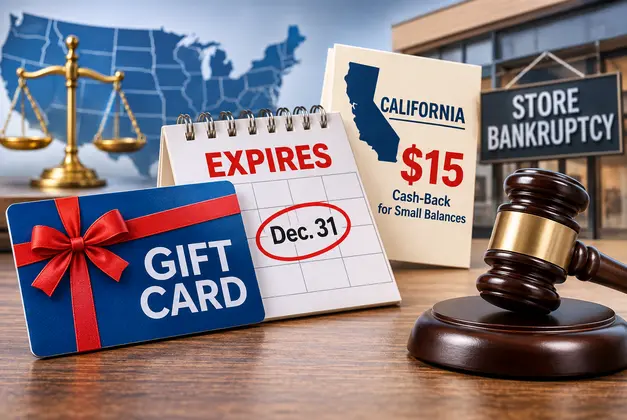
Federal law: most gift cards can’t expire for at least 5 years, and fees can start only after 12 months of no use.
Your state may give you more: no expiration at all, or cash back for a small balance (California: under $15 since April 1, 2026).
Not protected: free promo or reward cards, and a store that goes out of business.
USE IT NOW: Store in bankruptcy? Closing stores often stop accepting gift cards within weeks. See bankruptcy steps
SCAM WARNING: Someone told you to pay them with gift cards? That’s a scam. What to do now
Check your card and your state →
Laws checked November 26, 2026. Bankruptcy deadlines change — check the retailer’s notice.
Gift Card Rights Checker
Pick your state and card type. Never enter a card number or PIN. This tool doesn’t ask for them, save your answers or send them anywhere.
The Federal Rule: 5 Years and Limited Fees
Federal law generally stops gift card money from expiring sooner than five years after the card is issued or last loaded, and it allows inactivity fees only after twelve months without use, no more than once a month, with clear disclosure on the card.
PROTECTED: covered store cards, gift certificates and general-use (network) gift cards.
The law is the CARD Act (15 U.S.C. § 1693l-1). The detailed rule is Regulation E, 12 CFR 1005.20.
When can an inactivity fee be charged?
Under § 1005.20(d), a dormancy, inactivity or service fee needs all of these:
- No activity on the card in the one-year period before the fee.
- The card states the fee amount and frequency.
- The card says inactivity can trigger it.
- No more than one such fee in any calendar month.
What must you be told?
Under § 1005.20(c), disclosures must be clear and conspicuous. Key fee and expiration terms must be disclosed before you buy.
Required card disclosures must be on the card itself. Packaging, stickers and separate terms don’t count.
Other kinds of fees can exist. They have their own disclosure rules, including a toll-free number for fee information.
Cards the Federal Rule Doesn’t Protect
The federal five-year rule skips several kinds of cards, including free promotional, loyalty and award cards, certificates issued only on paper, and reloadable cards that aren’t marketed as gift cards, so those can expire much sooner unless your state says otherwise.
NOT PROTECTED by the federal rule (§ 1005.20(b)):
- Cards usable only for telephone services
- Reloadable cards not marketed or labeled as a gift card or gift certificate
- Loyalty, award or promotional gift cards
- Cards not marketed to the general public
- Certificates issued in paper form only
- Certain event or venue admission cards, including related goods and services
Free promo cards aren’t covered by the 5-year rule.
Example: a free $10 card with a $50 purchase. Use it by its printed date.
What about store credit from a return?
Some laws treat return credit differently from a gift card someone bought. Check the terms on your receipt and your state’s rules.
| Card type | Federal 5-year rule? | Typical state coverage | Notes |
|---|---|---|---|
| Single store or restaurant card | Generally yes | The main target of state gift card laws | Best chance of cash back where a state requires it |
| Visa, Mastercard or Amex gift card | Generally yes | Varies; some state rules exclude or treat them differently | Plastic can expire before the money |
| Mall, multi-restaurant or third-party card | Generally yes | Varies | Check who issued it |
| Free promo or reward card | No | Often excluded | Use by the printed date |
| Store credit from a return | Don’t assume so | Varies | Read the terms |
| Paper-only certificate | No | Varies; Hawaii sets a 2-year minimum | State law matters most |
Your State’s Rules
Many states add protection on top of the federal rule, such as banning expiration dates or fees altogether, so the answer for your card depends on where you are and which type of card you hold; the table below lists only rules we checked.
| State | Expiration rule | Fee rule | Source |
|---|---|---|---|
| California | Most gift certificates and gift cards can’t have an expiration date. Listed exceptions apply. | Most can’t carry service fees. A narrow dormancy-fee exception (up to $1 a month, with conditions) and other exceptions apply. | Cal. Civ. Code § 1749.5 |
| Colorado | Not confirmed in our check. | Cards covered by the statute can’t be sold with service, dormancy, inactivity, maintenance or other fees. | Colo. Rev. Stat. § 6-1-722 |
| Connecticut | Gift certificates (as state law defines them) can’t expire. Network prepaid cards have separate rules. | Not confirmed in our check for store cards. | Conn. Gen. Stat. §§ 42-460, 42-460a |
| Hawaii | At least 5 years from issue (2 years for paper-only certificates). No date means valid indefinitely. | No service, dormancy or inactivity fees. Activation fee capped at 10% of face value or $5, whichever is less. | Haw. Rev. Stat. § 481B-13 |
| Massachusetts | At least 7 years from issue. If no expiration date is clearly marked, it can be redeemed indefinitely. | Not addressed in this section. | Mass. Gen. Laws ch. 200A, § 5D |
| Montana | Valid until redeemed; doesn’t terminate. | Value can’t be reduced by any fee, including a dormancy fee. | Mont. Code § 30-14-108 |
| New Jersey | State minimum is 24 months; the federal 5-year minimum is longer for covered cards. | No dormancy fee for 24 months after sale or after the last activity; then no more than $2 a month. | N.J. Stat. § 56:8-110 |
| New York | Bought on or after Dec. 10, 2022: at least 9 years from issue or last load. Promotional certificates are treated differently. | Fees are banned, except a one-time activation fee of up to $9 on network (open-loop) cards. | N.Y. Gen. Bus. Law § 396-i |
| Oregon | Not confirmed in our check. | Covered cards can’t lose face value over time or carry inactivity, maintenance or service fees. Exceptions apply. | Or. Rev. Stat. § 646A.276 |
| Rhode Island | No expiration date or time limit on redemption. | No surcharges or monthly or annual service or maintenance fees. | R.I. Gen. Laws § 6-13-12 (as amended 2024) |
| Vermont | Not confirmed in our check. | Dormancy, issuance, redemption and other service fees are prohibited. | 8 V.S.A. § 2703 |
| Washington | Valid until redeemed or replaced. Check the chapter for exceptions. | State law restricts service, dormancy and inactivity fees. Check the chapter for exceptions. | RCW ch. 19.240 |
State missing or “not confirmed”? A rule may still exist.
Check your attorney general or consumer protection office.
Cash Back for Small Balances
Several states require businesses to turn a small leftover gift card balance into cash, often when you ask, and California’s limit rose to under $15 on April 1, 2026, while most other states in our table set it at about $5 or lower.
| State | Cash back if balance is… |
|---|---|
| California | Under $15 |
| Cal. Civ. Code § 1749.5(b)(2). Effective April 1, 2026. Exception for certain donated certificates with a printed disclaimer. | |
| Colorado | $5 or less |
| Colo. Rev. Stat. § 6-1-722(2). On the holder’s request. Some card types, including paper-only certificates, are outside the definition. | |
| Connecticut | Under $5 |
| Conn. Gen. Stat. § 42-461(c). Balance left after a purchase, on request. Some card types are excluded. | |
| Hawaii | Under $5 |
| Haw. Rev. Stat. § 481B-13(c). The issuer must redeem the rest in cash. Free promotional and charity certificates are exempt. | |
| Maine | Under $5 |
| 33 M.R.S. § 2067(6). Balance left after an in-person redemption, on request. | |
| Massachusetts | Not reloadable: after 90% is used. Reloadable: $5 or less |
| Mass. Gen. Laws ch. 200A, § 5D. You choose cash or keep using the card. | |
| Montana | Under $5 |
| Mont. Code § 30-14-108(4). Only if the original value was more than $5, on request. | |
| New Jersey | Under $5 |
| N.J. Stat. § 56:8-110(c). After a redemption, on request. Excludes network and multi-merchant cards, rewards cards, return credits and some others. | |
| Oregon | Under $5 |
| Or. Rev. Stat. § 646A.276. Only after at least one purchase. “Cash” can be a check. Some free or discounted cards are excluded. | |
| Rhode Island | Under $1 |
| R.I. Gen. Laws § 6-13-12(a). Unused amount after redemption. | |
| Vermont | Under $1 |
| 8 V.S.A. § 2704. On the holder’s demand. | |
| Washington | Under $5 |
| RCW 19.240.020(3). Balance left after a purchase, on demand. | |
New York: a state consumer alert says balances under $5 may be redeemed for cash.
It’s not in the table: we haven’t checked that statute text.
What changed in California?
SB 22 raised the cash-out line from under $10 to under $15, starting April 1, 2026.
Some older cards may print a lower figure.
SB 1078 (Sept. 20, 2026) lets some pre-April cards stay on sale through 2028.
Conditions include posting a notice of the $15 rule.
Certain certificates donated free to a nonprofit or charity are exempt from cash-out.
They must carry the required disclaimer.
California: cash back for balances under $15
Show the cashier:
“(2) Notwithstanding paragraph (1), a gift certificate with a cash value of less than fifteen dollars ($15) is redeemable in cash for its cash value.”
Cal. Civ. Code § 1749.5(b)(2). Effective April 1, 2026. Text checked November 26, 2026.
What to say:
Hi — California law requires cash back on gift card balances under $15 when the holder asks. Here’s the section.
“Gift certificate” includes gift cards. Read the full section for exceptions. Other states: see the table.
What if the store says no?
- Stay friendly and show the statute. The cashier may not know the rule.
- Ask for a manager, then contact the company’s customer service in writing.
- Note the date, store, balance and who you spoke with. Keep the card.
- Complain to your state attorney general or consumer protection office.
- If a legally required cash-out is still refused, small claims court may be an option.
Visa, Mastercard and Amex Gift Cards
The date printed on a Visa, Mastercard or Amex gift card can arrive before the money expires, because federal rules protect the funds for at least five years and generally require a way to get a replacement card or your remaining balance.
PROTECTED: unexpired funds on a covered card, even if the plastic has expired.
How do you get the money from an expired card?
- Call the toll-free number on the back, or use the issuer’s website.
- Ask for a replacement card or your remaining balance.
- Have the card, the receipt and your photo of the card ready.
Is the replacement free? Yes, while the funds are unexpired.
The exception is a lost or stolen card (§ 1005.20(e)). This covers paying the balance another way, too.
Cards generally must say the money outlasts the plastic.
Some non-reloadable cards dated 7+ years from manufacture are excepted.
Fees and online problems
Some cards charge a purchase or activation fee. Read the packaging and the card before buying, and check your state’s fee rule.
Online order declined? Check the balance first.
Then see if the issuer lets you register your name and ZIP code.
When the Store Goes Bankrupt
If a retailer files for bankruptcy, your gift card generally makes you a creditor, and whether it still works depends on what the bankruptcy court allows, so spend the balance as quickly as you can and watch for a deadline.
USE IT NOW: Closing stores may stop taking gift cards within weeks.
Live deadline: The Children’s Place and Gymboree
Use by December 12, 2026.
The company filed Chapter 11 in November 2026.
It says cards won’t be accepted after that date, or redeemed for cash.
My Place Rewards ends the same day.
Source: LiveNOW from FOX report on the company notice. Status checked November 26, 2026.
Why can the window be so short? Past examples
- Saks (February 2026):
A court ruling required closing stores to take cards for only the first 15 days.
The clock started with store-closing sales.
- Eddie Bauer (passed):
Court filings set a March 12, 2026 cutoff at closing U.S. and Canadian stores.
The separate online business wasn’t part of the filing.
Chapter 11 vs. Chapter 7
| Chapter | What it is | Do cards still work? | What to do |
|---|---|---|---|
| Chapter 11 | Reorganization or sale while the business usually keeps operating | Often for a time, if the court approves; a deadline may apply | Spend now and read the company and court notices |
| Chapter 7 | Liquidation: a trustee sells assets and the business winds down | Often not | Keep proof, watch for claim instructions, ask your card issuer about a dispute |
Can you file a claim?
You may need to file a proof of claim by the court’s deadline. Look for the case notice or the claims website named by the company.
Some consumer deposits get limited, capped priority (11 U.S.C. § 507(a)(7)).
Don’t assume a gift card qualifies or expect full repayment.
Washington (RCW 19.240.090) says card value is held in trust.
Montana (§ 30-14-108) calls it trust property in bankruptcy.
Neither guarantees a store will keep accepting your card.
Bought it with a credit card?
A chargeback may be possible, but isn’t guaranteed.
Ask your card issuer soon: time limits apply.
See how to dispute a credit card charge.
Third-Party and Multi-Restaurant Cards
A card sold by one store but issued by another company depends on that issuer, so it can stop working if the issuer fails even while the store that sold it stays open; read the fine print on the back to find the responsible company.
Check who issued a card sold at another store. If that company is in trouble, use the balance now.
The Synergy example: Synergy World ran a multi-restaurant card sold at Costco.
In January 2026 it announced a wind-down and plans to file Chapter 7.
Cards were then reported abruptly invalidated, leaving unused balances.
Holding one? Ask the seller what it offers.
Gift Card Scams and Tampering
Anyone who demands that you pay with a gift card is a scammer, whether they claim to be a government agency, a utility, your boss or a relative, so stop, keep the card and receipt, and contact the card issuer right away.
No real business or agency asks you to pay with gift cards.
What to do in the first hour
- Stop contact. Don’t send any more numbers, PINs or photos.
- Call the card issuer. Say it was used in a scam and ask it to freeze the funds or refund you.
- Keep the card, receipt, messages and phone numbers.
- Report it at ReportFraud.ftc.gov.
- If you lost money, you can also file a police report.
How to spot a tampered card
- Torn, resealed or loose packaging
- A scratched or replaced PIN strip
- A sticker placed over a barcode
- A card number that doesn’t match the packaging or receipt
Forgotten Cards and Unclaimed Property
States handle forgotten gift card balances very differently: some treat certain unused balances as unclaimed property after a set period, while others leave them with the business, so check your state’s rules and ask the issuer before giving up on money.
- Washington: its law aims to spare businesses unclaimed-property reporting.
- Maine:
Gift obligations are generally presumed abandoned after two years.
The count starts after the year of last activity. Exceptions apply.
Looking for lost money? See how to find unclaimed money.
Before You Buy This Holiday Season
A safe gift card purchase takes a few minutes: choose a trustworthy seller, inspect the packaging, find out who issued the card, keep your receipt and a photo, and favor companies that look financially stable so the recipient can actually spend the money.
Holiday reading: buying gift cards with a credit card, credit or debit for online shopping, and what to do if the price drops after you buy.
FAQ
The short version: most purchased gift cards keep their money for at least five years, states may add longer protection or cash back, and the biggest risks are free promotional cards with early dates, scams, and companies that close or file for bankruptcy.
Do gift cards expire?
Some can. Most gift card money is protected for at least 5 years.
Some states ban expiry; excluded cards can expire sooner.
Why did my gift card expire in less than 5 years?
It may be a promo, reward or paper-only card, or another excluded type. Or only the plastic expired. Call the issuer.
Can a store charge an inactivity fee?
Federally, only after 12 idle months, monthly at most, if disclosed.
Many states in our table limit or ban fees.
Do Visa gift cards expire?
The plastic can. Covered funds can’t expire sooner than 5 years after issue or the last load.
What happens to the money on an expired Visa gift card?
If the funds haven’t expired, ask for a replacement or the balance. No fee is allowed for that unless the card was lost or stolen.
Do promotional gift cards expire?
Yes, they can. The federal 5-year rule doesn’t cover them.
Does store credit from a return expire?
It depends. It may be treated differently from a purchased card. Check the terms and your state.
Can I get cash back on a gift card balance?
In states with a cash-back law, yes for qualifying balances and card types. Elsewhere it’s generally up to the business.
Which states require cash back?
Our table covers 12 states we checked.
See its New York note. Other states may have rules.
Can a cashier in California refuse cash back under $15?
For a covered card, state law makes a balance under $15 redeemable in cash. Show the section above. Exceptions exist.
What happens to my gift card if the company goes bankrupt?
You’re generally a creditor. The court decides whether the company can keep honoring cards.
How long do I have to use a gift card from a bankrupt store?
It varies by case and can be a matter of weeks. Check the company’s notice today.
Can I get a refund for a worthless third-party gift card?
Possibly, but not automatically. Ask the seller and your card issuer, and look for claim instructions in the issuer’s case.
Can I dispute a gift card purchase with my credit card company?
You can ask. A chargeback may be possible, subject to network rules and time limits.
Does my state take unused gift card balances?
Some states treat certain balances as unclaimed property and others don’t. Check your state’s unclaimed property office.
Someone asked me to pay with gift cards — what now?
Don’t pay. If you already did, call the card issuer immediately and report it at ReportFraud.ftc.gov.
Last updated:
General information, not legal advice. Your rights depend on card type, terms and state law. Courts and retailers set bankruptcy deadlines, which can change. Laws checked November 26, 2026.

Daniel Hayes is the founder and sole researcher at AdvoraHQ. He covers U.S. personal finance, insurance, and consumer law — working directly from IRS publications, federal and state statutes, court opinions, and SEC filings rather than secondary summaries. His focus is the gap between what readers think they know and what the source documents actually say. Daniel is not a licensed attorney, CPA, or financial advisor; his articles are educational and not personalized advice. Reach him at Daniel.Hayes@advorahq.com.
